
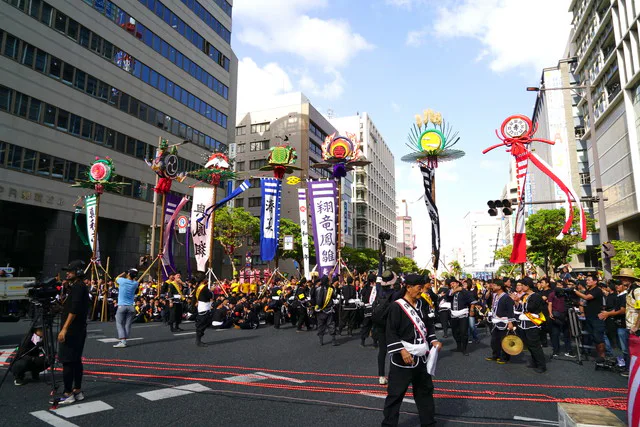
If the Naha Great Tug-of-War is one of the reasons you are in Okinawa, protect Sunday, October 11, 2026 from late morning through the end of the tug rather than trying to squeeze it between sightseeing stops. The preservation society currently lists the 2026 main event as planned for October 11, with the Hatagashira procession on Kokusai Street from 11:30–14:00 and the tug on Route 58 at Kumoji Crossing from 14:30–17:00. Naha City has separately confirmed the October 10 pre-event night parade.
For a first visit, I would watch part of the flag procession, leave it before the end, move toward Kumoji with a buffer, and decide at the rope whether to participate. You do not need to force your way into the densest section for the festival to be worthwhile. The event is unusual because spectators can become pullers, but that also makes crowd strategy more important than getting one perfect camera position.
↔ Scroll table left or right
Your priority | Best plan | Main trade-off |
See the defining event | Protect Oct 11, roughly 13:00–17:00 | You give up the last part of the parade to position for the tug |
See traditional performance without the main crowd | Add the confirmed Oct 10 night parade | It is a pre-event, not a substitute for the giant tug |
Participate in the pull | Start on an outer hand rope | Less dramatic position, but easier to exit if crowd density feels wrong |
Young children / older travellers | Spectate from the edge | You lose the tactile participation but gain a wider and safer view |
Early flight Oct 12 | Sleep in Naha, but choose the hotel by airport route as well as festival walk | The closest festival hotel is not automatically the easiest departure hotel |
Rental car still active | Return it before the festival if practical | You trade one earlier return for less road-control and parking risk on Oct 11 |
First, separate what is confirmed from what is still listed as planned
As of August 25, the Naha Great Tug-of-War Preservation Society lists the 56th event for October 11, 2026 as planned: Hatagashira procession 11:30–14:00 on Kokusai Street and the main tug 14:30–17:00 at Kumoji Crossing on Route 58. Its current news also says the association is preparing for the October 11 event.
Naha City has separately published the October 10 “Traditional Performing Arts Night Parade & Citizens On Stage” as part of the 56th festival weekend. That page is a stronger confirmation for the pre-event itself.
This distinction matters because festival schedules are vulnerable to weather and operational changes. The preservation society’s general event information explicitly notes that the annual date can change in a typhoon. Do not make a non-refundable flight or same-day connection depend on a festival timetable that the organiser still labels as planned.
The Hatagashira procession and the tug are two different experiences
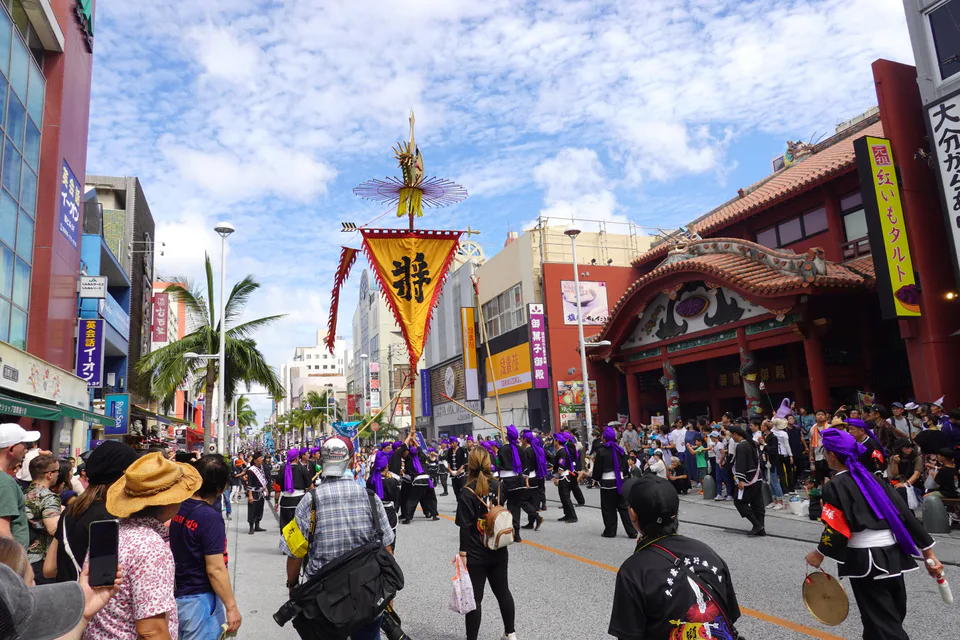
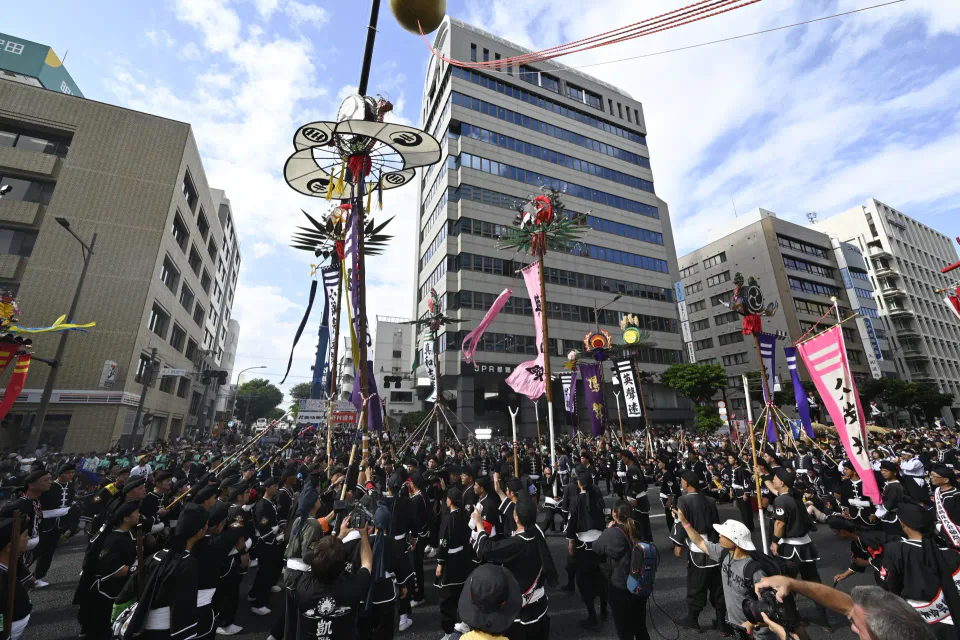
The 11:30–14:00 Kokusai Street procession features 14 registered Hatagashira, seven on the east side and seven on the west. The preservation society describes the flag standards as community symbols accompanied by drums, gongs, conch shells and other traditional performance elements.
It is worth seeing, but following the whole procession creates a conflict with the main tug. The official windows touch each other: the procession ends at 14:00 and the tug programme starts at 14:30. A normal walk toward Kumoji can become much slower as spectators converge and road space changes.
For a first visit, I would watch the flags for 45–75 minutes rather than chase every group. Then move toward Kumoji before the procession officially ends. The trade-off is missing some flags; the benefit is protecting the one event you cannot reproduce later in the day.
14:30 is the programme start, not the time I would arrive at Kumoji
The preservation society’s current 2026 schedule gives 14:30–17:00 for the main event. Treat 14:30 as the start of the event window, not as your target arrival at the crossing.
I would aim to be in the Kumoji area around 13:30–14:00 if the tug is the priority. That is a ValueNavi crowd-management buffer, not an official arrival rule. It gives you time to find the side of the route you prefer, hydrate, understand the crowd flow and abandon an overly dense position before participation begins.
Do not place a fixed 17:15 dinner reservation on the assumption that “the event ends at 17:00, therefore I will walk normally at 17:01.” The published window describes the programme; it does not guarantee an instant crowd exit.
The rope dimensions explain why the outer hand ropes are a sensible first attempt
The preservation society’s general event description lists the traditional giant rope as two 100m sections joined into roughly 200m, about 40 tonnes, around 1.56m in diameter, with 280 hand ropes. It also reports very large spectator and puller numbers in the event’s general profile.
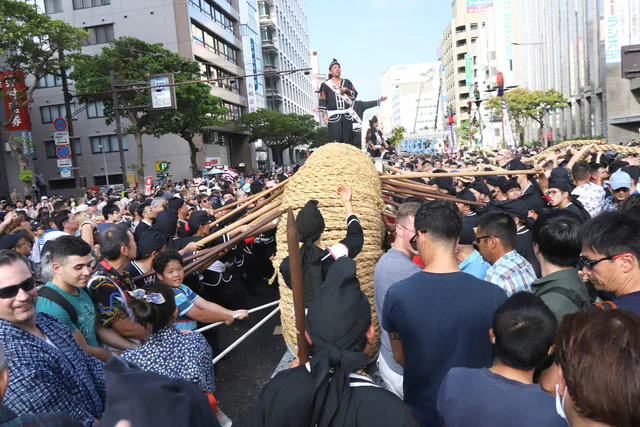
Those figures describe the scale of the tradition; they should not be treated as a final certified measurement or attendance forecast for the 2026 rope until the organiser publishes that year’s execution details. The planning implication is still clear: this is a mass-participation event, not a small demonstration.
If you want to pull, begin on an outer hand rope. Wear closed shoes, keep both hands free and avoid bringing a large backpack into the tightest section. Participate for one pull, then decide whether you want to stay. Moving deeper only because it looks more authentic is not a meaningful upgrade.
Families and older travellers do not need to pull for the day to be complete
The festival’s strongest visual is often the scale of the rope and the crowd, which can be easier to understand from the edge than from inside the compression. For a family with small children, a stroller, an older parent or anyone uncomfortable in dense crowds, I would make the participation decision optional.
A complete lower-risk version is:
watch the Hatagashira procession from one section of Kokusai Street;
move toward Kumoji before the official transition;
watch the rope and opening action from the edge;
leave before the densest post-event flow if the group is tired.
The festival is not a test of whether every traveller physically touches the rope.
October 10 is worth adding only if you already have the Naha night
Naha City has announced the October 10 pre-festival “Traditional Performing Arts Night Parade & Citizens On Stage.” This is useful for travellers who already sleep around Naha and want a second, lower-stakes festival block before Sunday.
I would not move an Onna or Motobu hotel night solely for the pre-event if October 11 is already protected. The Saturday event adds atmosphere; Sunday’s giant tug is the irreplaceable reason to restructure the trip.
If the Okinawa route still has a resort-versus-city conflict, use Onna or Naha for the last night before moving hotels only for the festival.
Hotel choice is really a three-way trade: Kokusai Street, Kumoji and the airport
A Kokusai Street hotel is attractive because the procession is outside or nearby. But the main tug is at Kumoji Crossing, and the next morning may be an airport problem. “Festival hotel” is therefore not one geographic answer.
Central Kokusai Street: strongest for the parade and evening atmosphere, but you may be deeper inside pedestrian and crowd flow.
Kumoji / Kencho-mae / Asahibashi side: stronger when the tug and airport access matter more than being in the middle of Kokusai Street.
Airport-corridor hotel: only wins when the October 12 flight is early enough that departure risk dominates the festival-night walk.
Do not change hotels for one night unless the new room deletes a real festival or airport transfer. The Naha hotel comparison is more useful than choosing from a map pin labelled “near Kokusai Street.”
If you still have a rental car, the festival can be the right moment to end the rental
The main tug occupies Route 58 at Kumoji Crossing and the festival changes normal city traffic patterns. That is exactly the kind of day when keeping a rental car in central Naha can create more work than value.
If the road-trip section has already finished, compare returning the vehicle on October 10 with keeping it through October 11. Returning it early can delete:
festival-day city driving;
hotel parking;
a rental-return deadline after a dense crowd event;
fuel and shuttle tasks on the next morning if you fly out.
The answer reverses if October 12 continues by car to another part of Okinawa rather than the airport. Use the Okinawa car-rental comparison to decide whether a city return actually fits the exact branch.
Do not pair the tug with a tight airport day
If October 11 is also arrival or departure day, the festival needs a higher burden of proof. A morning arrival can work when the flight is early and the hotel/luggage hand-off is simple. An afternoon arrival risks missing the main event entirely. A same-evening departure forces you to leave before the most important crowd sequence and makes traffic or transport disruption much more expensive.
I would treat October 11 as a Naha night whenever the tug is a priority. The value of sleeping in the city is not luxury; it is deleting the need to escape a mass event on a flight clock.
My first-timer plan
10:30–11:15: early lunch or substantial snack before the crowd peak.
11:30–12:30: watch one strong section of the Hatagashira procession.
12:30–13:30: hydrate, use toilets and begin moving toward Kumoji rather than following every flag.
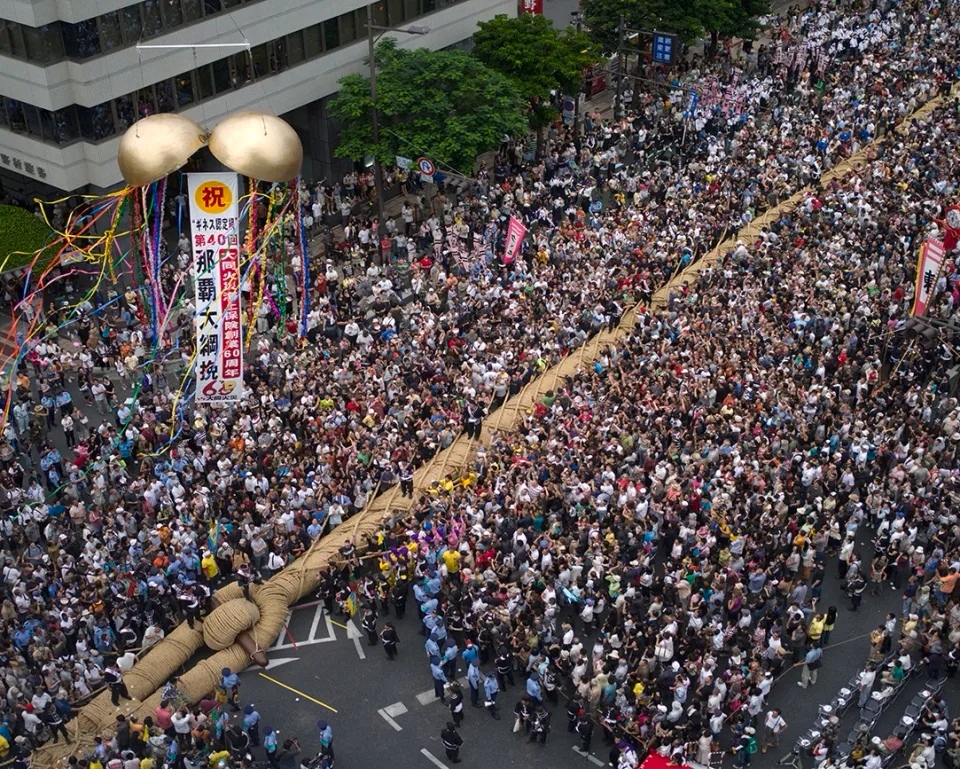
13:30–14:00: choose a viewing/participation position near the tug route.
14:30–17:00: protect the official main-event window; participate only if the crowd feels manageable.
After 17:00: leave according to actual crowd flow. Keep dinner flexible enough that being delayed 30–60 minutes does not ruin another reservation.
These are ValueNavi planning buffers around the organiser’s published event windows, not official sub-event times.
Final verdict
For a first visit, October 11 afternoon is the priority, but the smart version starts before 14:30. Watch part of the Hatagashira procession, move early to Kumoji, participate from an outer hand rope only if the density feels comfortable, and sleep in Naha if the tug is a major trip goal. Add October 10 only when you already have the Naha night. If October 12 is an early flight, let airport access influence the hotel and consider ending the rental-car period before the festival.
As of August 25, the preservation society still describes the October 11, 2026 programme as planned. Recheck the organiser immediately before travel, especially if a typhoon or severe weather is possible.
Nishimonai Bon Odori 2026: What Time Should You Arrive? 7:30 PM vs After 9 PM
Chiikawa Park Tokyo 2026: ¥3,500 Is Not a Shopping Fee — Check the Time Slot First
Ise Ninja Kingdom Is Still Closed in 2026 — Don’t Build Your Ise Day Around an Old Calendar
References
Naha Great Tug-of-War Preservation Society — planned 2026 date and times · Preservation Society — event history and traditional rope specifications · Naha City — October 10, 2026 pre-festival night parade announcement. Checked August 25, 2026.