
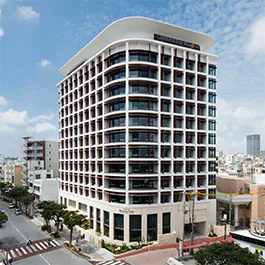
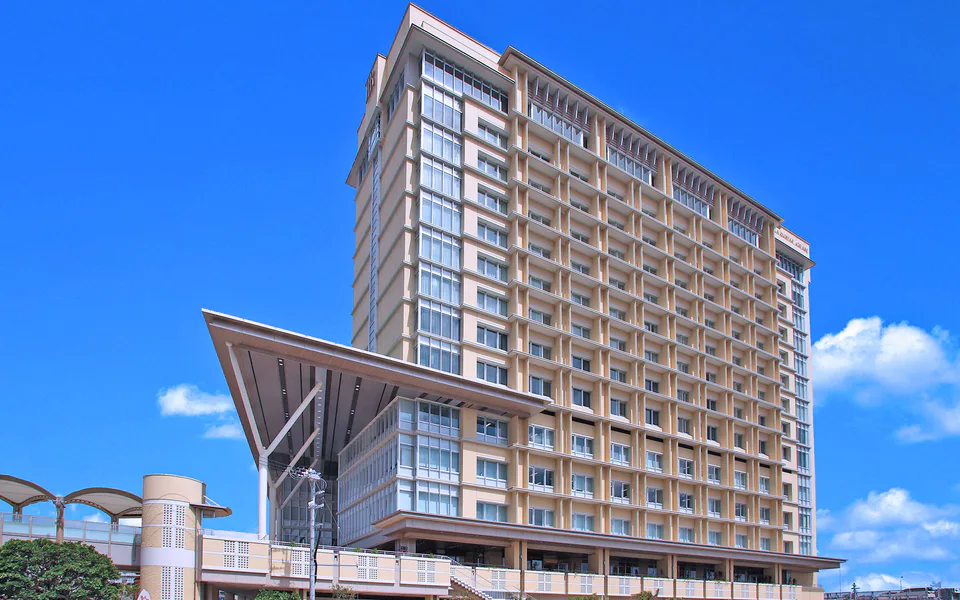
Choose RIHGA Royal Gran Okinawa when the stressful part of the stay is the journey into or out of Naha: late arrival, large luggage, a bus-terminal connection or a final night before the airport. Choose JR Kyushu Hotel Blossom Naha when the stressful part repeats every evening: Kokusai-dori dinners, shopping, quick room returns and laundry. The two hotels do not save the same minutes. RIHGA saves more at the edges of the trip; JR Blossom can save smaller amounts repeatedly in the middle.
This distinction matters because a one-night stay and a three-night stay can produce opposite answers. RIHGA is directly linked to Asahibashi Station by walkway and all guestrooms are at least 35m². JR Blossom is about five minutes from Miebashi Station and one minute from Kokusai Street; its Superior Twin is 26m², but it adds 24-hour self-service laundry. The right hotel is the one that removes the friction you encounter most often.
Naha hotel comparison: the quick winner table
↔ Scroll table left or right
Trip pattern | Start with | Reason | Reverse it when… |
Late arrival or final night with two large cases | RIHGA | Naha Airport → Asahibashi is about 10 minutes by Yui Rail, followed by the connected walkway. | The evening is primarily for Kokusai-dori and you will go in and out several times. |
Three nights, Kokusai-dori most evenings | JR Blossom | About one minute to Kokusai Street and 24-hour laundry create repeat daily value. | You need the larger 35m²-class room enough to outweigh the repeated location gain. |
Room used for repacking / work / two large suitcases | RIHGA | All rooms are currently listed at 35m² or larger. | You leave early, return late and barely use the room awake. |
Light-packing summer trip with laundry | JR Blossom | 11F coin laundry is open 24 hours and machine status can be checked from the room. | It is only a one-night stay. |
ValueNavi Arrival-vs-Evening Friction Ledger
Instead of scoring “location” once, ValueNavi separates one-time friction from repeating friction. Write the stay as a ledger:
total friction = arrival/departure events + repeated evening legs + laundry/packing events + special transfer events
RIHGA normally performs better on the first and last categories: airport arrival, final departure and bus-terminal use. JR Blossom performs better when the same Kokusai-dori walk and laundry routine repeat. The point is not to pretend every minute has the same emotional value. It is to stop a single airport transfer from dominating a three-night stay without checking what happens six times afterward.
↔ Scroll table left or right
Event in a three-night stay | RIHGA signal | JR Blossom signal |
Airport → hotel with large luggage | Strong advantage | Acceptable but adds the Miebashi walk |
Kokusai-dori dinner, then room | Longer walk | About 1-minute hotel-side access |
Drop shopping, go back out | Higher restart cost | Very low restart cost |
Laundry | Hotel laundry service, not the same 24-hour self-service model | 24-hour coin laundry with VOD status |
Final airport run | Strong advantage | Acceptable but still includes station walk |
The ValueNavi Repetition Threshold: when does JR Blossom overtake RIHGA?
Using the published walking references in this comparison, RIHGA is roughly 10 minutes from the central Kokusai-dori area while JR Blossom is about one minute away. That is a planning difference of roughly nine minutes per hotel-to-Kokusai leg. The practical formula is:
repeated evening time difference = approximate walk difference × number of hotel/Kokusai legs
If you make one out-and-back Kokusai loop per night, the theoretical difference is about 18 minutes a night. Across three nights that becomes roughly 54 minutes of repeated walking. If you return once to drop bags and go back out on one of those nights, add two more legs and the difference grows further. Walking pace, exact destination, crossings and weather change the real number; this is a transparent itinerary model, not a stopwatch test.
My practical threshold: once you expect four or more hotel ↔ Kokusai-dori legs during the stay, JR Blossom’s repeated location advantage deserves at least as much weight as RIHGA’s easier airport arrival. If there are only one or two such legs, RIHGA’s arrival and room-space advantages stay much harder to dislodge.
RIHGA: the edge-of-trip hotel
RIHGA’s official access information puts Naha Airport to Asahibashi at about 10 minutes by Yui Rail, then about two minutes on foot using the connected walkway. The hotel is also directly beside the Naha Bus Terminal. “Connected” does not mean platform-to-room in two minutes — guests still follow the east exit, walkway, second-floor entrance and lift to the 14th-floor reception — but it removes much of the street-level search and luggage drag.
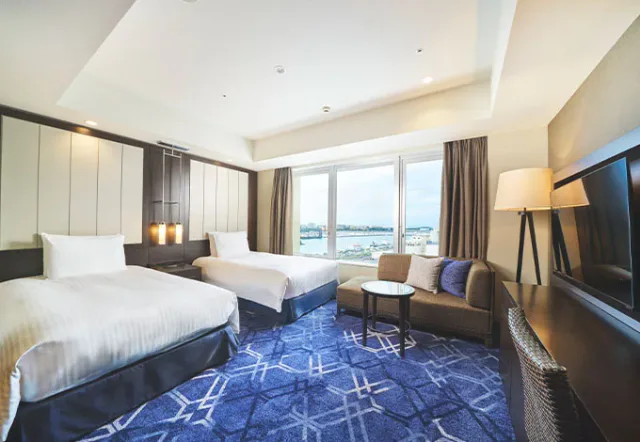
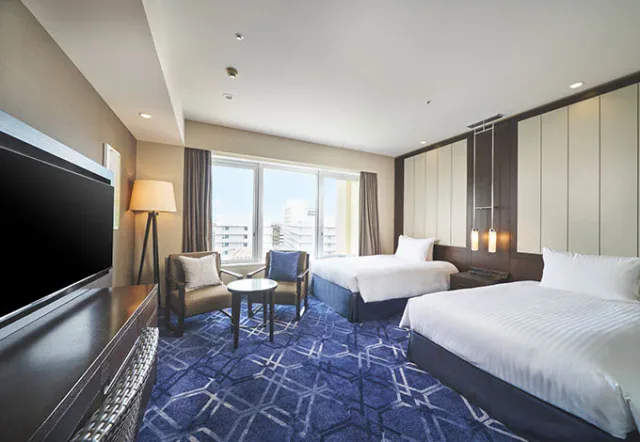
This is why RIHGA becomes disproportionately useful on a late first night or final night. Those are the moments when a missed turn, rain or a suitcase-heavy walk is most annoying. It also gives you a larger room baseline: the hotel currently states that all guestrooms are at least 35m², and multiple standard and premier twin categories are 35m².
The boundary condition is room utilisation. Nine extra square metres compared with JR Blossom’s 26m² Superior Twin are valuable if two travellers open large luggage, repack purchases, work or spend an afternoon in the room. If the room is occupied only from 23:00 to 07:30, the extra floor area is mostly unused capacity.
JR Blossom: the middle-of-stay hotel
JR Blossom’s current official access information gives about 14 minutes from Naha Airport to Miebashi Station and then roughly five minutes on foot. That is not as luggage-efficient as RIHGA. Its payback starts after check-in: the hotel positions Kokusai Street about one minute away.
The Superior Twin is currently 26m² with two 120×200cm beds. That is a meaningful size concession versus RIHGA’s 35m² baseline, but the room is not the only operational space in the stay. The hotel’s 11F coin laundry runs 24 hours, and the VOD system can show machine status and completion time. For a three-night humid-season trip, that can support lighter packing without turning laundry into a long supervised task.
I think of this advantage as night restartability: returning to the room does not have to mean the evening is finished. Drop bags, change shoes, put in laundry, go back out. That repeated behavior is exactly what a generic “five minutes from Miebashi” description misses.
Parking: neither hotel is the obvious self-drive bargain
↔ Scroll table left or right
Hotel | Current parking | Decision implication |
RIHGA | ¥1,500 per car per night, valet; no advance parking reservation | About US$9.45 at the 26 Aug 2026 rate; strongest when you value valet/terminal access rather than free parking. |
JR Blossom | 102-space mechanical car park, ¥1,500/night; high-roof capacity is limited | Same headline fee, but vehicle dimensions and Kokusai-dori traffic rules matter. |
JPY is the booking reference and exchange rates move. If you are driving north every day, the larger decision is probably whether central Naha should remain the base at all. A city hotel comparison cannot fix a base that conflicts with the route.
Breakfast: an early start changes the value more than the buffet photo
RIHGA’s current breakfast runs 07:00–10:00 and, after its 1 June 2026 price revision, costs ¥3,300 per adult (about US$20.75) and ¥1,870 for ages 6–11. JR Blossom currently opens breakfast at 06:30, with last entry at 09:30 and closing at 10:00.
If an early bus, ferry connection or airport run needs you out before 07:15, JR Blossom’s earlier opening has more planning value. If breakfast is leisurely and the room/transport question dominates, do not let a 30-minute opening difference decide the whole hotel.
One night, two nights, three nights: the winner can change
↔ Scroll table left or right
Length | What gets more weight | Likely lean |
1 night | Arrival + departure happen to everyone; repeated evening advantages have little time to compound. | RIHGA, especially with luggage or airport/bus-terminal focus. |
2 nights | One full evening loop can begin to offset arrival friction. | Depends on Kokusai use and room-space needs. |
3 nights | Dinner, shopping, room returns and laundry can repeat multiple times. | JR Blossom rises sharply for a Kokusai-centred stay. |
Room-space premium: calculate cost per actively used square metre-hour
If RIHGA is more expensive on your dates, do not ask only whether 35m² is “better” than 26m². Ask how much waking room time the larger floor area supports. A transparent planning formula is:
room-space premium per waking hotel hour = (RIHGA total − JR Blossom total) ÷ waking hours you expect to spend in the room
If you return every afternoon to work, sort shopping or rest, the premium is spread across meaningful use. If you only sleep there, the price is effectively buying easier luggage geometry and arrival friction rather than a richer hotel day. That may still be worth it — but it is a different purchase.
Failure modes that can make the “better” hotel worse
RIHGA failure mode: choosing it for the airport, then making six or eight Kokusai-dori legs over three nights and feeling the repeated walk more than the first-day convenience. JR Blossom failure mode: choosing it for Kokusai-dori but arriving late in heavy rain with two large cases and assuming “five minutes from Miebashi” behaves like a station-connected hotel. Self-drive failure mode: ignoring vehicle height, bus-lane restrictions or Sunday transit-mall rules around Kokusai-dori.
Final verdict
For one night, late arrival, final-night airport positioning or two large suitcases, I would start with RIHGA. For three nights with at least four Kokusai-dori hotel-return legs, I would start with JR Blossom. Two nights is the true tie zone: count your evening legs, laundry use and awake room time before comparing the same-date room totals.
If the itinerary spends most days in Chatan, Onna or Motobu, stop optimising these two hotels and revisit the Okinawa Hotel Decision Guide. The right Naha hotel cannot compensate for the wrong number of Naha nights.
Compare equivalent rooms before choosing a booking platform
Match the same dates, guest count, exact room, breakfast, taxes and cancellation deadline. RIHGA City View, Bayside, View Bath and Premier products are not interchangeable; JR Blossom Superior, Deluxe, Family and Premium inventory also solve different room needs.
Booking.com — RIHGA Royal Gran Okinawa
Trip.com — RIHGA Royal Gran Okinawa
Agoda — RIHGA Royal Gran Okinawa
Booking.com — JR Kyushu Hotel Blossom Naha
Trip.com — JR Kyushu Hotel Blossom Naha
Agoda — JR Kyushu Hotel Blossom Naha
Okinawa Itinerary: 5-Day Self-Drive Route from Naha to Churaumi
JR Kyushu Hotel Blossom Shinjuku Review: Is the 25m² Superior Twin Worth It?
Okinawa Private Boat Charter 2026: Naha, Chatan or Onna? Start With the Group Cost
Namba Hotel Comparison: Swissôtel, Royal Classic or Centara Grand?
Sources
RIHGA Royal Gran Okinawa — official access | RIHGA — official rooms | RIHGA — breakfast | JR Kyushu Hotel Blossom Naha — official access | JR Blossom — rooms | JR Blossom — facilities
Walking times are hotel-published planning references, not a guarantee for every traveller. Prices and operating details were rechecked on 26 August 2026. USD conversions are approximate; JPY is the booking reference. This article may contain affiliate links; ValueNavi may earn a commission from qualifying bookings at no additional cost to you.