
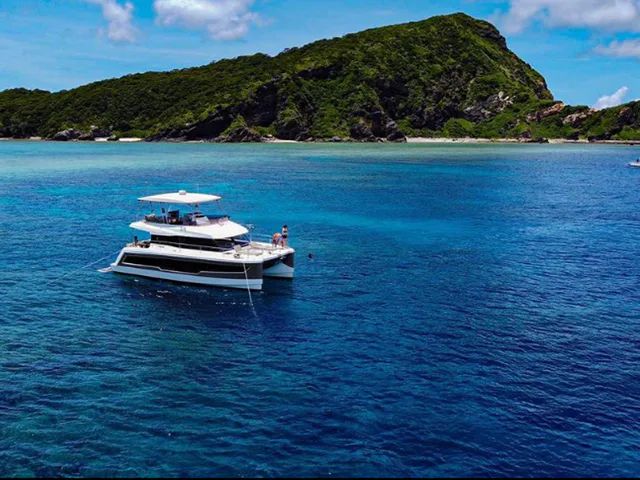
The easiest way to misread an Okinawa private boat charter is to treat the whole-boat price like a normal per-person activity ticket. Two people splitting one charter and ten people splitting the same charter may get the same privacy, but the cost per person changes completely. Add different departure ports in Naha, Chatan, Ginowan and Onna, different charter lengths, and extras such as BBQ, snorkeling, SUP, diving and marine sports, and two products that both say “private boat” can end up serving completely different trips.
If you are comparing an Okinawa yacht charter, Okinawa boat charter price, or a private yacht Okinawa experience, I would not start with which boat looks the most luxurious. Start with four questions instead: How many people are actually going? Where are you staying? Is the point cruising, Kerama-style water activities, or a private party? And are you willing to give half a day or a full day to sea conditions? Those four answers usually narrow the field faster than another hour of scrolling product photos. It also makes this one of the few high-ticket things to do in Okinawa where a bigger group can make a private option more rational rather than simply more expensive.
30-second decision: small cruiser, standard catamaran or luxury catamaran are not the same product
For a couple or a group of four to six, I would first look at a smaller cruiser rather than jumping straight to a large catamaran. Cerulean Blue currently lists a private SAFARI cruiser for groups of up to 12, departing from Naha or Ginowan, with current base pricing in the six-figure yen range. Snorkeling, SUP, fishing, BBQ and marine sports can be added. The point is a small group controlling its own day, not renting a floating party venue.
For larger family groups, company trips or several households traveling together, larger private-charter products become more interesting. Klook currently lists multiple Cerulean Blue boat types with capacities ranging from the low teens to several dozen people, and departure options include Naha, Chatan and Onna. The captain is provided by the operator; this is not a self-drive rental. What you are buying is exclusive use of the boat and its operating window, not a stack of individual admission tickets.
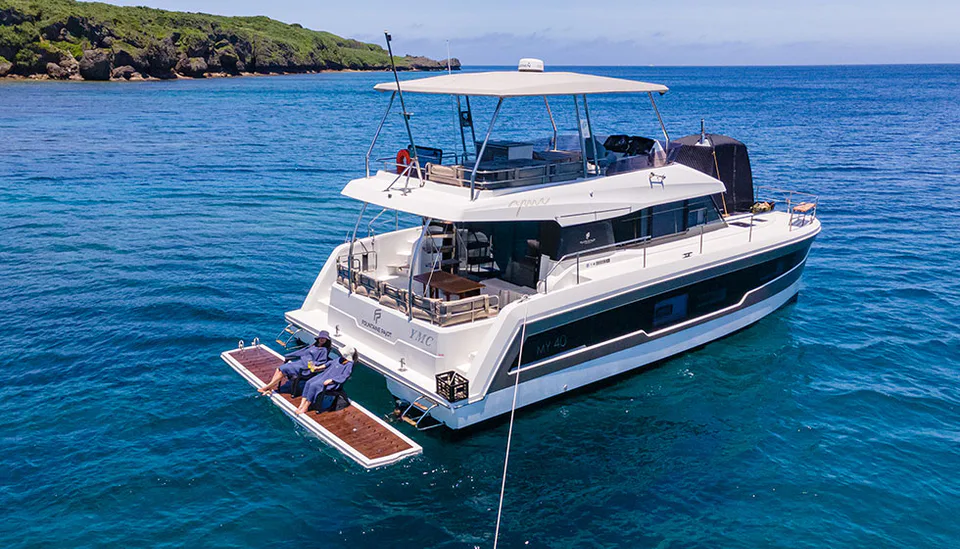
If your group is still relatively small but the boat itself is part of the experience, then the luxury-catamaran tier becomes relevant. Cerulean Blue currently lists a 45-foot luxury catamaran with multiple deck spaces, indoor seating, kitchen facilities, toilet and shower, English-speaking support, and sunset, half-day and longer charter formats. Current pricing is well above the small-cruiser tier. That extra money buys the vessel, space and service level—not simply “more ocean.”
Do the whole-boat math first: absurd for two can become reasonable for eight
The most useful calculation in private charter planning is simple: whole-boat base price divided by the number of people who will actually board. A small cruiser already costs well into the six-figure-yen range, so dividing it by two can look extreme. Divide the same kind of fixed cost across eight or ten travelers who were already going to pay for premium marine activities, equipment and transport, and the gap versus a join-in tour can shrink quickly.
The opposite mistake is seeing a maximum capacity of 30 or 40 and assuming that means a couple should rent the largest boat for the “best” experience. Capacity is an operating limit, not a recommended group size. The real question is whether the fixed charter cost, divided by your real group size, still makes sense against the alternative: per-person join-in activity prices, transport, rentals and however much value you place on not sharing the boat with strangers.
Naha, Chatan, Ginowan or Onna? Let your hotel choose the port—not the other way around
The practical value of the departure port is what it saves before and after you board. If you are staying in Naha without a car, Naha departure is the obvious baseline. If you are based around American Village, a Chatan departure often makes more sense than traveling south to Naha before turning back toward central Okinawa. If you are staying at a west-coast resort, an Onna departure can turn the charter into a true resort day. Ginowan sits between Naha and Chatan and can work well if you already have a car or are staying in central Okinawa.
Half day vs full day: longer only wins if you have enough content to fill it
A shorter charter works best when the mission is clear: cruise out, stop in one area, snorkel or run through a compact set of marine activities, and return. That is easier to control for a first private charter or when you still want a relaxed evening afterward. The small-cruiser tier is built around this kind of focused use.
Five- to eight-hour catamaran plans are different. Cerulean Blue currently lists a Naha/Chatan catamaran with 5- and 8-hour formats, while its luxury-catamaran range includes shorter sunset options as well as half-day and longer day charters. The extra time becomes worthwhile only if you genuinely plan to use it for snorkeling, SUP, BBQ, marine sports, photos, cruising and downtime on the boat.
A common overbuy is a six-person group that really wants a scenic cruise, photos and a drink, then books seven or eight hours because “full day sounds more complete.” Boat time is not free attraction time. Longer charter slots mean more crew time, fuel and vessel availability. Write down the three things you genuinely want to do. If a half day already holds all three, stretching the day is not automatically an upgrade.
BBQ, snorkeling, SUP, diving and marine sports: extras add cost and transition time
Current operator and Klook listings show a wide menu of optional services: snorkeling equipment, wetsuits, BBQ, catering, diving, fishing and marine-sports packages, with some options depending on the departure port and boat type. Those extras should not be treated like a checklist.
If the core goal is blue water and snorkeling, BBQ may be enough as a supporting add-on. You do not automatically need fishing, SUP and tow sports as well. If the trip is a birthday, company outing or private party, the group may care more about food, music, cruising and rotating marine activities than underwater ecology. The whole point of a charter is that you can customize it; selecting every add-on defeats that logic.
The expensive risk is not the headline price—it is putting the whole day on sea conditions
A private charter is still a marine activity. Paying for the entire vessel does not override wind, swell, rain or typhoon conditions. The operator may change the route, restrict some marine activities, shorten the usable plan or cancel the trip if conditions are unsafe. The higher the spend and the larger the group, the less this should be treated as fine print.
The safer schedule is to avoid putting a non-refundable, cannot-be-late dinner or show immediately after the charter. If the plan is sunset or evening-focused, weather and the operator’s final call matter even more. Klook’s current product structure also makes it clear that some special-use requests may still be governed by minimum charter lengths, so wanting only a short sunset ride does not guarantee the shortest possible billing block.
Large groups are where the private-charter equation deserves serious attention
A couple can absolutely charter a boat, but that is primarily a luxury purchase. Larger groups can potentially gain both lower per-person cost and private space at the same time. Multi-family trips, friend groups, company outings and celebrations already have to manage different activity levels: some people want to snorkel, others prefer to stay on board, children may need breaks, and older travelers may not want every water activity. A private boat can let those preferences coexist without forcing everyone into the same join-in tour timetable.
As capacity rises, ask about comfort—not just the legal maximum. Current listings range from boats for around a dozen passengers to vessels that can take several dozen. Maximum capacity does not mean dozens of guests still get the lounge space you imagine from a brochure. If privacy is the reason for paying more, ask how indoor seating, shade, toilets, showers and water-activity rotations work at your actual group size.
Your hotel base changes the fatigue cost before and after the charter
If Naha sits at the beginning or end of your trip, choose a Naha departure only if it also fits the rest of that day. A city-base charter day pairs naturally with Kokusai-dori or a simple nearby dinner; it should not become an excuse for a complicated north-south zigzag.
The same logic applies in Chatan and Onna. Chatan departure works best when you are already using American Village as a base. Onna departure works best when that day remains in resort mode. The least efficient pattern is to cross half the island in the morning for a particular boat, spend the day at sea, then cross back to the hotel at night. A high-ticket activity should reduce friction, not create extra transfers.
Five traveler types: how I would choose
Type 1 | Two to four people who only want one private ocean experience: start with a shorter small-group cruiser, not the largest luxury catamaran.
Type 2 | Six to twelve people who want snorkeling, BBQ and a few marine activities: compare a small cruiser with a 12-person luxury catamaran. The decision is activity flexibility versus vessel space and service.
Type 3 | A group in the teens or dozens: now a large private charter deserves real math. Divide the whole-boat price by actual attendance and compare it with the combined price of individual join-in activities.
Type 4 | Staying in Chatan or an Onna resort and unwilling to start with a long early-morning transfer: prioritize the nearest workable departure port rather than assuming Naha is always best because it has more listings.
Type 5 | Primarily interested in Kerama snorkeling or diving: compare regular day tours first unless private use of the vessel is itself one of the things you are willing to pay for.
Next decision: private charter or a regular Kerama day trip?
Check current boat types, charter lengths and add-ons|Cerulean Blue
Four NO-GOs: if one applies, I would not buy yet
NO-GO 1 | Only two or three people are going and the real goal is ordinary snorkeling, but “private” pushes you straight into a large charter.
NO-GO 2 | You are staying in Chatan or Onna but travel to Naha before dawn for a plan whose total land-and-sea cost you have not compared.
NO-GO 3 | You add BBQ, SUP, diving, fishing and marine sports even though nobody actually wants to do all of them, turning the day into equipment changes and waiting.
NO-GO 4 | You put a non-refundable activity immediately after the charter with no buffer for wind, route changes or delays.
Seven checks before payment
1 | Confirm whether the quote is for the whole boat, per person, or a base charter plus per-person activity fees.
2 | Confirm the actual departure port, travel time from your hotel, parking and any transfer arrangement.
3 | Confirm the actual charter duration and what is counted inside that window: check-in, leaving port, returning, boarding or operational buffer.
4 | Compare maximum capacity with comfort at your actual group size: seating, shade, toilets, showers and activity rotations.
5 | Confirm which of BBQ, snorkeling, diving, SUP, marine sports and fishing are included and which are extra.
6 | Check what happens with wind, swell or bad weather: route change, shortened operation, reschedule or cancellation, and whether add-ons follow the same rule.
7 | Calculate the per-person cost one last time. If the main value is simply not sharing the boat with strangers, decide how much that privacy is worth to your group.
Final decision: private charter gets more rational as the group gets larger and customization matters more
I would treat an Okinawa private boat charter as a group itinerary tool, not simply a premium water activity. A small group that wants a quick private escape should look at a small cruiser. A larger group that wants BBQ, snorkeling and marine sports in one day should seriously model a larger catamaran. Upgrade to a luxury catamaran when the boat itself—space, comfort and service—is part of what you are buying.
Once you understand that the price buys boat time, departure-port convenience, private space and itinerary control—not merely “more hours”—six-figure-yen quotes become easier to compare. If all you actually need is two or three hours of ocean activity, let a join-in tour do what it does best.
Okinawa 5-Day Itinerary: Don’t Rent a Car on Day 1 — Naha, Onna and Churaumi Without Hotel Hopping
Tokyu Stay Okinawa Naha: Is It the Right Final Night Before Your Flight?
Hilton Okinawa Chatan Resort Review: Are the Pool and 37m² Ocean-View Rooms Worth It?
Okinawa With Parents: The Best Hotel Is the One That Removes the Last 10 Minutes
Kyoto Private Car Charter: 8 vs 10 Hours? Check the 100km Limit First
Sources
Cerulean Blue|Boat Charter current listings
Cerulean Blue|Private SAFARI cruiser