
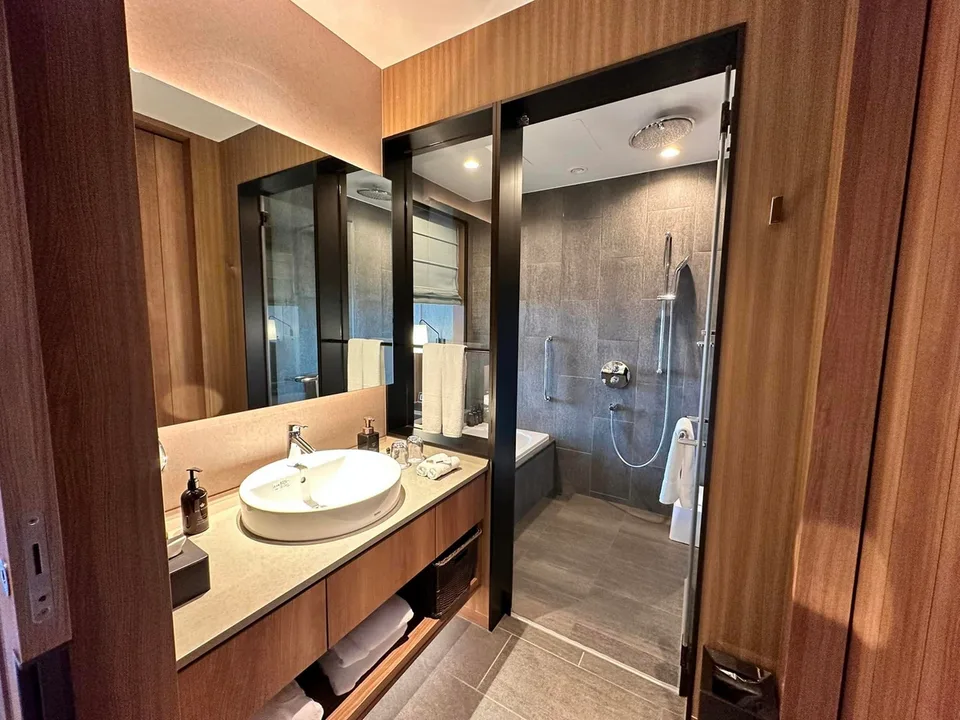
Okinawa hotels with parents: remove repeated friction before upgrading the view
The best Okinawa hotel for a trip with your parents is rarely the hotel with the most stars. It is the hotel that removes the inconvenience your group would otherwise repeat twice a day: the last walk from the monorail, another ride after dinner, an awkward bathroom, a hotel change that adds packing and waiting, or a resort premium you never have time to use.
My default recommendation is simple. If you are car-free, start with RIHGA Royal Gran Okinawa. If Kokusai-dori is part of the evening routine, start with JR Kyushu Hotel Blossom Naha. If room and bathroom comfort matter more than shaving minutes off a station walk, put HOTEL COLLECTIVE high on the list. The Naha Terrace makes more sense only when short taxis are already an intentional part of the budget. Hyatt Regency Seragaki Island Okinawa is the resort choice only when you will protect real downtime.
If you have not yet chosen between Naha, Chatan, Onna, Nago and Motobu, first use Where to Stay in Okinawa: Naha, Chatan, Onna, Nago or Motobu. This article starts one step later: which hotel removes the most friction once the broad route is known.
ValueNavi Parent-Trip Score: the same hotel can score differently when the itinerary changes
This score is not a luxury ranking. It measures how efficiently each hotel solves a parent-trip problem. All dimensions use 10 as better: walking efficiency, transport fit, room/bathroom comfort, evening flexibility, weather resilience, split-group flexibility and whether the upgrade is likely to be used rather than merely admired. The overall score assumes the travel pattern shown in the first column.
Hotel and assumed trip | Walking | Transport fit | Room / bath | Evening flexibility | Weather resilience | Split-group flexibility | ValueNavi score |
|---|---|---|---|---|---|---|---|
RIHGA Royal Gran — car-free, frequent bus / monorail days | 9.5 | 9.5 | 8.5 | 7.0 | 9.0 | 7.5 | |
JR Blossom Naha — sightseeing by day, Kokusai-dori after dinner | 8.0 | 8.5 | 8.0 | 9.5 | 7.5 | 9.0 | |
HOTEL COLLECTIVE — comfort-first central Naha stay | 7.0 | 7.5 | 9.0 | 9.5 | 7.5 | 9.0 | |
The Naha Terrace — taxi-friendly, quieter city stay | 6.5 | 6.5 | 9.0 | 7.0 | 8.0 | 7.0 | |
Hyatt Seragaki — two-night Onna stay with protected resort time | 7.0 | 6.0 | 9.0 | 8.0 | 7.0 | 8.0 |
The scores are editorial analysis, not hotel claims. More importantly, they are conditional. Hyatt can be the best choice in this article and still score poorly for a family that checks in late, leaves early and spends the only full day driving north. The Naha Terrace can move up sharply if taxis are already the default. RIHGA can move down if every evening ends on Kokusai-dori. The useful question is not “which hotel has the highest number?” but “which assumption in the score matches your trip?”
The “last 10 minutes” test is more useful than a map pin
Hotel maps encourage a common mistake: counting the main train, bus or drive but mentally deleting the final stretch. With parents, that final stretch can be the part you feel every day. A five- to seven-minute walk can be trivial at 10 a.m. and irritating at 9 p.m. after sightseeing, especially in heat, heavy rain or when one person wants to return earlier than the rest of the group.
Use a simple friction budget. Count every hotel-related transfer your group expects to repeat: station-to-hotel walk, taxi after dinner, parking-to-lobby transfer, luggage movement and hotel changes. If one choice removes a small inconvenience that occurs six or eight times, it can beat a more impressive hotel that solves a problem you experience once.
↔ Scroll table left or right
Travel pattern | Start with | What it removes | What you give up |
No rental car; frequent monorail or bus days | RIHGA Royal Gran Okinawa | The repeated last walk to transport | You are not directly on the busiest part of Kokusai-dori |
Dinner and Kokusai-dori most evenings | JR Kyushu Hotel Blossom Naha | The “one more ride” after dinner | Miebashi is still about five minutes on foot |
Bathroom and room comfort are daily priorities | HOTEL COLLECTIVE | Cramped-room friction | Kenchomae is about seven minutes away on foot |
Short taxis are acceptable | The Naha Terrace | Some city-centre noise and bustle | Repeated taxi dependence |
You will keep at least half a day free in Onna | Hyatt Seragaki | The need to create “an activity” every hour | Higher route friction for packed sightseeing |
RIHGA Royal Gran: best when public transport is the trip, not merely the airport transfer
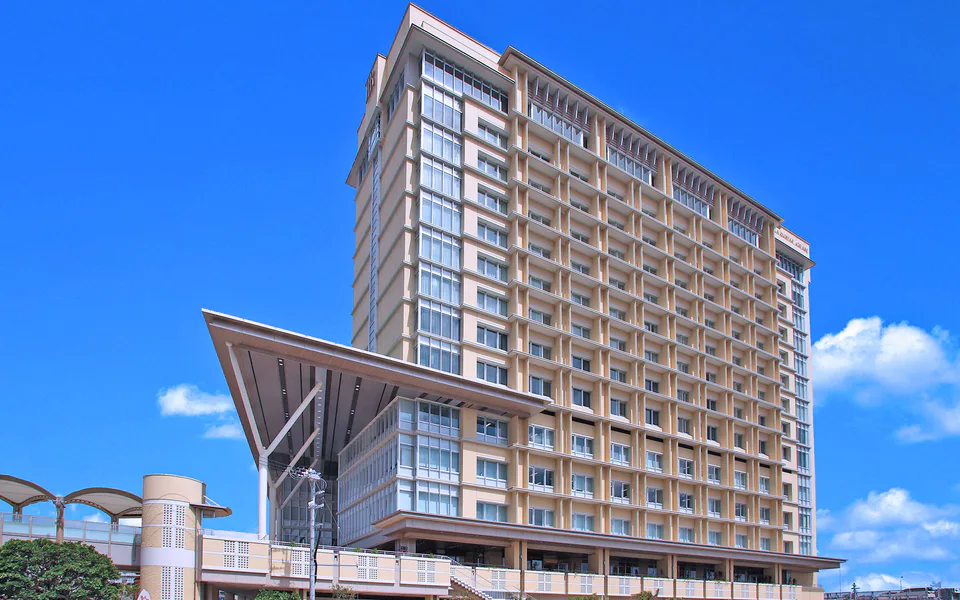
RIHGA Royal Gran Okinawa is directly connected to Yui Rail Asahibashi Station and Naha Bus Terminal, and the hotel states that all guest rooms are at least 35m². That combination is unusually coherent for a parent trip without a rental car: it reduces the transfer between room, monorail and longer-distance buses instead of simply putting the hotel near a popular street.
The hidden cost is the evening. If your parents want a slow dinner and a Kokusai-dori stroll most nights, you still have to return to Asahibashi. A connected station is valuable only when you actually use that station repeatedly. If late central-Naha evenings outnumber transport-heavy mornings, JR Blossom or HOTEL COLLECTIVE becomes more logical.
Best for: car-free travellers, airport first/last nights, bus-heavy itineraries and anyone who values predictable transfers. Avoid as the automatic answer if: every night ends around Kokusai-dori and your parents would rather walk back than board one more ride.
See what RIHGA actually saves on a first or last night
JR Kyushu Hotel Blossom Naha: best when the group may split after dinner
JR Kyushu Hotel Blossom Naha currently lists Kokusai-dori at about a one-minute walk and Miebashi Station at about five minutes on foot. That is more than a location statistic. It changes what happens when one parent is tired at 8 p.m. while someone else still wants to shop: the group can separate without turning the early return into a transport exercise.
The five-minute station walk should not be rounded down to zero. In Okinawa heat or rain, it is still part of the trip. There is also a Sunday access wrinkle: the Kokusai Street Transit Mall normally operates from 12:00 to 18:00, restricting general vehicle traffic on the affected section. If Sunday involves a rental car or taxi, plan the approach rather than assuming weekday access.
Best for: travellers who want central Naha to remain usable after sightseeing. Avoid if: you expect to board Yui Rail several times every day and do not care about evening access.
If the decision is specifically RIHGA versus JR Blossom, use Naha Hotel Comparison: RIHGA Royal Gran Okinawa vs JR Kyushu Hotel Blossom Naha.
Check whether JR Blossom fits your parents’ evening routine
HOTEL COLLECTIVE: choose it for the room routine, not because 30m² sounds luxurious
HOTEL COLLECTIVE states that all 260 rooms start at 30m². The hotel is about a seven-minute walk from Kenchomae Station, while buses 120 and 125 stop at Hotel Collective mae. That makes it a useful example of why “good transport” depends on the transport you actually intend to use.
The editorial case for HOTEL COLLECTIVE is daily room comfort. If your parents value more space, a less cramped bathroom routine and the ability to step directly onto Kokusai-dori, those benefits recur every day. If everyone walks comfortably and the itinerary starts on Yui Rail each morning, however, a larger room may not compensate for the repeated station walk.
Best for: comfort-first central stays, evenings on Kokusai-dori and travellers using buses or taxis as often as the monorail. Avoid if: the room is mostly for sleeping and station efficiency dominates the itinerary.
See whether 30m² and bathroom comfort justify the station walk
The Naha Terrace: “farther from the station” can be a feature only if taxis are already part of the plan
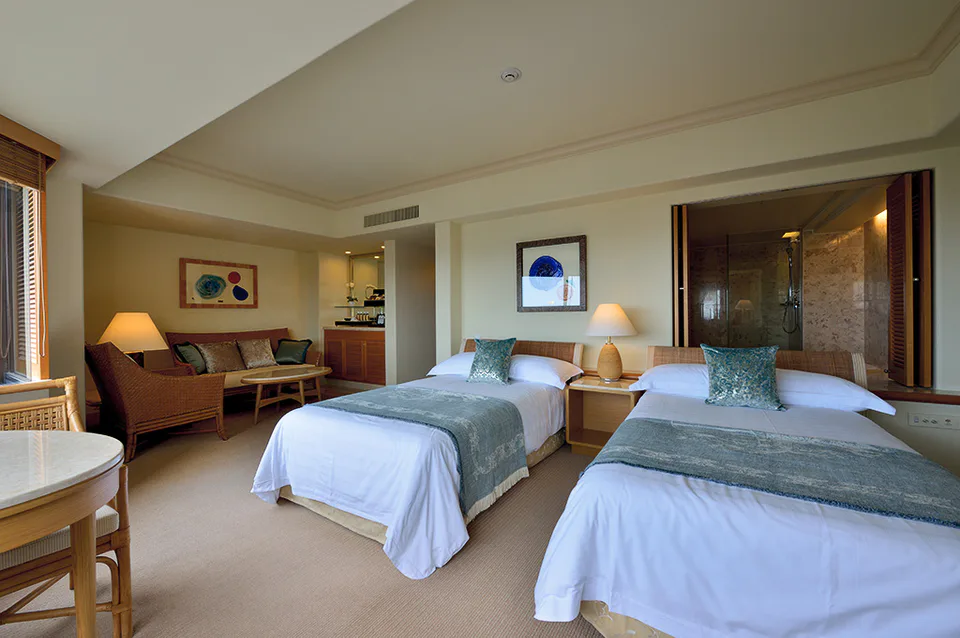
The Naha Terrace is not a station hotel. Its official access guidance suggests Yui Rail to Makishi followed by roughly five minutes by taxi. Registered guests can also use the Terrace Hotels inter-hotel shuttle with advance reservation, subject to availability. A limited-period airport shuttle is currently listed for April 1, 2026 through March 31, 2027, with advance reservation conditions; recheck eligibility and timing for your exact booking because some departures are restricted to direct-booking guests.
That transport structure tells you who should choose it. If short taxis are already an acceptable way to conserve energy, the quieter setting and 35m²-class room can be an intentional trade. If your plan is to use Yui Rail independently for every outing, the same hotel becomes a recurring inconvenience.
Best for: quieter city time, service-first stays and groups already willing to pay for short taxi hops. Avoid if: “we will just walk to the station” is likely to become the repeated compromise.
See when The Naha Terrace is worth giving up station-front convenience
Hyatt Seragaki: the resort premium only works when you deliberately leave something unscheduled
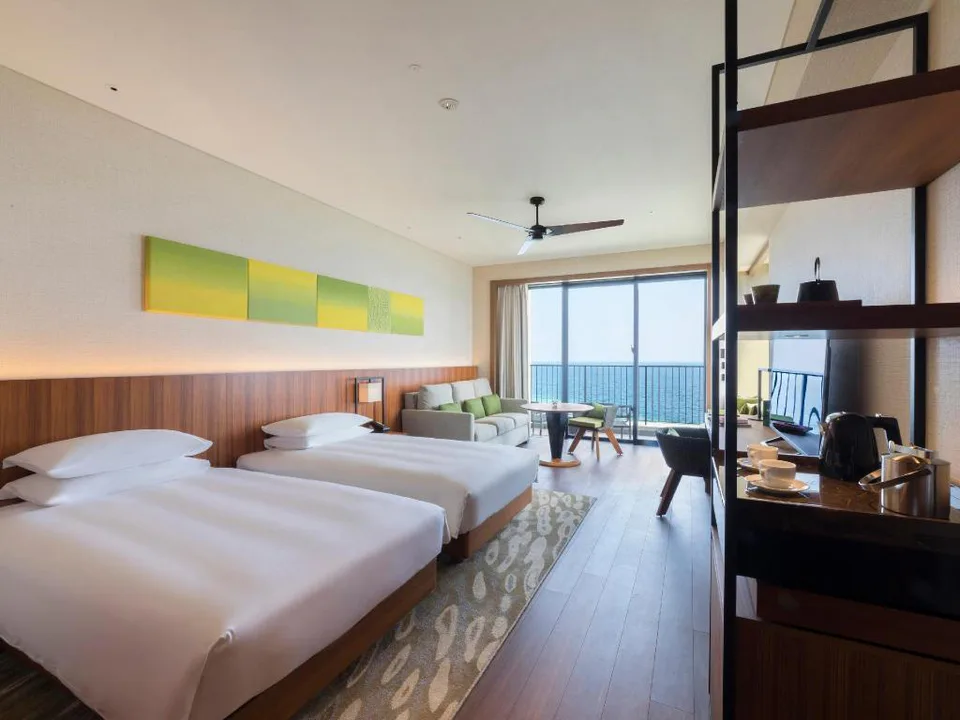
Hyatt Regency Seragaki Island Okinawa currently lists its Lagoon View Twin at 38m² with a balcony. The point of choosing it with parents is not that “older travellers like resorts.” The useful case is much narrower: you want a genuine half-day or full afternoon with no attraction, no long transfer and no pressure to maximise sightseeing.
The hotel’s parking arrangement creates a small but real friction. Self-parking is on the main-island side, and the hotel directs guests to use the Beach House shuttle or walk from that area after dropping luggage. For most travellers this is minor. It matters more if somebody has limited walking tolerance or if the family plans to enter and leave the property several times a day.
The bigger failure mode is paying for a resort while scheduling it like a roadside motel. If Night 1 is a late arrival, Day 2 is a full northern road trip and Day 3 begins with an early checkout south, the resort premium has almost no time to work.
Best for: a deliberately slow Onna segment. Avoid if: every daylight hour already belongs to Churaumi, Kouri, Cape Manzamo or long drives.
If you are comparing Onna resorts rather than deciding whether to stay in Onna at all, use Onna Resort Comparison: Monterey vs Manza vs Hyatt Seragaki for Two Nights.
Check whether Hyatt Seragaki deserves one unscheduled afternoon
When does changing hotels actually pay back the disruption?
A neat-looking Okinawa itinerary often creates too many bases: Naha, then Onna, then Naha again. The hidden cost is not just check-in time. Each move adds packing, luggage handling, a period when the next room may not be available, a new breakfast routine, a new parking or station layout and another chance for one person to be ready before everybody else.
Use a threshold rather than a feeling. A second base should do at least one of two jobs: remove a long return journey you would otherwise repeat, or create at least half a day of resort time you genuinely intend to use. If it does neither, the hotel change is mostly novelty.
↔ Scroll table left or right
Proposed move | Usually worth it? | Why |
Naha → Onna for two nights, with one slow afternoon | Yes, often | The move changes both route geography and how the day is used |
Naha → Onna for one late night before a full northern road trip | Usually no | You absorb the move but barely use the resort |
Naha → Naha hotel purely to “try another property” | Rarely | Almost no route saving; all packing cost remains |
Airport-side / Asahibashi final night before an early flight | Sometimes | It can remove departure-morning uncertainty, especially after a longer northern stay |
Three cases where a hotel shortlist is not enough
First, if a parent needs a specific accessible-room feature, do not infer it from room size or the phrase “separate bathroom.” Ask the hotel about the exact room configuration, step height, shower access and any equipment you require. Second, if the group needs connecting rooms or a particular bed arrangement, confirm the actual room type rather than assuming a large room solves sleeping logistics. Third, if a fixed routine makes early dinner, nearby food or easy taxi pickup essential, those operating details can outweigh the pool, lounge or view.
This is a useful boundary condition for the whole article: ordinary “parent-friendly” advice stops being reliable when the trip has a specific accessibility requirement. At that point, hotel confirmation beats editorial scoring.
Before paying, fix six variables so you are comparing the same trip
Set the maximum repeated walk your parents are comfortable with. Decide whether you will genuinely use the monorail and buses. Decide whether short taxi rides are an acceptable way to buy back energy. Confirm whether bathroom layout matters. Block out whether an Onna resort will receive at least half a day of real downtime. Finally, set a maximum number of hotel changes.
Only after those decisions should you compare rates for the same dates, number of guests, room type, breakfast inclusion and cancellation terms. A cheaper room with a different cancellation rule or sleeping arrangement is not the same product.
Final verdict: do not spend your parents’ energy just because they are capable of walking
For a car-free trip, RIHGA is my first check because it removes a repeated transport transfer. For evenings centred on Kokusai-dori, JR Blossom is stronger. HOTEL COLLECTIVE moves ahead when the room routine matters every night. The Naha Terrace works when taxis are an intentional trade for a quieter stay. Hyatt Seragaki wins only when the itinerary leaves room for the resort to be the activity.
The counterargument is important: if your parents walk comfortably, enjoy moving between hotels and dislike paying for convenience, you do not need to “upgrade” simply because this is a parent trip. The recommendation changes when mobility friction is low. What does not change is the method: count the inconvenience that repeats, not the feature that photographs best.
Next, use Do You Need a Car in Okinawa? Rental Car vs Public Transport to lock in the transport strategy. For the first or last night, continue with Late Arrival or Early Flight in Okinawa: Hotels Near Naha Airport.
Nokogiriyama Ropeway: Round Trip or One Way? The Route Choice That Changes Your Day
Okinawa Hotels With Babies and Toddlers: Naps, Strollers and Laundry Come Before the Pool
Okinawa Guys’ Trip Hotels: The Best Base Is Where You Can Stop Driving at Night
Hakone Loop Before Check-In or After Checkout? The Best Order for a One-Night Ryokan Stay
Okinawa Helicopter Tours: 4, 12, 20 or 35 Minutes? Pick the View Before the Flight Time
Sources
RIHGA Royal Gran Okinawa — official hotel and room information
JR Kyushu Hotel Blossom Naha — official access information
HOTEL COLLECTIVE — official access information
HOTEL COLLECTIVE — official guest-room information
The Naha Terrace — official access and transportation services
Hyatt Regency Seragaki Island Okinawa — official room information
Hyatt Regency Seragaki Island Okinawa — official parking and transportation