For a first car-free visit to Izu Oshima, choose a jetfoil day trip when Mount Mihara plus Motomachi is enough. Take the overnight large passenger ship out and a jetfoil back when you want one very long island day and can genuinely sleep onboard. Stay one night on Oshima only when the second day has a named job—Habu Port, the southern coast, an onsen/sunset block, a slower hike, or timetable resilience.
The most useful comparison is not “day trip versus overnight.” It is usable island hours versus sleep quality and weather risk. Current summer services illustrate the trade clearly: jetfoils can reach Oshima around 09:35–10:00, while the overnight large passenger ship can arrive around 06:00. That is roughly 3½–4 extra morning hours. Those hours are valuable if they solve Mount Mihara and a second island zone; they are wasted if you arrive exhausted and spend the morning recovering.
↔ Scroll table left or right
Your real goal | Best starting point | What you are buying | Main risk |
Mount Mihara + Motomachi, one Tokyo spare day | Jetfoil day trip | Normal Tokyo sleep and the least hotel disruption | Only one main island zone fits comfortably without a car |
One very long island day, no island hotel | Overnight large ship out + jetfoil back | About 3½–4 extra morning hours in current summer patterns | Onboard sleep quality can erase the time gain |
Mount Mihara + Habu/south + evening or morning island time | One island night | Two separate sightseeing windows and less pressure on the return boat | Extra hotel move and weather can still strand or delay you |
Large suitcase between Tokyo hotel bases | Do not bring it on the sightseeing loop | A day bag makes buses and port changes much easier | Jetfoil baggage limits are materially tighter for large/heavy items |
Fixed Tokyo dinner/event immediately after return | Do not use Oshima as the same-day lead-in | You preserve recovery margin | Weather can cancel or even advance sailings by hours |
A jetfoil day trip is a one-zone itinerary, not a small version of a two-day trip
Tokai Kisen currently describes the high-speed jet ferry as the fastest sea route, with Tokyo–Oshima at about 1 hour 45 minutes in the current timetable. Recent 2026 summer operating examples include Tokyo Takeshiba departures around 07:50 or 08:15 reaching Oshima around 09:35 or 10:00, with several afternoon return options depending on the date.
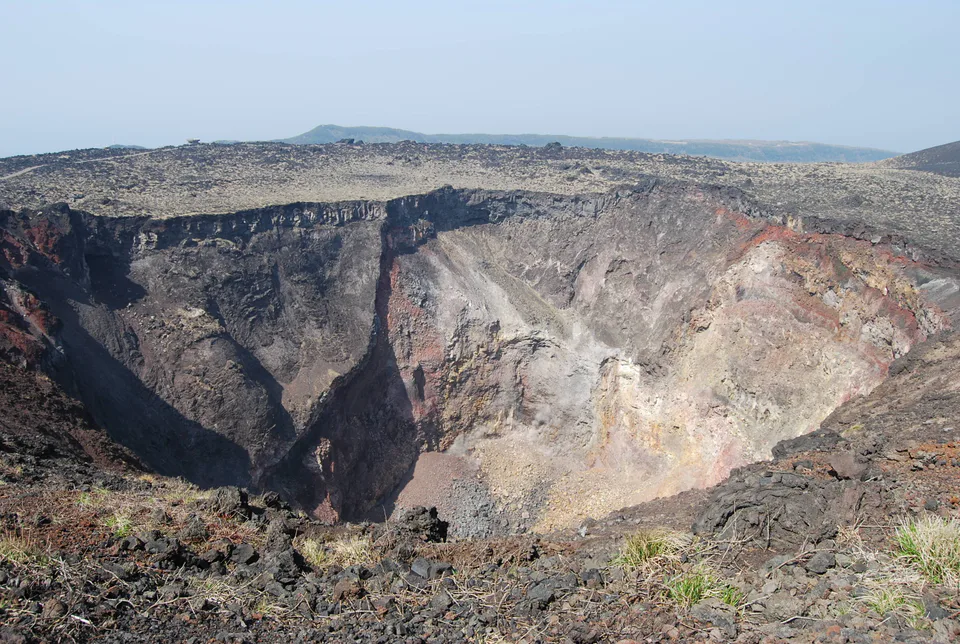
That sounds like plenty of time until Mount Mihara is added. Tokyo Islands' official guide gives the summit trail plus crater loop at roughly 2 hours 30 minutes from the Miharayama summit bus-stop area. Izu Oshima tourism information currently puts the bus from Motomachi to Miharayama summit entrance at about 36 minutes. Add bus waiting, the return trip, food and the port margin, and the mountain can consume most of a car-free day.
ValueNavi analysis: if Mount Mihara is the main reason for going, pair it with Motomachi/onsen/coast nearby and stop. Do not also promise Habu Port, the southern coast and several museum stops because the island looks compact on a map. Without a car, the second geographic zone is what turns a day trip into a fragile timetable exercise.
This is even more important in summer 2026: Oshima Bus currently says its organised sightseeing bus is suspended from July 1 through August 31, while ordinary route buses continue. A visitor who expected a simple hop-on sightseeing circuit must therefore build around the actual route-bus timetable or pay for taxis.
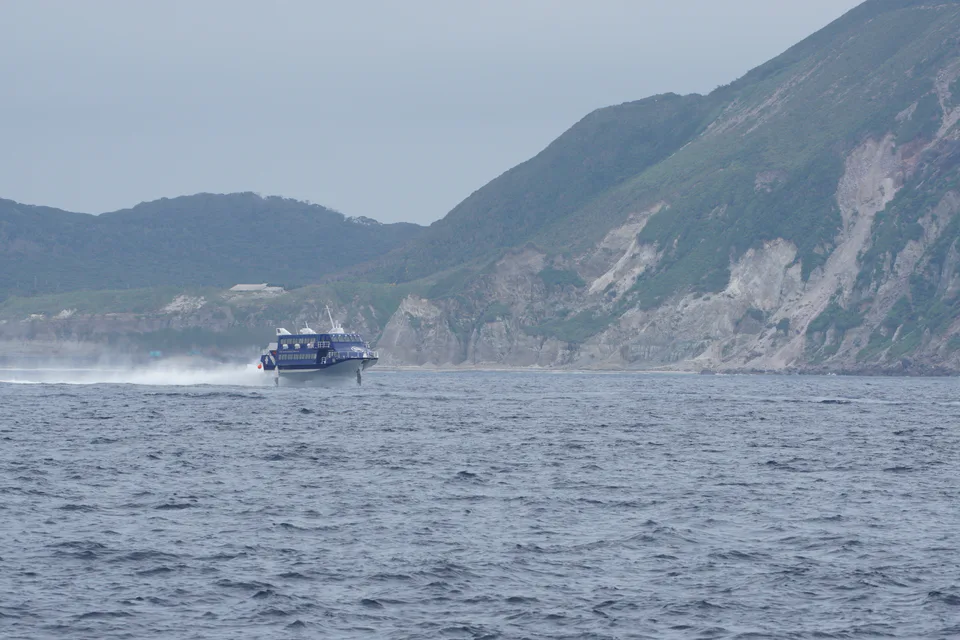
Tokai Kisen jetfoil Seven Island Yui. Photo: Sota Kaneko / Wikimedia Commons, CC BY-SA 4.0.
The overnight ship buys 3–4 morning hours—but only if you can use them awake
Current summer schedules include a large passenger ship leaving Tokyo Takeshiba around 23:00 and reaching Oshima around 06:00. Compared with a 09:35–10:00 jetfoil arrival, that can buy roughly 3½–4 extra hours before the day-trip crowd reaches the island.
Oshima Bus explicitly says it runs connecting buses to several island areas when the large passenger ship arrives early around 06:00. That makes the early arrival operationally useful rather than leaving passengers stranded at the port until normal sightseeing hours.
The trade-off is sleep. A large ship's lowest fare class and a normal Tokyo hotel bed are not equivalent products. If you sleep poorly on moving transport, the extra three or four hours may become breakfast, coffee and recovery rather than hiking time. A traveller who needs good sleep before a 2½-hour volcanic walk should value the Tokyo hotel more than the nominal morning gain.
Parents should be stricter. A child who sleeps badly at sea can turn an “efficient” overnight into the least useful version of the trip. For families, a jetfoil day or a real island hotel often produces fewer nominal hours but more usable ones.
The fare math currently favours the overnight ship—but comfort is not matched
Tokai Kisen's August 2026 adult one-way fare is currently JPY 12,300 for the jetfoil and JPY 8,220 for second class on the large passenger ship. Fares include the current fuel adjustment and change by month.
Using those August fares only as a planning example:
Jetfoil out + jetfoil back: JPY 24,600.
Large passenger ship second class out + jetfoil back: JPY 20,520.
That is a JPY 4,080 transport difference before any promotions. The overnight pattern can therefore be both cheaper and longer on the island. But it is not “free accommodation.” You are replacing a Tokyo hotel bed with shipboard second-class travel and accepting a different sleep product. If you need a higher ship class to sleep properly, redo the comparison using that fare.
The monthly fare movement is also large enough that a static “cheapest option” claim would be misleading: Tokai Kisen's published September 2026 Tokyo–Oshima fares fall to JPY 10,430 by jetfoil and JPY 6,430 in large-ship second class. Always calculate on the actual month.
One island night should buy a second geography, not merely more of Motomachi
An island hotel becomes more convincing when Day 2 has a separate job. Good examples are Habu Port and the southern coast, an early/late onsen block, cycling, a slower second hiking area or a morning that would otherwise collide with the return boat.
A weak overnight looks like this:
Day 1: Mount Mihara + Motomachi
Day 2: more Motomachi → ferry back
A stronger overnight looks like:
Day 1: Mount Mihara + Motomachi / onsen
Day 2: Habu / south coast or another defined island zone → return
The distinction matters because Oshima is about 90 km² and 52 km around. The southern side is not a short station-area add-on. Izu Oshima Tourism Association's current taxi reference, for example, puts Motomachi to Habu at roughly JPY 5,500 for a medium taxi. That is not a fixed fare guarantee, but it illustrates why southern geography has a real transport cost without a car.
If you cannot name the second geography or morning/evening experience, save the hotel move and take a jetfoil day trip.
Motomachi vs Okada is a daily operating decision, not a hotel guarantee
Oshima has two main passenger ports, Motomachi on the west side and Okada on the north side. Tokai Kisen states that the arrival/departure port is decided according to that day's sea conditions, and the outbound and return ports can differ.
This changes how you should book accommodation. A Motomachi hotel may be excellent for restaurants, onsen and town access, but it does not guarantee that your ferry will use Motomachi. A hotel advertising port pickup should be asked whether pickup follows the day's operating port automatically or needs a reservation and confirmation.
For a day trip, the first task after the 06:00 operating update is not “open Google Maps.” It is confirm today's operating ship and port, then load the matching bus plan. A saved itinerary built around Motomachi can be wrong before you step ashore if the ship uses Okada.
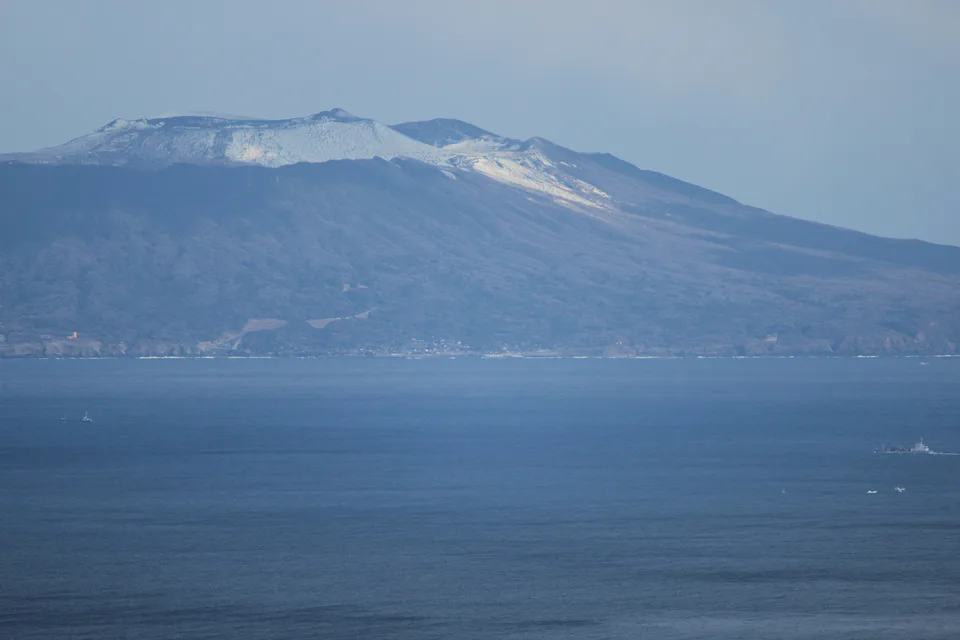
Izu Oshima and Mount Mihara viewed from the Izu Peninsula. Photo: Batholith / Wikimedia Commons, public domain.
Weather risk includes schedule changes, not only cancellations
Tokai Kisen currently decides high-speed jet-ferry operation around 06:00 on the day. Large passenger ship information is updated later and final decisions can be made around 17:00. If the operator cancels a service, tickets booked through Tokai Kisen can generally be cancelled or changed without a cancellation fee under the published conditions; however, Tokai Kisen also states that accommodation costs caused by being forced to stay locally are borne by the passenger.
The more important itinerary lesson is that weather can change the time, not only produce a binary operate/cancel result. August 2026 provides a useful real example. During typhoon disruption, Tokai Kisen's status pages showed scheduled afternoon Oshima–Tokyo jetfoils moved forward by several hours; on another day all jetfoils were cancelled while a large passenger ship operated on an amended schedule.
That means a same-day Tokyo dinner, concert or flight after Oshima is a bad pairing even when the timetable appears to leave margin. Your return plan needs enough slack to accept an earlier departure, a different port or a cancellation without destroying a second expensive booking.
Boundary condition: an island hotel gives you more timetable resilience while sightseeing, but it does not insure you against a cancelled return. If the following day in Tokyo contains a non-movable international flight or major reservation, move Oshima earlier in the trip.
Large luggage is a stronger reason to keep the Tokyo hotel than many travellers expect
Tokai Kisen's current jetfoil baggage rules allow two pieces per person within the free allowance when the three dimensions total 120 cm or less and total weight is 20 kg or less. Larger/heavier baggage within the published upper limit is charged JPY 1,200 one way; baggage over 200 cm total dimensions or 30 kg is not accepted on the jetfoil.
The large passenger ship has a different baggage structure and can accept some larger checked items, but that does not make a full-size suitcase useful on island buses. If Oshima is a side trip from Tokyo, leave the main suitcase at the Tokyo hotel and take a day bag. If the island sits between two hotel cities, consider forwarding the main luggage using the Japan luggage-forwarding guide.
This is one of the strongest arguments for a day trip or night-ferry excursion while retaining the same Tokyo room: the island trip can happen without turning every port and bus transfer into a baggage movement.
Three trip patterns that actually work
Pattern A: easiest first visit
Tokyo hotel → morning jetfoil → Mount Mihara + Motomachi → afternoon jetfoil → same Tokyo hotel. Best for first-time visitors who want the volcanic landscape without adding another room key. The trade-off is giving up the southern island.
Pattern B: maximum island time without an island room
23:00-ish large passenger ship from Takeshiba → around 06:00 Oshima arrival → full island day → afternoon jetfoil back to Tokyo. Best for adults who can sleep on the ship and have a clear plan for the early hours. The trade-off is sleep quality and more weather-sensitive sequencing.
Pattern C: geography-first overnight
Jetfoil or ship to Oshima → Mount Mihara / Motomachi → island hotel → Habu or another defined second zone → return next day. Best when the second day adds something structurally different. The trade-off is hotel cost, luggage and exposure to another day of sea operations.
When I would not choose Izu Oshima for this trip
I would skip Oshima when the Tokyo itinerary already has several weather-dependent day trips, when the following evening contains a non-refundable major event, or when the traveller needs a guaranteed return geometry. Hakone and other rail-access destinations are easier to recover when marine transport changes.
I would also skip the overnight ferry for travellers who already know that poor sleep destroys the next day. “Arrive at 06:00” has no value if the first three hours are spent recovering from the ride.
And I would skip the island hotel if Day 2 has no task. More nights are not automatically more resilient; sometimes they simply add another checkout before you return to the same Tokyo route.
Final verdict: buy only the extra island hours you can name
Choose the jetfoil day trip for Mount Mihara + Motomachi and a normal Tokyo night. This is the best default first visit.
Choose the overnight large ship out + jetfoil back when roughly 3½–4 extra morning hours have a concrete job and you can tolerate shipboard sleep. In current August 2026 fares, this can even cost less than a jetfoil round trip, but the comfort product is not equivalent.
Choose one island hotel night when it unlocks a second geography or genuine evening/morning value. Do not buy a room just to turn one well-designed day into two thinner days.
Whatever pattern wins, confirm the day's operating ship and Motomachi/Okada port before setting the bus plan, and keep the Tokyo schedule after your return deliberately loose.
Related planning
Mito or Oarai Without a Car · Japan Luggage Forwarding · Hakone vs Kawaguchiko
Sources and verification date
Tokai Kisen — timetable and fare table · Tokai Kisen — August 2026 fares · Tokai Kisen — operating status and ports · Tokai Kisen — cancellation/operation decisions · Tokai Kisen — jetfoil baggage rules · Oshima Bus — 2026 route-bus information · Oshima Bus — island transport and attractions · Izu Oshima Tourism Association — Mount Mihara access. Checked August 25, 2026. Sailings, fares, operating ports and bus connections can change by date and weather; verify the actual travel day.