
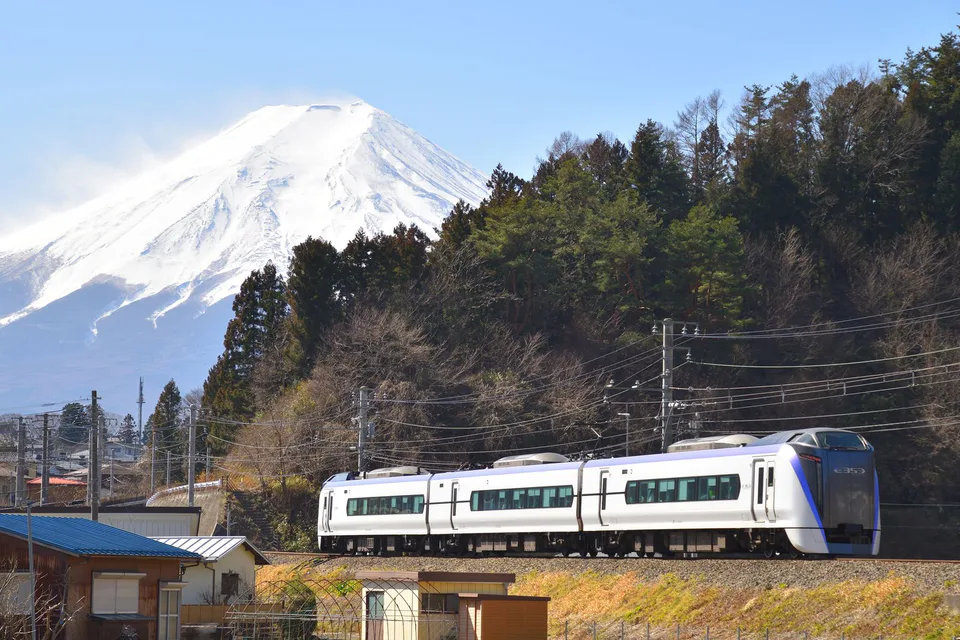
Book the Fuji Excursion when the one-seat Shinjuku–Kawaguchiko ride genuinely removes a difficult Otsuki transfer for your group. If your date is fixed, reserve both directions when sales open. But do not treat “reserved seats sold out” as the same thing as “the train is impossible.” JR East currently sells a seat-unreserved limited express ticket for Fuji Excursion: you may use an empty ordinary-class seat, but you have no assigned seat and must move if the passenger holding that seat’s reservation arrives. That is a very different backup from a confirmed seat, especially for families or large luggage.
The second source of confusion is the fare. The direct train crosses from JR East to the privately operated Fujikyu Railway at Otsuki. Fujikyu currently lists Shinjuku–Kawaguchiko at JPY 4,200 one way: JPY 2,580 basic fare plus JPY 1,620 express fee. Pass coverage therefore has to be checked by product rather than by the JR logo on the train.
Fuji Excursion booking in 30 seconds
↔ Scroll table left or right
Your situation | Best action | Main risk |
Date fixed, direct train is important | Reserve outbound and return when sales open | Late-afternoon return inventory can disappear even if the morning still works |
Reserved seats sold out | Decide whether a seat-unreserved ticket is acceptable | No assigned seat; you may have to move or stand in the deck if reserved passengers arrive |
Family / older traveller / mobility needs | Prefer confirmed adjacent seats | A seat-unreserved backup removes the seat certainty that made the direct train valuable |
Weather-flexible Fuji day | Keep Otsuki train or highway-bus fallback | Booking the direct train early can reduce the flexibility you wanted |
JR TOKYO Wide Pass holder | Use the pass within its validity and reserve the train | Do not confuse Fuji Excursion with other Fujikyu premium trains that can require extra charges |
Check JR-EAST Train Reservation
First decide whether the direct train solves a real problem
Fuji Excursion is most valuable when your Tokyo base is already near Shinjuku and a transfer at Otsuki would be expensive in human terms: young children, older relatives, mobility limitations, several suitcases or a group that simply wants one reserved seat from Tokyo to the Fuji area.
It is less compelling when you first have to cross Tokyo to reach Shinjuku. A traveller staying near Tokyo Station or Ueno can spend enough time reaching the departure station that the “direct” label becomes less meaningful. Settle the hotel base first with Tokyo Station vs Shinjuku rather than buying a train ticket that then dictates the hotel.
It is also weaker when the trip’s central objective is weather flexibility. Mount Fuji visibility can change sharply. If you want to choose between Tuesday and Wednesday only after checking the forecast, a train that rewards booking one month ahead is structurally fighting the strategy. In that case, the Tokyo to Kawaguchiko transport comparison should decide whether an Otsuki transfer or highway bus is the more resilient product.
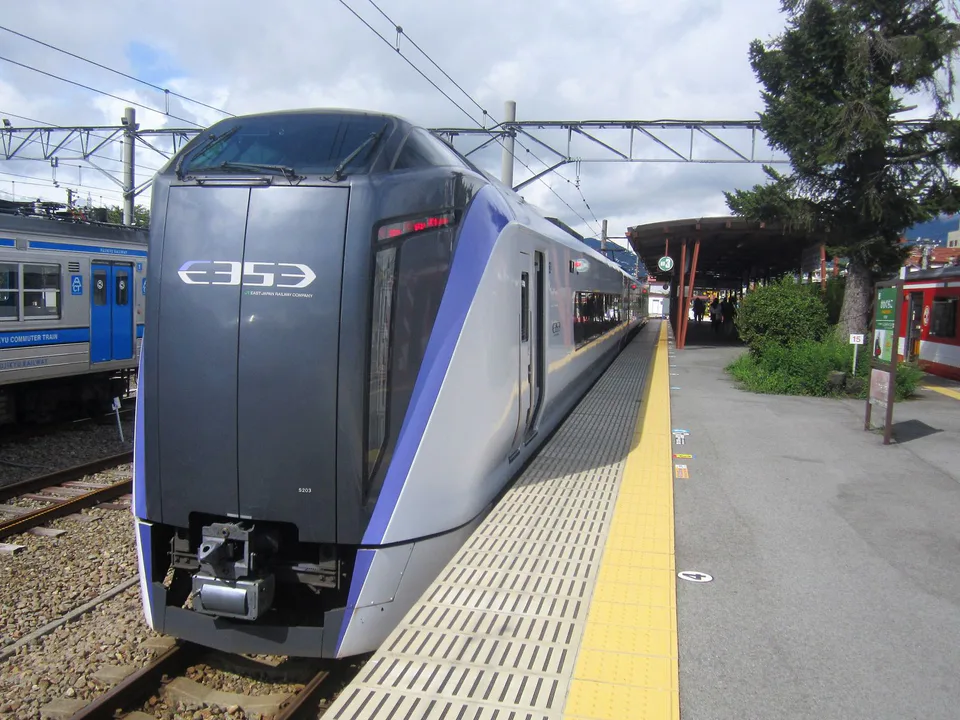
The current one-way fare is JPY 4,200 to Kawaguchiko
Fujikyu Railway currently publishes a one-way Shinjuku–Kawaguchiko total of JPY 4,200: JPY 2,580 basic fare plus JPY 1,620 express fee. Shinjuku–Shimoyoshida is currently JPY 4,010.
That published split is useful because it stops one common booking mistake: buying or holding only one layer of the journey and assuming the train is fully paid. The ordinary fare and the limited-express entitlement are separate concepts even when the booking interface packages them together.
Use the official checkout as the final authority for the actual ticket product. Do not mix a limited-express e-ticket, IC-card assumption, paper basic-fare ticket and pass without understanding which layer each one replaces.
“All seats reserved” does not mean the same thing as “you cannot board when full”
This is the most important correction to ordinary Fuji Excursion advice. JR East describes Fuji Excursion ordinary cars as all-reserved-seat trains, but it also sells a seat-unreserved ticket for Fuji Excursion.
A seat-unreserved ticket specifies the date and section but not a particular train seat. JR East says passengers using it may sit in an empty ordinary-class seat. If the passenger holding a reservation for that seat arrives, you must move to another empty seat or use the deck. The ticket costs the same limited-express fare as the reserved-seat product, and you can later have a seat assigned without an extra fee if inventory becomes available.
There is one operational catch that matters for international travellers: JR East’s FAQ currently states that the seat-unreserved ticket cannot be purchased on Eki-net; use a reserved-seat ticket machine or another eligible station sales channel.
↔ Scroll table left or right
Ticket state | What you actually have | Who should accept it |
Confirmed reserved seat | A specific seat on a specific service | Families, groups, older travellers, anyone prioritising certainty |
Seat-unreserved ticket | Permission to use ordinary-class empty seats without an assigned seat | Flexible solo/couple travellers willing to move or potentially stand |
No suitable direct-train product | Use another route | Anyone for whom seat uncertainty defeats the purpose of the direct train |
ValueNavi verdict: a seat-unreserved ticket is a legitimate sold-out fallback, but it is not a substitute for a reservation when the reservation itself was the reason you chose Fuji Excursion. A family of four should not call the problem “solved” merely because four people can still board without four assigned adjacent seats.
Tickets normally open one month before travel at 10:00
Fujikyu’s current special-train notices state that Fuji Excursion tickets go on sale from 10:00 a.m. one month before the travel date through JR East Eki-net, reserved-seat ticket machines, JR ticket offices and specified Fujikyu stations.
For a fixed day trip, I would treat the return as equal priority to the outbound. The travel pattern is asymmetric: travellers may spread across several morning departures, but many want a similar mid- to late-afternoon return after Kawaguchiko. A confirmed 07:30 outbound with no acceptable return can produce a worse itinerary than a slightly later outbound with a return you actually want.
Before purchasing, write the day as a pair:
outbound arrival time
+
latest return you would genuinely accept
If only one half works, the booking is not complete.
Current timetable: four regular round trips plus some seasonal extras
Fujikyu’s timetable effective March 14, 2026 lists four regular daily Fuji Excursion round trips between Shinjuku and Kawaguchiko, with additional seasonal services on selected dates. The exact departure list differs by weekday and holiday pattern, so use the timetable for the actual travel date rather than preserving a screenshot from another month.
This matters when a travel blog says “the Fuji Excursion leaves at X.” The service is a timetable family, not one immutable train. Seasonal No. 81/78 and No. 93/94 services can change the usable arrival and return windows on selected dates.
JR TOKYO Wide Pass is the notable pass exception
The JR TOKYO Wide Pass currently covers JR East services and all Fujikyu Railway lines within its three-day validity area. That makes it materially different from assuming a generic JR product automatically covers the private railway after Otsuki.
JR East currently prices the pass at JPY 16,000 for adults and JPY 8,000 for children aged 6–11. A single Fuji Excursion day is not by itself enough reason to buy it; the value depends on the other eligible travel within the three days.
The pass terms also warn that separate charges apply to reserved seats on the Fujisan Express and Fujisan View Express, and to Fuji Tozan Densha. Those are different Fujikyu products. Do not transfer their extra-charge rule onto the direct Fuji Excursion without checking the exact train.
Sold-out decision tree: reservation, seat-unreserved ticket, Otsuki, bus or overnight
A sold-out search result should trigger a hierarchy rather than panic.
Check whether another Fuji Excursion time works. The easiest fix is often moving the day earlier or later.
If the direct ride matters more than seat certainty, consider a seat-unreserved ticket. This is strongest for a solo traveller or flexible couple. It is weaker for families and groups.
Use JR to Otsuki + Fujikyu Railway. This preserves the rail day while giving up the one-seat ride. Azusa/Kaiji can speed the JR portion when the timetable fits; ordinary Chuo Line services can reduce cost.
Check the highway bus. It restores a direct ride but introduces road-traffic uncertainty.
If only the return is the problem, reconsider the day-trip assumption. A planned overnight can be a better product than forcing an awkward early return.
The right backup is determined by the reason you wanted Fuji Excursion. If the reason was “no transfer with my parents,” Otsuki is a worse substitute than a bus. If the reason was “rail is more predictable than road,” Otsuki is a better substitute than a bus. A generic backup list cannot choose for you.
A sold-out return can be evidence that you should stay overnight
Do not automatically book a hotel because a train is full. But if the only available direct return is much earlier than the sightseeing plan wants, the transport problem may be exposing a stay-length problem that already existed.
An overnight becomes stronger when it buys two things at once: a later first day and a high-value early morning or ryokan/hotel experience on day two. It is weak when it merely adds a hotel bill so you can board tomorrow’s train.
Use the Mt Fuji day trip or overnight guide and How Many Nights in Lake Kawaguchiko? before turning transport scarcity into an accommodation decision.
Luggage makes the direct train more valuable—but a seat-unreserved fallback less attractive
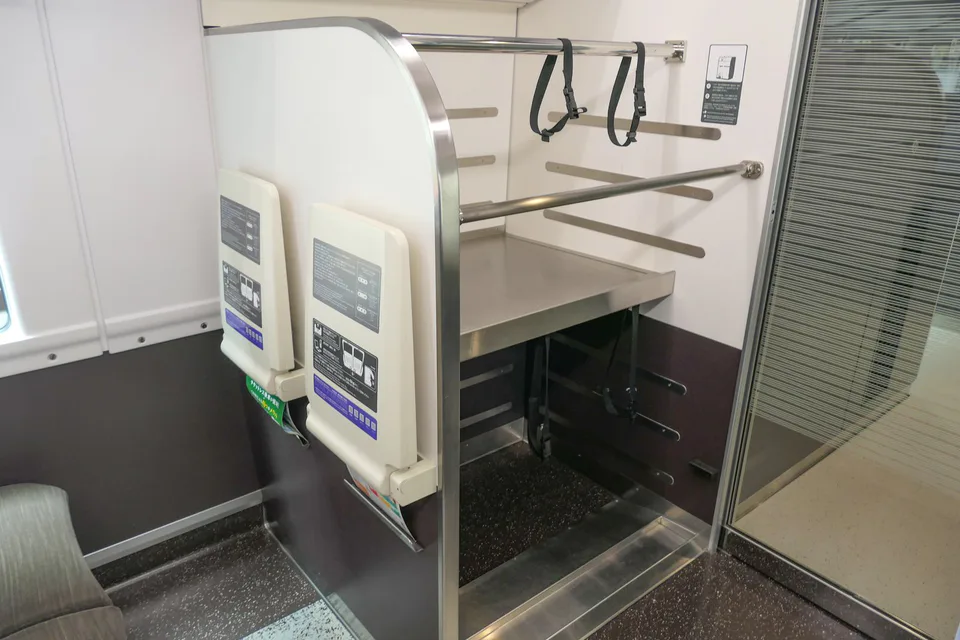
The E353 provides luggage areas, but they are shared; a booking does not assign a suitcase rack to your seat. Large luggage therefore strengthens the argument for avoiding Otsuki, but it also strengthens the argument for having a confirmed seat rather than moving around the carriage with a seat-unreserved ticket.
If Kawaguchiko is only one stop in a longer Tokyo–Fuji–Hakone or Kansai itinerary, luggage forwarding can change the transport decision more than the difference between two train times. Carrying one overnight bag turns an Otsuki transfer from a major problem into a much smaller one.
Families should optimise for adjacency, not just legal boarding
For families, reserve the whole party together and inspect the seat assignment before payment. A legal ticket for every passenger does not guarantee adjacent seats unless the reservation does.
This is the main reason I would rank the sold-out fallbacks differently for a family than for a solo traveller:
Solo: seat-unreserved Fuji Excursion can be a very reasonable rescue.
Couple: acceptable if both can tolerate moving or separating.
Family with young children: confirmed Otsuki route or another reserved/direct product may be more coherent than boarding without assigned seats.
The direct train is valuable because it reduces uncertainty. Do not preserve the train name after the certainty has disappeared.
Missed train: the next Fuji Excursion is not automatically your replacement
A specified reserved-seat ticket is tied to its rules and train. If you miss it, do not assume the next service will simply honour the same seat. Ask JR/Fujikyu staff or use the original booking channel to determine what remains valid and what needs to be changed.
JR East currently allows eligible seat-unreserved tickets to be converted to a reserved seat for the same section without an additional charge when seats are available. That is useful before boarding; it should not be turned into a blanket promise about every missed reserved ticket.
For a Tokyo–Kawaguchiko–Hakone itinerary, avoid making the next region dependent on the final fragile train connection. The combined itinerary should set the buffer before the ticket purchase.
Final booking rule
Use Fuji Excursion when confirmed seating plus no Otsuki transfer solves a real problem. Book both directions when the date is fixed, normally from 10:00 one month before travel. If reserved seats sell out, remember that JR East’s seat-unreserved ticket is a real option—but judge it as a lower-certainty product, not as a secret reserved seat.
For solo travellers, that fallback can preserve the direct train. For families, older travellers and luggage-heavy groups, the loss of assigned seating may remove the very benefit you were paying for. At that point, an Otsuki transfer, highway bus or overnight can be the more rational choice.
Things to Do in Tokyo When It Rains: The Best Plan Depends on How Hard It’s Raining
Asakusa Samba Carnival 2026: When to Arrive, Where to Stand and What Not to Bring
Kyushu National Museum Tickets: When ¥700 Is Enough — and When the Special Exhibition Is Worth It
Fukuoka Tower: Is the ¥1,000 Ticket Worth the Detour? Timing Changes the Answer
Arashiyama Guide: How Long to Spend, Which Station and What to Skip
Sources
Fujikyu Railway — current Fuji Excursion timetable and fares · JR East — seat-unreserved ticket rules · JR East — all-reserved-seat limited express boarding guidance · JR TOKYO Wide Pass terms. Checked August 25, 2026. Timetables, special-train dates, prices and sales channels can change; verify the exact date before payment.