
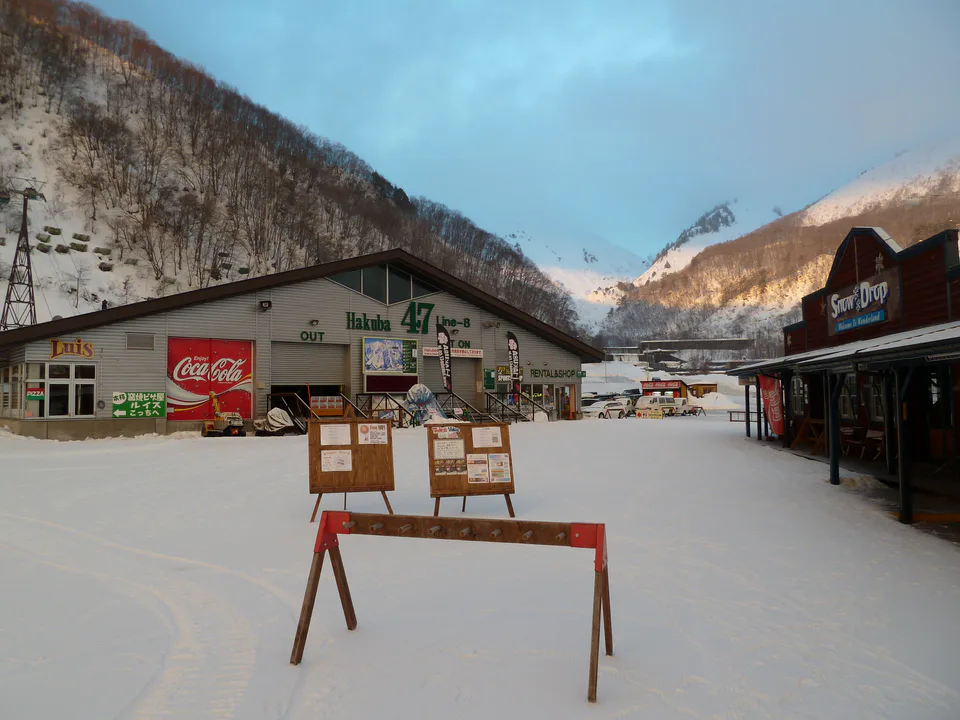
Choose Happo when you want Hakuba’s safest all-round base: Happo-One is your main mountain, you expect to change resorts with weather, or restaurants and evening movement matter almost as much as ski-in convenience. Choose Goryu when Goryu + Hakuba47 will account for most of your ski days, or when beginner/family terrain and an English-language ski-school setup are the hard constraints.
The decisive question is not which village looks better on a booking map. It is how many days your hotel can remove the first and last shuttle of the ski day. Hakuba Valley’s shuttle network links the resorts, but the operator explicitly warns that powder-morning and late-afternoon buses can fill to capacity. A shuttle therefore expands your options; it does not make a poorly located hotel free of friction.
↔ Scroll table left or right
Your ski-week pattern | Start with | Why | What reverses it |
First Hakuba trip, mountain mix still flexible | Happo | Large home mountain plus a central base for valley switching | Goryu/47 end up being 3+ of a 5-day ski plan |
Goryu + Hakuba47 on most ski days | Goryu | Removes the repeated morning and afternoon transfer to your actual home terrain | You want several Tsugaike/Happo/Iwatake days instead |
Young children / beginner-heavy group | Goryu gets stronger | Toomi and Iimori are officially positioned for beginners, kids and families | Your exact hotel still needs a shuttle or road walk in ski boots |
Mixed intermediate/advanced group, Happo-One is a priority | Happo | Happo-One offers 220 ha, 1,071 m vertical and a broad intermediate-led terrain mix | The group’s lessons and beginner days are concentrated at Goryu |
English-language group lessons are essential | Compare schools before hotels; Goryu is a strong starting point | Hakuba Snow Sports at Goryu publishes English and other-language group/private options | A Happo-area Evergreen lesson package already solves the language requirement |
Nightlife / restaurant variety is a repeated priority | Happo usually | More of the evening can happen near the main central visitor hub | You prefer a quiet ski-first stay and are happy using the night bus when required |
Use a home-mountain share before comparing hotel prices
A five-night hotel is not a neutral bed. It determines the first and last logistics of every ski day.
Before booking, make a rough ski list. You do not need a weather forecast six months ahead. Just mark the resorts you are most likely to use:
3 of 5 ski days at Goryu / Hakuba47: Goryu should become the default comparison.
2+ Happo-One days plus several undecided valley days: Happo is usually the lower-risk base.
Mostly Tsugaike / Cortina / Iwatake: neither Happo nor Goryu should win automatically; re-open the lodging search around the real mountain mix.
The “3 of 5” line is ValueNavi planning guidance, not an operator rule. Its purpose is to stop a common mistake: saving money on the room while buying the same shuttle transfer six or eight times over the week.
Happo buys flexibility because Happo-One is already a complete home mountain
Hakuba Valley currently lists Happo-One at 220 hectares, 16 courses, an 8 km longest run and 1,071 metres of vertical. Its published terrain mix is 30% beginner, 50% intermediate and 20% advanced.
That scale matters to the hotel decision. A first-time Hakuba visitor can stay in Happo, ski Happo-One for more than one day without immediately exhausting the mountain, then use the valley shuttle only when another resort has a clear job.
This is different from choosing Happo because it is “central.” The real advantage is optional mobility: your default ski day starts close to the hotel, but you retain the ability to switch to Iwatake, Tsugaike, Goryu/47 or another resort when snow, wind or group preference changes.
Happo weakens when every “flexibility” day on the spreadsheet is actually another Goryu or Hakuba47 day. At that point, centrality is being purchased but not used.
Goryu is not just the quieter option; it can be the better family operating system
ABLE Hakuba Goryu currently publishes 15 courses across Alps-daira, Toomi and Iimori, with a 35% beginner / 40% intermediate / 25% advanced mix. Hakuba Valley specifically describes Toomi and Iimori as suitable for beginners, children and families.
That turns Goryu into more than a cheaper southern base. If the family’s lessons, beginner laps, child hand-offs and lunch breaks happen around Toomi or Iimori, the accommodation can remove the most repetitive logistics of the trip.
The ski-school layer strengthens this further. Hakuba Valley currently lists Hakuba Snow Sports at Goryu with English, Chinese and other-language private and group lesson options, with different minimum ages by discipline. Happo also has English-language instruction—including Evergreen—so this is not “Goryu has English, Happo does not.” The correct sequence is: choose the school and lesson meeting point first, then choose the hotel that makes that meeting point easy.
A family hotel labelled “Goryu” can still be a poor choice if everyone must cross an icy road, carry children’s skis or wait for another bus. Door-to-lesson matters more than the neighbourhood name.
Hakuba47 changes the Goryu calculation only when the upper connection is usable
Hakuba47 and Goryu can be linked from the upper mountain and are commonly skied together. That is a genuine reason to treat them as one repeated ski cluster when choosing a base.
But the connection is still a mountain operation. Lift and gondola status can change with snow, wind and resort operations. Hakuba Valley itself tells visitors to check lift status before travelling.
This creates a boundary condition: do not choose Goryu solely because a perfect on-mountain link lets you imagine effortless Goryu↔47 movement every day. The base should still work when a lift is delayed, visibility is poor or your group decides to stay low.
In practical terms, a Goryu hotel is strongest when you are happy skiing Goryu even on a day when the ideal 47 link is not part of the plan.
The shuttle is a backup network, not a reason to ignore hotel location
Hakuba Valley’s current shuttle information is unusually explicit about the failure mode: buses may be extremely crowded, passengers cannot board after the vehicle reaches capacity, and powder-day mornings plus late-afternoon final services are expected to be particularly busy.
The published 2025–26 valley-wide fare was JPY 800 adult / JPY 400 child unless covered by an eligible Hakuba Valley pass, with separate resort shuttles also operating. The 2026–27 final winter timetable is not yet the basis for a fixed hotel recommendation, so do not book around a previous season’s 08:12 or 16:40 departure.
This is why “free shuttle included” should never erase the location premium. Compare:
hotel → stop walking distance in snow;
whether the stop serves your mountain directly;
how many ski days require the ride;
and what the fallback is if the final bus is full.
If the answer to the last question is “expensive taxi or leave the mountain early,” the cheaper hotel has a hidden daily risk cost.
The All-Mountain Pass removes lift-ticket friction, not transport friction
Hakuba Valley has already published 2026–27 All-Mountain Day Pass prices: JPY 11,100 for one adult day, JPY 21,800 for two days and JPY 32,200 for three days, with sale scheduled around November. The pass covers both Happo-One and Goryu/Hakuba47 along with the other Hakuba Valley resorts.
That makes lift-ticket compatibility a weak reason to choose one lodging area over the other. A multi-mountain pass can make switching mountains financially simpler, but it cannot shorten the hotel walk, guarantee a shuttle seat or move a tired child back to the room.
The more you intend to use the all-mountain concept, the more you should value a base with robust transport access. That usually helps Happo—but only if you truly switch resorts rather than spend the whole week at Goryu/47.
Arrival day can break a tie
The Hakuba Goryu Tourism Association currently lists the Nagano Station express bus at about one hour to the Hakuba Goryu stop, and Kamishiro Station on the JR Oito Line as the rail access point for the Goryu area. The Shinjuku–Hakuba highway bus also stops at Hakuba Goryu.
Happo has its own major bus-terminal role within the valley and is a common arrival/departure point for Hakuba services. If two hotels are otherwise tied, choose the one that removes a luggage transfer on arrival and departure.
Do not overvalue this for a seven-night stay, though. Arrival and departure happen once each; ski-day transfers happen repeatedly. Use the first/last-day benefit as a tie-breaker, not as the entire lodging strategy.
Evening location matters more on rest days than on full ski days
A strong skier may finish the day exhausted, eat near the hotel and sleep. For that traveller, Goryu’s ski proximity can dominate. A mixed group with non-skiers, rest days or several restaurant nights may place more value on Happo’s central visitor infrastructure.
Hakuba Valley operated a Night Bus in the 2025–26 season between Kamishiro/Goryu and the wider Hakuba area, specifically to support après-ski dining and evening movement. That is useful evidence that the evening connection exists—but it is also evidence that a Goryu stay may require transport for some nights out.
The 2026–27 night-bus schedule should be verified once published. Do not choose a distant dinner reservation months in advance because last winter’s final bus made it look easy.
Short stay versus ski week
Two or three nights: Happo is usually the safer first-time default. You get a huge home mountain and do not need the accommodation to optimise a long sequence of repeated Goryu days.
Five to seven nights: use the home-mountain share. If Goryu/47 owns the majority of the ski plan, the repeated-transfer saving becomes large enough that Goryu can clearly win.
Family lesson week: ignore the generic stay-length rule and follow the lesson meeting point. A 08:45 child drop-off repeated four mornings is a harder constraint than a dinner you can move.
Powder-chasing multi-resort week: Happo gets stronger because the hotel should preserve switching flexibility. Still choose an exact hotel near a useful shuttle stop rather than assuming all of Happo has equal access.
Do not split Happo and Goryu just to experience both
Changing hotels inside Hakuba creates packing, checkout, luggage storage and another check-in without moving far enough to create a new destination. For most trips, one base plus deliberate resort days is better.
A split only deserves consideration when the trip itself changes job—for example, three family-lesson days in Goryu followed by several nights built around Happo, nightlife and other northern resorts—and the luggage move is simple. Otherwise the shuttle or an occasional taxi is cheaper than rebuilding the hotel stay halfway through the week.
Final verdict
Choose Happo when Happo-One is your anchor mountain and you want the lowest-risk base for changing plans across Hakuba Valley. Choose Goryu when Goryu + Hakuba47 are your real home terrain, or when the beginner/family lesson ecosystem around Toomi and Iimori is the trip’s hardest constraint.
Do not let the All-Mountain Pass or the existence of a shuttle convince you that location no longer matters. Hakuba Valley itself warns that the busiest shuttle services can fill. The best hotel is the one that lets most ski days work even when the shuttle is late, full or unnecessary.
Hakone vs Kawaguchiko: Which Is Better for Your First Japan Trip?
The Orion Hotel Motobu vs Ala Mahaina: Which Churaumi Stay Fits?
Fukuoka Concert Hotels: Pick Your Base by the Trip Home After PayPay Dome or Marine Messe
References
Hakuba Valley — resort terrain and ski-school information · Hakuba Valley — shuttle capacity, routes and current timetable · Hakuba Valley — 2026–27 All-Mountain Day Pass · Hakuba Goryu Tourism Association — access. Checked August 25, 2026. The final 2026–27 winter shuttle and night-bus timetables should be rechecked before the free-cancellation deadline.