
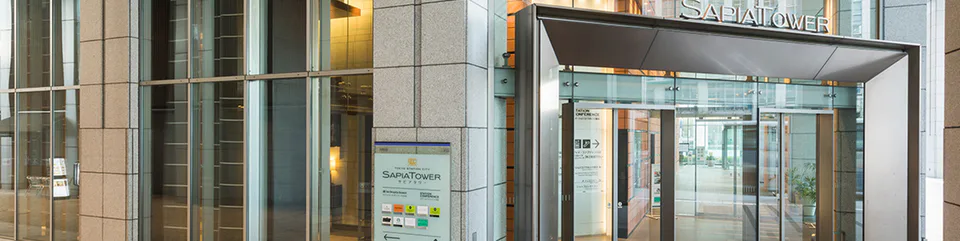
For one or two travellers with an early Shinkansen, large luggage or a rain-sensitive arrival, I would start with Hotel Metropolitan Tokyo Marunouchi. For three to six travellers, I would start with karaksa hotel TOKYO STATION because its family and connecting-room layouts can remove bathroom and packing queues every morning. The decision is not “zero-minute walk versus five-minute walk.” It is whether your trip pays more often for station friction or for room friction.
There is also an important correction to older comparisons: Metropolitan’s current official page lists the 40m² [-UTSUROI-] Premium Corner King for 1–2 guests, not four. It is a spacious two-person room, not a four-adult alternative to karaksa’s family inventory. That makes the split cleaner: Metropolitan is strongest as a station-first hotel for one or two; karaksa has the broader three-to-six-person room system.
Tokyo Station hotel comparison: the quick decision
↔ Scroll table left or right
Scenario | Start with | Why |
1–2 people, 07:00–08:00 Shinkansen | Hotel Metropolitan | Direct connection to the Nihombashi Exit removes the outdoor hotel-to-station leg. |
Rain + large luggage | Hotel Metropolitan | The hotel explicitly provides undercover/direct access from Tokyo Station. |
3–4 people in one room | karaksa | Family Triple and Family Quadruple have defined multi-bed layouts and separated wet-area functions. |
4–6 people who need two bathrooms | karaksa Connecting Rooms | Two connected rooms provide two bathrooms and two sleeping zones. |
2 people, 3 nights, little Tokyo Station use | Compare same-date rates | Neither the direct connection nor group-room parallelism is being heavily used. |
ValueNavi Tokyo Station Hotel Logistics Score
ValueNavi scores the traveller scenario, not the hotel as a permanent quality rating. The six factors are: station/luggage friction 30%, occupancy and bed fit 20%, parallel morning capacity 20%, luggage/room practicality 15%, repeated Tokyo Station use 10%, and weather resilience 5%. Each is scored from 0 to 10 and weighted.
Scenario | ValueNavi score | What drives it |
|---|---|---|
Metropolitan: 2 adults, 1 night, early Shinkansen, rain possible | Station and weather friction dominate the stay. | |
karaksa Family Triple: 3 travellers, 3 nights, one long-distance rail day | Separated shower, wash area and toilet create repeat parallel capacity. | |
karaksa Connecting Rooms: 4–6 travellers with early starts | Two bathrooms and two rooms remove a daily group bottleneck. | |
Metropolitan: 2 adults, 3 nights, only one ordinary Tokyo Station journey | The direct connection is useful, but its main advantage repeats too little. |
I use 8.5+ as a strong scenario fit, 7.5–8.4 as good but conditional, and below 7.5 as a sign that a core hotel advantage is underused. A room that cannot accommodate the party is removed before scoring.
ValueNavi Loaded Station-Leg Count: when does direct connection pay back?
Do not count “Tokyo Station access” as one abstract feature. Count the journeys where the final hotel-station segment is genuinely costly: large luggage, rain, a late arrival, an early departure, a child/stroller, or a tight long-distance rail day.
Loaded Station-Leg Count = number of hotel ↔ Tokyo Station legs where weather, luggage or schedule pressure materially matters
↔ Scroll table left or right
Trip pattern | Loaded legs | Decision signal |
Arrive with two large cases + leave next morning by Shinkansen | 2 | Metropolitan’s direct connection is used twice in under 24 hours. |
Three-night Tokyo stay, one day trip, carry-on only | 0–1 | Do not automatically pay a large station-connection premium. |
Two rail day trips + final Shinkansen with luggage | 3–5 | Station proximity becomes a repeated operating advantage. |
My practical rule: at two or more loaded legs, Metropolitan deserves a meaningful premium comparison. At zero or one, room quality, price and the rest of the Tokyo itinerary should carry more weight.
“Directly connected” still does not mean room-to-platform in one minute
Metropolitan’s current official access page says it is directly connected to Tokyo Station’s Nihombashi Exit, about two minutes from Yaesu North Gate and about one minute from the Shinkansen Nihombashi Gate. Those are station/hotel access references, not room-to-train guarantees. You still need the lift from the hotel floors, checkout, the correct gate and the correct platform.
That is why I treat the direct connection as a buffer, not permission to leave the room at the last possible minute. The hotel removes outdoor exposure; it does not shrink Tokyo Station itself.
ValueNavi True Departure Buffer
For an early train, work backward rather than relying on the hotel’s map distance:
usable departure buffer = train departure time − room-exit time − hotel/station transition − gate/platform navigation − luggage/elevator allowance
The first term is fixed; the remaining allowances depend on the traveller. Metropolitan mainly reduces uncertainty in the hotel/station transition. karaksa still requires the official roughly five-minute outdoor walk from Yaesu North Exit, so rain, heat and luggage need a larger allowance.
Neither hotel should be marketed with a fake precise “room-to-platform” time because the Shinkansen platform, lift wait and traveller pace differ.
Hotel Metropolitan Tokyo Marunouchi: strongest when the station itself is the trip infrastructure
The hotel occupies the upper floors of Sapia Tower and provides direct undercover access from the Nihombashi Exit. For a one-night transfer stay, that advantage can dominate: arrive, sleep, re-enter the station system without another outdoor navigation problem.
For a longer Tokyo stay, ask how often the connection actually enters the itinerary. If most days are Shibuya, Shinjuku, Asakusa and neighbourhood walking with no early rail departures, the location may still be convenient, but it is no longer doing the specific job that justifies a large premium.
The 40m² Premium Corner King is a spacious two-person product
The official page currently lists the [-UTSUROI-] Premium Corner King at 40m² with a 200×200cm king bed and capacity of 1–2 guests. Older wording that treated it as a four-person room should not be used for booking decisions. For two people with large luggage or meaningful waking room time, the size is a real upgrade; for a sleep-only transit night, it can be unused capacity.
Breakfast starts at 06:00, but the price and train time still need to coexist
TENQOO currently serves breakfast from 06:00 to 10:30, with last entry at 10:00. The current adult price is ¥3,400, about US$21.40 at the 26 August 2026 exchange rate. For a 07:00-class departure, buying breakfast can create a new schedule constraint; for a later Shinkansen it can fit comfortably. JPY remains the booking reference and exchange rates move.
Booking.com: Hotel Metropolitan Tokyo Marunouchi
Trip.com: Hotel Metropolitan Tokyo Marunouchi
Agoda: Hotel Metropolitan Tokyo Marunouchi
karaksa hotel TOKYO STATION: accept the outdoor walk to buy more parallel room capacity
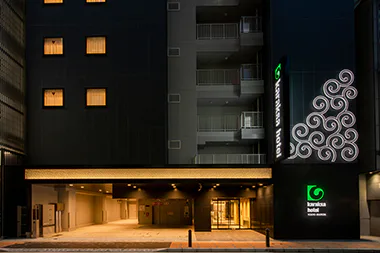
karaksa is currently about five minutes on foot from Tokyo Station Yaesu North Exit. That walk is real and should not be erased by the phrase “Tokyo Station hotel.” But once the group reaches the room, the hotel offers layouts designed around exactly the problem that station proximity cannot solve.
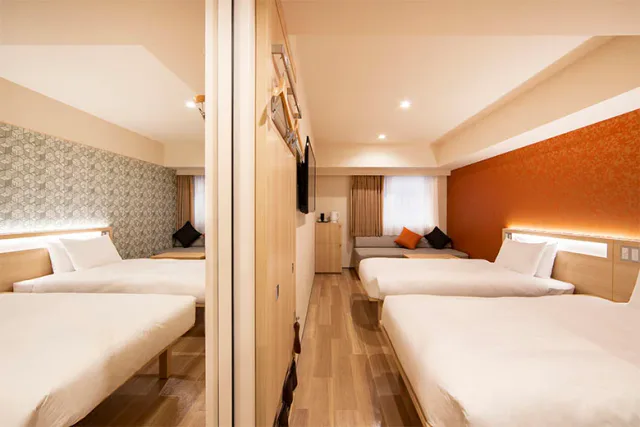
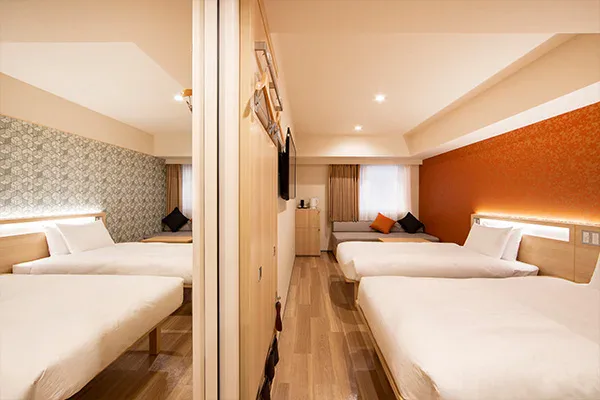
The 29.2m² Family Triple has two 110cm beds plus a 100cm extra bed, and the shower booth, wash area and toilet are separated so they can be used simultaneously. The 29.2m² Family Quadruple adds a sofa bed for the fourth guest. Japanese Family Rooms run from 32.9–43.1m² and can take up to six with futon bedding. Connecting rooms provide two bathrooms.
ValueNavi Bathroom Parallelism Model
For a group, the morning bottleneck can be estimated without pretending every guest has identical habits:
serial shower window ≈ shower users × average shower slot ÷ number of bathrooms
If four adults each need a 15-minute shower, one bathroom creates a theoretical 60-minute serial window. Two connecting-room bathrooms can reduce that to about 30 minutes when use is evenly split. The example is a planning model, not a claim about actual guest shower length.
karaksa’s Family Triple/Quadruple also creates partial parallelism without two bathrooms because shower, basin and toilet are separate. That matters more on a three-night group stay than it does for a couple.
Do not navigate by the brand name alone
karaksa hotel colors Tokyo Yaesu is also nearby. Confirm the full property name and the 1-5-3 Yaesu, Chuo-ku address before booking, taxi pickup or walking with luggage. The buttons below are for karaksa hotel TOKYO STATION.
Booking.com: karaksa hotel TOKYO STATION
Trip.com: karaksa hotel TOKYO STATION
Agoda: karaksa hotel TOKYO STATION
Same trip, different bottleneck
↔ Scroll table left or right
Timeline | Metropolitan advantage | karaksa advantage |
21:30 arrival in rain | No outdoor hotel transfer from Nihombashi Exit | Five-minute outdoor leg remains |
06:15 four-person morning routine | Mainly a 1–2-person room product in this comparison | Family/connecting layouts allow more parallel preparation |
07:30 Shinkansen | Station transition is simpler | Leave extra walking/weather margin |
Three ordinary Tokyo nights | Direct access may be underused | Group-room value can repeat each morning/night |
What would reverse the recommendation?
Metropolitan loses its edge when Tokyo Station is not a repeated transport node and the same-date premium is large. karaksa loses its edge for one or two travellers whose main concern is a wet, luggage-heavy transfer before an early Shinkansen. For a group, the answer can also reverse if the only suitable karaksa family/connecting inventory is priced far above two ordinary rooms elsewhere.
If most city days are west-side Tokyo, the bigger answer may be to skip both and choose a different base. A perfect Tokyo Station hotel cannot fix a Tokyo itinerary that rarely needs Tokyo Station.
Final verdict
Choose Metropolitan for a station-first 1–2-person stay. Choose karaksa for a room-flow-first 3–6-person stay. Count Loaded Station Legs for the first decision and bathroom/packing bottlenecks for the second. If neither count is high, compare equivalent rooms and cancellation terms rather than paying for a feature your itinerary barely uses.
Tokyo rainy-day itinerary | Japan luggage forwarding | KOKO HOTEL Residence Tokyo Oshiage
Hotel JAL City Fukuoka Tenjin: Is a 1-Minute Akasaka Walk Worth Choosing Over Tenjin Station?
Where to Stay in Osaka With Kids — USJ, Namba or Osaka Station?
Tokyo Attractions Map: Which Areas Actually Belong on the Same Day?
Sources
Hotel Metropolitan Tokyo Marunouchi — official access | Hotel Metropolitan — official rooms | TENQOO breakfast | karaksa hotel TOKYO STATION — official access | karaksa — official rooms
Room inventory, rates and cancellation conditions vary by date. Facts were rechecked on 26 August 2026. USD conversions are approximate; JPY is the booking reference. This article may contain affiliate links; ValueNavi may earn a commission from qualifying bookings at no additional cost to you.