
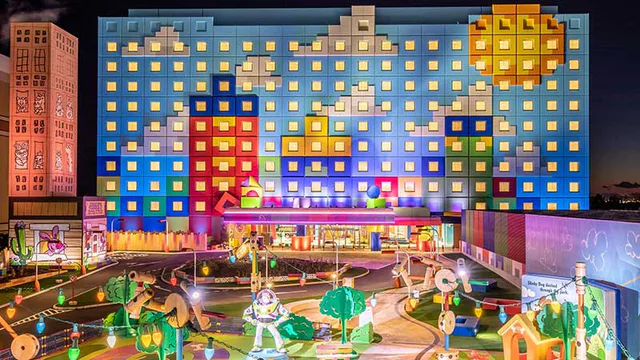
The best Tokyo Disney hotel for four people is the one that solves the fourth-bed problem before it sells you a view, character theme or park benefit. For four adults or older teens, I would start with a true four-bed room such as Grand Nikko Tokyo Bay Maihama’s Deluxe Family categories. For two adults and two younger children, Toy Story Hotel becomes much more persuasive because a smaller fourth sleeping surface may be an acceptable trade for Disney theming. If value matters more than Disney-owned benefits, Oriental Hotel Tokyo Bay deserves a serious look—especially its larger Marin Deluxe, not only the smaller four-person rooms.
My default order is therefore not a universal hotel ranking. Four adults: start with Grand Nikko, then compare Oriental’s true multi-bed rooms. Two adults plus two children who care about Toy Story: start with Toy Story Hotel. A Disneyland-focused family that expects midday room returns: price Tokyo Disneyland Hotel as a time-saving product. If nobody will return to the room during the park day, downgrade location and upgrade beds or floor space instead.
Checked August 25, 2026. Official room pages currently list Grand Nikko’s 56 m² Regular Deluxe Family with four 120 cm permanent beds and its 56–64 m² Nikko Deluxe Family with four 140 cm beds; Toy Story Hotel offers four-person Standard rooms around 29 m² and Superior rooms at 35 m², with four-person rooms using three regular beds plus a pull-down bed; Tokyo Disneyland Hotel’s 57 m² Junior Family Room uses three regular beds plus a trundle bed; Oriental Hotel Tokyo Bay’s 32 m² Marin Superior uses 120/120/100/90 cm beds, while the 42 m² Marin Deluxe has four 110 cm beds plus two 90 cm beds. Hotel benefits and transport operations remain date-sensitive.
Best Tokyo Disney hotels for families of 4: the decision in 30 seconds
↔ Scroll table left or right
Your group | Start with | Why | Main trade-off |
4 adults / older teens | Grand Nikko Deluxe Family | Four permanent adult-size beds and 56–64 m² | Specific Family inventory is limited; Official Hotel, not Disney Hotel |
4 adults, value-first | Oriental Marin Deluxe | 42 m² with four 110 cm beds before the two smaller extra beds are needed | Partner Hotel shuttle adds road and timetable friction |
2 adults + 2 younger children, theme matters | Toy Story Hotel | Disney-owned stay and immersive theming; 35 m² Superior gives a less cramped option | Fourth sleeping position is still a pull-down bed |
Disneyland-focused family using midday breaks | Tokyo Disneyland Hotel | Park-front geography can be used repeatedly during the day | Premium is difficult to justify if you leave once and return only at night |
“Sleeps four” is an occupancy rule, not a comfort guarantee
The most expensive mistake is comparing booking-engine capacity instead of sleeping surfaces. Two parents with two primary-school children can accept a trundle or pull-down bed very differently from four adults. Before checking rates, write down how many guests need a normal permanent bed, whether the fourth guest is an adult-sized teenager, how many large suitcases must stay open, and whether the family expects to spend any waking time in the room.
This immediately changes the ranking. A 29 m² room that technically accommodates four can be perfectly sensible for a theme-focused family that spends all day in the parks. The same room can be the wrong product for four adults with four large suitcases, even if the headline nightly rate is lower.
Grand Nikko is the safest default for four adults—but book the exact Family Room
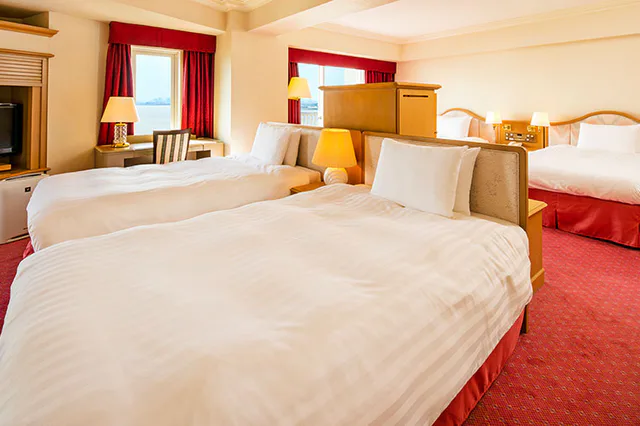
Grand Nikko’s real advantage is not the hotel name; it is specific room inventory built around four proper beds. The Regular Deluxe Family is 56 m² with four 120 cm Simmons beds. The Nikko Deluxe Family is 56–64 m² with four 140 cm Simmons beds. That is fundamentally different from placing two extra beds into an ordinary twin room.
There is an important failure mode: not every Grand Nikko room that accepts four guests has this layout. The regular 32 m² Superior and 40 m² Deluxe rooms can take extra beds for the third and fourth guests. If the true Family categories disappear, the reason Grand Nikko ranked first has disappeared with them. The official inventory is also relatively small: the Regular Deluxe Family page lists only two such rooms, while the Nikko Deluxe Family lists eleven rooms across its current types. Treat the full room name—not the hotel brand—as the product.
If Grand Nikko is already winning, compare Regular Deluxe Family vs Nikko Deluxe Family before paying more for wider beds and Nikko Floor benefits.
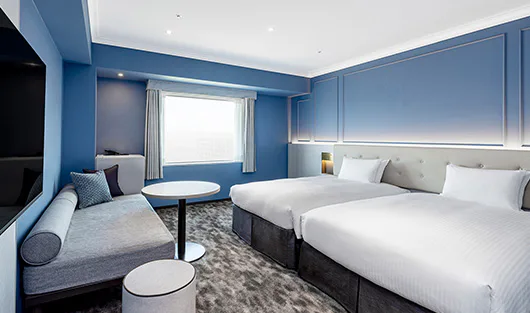
Oriental Hotel Tokyo Bay is more than a small-room budget option
Oriental’s 32 m² Marin Superior is a practical four-person room, but its bed widths—120, 120, 100 and 90 cm—make it better suited to two adults plus children than to four adults who expect equal beds. The more interesting four-adult alternative is the 42 m² Marin Deluxe: it can accommodate up to six and currently lists four 110 cm beds plus two 90 cm beds. For a party of four, that creates four adult-usable sleeping positions without needing the two smallest beds.
The trade-off is transport. Oriental Hotel Tokyo Bay is a Tokyo Disney Resort Partner Hotel in Shin-Urayasu. The resort lists a complimentary direct shuttle to both parks at about 15 minutes, while the hotel itself warns that actual travel can be around 15–30 minutes and operates on a timetable. That is a strong value proposition for a family that leaves once in the morning and returns once at night. It is much weaker for a toddler nap strategy that requires spontaneous park–hotel–park trips.
Toy Story Hotel wins on theme only after the sleeping setup passes
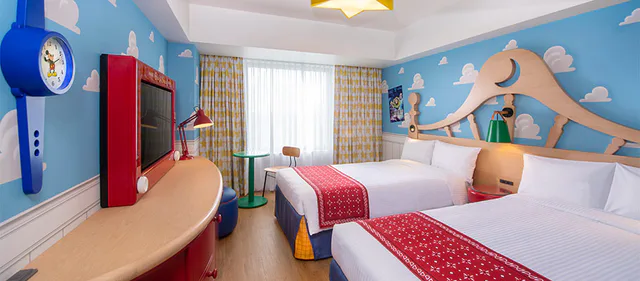
Toy Story Hotel should not be reduced to its 29 m² Standard room. The current four-person inventory also includes 35 m² Superior rooms, which can be the better compromise when the family wants the Toy Story experience but the Standard footprint feels too tight. The sleeping logic, however, does not become four equal beds: four-person rooms use three regular beds plus a pull-down bed.
That is why I like Toy Story Hotel most for two adults and two younger children whose parents consciously value the hotel as part of the Disney experience. For four tall adults, a larger Toy Story room improves circulation but does not remove the bed-equity issue. If theme is losing to sleep quality, compare Toy Story Hotel vs Grand Nikko instead of forcing the Disney-owned option to win.
Tokyo Disneyland Hotel buys repeated time, not four identical beds
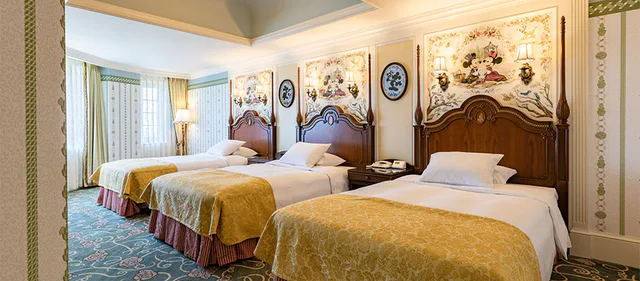
Tokyo Disneyland Hotel’s 57 m² Junior Family Room sounds like the obvious premium family answer, but its current layout is three regular beds plus one trundle bed. Its strongest advantage is therefore not equal sleeping surfaces. It is the ability to combine a large two-zone room with Disneyland-front geography.
If a child needs a midday nap, one parent may leave early, somebody needs medication from the room, or the family expects to reset before the evening, that location can be used multiple times. If the plan is rope drop to closing with no hotel return, most of the location premium is used only twice—once in the morning and once at night. In that scenario, four permanent beds at an Official Hotel may be a more rational luxury.
For the direct premium decision, use Tokyo Disneyland Hotel vs Toy Story Hotel.
One Disney day and two Disney days should not use the same hotel ranking
For one park day, room quality can outrank resort proximity because the family only pays the commute once in each direction. For two consecutive full park days, location starts compounding: the late return after Day 1 and the early start on Day 2 occur back-to-back. This is where an Official Hotel or Disney Hotel can become worth more even when a Partner Hotel has the better room.
Settle 1 or 2 Days at Tokyo Disney before treating hotel geography as a fixed priority.
A nap strategy needs door-to-door repeatability, not the words “near Disney”
If a young child will definitely return to the room, count the entire loop: leaving the park, reaching the transport stop, waiting, riding, walking to the room, then repeating the process to re-enter. A 15-minute direct shuttle is not automatically bad, but it is a scheduled road product rather than an almost on-demand room return. The more times the family expects to cross the park–hotel boundary, the more heavily proximity should be weighted.
If nobody plans to return before closing, remove “midday break” from the comparison entirely. Do not pay a location premium for a feature the family will never use.
Happy Entry comes after the bed test
Happy Entry can be valuable, but it should be applied after the room has already passed the sleep and space test. Toy Story Hotel and Tokyo Disneyland Hotel currently qualify for Tokyo Disneyland Happy Entry under the published rules; Grand Nikko and Oriental do not receive Happy Entry simply from being Official or Partner Hotels. The benefit is also hotel-, park- and date-dependent and cannot be used on check-in day.
A poor fourth bed affects every night. Happy Entry may affect one morning. Unless that morning is central to the trip, the recurring sleep problem should receive the higher weight. Use Is Happy Entry worth paying for? only after the room shortlist is already viable.
Four adults and two adults plus two children need separate rankings
Four adults should prioritize permanent-bed equality, floor area, bathroom practicality and luggage circulation. Two adults plus two children may rationally trade some of that equality for character theming, shorter park access or a lower rate. Older teenagers sit in the uncomfortable middle: they may technically fit a pull-down or trundle bed but value it very differently after a 12-hour park day.
For that reason, I would not publish one universal “best family hotel” winner. The useful question is: which hotel gives the weakest sleeper in your group an acceptable bed without forcing everyone else to pay for a location or benefit they will barely use?
Price the exact room, not the cheapest four-person search result
When checking rates, compare the precise room categories above. Grand Nikko Superior with added beds is not the same product as Grand Nikko Deluxe Family. Toy Story Standard is not the same space as Toy Story Superior. Oriental Marin Superior is not the same sleeping proposition as Marin Deluxe. Tokyo Disneyland Hotel Superior Alcove, Deluxe and Junior Family also solve different space problems.
This is one of the clearest cases where the cheapest listing can become the more expensive mistake: saving on the headline rate does not help if one adult sleeps badly for two nights, four suitcases cannot be opened, or the family pays for repeated taxis because the shuttle pattern does not match the itinerary.
Final verdict
Four adults or older teens: start with Grand Nikko’s true Deluxe Family rooms; if the rate or availability fails, Oriental’s Marin Deluxe is a legitimate four-bed value alternative if you accept the Partner Hotel shuttle. Two adults plus two younger children who want the hotel to feel like part of Disney: start with Toy Story Hotel, and compare the 35 m² Superior rather than assuming the 29 m² Standard is the only option. Disneyland-focused families who will actually return to the room should price Tokyo Disneyland Hotel as a repeated time-saving product. In every case, verify the exact room name and sleeping surfaces before comparing price.
Your next decision
Once the room has passed the bed-and-space test, decide whether the family should stay near Tokyo Disney or keep a Tokyo hotel, then use Disney Hotels vs Official and Partner Hotels to decide how much resort proximity and Disney-specific benefits are actually worth.