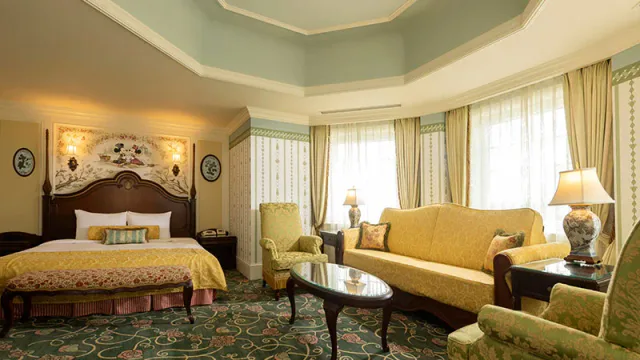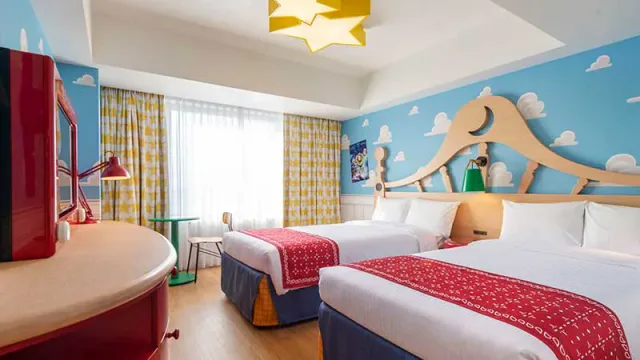
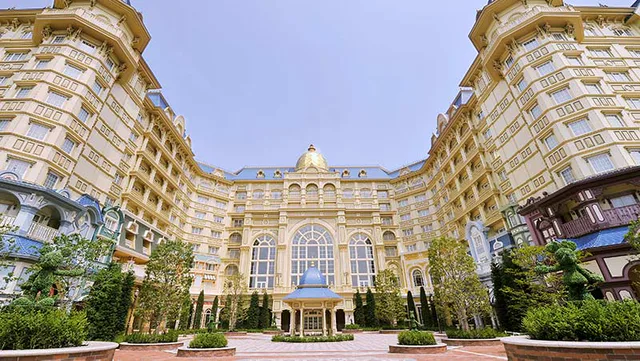
Choose Tokyo Disneyland Hotel when you will repeatedly use its location: a midday room break, split-family schedules, a tired child or grandparent returning early, or a Disneyland-heavy stay where being one minute from the park entrance changes the day. Choose Toy Story Hotel when the 29 m² four-person layout works, the Toy Story theming is part of the holiday, and you would rather accept a Disney Resort Line ride than pay mainly for front-gate convenience.
Both hotels currently qualify for Tokyo Disneyland Happy Entry, so that benefit does not by itself justify the higher-priced hotel. The better question is how many times you will actually use the extra location, room flexibility and park access during the stay. If you leave the hotel once in the morning and return once at night, Toy Story Hotel can be the more rational Disney stay. If somebody is likely to cross the park–hotel boundary again during the day, Tokyo Disneyland Hotel’s advantage compounds.
Checked August 25, 2026. Happy Entry, room inventory, DisneySea access arrangements and hotel operations are date-sensitive. Tokyo Disneyland Hotel has temporary DisneySea Happy Entry eligibility only for park entry through September 14, 2026; Toy Story Hotel does not currently have DisneySea Happy Entry. Toy Story Hotel is also scheduled to close temporarily on January 18, 2027, with related operational changes on January 18–19.
If the bigger decision is whether to move into the resort area at all, start with Stay Near Tokyo Disney or in Tokyo?. If you still have not decided whether Disney gets one or two full days, settle that with 1 or 2 Days at Tokyo Disney? before paying for a hotel advantage you may barely use.
Tokyo Disneyland Hotel vs Toy Story Hotel: the decision that matters
↔ Scroll table left or right
Your real priority | Better starting point | Why | What you give up |
Disneyland is the main park and you expect a midday room return | Tokyo Disneyland Hotel | The hotel is directly in front of Disneyland; the official site describes the park entrance as about a one-minute walk away | You may pay substantially more for a location you need only on Disneyland days |
Toy Story immersion is part of the trip and one morning/one evening transfer is fine | Toy Story Hotel | The hotel itself continues the Toy Story experience and Bayside Station connects it to both parks | Every park trip includes the Resort Line rather than a front-gate walk |
Four adults or older teens want more floor area and room choice | Usually Tokyo Disneyland Hotel | It offers many four-person rooms around 40 m² and above, including a 57 m² Junior Family Room | More space can be poor value if the room is used only for sleeping |
The only reason to upgrade is Tokyo Disneyland Happy Entry | Choose the cheaper suitable room | Both hotels currently qualify for Disneyland Happy Entry | Do not pay twice for a benefit both choices already provide |
DisneySea is the main reason for the hotel stay | Reconsider this comparison | Tokyo Disneyland Hotel has only temporary DisneySea Happy Entry through September 14, 2026; Toy Story Hotel has a different DisneySea access perk from 10:00, not early entry | MiraCosta or Fantasy Springs Hotel may solve the DisneySea problem more directly |
The Disneyland Hotel premium is easiest to justify when you use the location more than twice
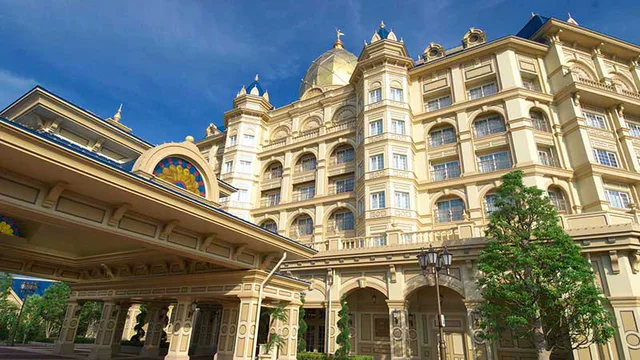
Tokyo Disneyland Hotel is the closest hotel to Tokyo Disneyland, with the park entrance directly across from the hotel and the Resort Line station building in between. That location is not merely about shaving a few minutes from the morning commute. Its real value appears when the family needs the room again after entering the park.
Think of the premium as a usage problem. If your day is hotel → Disneyland → hotel, you use the location advantage twice. If your day becomes hotel → Disneyland → room for a nap or clothing change → Disneyland → hotel, you use it four times. Add a grandparent who returns early while the rest of the group stays in the park and the location solves another separate movement problem.
That is why I would pay more for Tokyo Disneyland Hotel more readily for a family with a realistic midday-break plan than for two adults who intend to stay inside Disneyland from opening until closing. The room can be identical in price difference, but the first group repeatedly consumes the location benefit while the second mostly admires it.
Toy Story Hotel wins when the theme is real value and the transport friction stays low
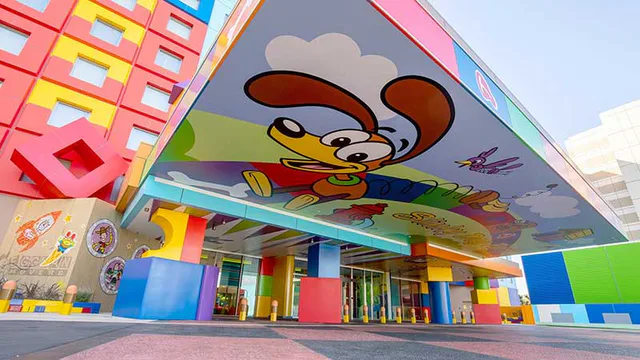
Toy Story Hotel is not simply the cheaper Disney Hotel in this comparison. Its public spaces and rooms are designed around the Toy Story films, with guest rooms inspired by Andy’s bedroom. For a child who genuinely cares about the theme, time at the hotel is part of the Disney experience rather than dead time between park visits.
The trade-off is location. Bayside Station is the nearest Disney Resort Line station, so trips to Disneyland and DisneySea normally include the monorail. If the family leaves once in the morning and returns once at night, that extra step is predictable and relatively contained. If you expect two or three room returns in one Disneyland day, the same transfer repeats until the front-gate hotel starts solving a materially different problem.
This is the key boundary condition: Toy Story Hotel remains a strong value choice when the hotel is used as a themed base; Tokyo Disneyland Hotel becomes stronger when the room is used as part of the park-day operating system.
For four guests, “sleeps four” does not mean four equivalent beds
Toy Story Hotel’s four-person Standard Room is about 29 m². The official room information says rooms for four use two regular beds, one trundle bed and a fourth pull-down bed. That can work very well for two adults with children. It is a different proposition for four adults or large teenagers who care about equal sleeping surfaces, luggage space and room circulation.
Tokyo Disneyland Hotel has far more four-person room types. Current official listings include 40 m² Superior and Superior Alcove rooms, 48 m² Deluxe options and a 57 m² Junior Family Room, with larger character and family categories above those. The hidden cost of the Toy Story option is therefore not merely square metres. It is how much of the 29 m² room remains usable after the third and fourth sleeping positions, suitcases and a stroller are in play.
Do not overcorrect, though. A family of two adults and two younger children may gain little from paying for 40–57 m² if everyone is comfortable in the Toy Story layout. Four adults should be much more sceptical. If bed equality is the real requirement, widen the search with Best Tokyo Disney Hotels for Families of 4 rather than assuming the Deluxe-Type Disney Hotel must be the answer.
Happy Entry is a Disneyland tie, not a reason to upgrade
Both Tokyo Disneyland Hotel and Toy Story Hotel currently qualify for Tokyo Disneyland Happy Entry. The benefit can be used during the stay, including checkout day, but not on the day of check-in. Disneyland entry begins 15 minutes before other guests.
That 15 minutes should not be described as 15 minutes of extra ride time. Tokyo Disney Resort states that attractions begin operating after general guests start entering. What Happy Entry does give you is an earlier position inside the park: you can move toward a priority area and, after entering, purchase Disney Premier Access, make an Entry Request or obtain an applicable Standby Pass.
This creates an important failure mode. If your only Disneyland visit is on hotel check-in day, neither hotel gives you Happy Entry for that morning. If you choose a more expensive hotel specifically for Happy Entry and then schedule a long breakfast that makes you miss the early-entry window, you have also weakened the benefit you paid to access.
For a deeper benefit calculation, use Is Tokyo Disney Happy Entry Worth It?.
DisneySea is where the two hotels stop being direct substitutes
Tokyo Disneyland Hotel has temporary DisneySea Happy Entry eligibility for park entry from July 1 through September 14, 2026. Toy Story Hotel is not on the current DisneySea Happy Entry list. If DisneySea early entry is the specific product you are trying to buy, this comparison therefore has an expiry date: after September 14, Tokyo Disneyland Hotel’s temporary advantage disappears under the currently published rules.
Toy Story Hotel has a different DisneySea benefit. Guests can currently use the Fantasy Springs Entrance from 10:00 a.m. for entry or re-entry with proof of stay. That can make a later return to DisneySea more convenient, but it is not Happy Entry and should not be valued as early admission.
If DisneySea is the main park rather than a secondary day, compare MiraCosta vs Fantasy Springs Hotel before forcing a Disneyland-focused pair to answer a DisneySea question.
One night and two nights require different premium tests
For a one-night Disney stay, identify the one thing that makes the hotel move worthwhile: Happy Entry the following morning, a genuine midday-break need, or a child for whom Toy Story Hotel itself is a major part of the trip. If none of those exists, the better answer may be to keep your existing Tokyo hotel rather than choose between these two at all.
For two nights, count repeated use. Two Disneyland days can make Tokyo Disneyland Hotel’s location compound across two mornings, two evenings and any room breaks. But if Day 2 is DisneySea, central Tokyo or a transfer to Kyoto, the second night may be paying for a premium address that no longer matches the next day’s direction.
This is especially relevant for international first-time visitors. A final Disney night before an early Shinkansen or airport transfer may create a new morning transfer just after you paid to remove the previous evening’s transfer. The hotel decision should follow the most time-sensitive movement, not the desire to keep a visually neat itinerary.
Do not compare hotel brands; compare the exact room on the exact date
Tokyo Disney Resort hotel rates vary by date, demand and room type, so there is no durable price gap that makes one hotel “always worth it.” Compare the room your group would actually book on the same date, then ask what the price difference buys.
A useful premium-utilisation test is:
How many park–hotel crossings become easier?
Does anybody realistically need a midday room return?
Does the larger room solve a real four-person sleeping or luggage problem?
Is the Toy Story theme itself part of the experience for the children?
Will you actually use Happy Entry on an eligible morning?
Does the following day point toward Disneyland, DisneySea, Tokyo Station or the airport?
If Disneyland Hotel wins only on the word “Deluxe,” the premium is weak. If it removes repeated family friction and fixes the room layout, the same price gap can be rational. If Toy Story Hotel fits the group and the children value the theme, spending more purely to eliminate one morning and one evening Resort Line ride is much harder to justify.
A date check can overturn the recommendation
Toy Story Hotel is scheduled to close temporarily on January 18, 2027 because of work on its thermal-energy supply equipment, with related operational changes on January 18–19. Happy Entry exclusions and eligible parks can also be revised by date. Room inventory changes independently.
That means this comparison always needs one final veto check after you choose a hotel conceptually: confirm your actual date, actual room type, Happy Entry eligibility and any hotel notice before booking. A strong generic recommendation is useless if the benefit or hotel operation you are counting on does not exist on your stay date.
Compare the same date and the room your group would really book
Toy Story Hotel:official hotel page · Agoda · Trip.com
Tokyo Disneyland Hotel:official hotel page · Agoda · Trip.com
Final verdict: pay for repeated usefulness, not the hotel label
For a Disneyland-focused family that expects at least one midday return, split-family movement or a four-person room that genuinely needs more space, I would choose Tokyo Disneyland Hotel when the price difference is acceptable. Its premium is easiest to defend when the location gets used repeatedly, not simply because it is the more luxurious Disney Hotel.
For two adults with children who fit comfortably into the 29 m² four-person room, leave the hotel once in the morning and return once at night, and genuinely value the Toy Story environment, I would usually choose Toy Story Hotel and keep the price difference for the rest of the Japan trip.
If the only argument for Tokyo Disneyland Hotel is Disneyland Happy Entry, the upgrade case is weak because Toy Story Hotel currently gives you that benefit too. If DisneySea is the real priority, change the comparison rather than forcing either hotel to win the wrong decision.
Official sources checked
THE LUIGANS Spa & Resort Fukuoka: Is a 33m² Sea-View Room Worth Leaving Hakata for One Night?
40 Best Things to Do in Tokyo in 2026 — What’s Actually Worth Your Time by Area
Grand Nikko Tokyo Bay Maihama vs Hilton Tokyo Bay for Families
Tokyo Disney Room-Only vs Vacation Package: Which Opens First?