Choose Toy Story Hotel when two adults and younger children want the hotel itself to feel like part of Disney, the family can live comfortably with two regular beds plus a trundle and pull-down bed, and a Tokyo Disneyland Happy Entry morning will actually be used. Choose Hilton Tokyo Bay when you need broader room capacity, a full-service resort, more dining and facility choice, or one room for five or six people. For four adults who care about equal sleeping surfaces, I would widen the search rather than force either hotel to win.
The useful comparison is not “Disney Hotel versus normal hotel.” Both sit in the Bayside Station side of Tokyo Disney Resort, but they solve different problems. Toy Story Hotel buys immersion and Disney-Hotel privileges. Hilton buys room-category flexibility and hotel infrastructure. The best answer changes with the ages of the children, the park you are visiting, whether anybody will return to the room midday, and how many waking hours you will actually spend at the hotel.
Checked August 25, 2026. Toy Story Hotel currently offers four-person Standard rooms around 29 m² and Superior rooms at 35 m²; the four-person Superior layout has two regular beds, one trundle bed and one pull-down bed. Hilton Tokyo Bay currently lists Happy Magic rooms at about 35–40 m² for three to four guests and Family Happy Magic rooms at about 35–40 m² for five to six guests; the latter use a bunk-bed concept, and Hilton states that the upper bunk is for guests age 10 or older. Toy Story Hotel currently qualifies for Tokyo Disneyland Happy Entry, not Tokyo DisneySea Happy Entry. Recheck the exact stay date and room before booking.
Hilton Tokyo Bay vs Toy Story Hotel: the 30-second decision
↔ Scroll table left or right
Your situation | Start with | Why | Main trade-off |
2 adults + younger children who love Toy Story | Toy Story Hotel | The hotel itself extends the Disney experience | Compact rooms and an auxiliary third/fourth sleeping surface |
5–6 guests in one room | Hilton Tokyo Bay | Family Happy Magic can accommodate larger groups | Higher capacity comes from flexible/bunk sleeping, not six equal beds |
Tokyo Disneyland Happy Entry is a real priority | Toy Story Hotel | Current Disney-Hotel benefit | Not available on check-in day and not a DisneySea Happy Entry solution |
Pool, multiple restaurants, spa/fitness and full-service resort time matter | Hilton Tokyo Bay | Far broader hotel infrastructure | Some facilities require reservations or additional charges |
4 adults want comparable permanent beds | Often neither | Capacity does not guarantee bed equality | Compare a true four-bed Family Room elsewhere in the resort cluster |
The fourth sleeping surface is the first filter, not the hotel logo
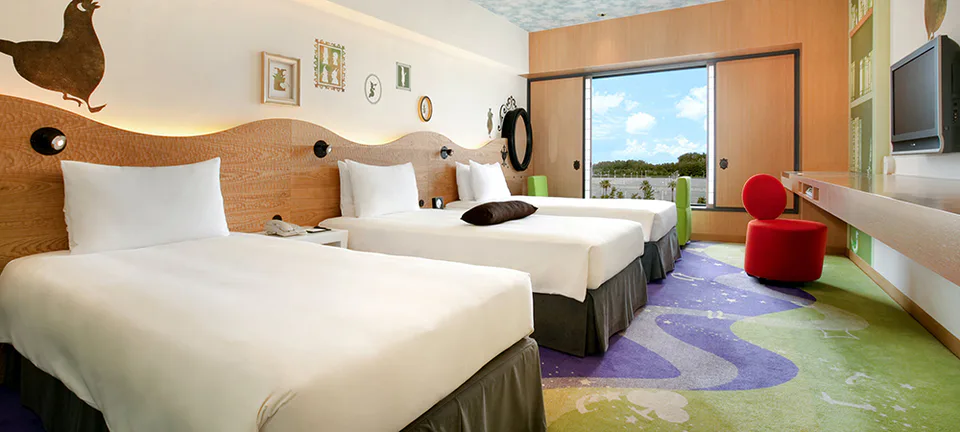
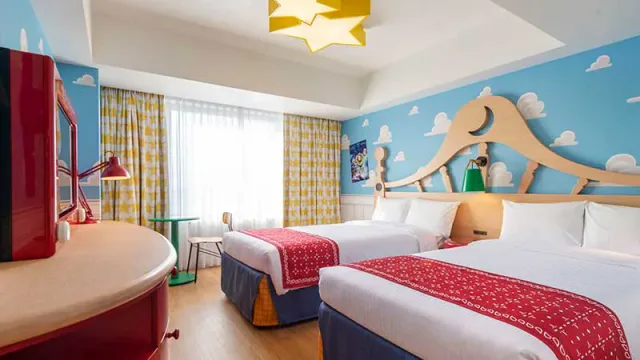
Toy Story Hotel is easy to misunderstand because “accommodates four” sounds like a conventional four-bed room. The current four-person Superior Room is 35 m² and uses two regular beds, one trundle bed and one pull-down bed. The same basic sleeping logic applies to the four-person inventory: the third and fourth guests are not simply getting two more identical full-size beds.
That can be a perfectly rational setup for two adults with two children. It is a much weaker proposition for four tall adults after a 12-hour park day. The 35 m² Superior solves circulation better than the 29 m² Standard, but it does not turn the room into four equal sleeping surfaces.
Hilton wins the group-size problem, but not automatically the bed-equality problem
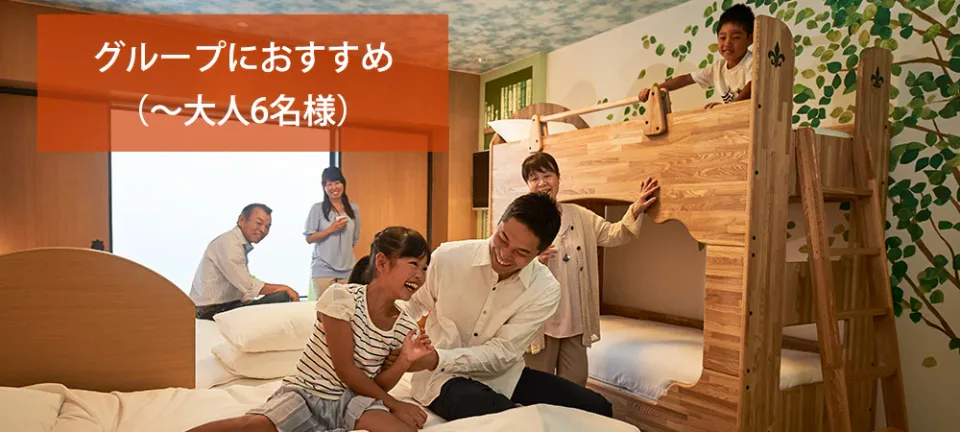
Hilton Tokyo Bay has a much broader room ladder. Happy Magic rooms are currently about 35–40 m² and accommodate three to four guests. Family Happy Magic keeps the themed concept but adds bunk sleeping and accommodates five to six guests. Hilton’s own room list currently shows the Park version for five and the Ocean version for six.
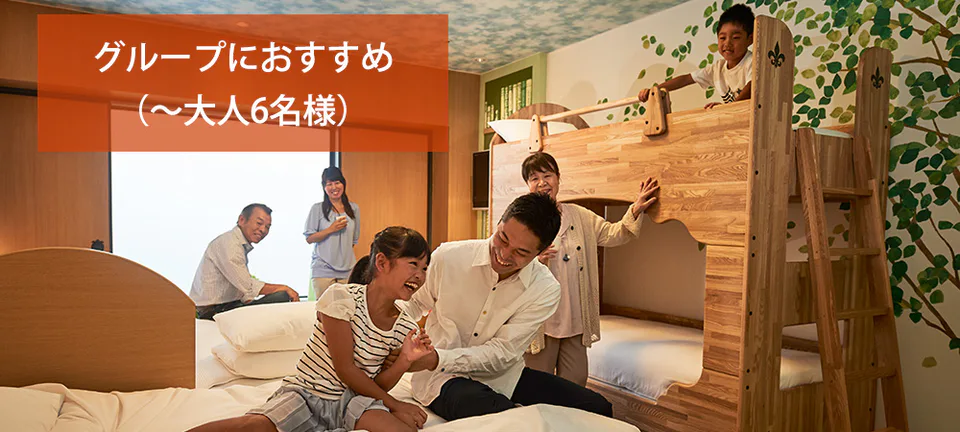
This is the strongest reason to choose Hilton when one room must hold a larger family or multigenerational group. But “sleeps six” should not be read as “six adults get six identical conventional beds.” Hilton explicitly uses a bunk-bed concept, and the upper bunk is restricted to guests age 10 or older. If your group includes grandparents, tall teenagers or adults who will not use a bunk, verify the exact layout before letting the larger occupancy number decide the booking.
Toy Story Hotel wins only if the theme will be consumed
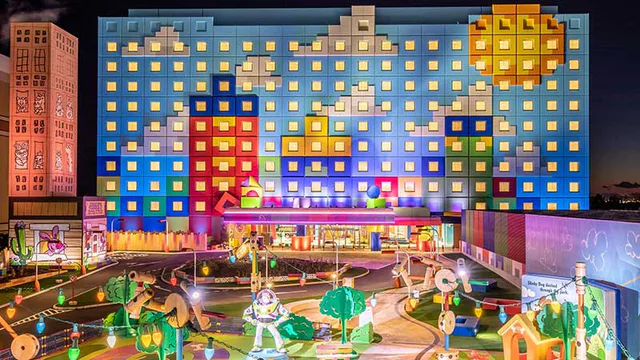
Toy Story Hotel has a clean emotional advantage: all 595 rooms and the public spaces extend the Toy Story world. For a child who treats the hotel as another attraction, that value continues after leaving the park. For parents who know the children will explore the courtyard, notice the room details and talk about the hotel as part of the trip, the premium is buying a real experience.
Now red-team that argument. If the family leaves before sunrise, comes back after closing and goes straight to sleep, the themed public spaces may receive almost no waking use. In that itinerary, Hilton’s more conventional room and facility flexibility—or a cheaper Official Hotel room elsewhere—can be the better purchase. Theme is not automatically valuable just because it is well executed.
Hilton is a full-service resort—but unused facilities are not value
Hilton Tokyo Bay currently advertises multiple dining venues, an indoor pool, fitness center, spa and a seasonal outdoor Garden Pool Restaurant. This can matter on a rest afternoon, a rain-affected park day or a two-night stay where the hotel itself needs to absorb family downtime.
But do not credit every facility at full value. Hilton notes that some facilities require reservations or extra charges; its Happy Magic room information specifically says the gym is complimentary for hotel guests while the indoor pool is charged for standard room guests. The seasonal Garden Pool Restaurant also uses a reservation/admission model rather than functioning as a free hotel pool. If the family is in the parks from morning to night, “more facilities” can become brochure value rather than itinerary value.
The transport gap is smaller than the branding suggests—but Toy Story removes one small step
Both hotels sit in the Bayside Station side of the resort rather than directly at a park gate. Toy Story Hotel is immediately beside Bayside Station, and guests use the Disney Resort Line for both parks. Hilton is also a Tokyo Disney Resort Official Hotel in the Bayside cluster, but the standard resort pattern is hotel → complimentary Disney Resort Cruiser → Bayside Station → Disney Resort Line.
That makes Toy Story slightly cleaner for repeated room returns because it removes the hotel-to-station shuttle leg. The difference is easy to overstate for a family that leaves once in the morning and returns once at night. It matters more if a toddler nap, medication, wet clothes or split-family schedule creates two or three park–hotel crossings in one day.
If repeated midday returns are the main reason for moving near Disney, compare the wider Stay Near Tokyo Disney or in Tokyo? decision before assuming either Bayside hotel is equivalent to a park-front Disney Hotel.
Happy Entry can decide Disneyland mornings, but it should not decide the room first
Toy Story Hotel currently qualifies for Tokyo Disneyland Happy Entry. Hilton does not receive Happy Entry as an Official Hotel. The benefit is unavailable on check-in day, so a one-night stay where the only Disneyland visit is arrival day should value it at zero.
More importantly, Happy Entry does not repair a bad room fit. If a family of four dislikes the trundle/pull-down setup, or a six-person group needs a room Toy Story cannot provide, the better Disney benefit does not make the sleeping arrangement disappear. Run the bed test first, then use Happy Entry value as a tiebreaker.
DisneySea changes the comparison more than many families expect
Toy Story Hotel is not currently on the Tokyo DisneySea Happy Entry list. Hilton also has no Happy Entry. That means the biggest Disney-owned privilege disappears from this head-to-head when DisneySea is the only park day.
Toy Story guests currently have a separate benefit from 10:00 a.m.: with proof of stay they can use Fantasy Springs Entrance to enter or re-enter Tokyo DisneySea. That is a useful geography benefit, but it is not early entry. If DisneySea Happy Entry itself is the purchase, compare MiraCosta vs Fantasy Springs Hotel instead of forcing Hilton or Toy Story to answer the wrong question.
For four adults, I would often choose neither
This is the most important boundary condition. Toy Story’s four-person setup uses auxiliary beds. Hilton offers many four-person categories, but the headline capacity does not establish four equivalent permanent beds. If four adults or older teens insist on similar sleeping surfaces, the most rational move can be to leave this comparison entirely.
The Tokyo Disney hotels for families of four guide includes true four-bed alternatives such as Grand Nikko’s Deluxe Family categories. That is a better solution than paying for Toy Story theming or Hilton facilities while compromising the sleep requirement that matters every night.
For five or six people, Hilton can prevent the cost of a second room
Hilton’s Family Happy Magic capacity creates a different kind of value: avoiding a second room. A party of five or six should compare the total price of one suitable Hilton family room against two Toy Story rooms, not against one Toy Story room that cannot hold the group.
The trade-off is internal. A single large-group room reduces booking and coordination complexity, but it also puts more people into one bathroom and one shared sleeping environment. For grandparents plus children, two rooms may still be worth the extra cost. For parents with three or four children, one Family Happy Magic room may be operationally simpler.
One night and two nights should not use the same hotel ranking
A one-night stay around two intense park days leaves surprisingly little awake hotel time. In that scenario, Toy Story theming and Hilton facilities may both be underused; room fit, morning access and the sleep itself dominate.
Two nights create another evening, another morning and potentially a rest window. Hilton’s restaurants and facilities become more usable. Toy Story’s themed public spaces get another chance to matter. Count awake hotel hours and planned room returns—not just the number of nights printed on the booking.
Large luggage makes 29 m² versus 35–40 m² an operational issue
Long-haul visitors may arrive with two to four large suitcases, a stroller and park purchases. In a compact room, the penalty is not merely aesthetic. Four people getting ready while luggage is open can slow the morning and make the room harder to reset for a child’s nap.
Toy Story’s 35 m² Superior is therefore a materially different product from the 29 m² Standard for a four-person family. Hilton’s 35–40 m² Happy Magic range can offer similar or slightly more floor area, while its wider hotel inventory gives you more escape routes if the themed room is not the best fit. Compare the exact room category, not the hotel’s cheapest four-person result.
January 18, 2027 is a date veto for this comparison
Both hotels currently have unusual operating restrictions around January 18, 2027. Tokyo Disney Resort states that Toy Story Hotel will be closed on January 18 for thermal-energy-supply equipment work. Hilton Tokyo Bay separately states that it will temporarily close from 3:00 p.m. January 18 until 7:00 a.m. January 19 for a hotel-wide electrical inspection. If your stay touches that date, ordinary room and facility comparisons are secondary—check the live operating notice first.
Compare price only after matching what each room solves
Do not compare the cheapest Hilton room against the cheapest Toy Story room and call the difference a Disney premium. Match the same dates, actual adult/child mix, exact sleeping surfaces, room size, meal plan and cancellation basis. If the family needs five beds, Toy Story may already be disqualified. If the family needs Disneyland Happy Entry and loves Toy Story, Hilton may be solving the wrong problem.
Booking.com: compare Hilton family rooms
Agoda: check Hilton Tokyo Bay room options
Trip.com: compare Hilton Tokyo Bay rooms
Final verdict
Choose Toy Story Hotel for two adults with younger children when Toy Story immersion is genuinely part of the holiday, the auxiliary third/fourth beds fit the family, and Tokyo Disneyland Happy Entry will be used. Choose Hilton Tokyo Bay when one room must handle five or six guests, full-service hotel time matters, or broader room inventory is more valuable than Disney-owned privileges. For four adults who demand equal beds, DisneySea-Happy-Entry-driven trips, or families that will barely use either hotel while awake, widen the shortlist instead of forcing a winner.
Tokyo Autumn Leaves: Timing for Mt. Takao, Okutama, Gardens and Ginkgo
Chatan Hotel Comparison: Hilton vs Vessel Campana vs LeQu for Two Nights
Best Japan eSIM for Tokyo, Osaka and Kyoto: Data and Hotspots
Tokyo Split Stays: For 5–7 Nights, I’d Only Move Hotels in These Three Cases
References
Tokyo Disney Resort — Toy Story Hotel rooms, Happy Entry, Fantasy Springs Entrance and hotel operating notices
Hilton Tokyo Bay — Happy Magic / Family Happy Magic rooms, Kids & Family facilities and January 2027 closure notice
Tokyo Disney Resort — Official Hotel transport and baggage benefits