
A Tokyo split stay is not automatically more efficient just because you sleep in two different areas. For most 5–7 night trips, I would not move hotels for one attraction. I would move only when the switch removes at least two recurring problems from the rest of the trip — for example, two or more consecutive days around Shinjuku and Shibuya followed by Hakone, or a final section that is already centred on Tokyo Station before an early Shinkansen. Otherwise, packing again, checking out, handling luggage, checking in again and spending part of the day without a room can be more annoying than another train ride across Tokyo.
My simple test is this: consider moving only when at least two of these are true — the second half of the trip shifts clearly to another side of Tokyo for two or more consecutive days; the move also improves a long-distance departure such as Hakone or a Shinkansen; and the move day does not depend on having a room at midday. If only one is true, I would normally keep one base. This is not a transport law. It is a way to stop a theoretical 15-minute saving from turning into a full hotel move.
That rule also works well for Tokyo independent travel because it forces the hotel decision back into the whole itinerary instead of treating each district as a separate mini-trip.
Tokyo split stay in 30 seconds: one hotel move should buy at least two later advantages
↔ Scroll table left or right
Your itinerary | Stay in one hotel | When a split stay starts to make sense |
Tokyo for 4 nights or less | Usually yes | Usually no — one hotel move takes up too much of a short trip |
Tokyo for 5–7 nights with east and west mixed across the week | Usually yes — fix the itinerary before fixing it with a hotel move | Consider it only if the second half is concentrated in another side of the city for at least two consecutive days |
Narita arrival + first days around Ueno / Asakusa | Yes if you still keep returning to east Tokyo later | More reasonable if the second half becomes Shinjuku / Shibuya plus Hakone |
One Shinkansen ride on the final day | Usually yes for a normal daytime train | More reasonable when the train is very early and the previous evening is already around Tokyo Station |
A child, older parent or anyone who may need a midday hotel break | Strongly prefer one hotel | A move day can leave you without a usable room for hours |
Two 28-inch suitcases + rain | Strongly prefer one hotel | Only split if luggage storage / forwarding is already solved |
If you have not even narrowed down your base yet, do that first. Use the six-area guide for first-time Tokyo stays to reduce Ueno, Shinjuku, Shibuya, Tokyo Station and the other candidates to two realistic bases before asking whether you should physically move between them.
Next decision: narrow Tokyo to two realistic bases before planning a hotel move
The most overrated benefit is “saving 15 minutes a day”; the most underrated cost is having no room on move day
A split stay looks beautifully tidy on a map: three nights in Ueno, three nights in Shinjuku, with each half apparently closer to its own sights. But the real action is not simply “move from A to B.” You repack both suitcases, check out, confirm where your luggage can go, carry the things you cannot leave behind, and then wait until the next hotel can actually give you a room. Check-out times, check-in times and pre-arrival luggage policies differ by hotel, so you cannot assume that noon means the second room is ready.
If you are out from breakfast until late dinner, that gap may barely matter. If you travel with a child, an older parent, migraines, heat sensitivity, or simply like returning for a shower and a reset in the middle of the day, it can be the biggest hidden cost of a split stay. You are not only dragging luggage once. You are giving up the option to return to your own room for several hours.
So I would not compare only train minutes. Count how often you actually use each route: hotel to station, dinner back to the hotel, airport arrival, long-distance days and midday returns. Repeated movements deserve more weight than the distance to one attraction.
Ueno after Narita can make sense — but Narita does not automatically mean “start in Ueno”
Ueno has a real arrival advantage. Keisei currently runs the Skyliner directly between Narita Airport, Nippori and Keisei-Ueno. If your first two days are already Ueno, Asakusa, Tokyo Skytree and Akihabara, using Ueno as the first base puts the airport arrival and east-Tokyo sightseeing on the same side of the city.
The counterargument is just as important. JR East still runs the Narita Express directly to major stations including Tokyo, Shibuya and Shinjuku. If four of the next six days are really Shinjuku, Shibuya, Harajuku and west Tokyo, staying two nights in Ueno only because the airport transfer looks cleaner may save one arrival transfer and then create a hotel move you did not otherwise need.
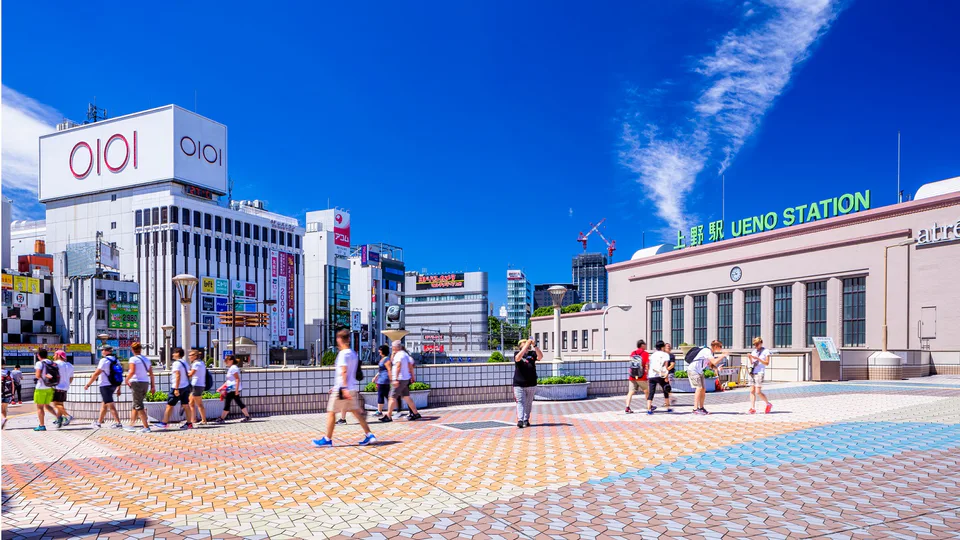
The decision should be driven by the days after arrival, not by the first hour. If you are between the two bases, compare Ueno vs Shinjuku for Narita, nightlife and east-versus-west sightseeing. If Ueno wins, then use the Mitsui Garden Hotel Ueno access guide to check the actual walk from the Skyliner instead of assuming “Ueno hotel” means “next to the Keisei-Ueno platform.”
Arriving via Narita? Compare Ueno and Shinjuku before creating a hotel move
Moving from Ueno to Shinjuku only pays off when the second half genuinely becomes west Tokyo
The most common split is two or three nights in Ueno followed by two to four nights in Shinjuku. That can work, but it needs a real dividing line. If the first half is Asakusa, Skytree, Ueno and Akihabara, while the second half becomes Shinjuku, Shibuya and Harajuku plus Hakone, one move can improve several late returns and also your Hakone departure. Odakyu currently lists direct Romancecar services from Shinjuku to Hakone-Yumoto, with the fastest trip at about 75 minutes and no transfer. This is the kind of second-half concentration that gives a new base a job.
If the so-called second half is only one Shibuya day and one Shinjuku evening, while the rest returns to Tokyo Station, Ginza and Asakusa, the city has not naturally divided itself into two halves. You divided it. Tokyo rail is already built for cross-city travel; do not add a full check-out and check-in cycle merely to avoid one or two 20–30 minute urban trips.
Shinjuku is not one single point either. Kabukicho late nights and South Exit departures create different hotel needs. If you really plan to move west, compare Shinjuku vs Shibuya and then check whether the JR Kyushu Hotel Blossom Shinjuku 25m² Superior Twin and South Exit location actually remove daily friction after the move.
Moving to Tokyo Station for the last night is not automatically justified by “we have a Shinkansen tomorrow”
Tokyo Station is a major departure point for the Tokaido Shinkansen and several JR East Shinkansen routes. If you have a very early train toward Kyoto, Osaka, Nagoya or another long-distance destination, sleeping nearby can remove the final city transfer in the morning. The question is how early the train actually is.
For a normal daytime departure, and especially if your current base is already Ueno or Shinjuku, leaving your original hotel a little earlier and going straight to Tokyo Station is often simpler than checking out the day before, moving hotels and rebuilding the room for one night. Moving for a single train is a classic case of a low-frequency requirement controlling an entire hotel night.
The final-night move becomes more convincing when two conditions appear together: your train is early enough that delays would make you anxious, and the previous evening is already around Ginza, Marunouchi, Nihonbashi or Tokyo Station. Then one move improves both the night before and the morning after, instead of serving only one departure.
If Tokyo Station and Shinjuku are the two candidates, use Tokyo Station vs Shinjuku to compare Shinkansen, airport and Hakone logistics. The useful question is not which station is larger; it is where your long-distance travel is concentrated.
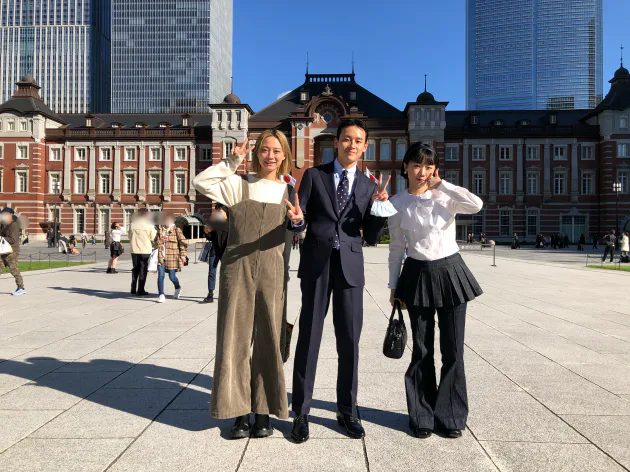
Should the final night move? Compare Tokyo Station and Shinjuku as long-distance bases
The best split-stay exception is when the new base changes both your early start and your late return
Some moves are genuinely worth it. The clearest cases are not about “trying two hotels”; they are about two consecutive days that both require an early start and a late return in the same outer area. The new base then helps at both ends of the day, so the benefit is repeated rather than theoretical.
Tokyo Disney is the obvious example. If you plan two consecutive park days, when you move to the Maihama / Shin-Urayasu area changes two mornings and two evenings. That specific problem is already broken down in the Tokyo Disney split-stay guide. One park day is different; do not automatically import a Disney split-stay strategy into an ordinary Tokyo itinerary.
The same logic can apply to two consecutive Tokyo Dome events, two Makuhari days or another section that genuinely pulls you away from your normal central-Tokyo base. Ask the same question every time: does one hotel move improve at least two repeated movement nodes? If yes, the split stay deserves another look.
Luggage is not a side issue: if the luggage plan is still vague, assume you are not moving
Moving hotels with two cabin bags is one task. Moving with two 28-inch suitcases is another. Rain, rush hour, station stairs and elevator locations can turn a short city transfer into physical work. You also need to keep medication, passports, cameras, power banks and valuables with you even when the big cases are stored or forwarded.
The common mistake is to design “three nights Ueno + three nights Shinjuku” first and ask about luggage later. Reverse the order. Check each hotel’s current policy for storage before check-in and after check-out, decide whether the bags can be sent to the next hotel, whether you must carry them yourself, and when the next room will actually be usable. These policies vary by property and should be rechecked before booking.
If Tokyo is followed by Kawaguchiko or Hakone, do not treat that as an ordinary city hotel move. Use the Kawaguchiko and Hakone luggage-forwarding guide to decide whether the large suitcase needs to travel with you at all.
Solve the luggage first: Tokyo → Kawaguchiko / Hakone should not be improvised with large cases
A split stay also means two bookings: mismatched cancellation terms can be harder to recover from than the luggage move
There is another cost people underestimate: you are not splitting one six-night price into two identical chunks. You are creating two bookings that can have different room types, rates and cancellation rules. Seeing three cheap nights in Ueno and three cheap nights in Shinjuku does not prove that the full plan is cheaper or more flexible. Compare the same occupancy, a comparable bed setup, breakfast inclusion and similar cancellation terms, then compare the total cost across all nights. Do not stitch together two unrelated “from” prices.
If the itinerary may still change because of concert tickets, weather, a Hakone stay or flight timing, one base is often easier to recover. You change one booking instead of two. A split stay is still reasonable when the second base produces enough value, but before payment check each free-cancellation deadline, change restriction and what happens to the other half if one booking has to be cancelled.
The cleanest fallback is to make the move day independent of the room. Do not schedule a required nap, formal clothes change, a huge shopping drop-off or a fixed evening event on that day. Confirm that the second hotel will accept luggage before check-in. If that point is still unknown, the split stay is not ready to be locked in.
Four situations where I would not split the stay
1. Tokyo is only 3–4 nights
Short trips are starved of usable time, not hotel districts. If you have not even settled how long Tokyo needs, start with 3, 4 or 5 days in Tokyo instead of creating a hotel-move day inside a four-night visit.
2. You simply want to “experience two neighborhoods”
If the hotel move does not improve airport access, long-distance transport or at least two later itinerary days, that is a lodging preference rather than an efficiency strategy. You can absolutely do it, but do not pretend it is automatically the faster plan.
3. Someone needs to return to the room at midday
Children who nap, older parents, unstable health conditions or hot-weather trips where you expect a midday shower make the roomless gap on move day expensive. These travellers often get more value from one base and using Tokyo rail to cross the city.
4. The luggage plan is still “we’ll figure it out later”
Without a specific storage, forwarding or carrying plan, do not make the split stay a fixed part of the itinerary. With two or more large suitcases, one rainy rush-hour transfer can give back every minute you thought you were saving.
Final verdict: for 5–7 nights in Tokyo, stay in one hotel by default — move once only in these three cases
First: your Narita arrival and first days are genuinely concentrated around Ueno / Asakusa, while the second half has at least two consecutive days around Shinjuku / Shibuya and then Hakone or another west-side long-distance move. Ueno → Shinjuku then changes the whole second-half movement pattern, not one attraction.
Second: the final long-distance departure is genuinely early and the previous evening is already around Tokyo Station. Then the last-night move improves both the previous night and the next morning. “We have a Shinkansen tomorrow” on its own is usually not enough.
Third: at least two consecutive days have both early starts and late returns around the same outer destination, such as Disney. In that case the new base changes both ends of the day, not just the middle of it.
In most other cases, keep one hotel. Before paying, recheck four things: the real check-out and check-in times at both properties, luggage-storage rules before and after the stay, the total price and cancellation terms across every night, and exactly how many days the move will truly save you a walk or transfer. If the answer is still only “it should probably feel smoother,” that is not enough reason to pack the suitcase again.