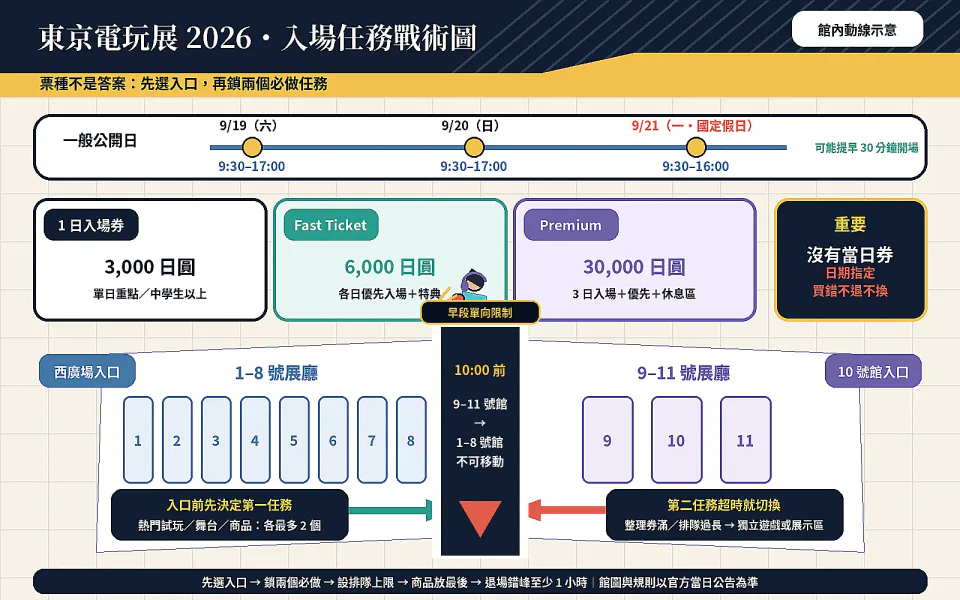
For most visitors to Tokyo Game Show 2026, the JPY 3,000 One-Day Ticket is still the default. Buy the JPY 6,000 Fast Ticket only when you can name the first high-demand booth or stage you are trying to reach — and, crucially, which hall side it is on. Until 10:00 each public day, visitors who start in or move into Halls 9–11 cannot return to Halls 1–8. Fast entry therefore buys a first-position advantage, not freedom to zigzag across all 11 halls from opening.
Families need a second calculation. Standard admission is free for elementary-school-age children and younger, but a child who needs Fast Ticket priority benefits must also hold a Fast Ticket regardless of age; the same rule applies to Premium benefits. That can turn a small upgrade into a large party-level premium.
↔ Scroll table left or right
Your real TGS plan | Start with | Main reason |
One public day, 2–3 flexible priorities | JPY 3,000 One-Day | You do not need to pay double just to enter earlier without a defined bottleneck |
One must-do demo or stage near opening | JPY 6,000 Fast | Priority entry can improve the first queue — if you choose the correct hall entrance |
Three public days + daily priority + lounge/charging value | JPY 30,000 Premium | You are actually using the multi-day bundle rather than buying a prestige badge |
Family with young child who also needs priority benefits | Recalculate whole-party cost | Free standard child admission does not carry over to Fast/Premium privileges |
Only Monday Sep 21 fits | One-Day or Fast depending first target | Monday closes at 16:00, so the day has less recovery time for a poor opening choice |
The 2026 public days are September 19–21 — but Monday is one hour shorter
Tokyo Game Show 2026 runs for five days, with ordinary public admission on September 19, 20 and 21 at Makuhari Messe. The first two public days run 09:30–17:00; Monday, September 21 runs 09:30–16:00.
That one-hour difference matters more than it appears. A poor first queue on Saturday can be repaired later. On Monday, every long wait consumes a larger share of the event. If Monday is your only day and one demo is genuinely non-negotiable, the Fast Ticket becomes easier to justify.
All public tickets are date-specific. The official ticket page says there are no refunds or exchanges for a date mistake, so fix the event day before booking a hotel or another timed Tokyo activity around it.
Fast Ticket: choose the first hall before you choose the first booth
The official 2026 Fast Ticket rules contain a restriction that changes opening strategy. Fast holders may use the priority entrance for either Halls 1–8 or Halls 9–11. After opening, movement from Halls 1–8 to Halls 9–11 is possible, but movement back from Halls 9–11 to Halls 1–8 is restricted until 10:00. If you leave Halls 1–8 for 9–11 during that period, you cannot immediately return.
So the opening question is not simply “what game do I want first?” It is:
Which hall contains the first scarce demo, stage or merchandise target?
What is my second priority?
Does choosing the first hall temporarily block the second?
A Fast Ticket used at the wrong entrance can still leave you waiting for the hall restriction to end. Priority entry is only valuable when it is attached to a hall-level plan.
Fast is not a permanent skip-the-line product
The priority entrance exists at opening. The official rules say the dedicated priority lane is removed after the designated period, and no refund is given if you arrive too late to use it. That means a Fast Ticket purchased for a relaxed 11:00 arrival is usually a bad upgrade.
The ticket should protect one expensive opening decision: a high-demand demo, an early stage, a limited merchandise target or another experience whose queue can damage the whole day. It does not turn every later line into a Fast Pass.
This is why I would not buy Fast simply because TGS is crowded. Crowds are the condition; a specific bottleneck is the reason to pay.
The child-ticket rule can triple the apparent upgrade cost
Standard admission is free for elementary-school-age children and younger. But TGS states that a child must hold a Fast Ticket to receive Fast Ticket benefits regardless of age. Premium has the same logic for Premium benefits.
Consider a simple family of two adults and one elementary-school-age child:
Standard admission: JPY 6,000 total for the two adults; child admission is free.
Fast benefits for all three: JPY 18,000 total because all three need Fast Tickets.
Premium benefits for all three: JPY 90,000 total if all three need the Premium privileges.
Those are derived party totals from the published ticket prices and child-benefit rules, not family-package prices. The point is that “the child gets in free” stops being true as a budgeting shortcut the moment the family wants the same priority benefits.
Photo ID is part of the Fast/Premium product
The 2026 ticket rules say the purchaser’s name is printed on the relevant priority ticket and checked on site. Bring original photo ID such as a passport, driver’s licence or student ID matching the purchaser name. The official page warns that without accepted identification, verification may take longer and entry may be delayed or refused.
Participant changes for personal reasons are also not permitted under the stated Fast/Premium conditions. This makes those tickets less flexible than a casual event pass. Do not buy a named priority ticket for someone whose attendance is uncertain.
For an international visitor, “remember the passport” is therefore not merely travel advice. It is part of the admission workflow you paid extra for.
Premium only makes sense when three public days are already your plan
The JPY 30,000 Premium Ticket includes Fast-style priority benefits for all three public days plus access to the Energy Spot lounge, with charging and catering-style benefits described by the organiser. That is a very different product from “a nicer one-day ticket.”
I would use a three-benefit test:
Will you attend all three public days?
Will priority entry matter on more than one morning?
Will you genuinely use the lounge/charging/rest function rather than staying in the halls all day?
If one of those is no, price the days separately before paying for Premium. If two are no, Premium is probably solving status rather than itinerary friction.
First-entry and re-entry deadlines create another hidden clock
For standard public admission, the official page currently sets first-entry deadlines at 16:00 on September 19–20 and 15:00 on September 21. Re-entry is allowed until 16:30 on the first two public days and 15:30 on Monday.
This matters for travellers trying to split TGS with central Tokyo. A ticket is not permission to arrive at any point before closing. Monday in particular is a poor day for a long morning elsewhere followed by a casual late-afternoon convention visit.
If TGS is worth buying, give it a coherent event block. Do not turn a JPY 3,000 ticket into an hour-long rushed walk because another attraction ran late.
One TGS day usually does not justify moving hotels to Makuhari
For one specialist day inside a broader Tokyo trip, I would usually keep the central Tokyo hotel. The hotel move, luggage handling and second check-in can cost more than one long commute.
Makuhari becomes much easier to justify for two or three consecutive public days because the commute repeats at the most tiring moments: morning queue and evening exit. At that point a local hotel is not about sightseeing convenience; it is about protecting multiple event-day edges.
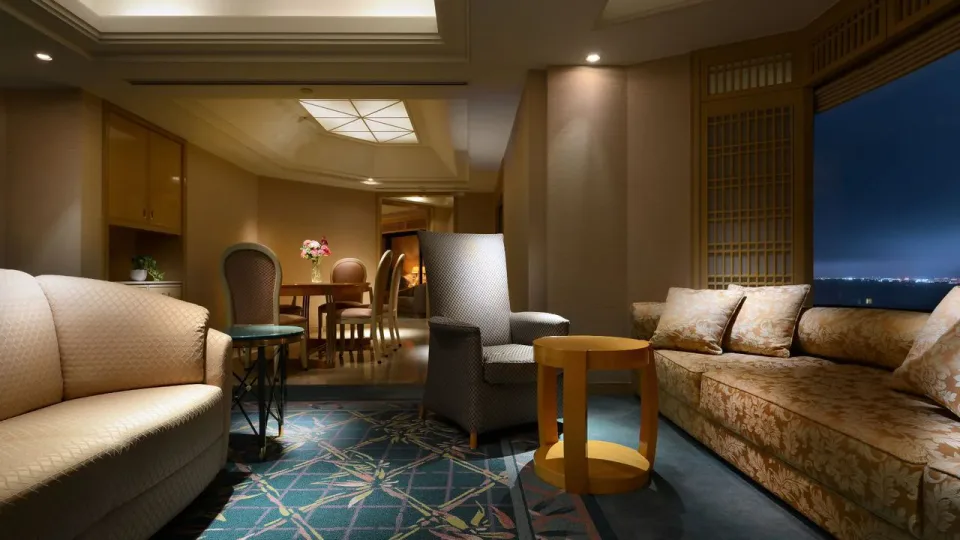
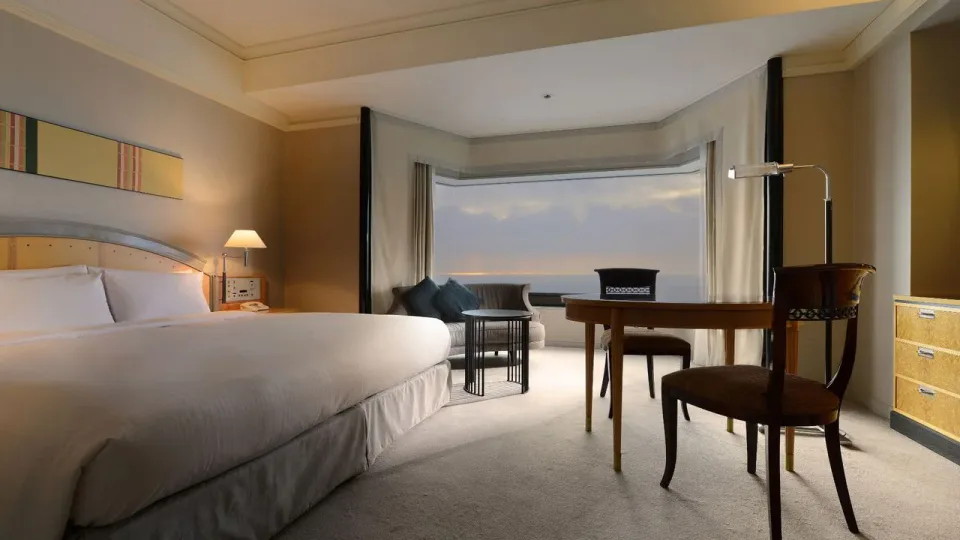
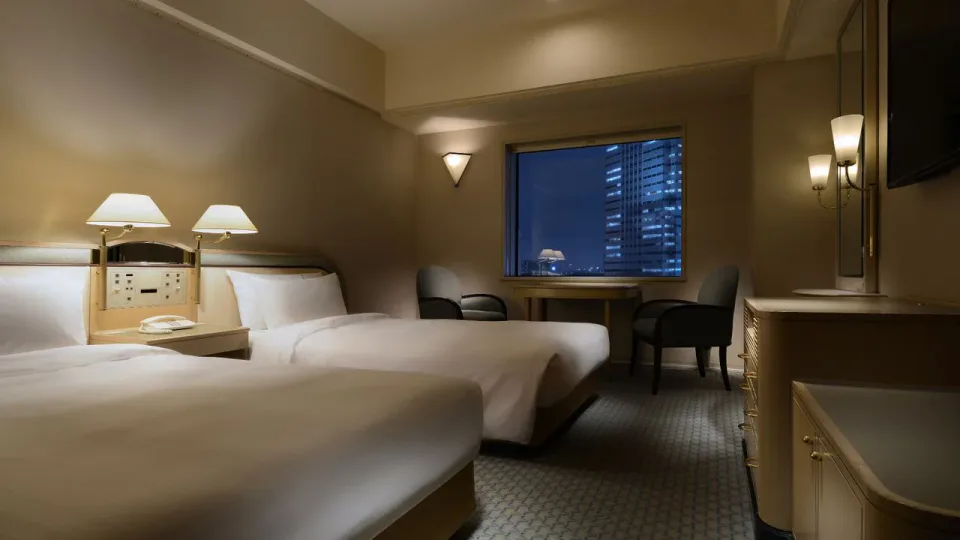
Use the Tokyo event accommodation guide if TGS is the anchor of the trip. If it is only one day, use Where to Stay in Tokyo for First-Time Visitors to protect the rest of Tokyo first.
Three priorities beat an eleven-hall completion plan
Even with priority entry, do not make “see every hall” the success metric. Rank the day into:
one must-do demo or booth;
one stage or creator/game presentation;
one merchandise or discovery block.
After that, use the remaining halls opportunistically. If a queue grows beyond the limit you set before entering, switch rather than protecting sunk waiting time.
This is especially important on the shorter Monday. The best TGS day is not the one with the highest step count; it is the one where the scarce experiences actually happened.
Final verdict: pay for the first bottleneck, then respect the hall geometry
One-Day at JPY 3,000 remains the right default for a flexible one-day visit. Upgrade to Fast at JPY 6,000 when the first high-demand experience is worth protecting and you know which side of Makuhari Messe to enter. The 10:00 movement restriction makes that hall choice part of the ticket value.
For families, recalculate the whole party: young children may enter free on the standard rules, but they need their own Fast or Premium ticket to receive those priority benefits. For Premium, demand three useful public days plus repeated priority and lounge value before paying JPY 30,000 per person.
And whatever priority ticket you buy, bring the matching original photo ID. A premium admission strategy that fails at identity verification is the most avoidable queue of the day.
Tokyo Disney Vacation Package Cancellation: What Changes Cost You in 2026
Tokyo to Lake Kawaguchi and Hakone: Trains, Buses and Travel Passes Compared
Kerama Discovery Diving: Seasickness, SEASIR Naha and Your First Dive
References
TOKYO GAME SHOW 2026 — official public ticket rules, prices and priority-entry conditions · TOKYO GAME SHOW 2026 — official dates and public-day hours. Checked August 25, 2026. Ticket inventory can sell out and operational details may still be updated before September.