
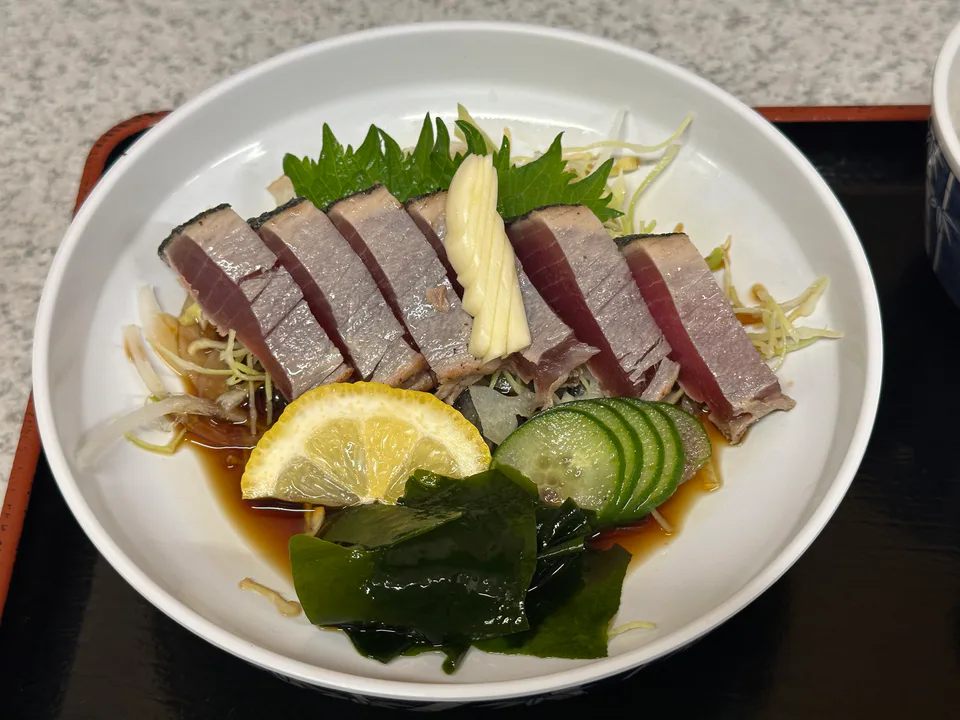
For most first-time visitors staying in Kochi city, Tosa Tataki Dojo is the easiest way to turn katsuo tataki into an activity rather than just a meal. But it is not automatically the “best” straw-grilling experience. Kuroshio Kobo and Kuroshio Ichibankan ask for more route commitment and advance planning in exchange for a deeper coastal food experience. Hirome Market is the opposite: skip the workshop entirely and keep the meal flexible.
The key distinction is not simply city versus coast. It is how much participation you actually want to buy. Tosa Tataki Dojo is a low-commitment grilling stop. Kuroshio Kobo can involve a whole fish and uses a market-price fish cost plus a workshop fee. Kuroshio Ichibankan has a ¥3,000 (~US$19) easy course and a ¥4,000 (~US$25) full course, both requiring advance booking and at least two participants. A solo traveller, a couple on a coastal road trip and a festival visitor therefore should not make the same choice.
USD conversions are approximate at the August 26, 2026 exchange rate and are only for scale; pay attention to the JPY price actually charged.
In Kochi, the real decision is whether you want to eat katsuo tataki, grill it yourself, or build a larger coastal food experience around it.
Choose by commitment level, not by which workshop sounds most authentic
↔ Scroll table left or right
Option | Current structure | Best fit | Main reason to skip |
Tosa Tataki Dojo | Hands-on straw grilling; ¥1,800 (~US$11) set meal or ¥1,500 (~US$9) tataki-only experience | First Kochi visit, solo traveller, city-based itinerary | You want a deeper fish-preparation experience or are already driving the coast |
Kuroshio Kobo, Nakatosa | Advance booking; fish charged at market price + ¥800 (~US$5) beginner fee or +¥1,500 (~US$9) intermediate fee | Road trip through Kure/Nakatosa; travellers who want the fish itself to be part of the activity | You want a predictable fixed price before travel |
Kuroshio Ichibankan, Kuroshio Town | Advance booking, minimum 2 people; ¥3,000 easy course or ¥4,000 full course per adult | Couple/group already travelling through western Kochi | Solo traveller or anyone making a large detour only for lunch |
Hirome Market | No workshop; buy tataki and other Kochi dishes from individual stalls | Festival day, short stay, mixed-interest group, late flexible meal | The straw fire itself is the reason you came |
Tosa Tataki Dojo is the default because it keeps the failure cost low
Kochi Prefecture’s current tourism listing gives Tosa Tataki Dojo hours of 10:30–15:00, with earlier closure when the day’s bonito sells out. The current experience set is ¥1,800 (~US$11), while the tataki-only option is ¥1,500 (~US$9). The listing also notes free parking and about 20 minutes by car from Kochi IC.
That last detail matters: “city option” does not mean “walkable from Hirome Market.” Tosa Tataki Dojo is still a deliberate trip within Kochi. Its advantage is that it does not require the much larger coastal commitment of Nakatosa or Kuroshio Town.
The hidden risk is inventory rather than reservation complexity. Because the venue can close when bonito sells out, arriving near 15:00 is not a resilient plan. If the workshop is one of the day’s priorities, put it before the final hour instead of treating 15:00 as a guaranteed last admission.
ValueNavi rule: choose Tosa Tataki Dojo when you want roughly one meal-sized activity and do not want the activity to dictate the rest of the day.
Kuroshio Kobo is not a fixed-price workshop — the fish price is part of the decision
Kuroshio Kobo in Nakatosa currently runs its restaurant from 11:00–14:00 and its tataki experience from 10:30–13:30. Advance booking is required. The current beginner course is the market price of the bonito + ¥800 (~US$5); the intermediate course is the market price of the bonito + ¥1,500 (~US$9).
That makes the budgeting logic very different from Tosa Tataki Dojo. The workshop fee is not the whole price. If you need a fully predictable food budget, the variable fish price is a real disadvantage. If the appeal is handling more of the fish and the coastal stop is already part of the trip, the variable pricing can be an acceptable part of buying a more involved experience.
The intermediate course goes further than simply holding bonito over straw: the tourism listing describes preparing a whole fish before grilling and packing/eating it. That is why comparing only “¥800 vs ¥1,800” would be misleading. You are not comparing equivalent products.
Choose Kuroshio Kobo when Nakatosa already earns its place in the route. Do not add a long coastal detour merely because the workshop surcharge looks inexpensive; the fish cost and travel time are the larger parts of the purchase.
Kuroshio Ichibankan is the clearest choice for a couple that wants a deeper workshop
Kuroshio Ichibankan in Kuroshio Town currently offers two advance-booked experiences. The easy course starts with the straw-grilling stage and costs ¥3,000 (~US$19) per adult. The full course includes preparing the bonito from an earlier stage and costs ¥4,000 (~US$25) per adult. Both are listed for two or more participants.
That minimum creates a hard boundary the older version of this article did not make clear: a solo traveller should not treat Kuroshio Ichibankan as the default bookable workshop. Tosa Tataki Dojo is structurally easier for one person. A couple or small group, however, can justify Ichibankan when western Kochi is already on the itinerary and the preparation process is part of the reason for travelling there.
The listed workshop season also matters: the current Kochi tourism page ties the eligible experience programme to roughly early March through November. Recheck the live page for your exact date rather than assuming an annual year-round schedule.
Hirome Market wins when your scarce resource is itinerary flexibility
Hirome Market is not a consolation prize for skipping a workshop. It solves a different problem. The market building currently operates 10:00–23:00 Monday–Saturday and 09:00–23:00 Sunday, although individual shops keep their own hours and days off. That gives a short-stay visitor a much wider meal window than any of the daytime workshop schedules.
For a Yosakoi day, late arrival or mixed-interest group, that flexibility can be worth more than participation. One person can order katsuo tataki while someone else gets another Kochi dish; nobody has to protect a workshop booking or send the whole group to the coast.
If the market is the choice, use the Hirome Market timing guide to decide whether lunch or dinner fits the crowd pattern better. Do not schedule Tosa Tataki Dojo for lunch and Hirome only a few hours later unless comparing the two tataki styles is intentionally the point of the day.
The best option changes sharply for solo travellers, couples and road trips
↔ Scroll table left or right
Traveller | What I would choose | Why |
Solo, one or two nights in Kochi | Tosa Tataki Dojo or Hirome | No two-person workshop minimum and less route commitment |
Couple, first Kochi trip | Tosa Tataki Dojo by default | Participation without giving a large part of the day to one meal |
Couple/group already driving through Nakatosa | Kuroshio Kobo | The route already pays the travel cost, so the deeper workshop becomes easier to justify |
Couple/group continuing through Kuroshio Town / western Kochi | Kuroshio Ichibankan | Two-person minimum stops being a problem and the more involved course fits the regional trip |
Yosakoi festival visitor | Hirome or early Tosa Tataki Dojo | Festival timing is more valuable than protecting a coastal workshop slot |
Do not let one food experience create an unnecessary hotel move
The strongest reason to reject a coastal workshop is not price. It is itinerary distortion. A workshop can be excellent and still be the wrong purchase if reaching it forces a separate coastal transfer, luggage handling and a hotel change that the rest of the trip did not need.
If you are already building a no-car Shikoku route, compare the detour with the four-day Shikoku itinerary. If your wider route needs hotel changes, solve the bags separately with the Japan luggage-forwarding guide rather than carrying them into a food workshop.
A good red-team question is: if the exact same tataki meal were available in Kochi city, would you still want to visit this coastal town? If the answer is no, the workshop is probably not strong enough to justify the detour. If the answer is yes because Kure, the Pacific coast or western Kochi is already part of the day, the workshop becomes route-efficient rather than route-distorting.
Final verdict
Tosa Tataki Dojo remains the best default for a first Kochi visit, but for a more precise reason than “it is convenient.” It gives you the straw-fire participation without a two-person minimum, variable whole-fish pricing or a western-Kochi itinerary commitment.
Choose Kuroshio Kobo when Nakatosa is already on the route and you want a more involved fish-preparation experience. Choose Kuroshio Ichibankan when you are travelling as a pair/group through Kuroshio Town and are willing to reserve a deeper workshop. Choose Hirome Market when the trip needs flexibility more than participation.
Salt versus sauce is a taste decision, not an authenticity test. The bigger planning mistake is spending half a travel day chasing a “more authentic” version of a dish when the route itself does not benefit.
Official information checked
Kochi Tourism — Tosa Tataki Dojo: current hours, sell-out condition, pricing, parking and road access.
Kochi Tourism — Kuroshio Kobo: current restaurant/workshop hours, reservation rule and market-price-plus-fee structure.
Kochi Tourism — Kuroshio Ichibankan: current two-person minimum, course prices, booking requirement and programme period.
Hirome Market official site: market opening hours; individual shop hours still vary.