
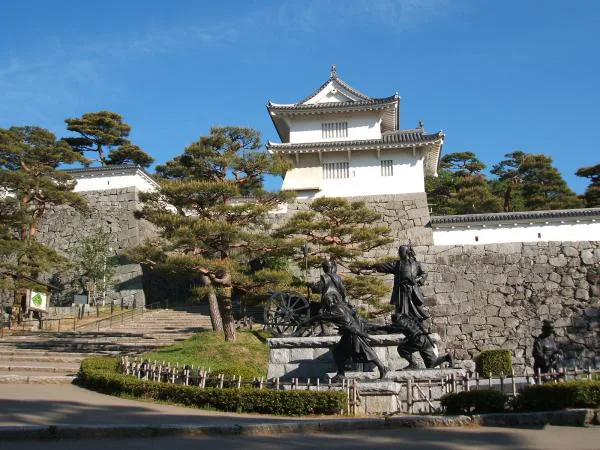
Nihonmatsu Castle is free, but it is not a low-effort castle. The lower park, reconstructed Minowa Gate and Nihonmatsu Boys monument are easy to reach; the honmaru, old stonework and keep foundation sit much higher on the hill. That elevation changes the real cost of No.11 from “zero yen” to time, walking and the risk of missing a staffed stamp desk on the way back.
ValueNavi verdict: rail travellers should lock in the No.11 stamp at JR Nihonmatsu Station first, then decide how much hill their timetable and legs can afford. About 60 minutes is a legitimate collector stop focused on Minowa Gate and the lower castle. A proper first visit needs 90–120 minutes; the upper stone walls are the reason to spend the second hour. In October and November, keep the separate ¥1,000 (about US$6.28 at the 27 August 2026 reference rate) chrysanthemum exhibition out of the castle-admission calculation: the castle ruins themselves remain free.
Stamp, lower castle or honmaru? Make the climb a deliberate purchase
↔ Scroll table left or right
Your goal | Best plan | Time budget | What you give up |
No.11 stamp only | Use the JR Nihonmatsu Station tourist information desk | Minimal | You complete the collection task without seeing why the castle occupies this hill |
Signature castle scene | Station stamp → Minowa Gate → lower san-no-maru | ~60 min plus station walking | You miss the older upper stonework and view |
Best first visit | Station/Johokan → Minowa Gate → climb to honmaru → descend | 90–120 min | More physical effort and less buffer for an onward train |
History-focused visit | Add the ¥200 Johokan permanent exhibition before climbing | 150 min+ | The cheap ticket adds interpretation, but also another indoor time block |
Oct 10–Nov 23 | Decide separately whether the chrysanthemum exhibition deserves time | Add 1–2 hours if it is a real objective | Event crowds can make a normally simple castle stop much slower |
ValueNavi Score: free entry hides a meaningful physical cost
The scores use ValueNavi’s seven attraction-decision dimensions. Higher is better; resilience means the visit is harder to derail. They are editorial planning scores, not official ratings.
↔ Scroll table left or right
Dimension | Score | Decision reason |
Money value | 9.8/10 | The ruins are free and the optional Johokan permanent exhibition is only ¥200 (about US$1.26) |
Time efficiency | 6.4/10 for the full castle; 8.5/10 for a collector stop | The station stamp is unusually convenient, but the upper castle adds a substantial climb |
Booking / access resilience | 8.8/10 | Two useful stamp locations reduce risk, although both are staffed facilities with closure windows |
Weather resilience | 5.8/10 | Rain, heat, snow or ice matter more on the steep honmaru route than at a flat city castle |
Crowd resilience | 8.5/10 normally; 5.5/10 during the chrysanthemum event | The park is spacious, but the major autumn event concentrates visitors and parking demand |
Route fit on the Tohoku Main Line | 8.7/10 | A station stamp makes No.11 unusually easy to protect on a rail-transfer day |
Uniqueness | 9.0/10 | Multiple stone-wall periods, a keep foundation that never carried a keep, and the vertical castle layout create a distinctive site |
Overall planning score: 8.1/10. The score becomes less useful if you collapse “stamp stop” and “full honmaru visit” into one activity. They have very different time and mobility costs.
The station stamp is not a shortcut to the castle — it is insurance against the climb
The official No.11 stamp is available at the tourist information office inside JR Nihonmatsu Station and at Nihonmatsu Johokan beside Kasumigajo Castle Park. The station desk is especially useful for rail travellers because it lets you finish the deadline-sensitive task before entering terrain whose return time is harder to predict.
The station information desk is currently listed at 09:00–17:30, with an unattended gap from 12:15–13:00 and a December 29–January 3 closure. Johokan opens 09:00–17:00, with last admission to its paid exhibition rooms at 16:30; it normally closes Mondays, shifting when Monday is a holiday.
Failure mode: doing the honmaru first because “the castle is free,” then reaching a stamp desk after it closes. Stamp first removes that risk without forcing you to shorten the castle.
¥200 at Johokan: buy context only when you have time to use it
Nihonmatsu Johokan’s permanent exhibition costs ¥200 for adults and ¥100 for high-school-age visitors and younger — roughly US$1.26 and US$0.63 at the reference rate. Exchange rates move, so the yen figures are the prices to plan around.
The museum explains the castle, archaeological work and castle town. For a visitor unfamiliar with the Niwa family or the Boshin War, that information can make the upper ruins much easier to read. But “only ¥200” is not a reason to add it to a 60-minute transfer stop. The extra cost you should care about is 30–60 minutes.
Decision rule: collectors short on time should stamp at the station and keep moving. First-time history visitors with 150 minutes or more should consider Johokan before the climb, when its interpretation can still change what they notice outdoors.
The 20-minute station walk gets you to the lower castle — not the honmaru
Official tourism information gives roughly 20 minutes on foot from JR Nihonmatsu Station to the Kasumigajo Park event/lower-castle area, while Johokan is about five minutes by taxi from the station. Neither benchmark includes the ascent to the honmaru.
This is the hidden-time calculation that matters. A 20-minute approach + lower castle + honmaru ascent/descent + 20-minute return is not a “one-hour free attraction.” If your onward train is fixed, work backwards from the station rather than upwards from Minowa Gate.
Minowa Gate is the easiest photo — the upper stonework is the reason to keep climbing
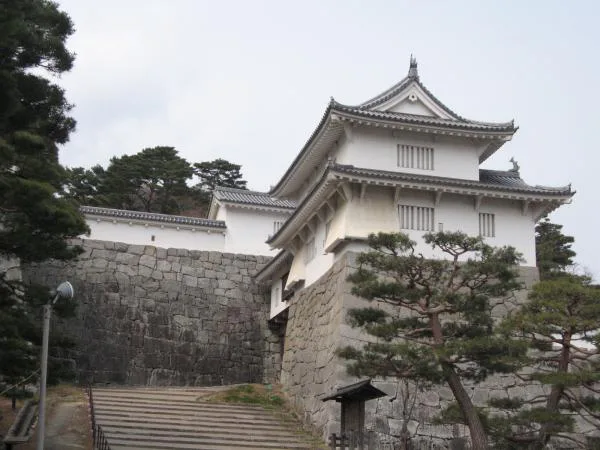
The present Minowa Gate was reconstructed in 1982 after the original was lost in the 1868 destruction of the castle. It is valuable because it gives the lower site scale and a clear formal entrance, but it should not become shorthand for the entire castle.
The honmaru area preserves and reconstructs stonework from different phases of the castle’s development. Nihonmatsu City highlights a large wall south of the honmaru that reaches about 13 metres, while older surviving sections around the upper castle show how masonry techniques changed as the site developed from a medieval mountain fortress into an early-modern castle.
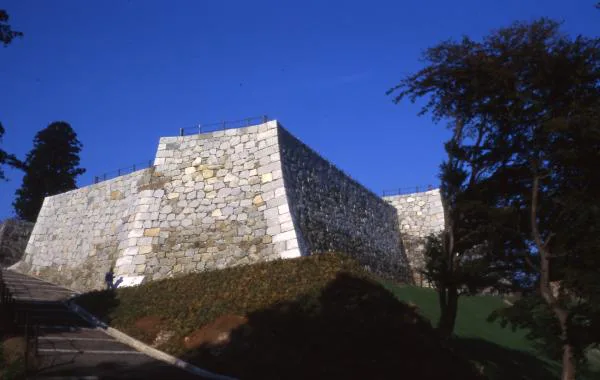
If you only have 60 minutes, stopping low is rational. If you have 120 minutes and suitable weather/fitness, turning around at Minowa Gate means leaving the castle’s best chronological evidence unseen.
The keep foundation never had a keep — and that is more useful than a myth
The tenshudai at the honmaru looks exactly like the kind of platform that encourages a “lost keep burned in 1868” story. Archaeological investigation instead found no evidence that a keep was ever built on it. Nihonmatsu City explicitly interprets the platform that way today.
That changes the value of the climb. You are not going uphill to imagine a missing tower. You are going for the strategic high point, the stone walls, the evolution of the site and the view toward the city and Adatara mountains. A castle guide that invents a lost tower gives you a more dramatic story and a worse understanding of the place.
Senshintei answers a different question from Minowa Gate
Minowa Gate is the most recognisable reconstructed castle image. Senshintei, a seventeenth-century tea-house building that survived through relocation and later returned to the site, is the stronger answer if your priority is surviving historical fabric.
That creates a useful hierarchy for a 90-minute visit: Minowa Gate for spatial orientation, Senshintei for surviving architecture, and the upper stonework for the castle’s older physical layers. You do not need to treat every feature as equally important.
60, 90 or 150 minutes: choose how much vertical history you are buying
↔ Scroll table left or right
Time | Suggested route | Best for |
~60 min | Station stamp → Minowa Gate → lower castle → return | Collector / fixed train |
90–120 min | Stamp → Minowa Gate → Senshintei/lower remains → honmaru stonework → descend | Best first castle-focused visit |
150 min+ | Johokan exhibition → full climb → slower stonework reading | Niwa/Boshin War/archaeology interest |
Bad weather / icy conditions | Stamp + Johokan + lower castle | Preserve information value without forcing the upper route |
If Nihonmatsu is one stop in a larger regional trip, use the Tohoku itinerary before turning No.11 into an extra hotel night. Route fit matters more than castle admission.
October 10–November 23: ¥1,000 buys the chrysanthemum event, not Nihonmatsu Castle
The 70th Nihonmatsu Chrysanthemum Dolls exhibition is officially scheduled for October 10 through November 23, 2026, 09:00–16:00, with no event closure days. Adult admission is ¥1,000, roughly US$6.28 at the reference rate; junior-high-school students and younger enter free.
The important distinction is simple: the normally free castle has not suddenly become a ¥1,000 attraction. The event occupies part of Kasumigajo Castle Park and should be evaluated as a second activity. If chrysanthemums are one of the reasons you are visiting, add the time. If No.11 is the goal, the event mainly changes crowd, parking and walking friction.
Event guidance also warns that some car-navigation systems can send drivers toward the honmaru or rear side of the hill when “Kasumigajo Park” is entered. In autumn, official event access instructions are more reliable than a generic map pin.
Who should skip the honmaru?
Skip the upper climb if weather makes the slope unpleasant or unsafe, if mobility is a hard constraint, or if the return train matters more than completing every layer of the castle. A stamp + Minowa Gate + lower-castle visit is not a failed version; it is a different version.
Do not skip the honmaru merely because “there is no keep.” For a castle enthusiast, the upper stonework and keep-foundation story are precisely what distinguish Nihonmatsu from a generic city park.
Final verdict: No.11 is easy to collect and harder to understand — use that difference
For collectors, Nihonmatsu is unusually forgiving: secure the stamp at the station and scale the outdoor visit to the time left. For a first proper visit, I would budget 90–120 minutes and climb to the honmaru if conditions are good. The second hour buys the stone-wall history that Minowa Gate alone cannot show.
The red-team case is a traveller with a tight rail connection, heavy luggage or poor weather. In that situation, recommending the full climb just because the park is free would be bad planning. Stamp first, use the lower castle, and leave the hill for a day when the physical cost is worth paying.
Official facts to recheck before travel
Castle history, stone walls, Minowa Gate and the never-built keep: Nihonmatsu City — official castle guide. Johokan 09:00–17:00 hours and Monday closure: Nihonmatsu Johokan. ¥200 permanent exhibition: Nihonmatsu City — admission fees. Current 2026 chrysanthemum dates and ¥1,000 adult admission: Nihonmatsu Tourism Federation. Recheck stamp-desk hours, event traffic control and weather before attempting the honmaru route.