
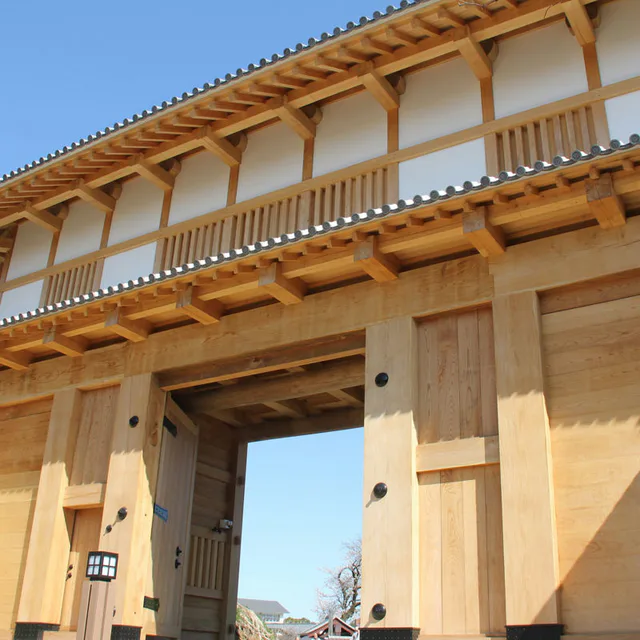
Mito Castle is worth a deliberate stop if you collect Japan’s 100 Famous Castles or care about the Mito Tokugawa story, but it is easy to visit in the wrong order. The free reconstructed Otemon can wait: it is accessible around the clock. Kodokan and the No.14 stamp are the time-sensitive side of the visit, while the reconstructed Ninomaru Corner Turret closes earlier. If you arrive with only 60–90 minutes, do the closing-time jobs first and leave the photogenic gate until last.
There is also a collector trap worth fixing before you travel: the Japan 100 Famous Castles stamp and Mito Castle’s paper castle seals (御城印, gojoin) are different products. Mito’s official tourism association currently sells several paper castle-seal designs at multiple locations, including its own office, Mito Tourist Information Center and a shop inside Kodokan. Those sales locations should not be copied into your notes as automatic No.14 stamp locations.
↔ Scroll table left or right
Your goal | Do this first | What can wait |
No.14 stamp | Confirm the current Kodokan-side stamp procedure before arrival | Otemon photos |
First proper Mito Castle visit | Kodokan + Ninomaru Corner Turret | Otemon and outdoor earthworks |
Free castle remains only | Ninomaru Corner Turret before its closing time | Otemon and exterior remains |
Evening arrival | Accept that this is an outdoor-remains visit | Return another time for Kodokan/stamp if they matter |
First: do not confuse the No.14 stamp with a Mito Castle gojoin
The Japan Castle Foundation lists Mito Castle as Japan’s 100 Famous Castles No.14. Its own past operational notices explicitly linked Mito Castle stamp availability to Kodokan being open: when Kodokan temporarily closed, the association said the Mito Castle 100 Famous Castles stamp could not be used. That is the strongest first-party evidence for treating the stamp as a Kodokan-timing problem rather than a 24-hour castle-ruins problem.
Separately, Mito’s official tourism association currently sells multiple paper castle seals for Mito Castle. The current sales list includes the Mito Tourism and Convention Association office, Mito Tourist Information Center, Kitazawa shop inside Kodokan and, for selected officially approved Tokugawa designs, the Tokugawa Museum. These are souvenirs with printed calligraphy and designs; they are not interchangeable with the rubber stamp used in the Japan 100 Famous Castles stamp rally.
Practical rule: if No.14 is the reason for your trip, reconfirm the stamp at Kodokan shortly before travel. If a paper gojoin is the reason, use the official tourism association’s current sales-location list. Do not assume one location provides both simply because it sells “Mito Castle” merchandise.
Kodokan is the clock that should control the first half of the visit
Current official Ibaraki tourism information lists Kodokan at JPY 420 for adults and JPY 210 for elementary/junior-high-school students and visitors aged 70 or over. The current seasonal hours are 09:00–17:00 from roughly mid-February through September 30 and 09:00–16:30 from October 1 through roughly mid-February, with December 29–31 closed.
Those hours matter even if much of Mito Castle is free. A late visitor can still photograph gates and walk earthworks, but that does not recreate Kodokan or a time-sensitive stamp stop. For a collector, “Mito Castle is open 24 hours” is therefore the wrong mental model.
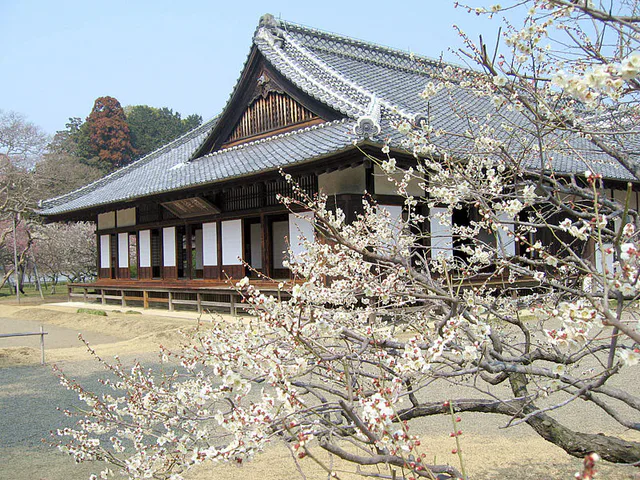
Kodokan also makes the castle more legible. Tokugawa Nariaki founded the domain school in 1841, and the surviving complex connects Mito’s military landscape to education, politics and the Mito Tokugawa family. If you have never visited before, I would not treat the JPY 420 ticket as a disposable add-on simply because the castle ruins outside are free.
Otemon is exactly the stop you can leave until last
Mito’s reconstructed Otemon was completed in 2020 and is one of the site’s easiest visual anchors. Official tourism information describes it as roughly 13 metres high and 17 metres wide. More important for itinerary design, the gate is free and can be viewed 24 hours a day.
That creates a counter-intuitive route rule. If you arrive at 15:20, do not spend the first 25 minutes photographing Otemon because it is the most obvious thing in front of you. Deal with Kodokan and the turret first. Otemon is the part of the visit that survives a late clock.
The Ninomaru Corner Turret is the earlier hard cutoff
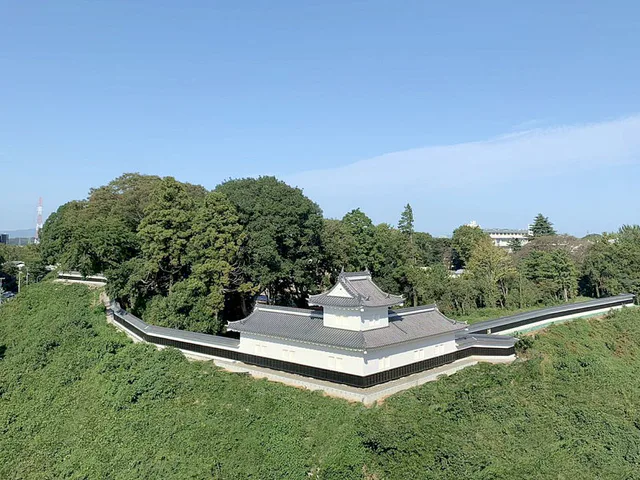
The reconstructed Ninomaru Corner Turret is free, but its visitor hours are much narrower than Otemon. Current Mito information gives 09:30–16:00, with year-end closure and possible temporary closure in severe weather. The approach is also a real walk through the former castle area rather than a doorway immediately beside Otemon.
This creates the simplest late-arrival priority:
if the No.14 stamp matters, handle the Kodokan side first;
reach the Ninomaru Corner Turret before 16:00 if you want to go inside;
then use the remaining daylight or evening for Otemon and the outdoor castle landscape.
If you arrive too late to complete all three, cut the part that remains available later rather than the part whose door is about to close.
Why Mito Castle can disappoint keep-first castle travellers
Mito Castle is not organised around a surviving or reconstructed main keep. Its distinctive value is the earth-built castle landscape: large earthworks, cut moats, changes in level, surviving Yakuimon, reconstructed Otemon and Corner Turret, plus Kodokan in the former Sannomaru.
If your Japan castle list is mainly about dramatic keeps, Himeji, Matsumoto or other skyline-first castles will produce a stronger immediate payoff. If you collect the 100 Famous Castles or want to understand how a major Tokugawa domain used an earth-built plateau, Mito becomes much more distinctive.
That distinction is the deletion test for this stop: would you still come if there were no giant keep photo at the end? If no, Mito is probably not worth a special Tokyo day. If yes, the earthworks-and-Kodokan combination is the reason to go.
Yakuimon is original fabric, but the school setting changes how you visit
Yakuimon is generally regarded as the only surviving original castle building. It stands within the grounds of Mito Daiichi High School. Mito’s official guidance explains that access uses the school gate and asks visitors to handle it appropriately.
For castle enthusiasts, surviving fabric is valuable enough to include. For a stamp-focused 60-minute stop, it is the first thing I would cut. A school campus should also be treated as a functioning school, not as an unrestricted castle park or a place to block for photography.
Use a closing-time route, not a sightseeing-order route
↔ Scroll table left or right
Time available | ValueNavi route | What you are deliberately giving up |
~60 minutes | Kodokan/stamp task → Otemon; turret only if timing is genuinely safe | Full historical walk |
~90 minutes | Kodokan → Ninomaru Corner Turret → Otemon | Slow earthwork exploration / Yakuimon if time tight |
~150 minutes | Kodokan → turret → Yakuimon → earthworks/moats → Otemon | Very little of the core castle story |
After 16:30–17:00 | Outdoor remains + Otemon | Kodokan/stamp and turret interior |
These are editorial planning windows, not official standard durations. The logic is simply to spend scarce minutes on access that expires first.
Do not travel from Tokyo only because No.14 looks close to Mito Station
Kodokan is roughly an eight-minute walk from JR Mito Station and Otemon roughly ten minutes, so the castle is easy once you reach Mito. That does not make the whole day a light Tokyo detour. The intercity rail journey still consumes meaningful time.
Mito Castle is strongest when one of three things is already true: you collect the 100 Famous Castles, you care about Tokugawa/Bakumatsu history, or you are combining Mito with a coherent Ibaraki plan such as Kairakuen. If none is true, another Tokyo-area day trip may have a higher opportunity-cost return.
If you are deciding whether to sleep in the area, use Mito or Oarai without a car. If the trip is competing with other Tokyo day trips, compare it with Tokyo Day Trips Compared before adding No.14 merely to collect another pin.
Mito Castle + Kairakuen works; Mito + every Ibaraki attraction does not
Kodokan, the castle remains and Kairakuen share a historical Mito theme and can form a coherent city day. Adding Oarai, Hitachi Seaside Park and Ryujin Suspension Bridge to the same day changes the problem from sightseeing to transport.
One useful rule is to keep the castle day thematic. If the main reason to travel north is Ryujin Bungy, build around that hard booking instead of assuming Mito Castle can be squeezed into whatever time remains.
Final verdict
For a No.14 collector, treat Mito as a Kodokan-timed visit, not a 24-hour ruins visit. Reconfirm the current stamp procedure, do Kodokan and the 16:00 turret before the flexible outdoor stops, and remember that the paper Mito Castle gojoin sold by the tourism association is a different collectible from the Japan 100 Famous Castles stamp.
For a first-time non-collector, give Mito about 90–150 minutes only if the earth-built castle and Mito Tokugawa story interest you. If all you want is a large keep photograph, the most useful conclusion may be to skip Mito rather than forcing it to be a different kind of castle.
Official sources and verification
Japan Castle Foundation — Japan’s 100 Famous Castles list · Japan Castle Foundation — Mito stamp/Kodokan closure notice · Ibaraki official tourism — Kodokan hours and admission · Mito official tourism — current Mito Castle paper seal designs and sales locations.
Checked August 25, 2026. Stamp arrangements, temporary closures and seasonal hours can change. If No.14 is non-negotiable, reconfirm the stamp procedure shortly before travelling.