Shirakawa Komine Castle is free, close to JR Shirakawa Station and unusually forgiving for Japan 100 Famous Castles collectors — but only if you separate three different clocks. The temporary Honmaru access route has its own hours, the reconstructed Sanju-yagura closes earlier, and the four official No.13 stamp locations follow separate schedules. In 2026, treating all three as “the castle is open” is the easiest way to lose time.
ValueNavi verdict: if you are arriving by ordinary JR train, this is an excellent 60–90 minute stop. Secure the stamp first if you are late, then prioritise the Sanju-yagura and stone walls. If you arrive by Shinkansen, recalculate the trip: the five-minute walk is from Shirakawa Station, while the Tohoku Shinkansen stops at Shin-Shirakawa. The other 2026 trap is the history museum: admission is temporarily only ¥150 (about US$0.94 at the 27 August 2026 reference exchange rate), but the VR theatre is still unavailable, so the discount reflects a missing feature rather than a bargain on the full experience.
Three clocks decide whether No.13 works smoothly
↔ Scroll table left or right
Clock | Current 2026 rule | What it means for you |
Honmaru access | Kiyomizu Gate is closed for restoration; use temporary stairs about 60 m west. Apr–Sep access is roughly 08:30–17:30. | An old map can send you to an entrance you cannot use. |
Sanju-yagura | Apr–Sep 09:00–17:00; Oct–Mar 09:00–16:00. | Outdoor access staying open does not mean you can still enter the turret. |
No.13 stamp | Four official locations; Shirakawa Tourist Station stays open until 18:00. | A closed turret does not automatically mean you have missed the stamp. |
The cleanest priority is therefore: stamp deadline → Sanju-yagura deadline → outdoor stonework. The things with fixed closing times should come before the parts of the site that remain flexible.
ValueNavi Score: excellent rail-stop efficiency, with a Shinkansen caveat
The scores use ValueNavi’s seven attraction-decision dimensions. Higher is better; resilience means the visit is harder to derail. These are editorial planning scores based on current public information, not official ratings.
↔ Scroll table left or right
Dimension | Score | Why |
Money value | 9.8/10 | The castle and Sanju-yagura are free; the temporarily reduced history-museum admission is ¥150. |
Time efficiency | 8.7/10 from Shirakawa Station | The castle is about a five-minute walk away, making a 60–90 minute stop realistic. |
Booking / access resilience | 8.8/10 | No reservation is needed and four stamp locations provide backup, although construction changes the Honmaru entrance. |
Weather resilience | 6.8/10 | Indoor interpretation exists, but the stone walls, temporary stairs and Honmaru are outdoor-heavy. |
Crowd resilience | 8.5/10 | The park spreads visitors out better than a compact keep interior. |
Route fit | 9.3/10 from Shirakawa; 7.0/10 from Shin-Shirakawa | The local-train transfer is the hidden cost for Shinkansen travellers. |
Uniqueness | 8.8/10 | Wooden reconstruction, major earthquake-restored stone walls and an active gate reconstruction make the site unusually good for reading preservation work. |
Overall planning score: 8.6/10 from a Shirakawa rail stop. That score falls if you are forcing a separate Shinkansen detour. Route fit matters more here than admission because the castle itself costs almost nothing.
Four stamp locations mean “turret closed” is not the same as “No.13 failed”
Shirakawa City currently lists the No.13 stamp at Shirakawa Tourist Station, Ninomaru Chaya, the Sanju-yagura and the Komine Castle History Museum. From April through September, the Tourist Station is the most forgiving late-arrival option because it stays open until 18:00; Ninomaru Chaya and the Sanju-yagura close earlier, and the history museum follows its own schedule.
This redundancy is genuinely useful. If you arrive at 17:10 in August, entering the Sanju-yagura is already off the table, but collecting the stamp may still be possible at the Tourist Station. Use the remaining daylight for exterior stonework rather than treating the whole stop as a failure.
The year-end period has a separate fallback arrangement at Shirakawa City Hall when the regular facilities are closed. Winter collectors should verify the exact current-year dates rather than assuming the four normal locations operate through New Year.
Kiyomizu Gate is still closed — and the restoration now runs to March 2027
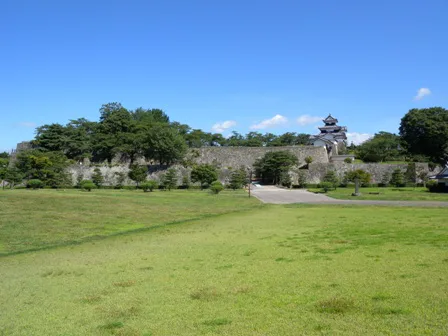
Kiyomizu Gate is not the current Honmaru entrance. Shirakawa City’s latest notice says the restoration period has been extended and completion is now planned for March 2027. Visitors use temporary stairs roughly 60 metres west of the gate and approach from the Yanomon side.
This is a classic “old guide costs time” problem. The castle is not closed. The route is different. If a saved map keeps pulling you toward Kiyomizu Gate, trust the current on-site signs instead of backtracking to force an obsolete entrance.
The Sanju-yagura is worth entering even though it is a reconstruction
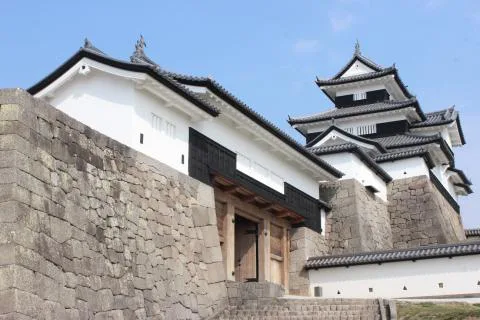
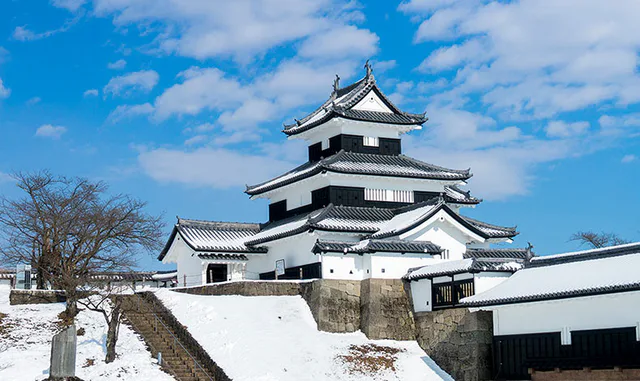
The present three-storey turret was reconstructed in wood in 1991, with Maegomon following in 1994. The original Honmaru buildings were lost after the 1868 Battle of Shirakawaguchi. The value of the reconstruction is not “original architecture survived”; it is that historical plans and archaeological work give the Honmaru its vertical scale back.
For a 60-minute visit, I would choose the Sanju-yagura before the history museum. Once you are inside the Honmaru, the relationship between turret, gate and stone walls becomes much clearer than it does from a model alone. If original fabric matters more to you than reconstructed architecture, spend more of the visit on the stone walls and castle layout.
The earthquake-restored stone walls are part of the story, not background scenery
The 2011 Great East Japan Earthquake damaged multiple sections of Komine Castle’s stone walls. Major restoration continued for years, with the main works completed in 2019 and another area reopening later. What looks like a coherent castle landscape today is partly the result of modern cultural-property restoration.
That gives Shirakawa Komine unusual information value for travellers interested in how Japan preserves castles after disasters. The current Kiyomizu Gate project adds another layer: this is a site where “reconstruction” and “restoration” are visible processes rather than historical footnotes.
The ¥150 history museum is half price because the VR is not working
The Komine Castle History Museum normally charges ¥300 for adults and ¥100 for school-age students. Since the VR theatre malfunction, the city has temporarily reduced admission to ¥150 for adults and ¥50 for students — roughly US$0.94 and US$0.31 at the 27 August 2026 reference rate. Exchange rates move, so the yen price is the one to plan around.
The other galleries remain open. You still get models, castle history, former-lord context and artefacts. What you do not currently get is the VR experience. That makes the museum worthwhile for a history-focused 90–120 minute visit, but weak as a “cheap VR attraction.”
As of August 27, the next published August museum closure is August 31. September also contains additional closure or partial-closure dates, so recheck the calendar if the museum is important. A museum closure does not automatically close the Sanju-yagura or the castle grounds.
Shirakawa versus Shin-Shirakawa: the five-minute claim hides a transfer
Official access information puts Komine Castle about five minutes on foot from JR Shirakawa Station on the Tohoku Main Line. The Tohoku Shinkansen, however, stops at Shin-Shirakawa Station.
If you arrive by Shinkansen, your real route is Shin-Shirakawa → local Tohoku Main Line train → Shirakawa → five-minute walk. The hidden cost is waiting for the local connection, not the final walking distance. Do not build a tight 45-minute castle stop by adding “five minutes” directly to your Shinkansen arrival time.
If you are linking several castles or autumn stops by rail, use the Tohoku itinerary to decide whether Shirakawa already fits the travel direction. A rail pass can cover fare; it cannot remove transfer time.
45, 90 or 120 minutes: the best route changes with your train
↔ Scroll table left or right
Time available | Best order | Cut first |
~45 min | Stamp → temporary-stairs route → Sanju-yagura / Maegomon | History museum |
75–90 min | Sanju-yagura → Honmaru / stone walls → museum only if time remains | Secondary park loops |
120 min+ | History museum → Sanju-yagura → stone walls / Obikuruwa → slower Shiroyama Park walk | Nothing needs to be rushed |
After 17:00 in Aug/Sep | Try Tourist Station stamp before 18:00 → exterior castle only | Do not expect to enter Sanju-yagura |
The temporary stairs are also a real accessibility boundary. A wheelchair user, stroller user or traveller who must avoid stairs should not assume the current Honmaru route is step-free. Build a minimum plan around the stamp, history museum and accessible parts of Shiroyama Park, then confirm the day’s Honmaru access with the city.
Do not confuse Shirakawa Komine Castle with Shirakawa-go when searching tickets
Current exact product checks do not show a useful advance admission product for Komine Castle, which is unsurprising because the Sanju-yagura and castle grounds are free and the history museum is a local facility. Generic searches for “Shirakawa” can instead surface Shirakawa-go in Gifu — an entirely different destination.
There is therefore no commercial CTA here. The useful next action is to verify the local-train connection, temporary entrance, VR status and stamp hours, not to buy an unrelated Shirakawa-area product.
Final verdict: a very efficient castle stop once you stop treating it as one opening-hours problem
Shirakawa Komine Castle works especially well for collectors and castle-history travellers already passing through southern Fukushima. The cash cost is negligible, the station walk is short, four stamp locations create resilience, and the stone walls plus wooden reconstruction give you more to read than a simple stamp stop suggests.
The red-team case is a Shinkansen traveller with a very tight connection who assumes the castle is five minutes from Shin-Shirakawa. That plan can fail before you even reach the site. Likewise, a visitor expecting the restored Kiyomizu Gate or the museum VR today will be disappointed. Once those two expectations are corrected, No.13 is a strong 60–90 minute stop rather than a construction-compromised attraction.
Official facts to recheck before travel
Current temporary Honmaru route and Sanju-yagura access: Shirakawa City — Komine Castle access. Four official No.13 stamp locations: Shirakawa City — Japan 100 Famous Castles stamp. Kiyomizu Gate restoration schedule: Shirakawa City — Kiyomizu Gate project. Current VR malfunction and temporary ¥150 fare: Shirakawa City — museum VR notice. Recheck museum closures and local train times for your exact date.