
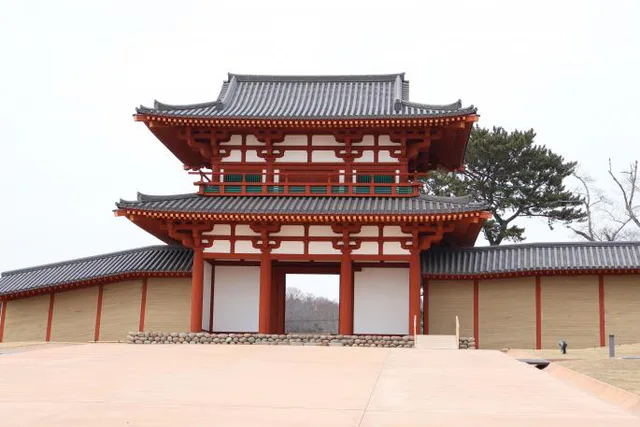
Taga Castle is one of the easiest Japan 100 Famous Castles stops to add to a Sendai stay — but only if you plan around the one fragile part of the visit. The ruins and reconstructed South Gate are not the problem. The official No.7 stamp is: it is now at the Taga Castle Site Guidance Facility, open 09:00–16:30, and old guides can still point you to the former management office.
ValueNavi verdict: if you are already sleeping in Sendai, Taga Castle is a strong two-to-three-hour history module rather than a hotel-changing destination. Give it about 60 minutes if the stamp, South Gate and National Treasure monument are your main goals; use 90–120 minutes if you want the government-office core and the site’s Nara-period administrative logic to make sense. If your idea of a Japanese castle depends on a keep, turrets and an indoor tower museum, this should be lower priority.
Decide whether you want a stamp stop or an ancient-state history visit
↔ Scroll table left or right
Your situation | Best plan | Why | Main risk |
100 Famous Castles collector | Lock the Guidance Facility’s 09:00–16:30 window first | The official stamp moved here in 2025 | Following an old guide to the former management office |
About 60 minutes on site | Guidance Facility → South Gate → National Treasure monument → outer boundary | This keeps the most legible entrance, original inscription and site scale | Stopping at the gate photo without understanding what the enclosure was for |
90–120 minutes | Add the main avenue and government-office ruins | The administrative core is what turns the gate into part of an ancient political system | Expecting Sengoku-castle architecture and finding the open ruins anticlimactic |
Already based in Sendai | Use Taga as a half-day module | JR access is short enough that no hotel move is justified | Overbuilding the day with Matsushima or mountain foliage in the opposite direction |
Arriving after 16:30 | Separate “see outdoor ruins” from “complete the stamp” | The site may still be visible outdoors, but the current stamp facility is closed | Assuming outdoor access means the No.7 stamp is also available |
ValueNavi Score: unusually strong route fit from Sendai
This uses the same seven ValueNavi attraction-decision dimensions as other guides. Higher is better; resilience scores measure how hard a visit is to derail. The scores are editorial analysis built from verified public facts, not official ratings.
Dimension | Score | Decision reason |
|---|---|---|
Money value | The historic site, South Gate and Guidance Facility do not require a standard admission ticket | |
Time efficiency | Short JR access from Sendai plus useful official 60- and 90–120-minute route options | |
Booking / access resilience | No timed ticket is needed, but the official stamp has a firm 16:30 facility closing time | |
Weather resilience | Most of the historical reading happens outdoors across a broad archaeological site | |
Crowd resilience | The open site disperses visitors better than a compact castle interior; event dates are the exception | |
Route fit from Sendai | It is close enough to add without changing accommodation and works as a clean half-day block | |
Uniqueness | A reconstructed Nara-period South Gate, National Treasure inscription and government-office ruins form a castle experience unlike a daimyo keep |
Overall planning score: 8.4/10 from a Sendai base. The same site scores lower if you are forcing it into a trip that does not otherwise include Sendai. Route fit is a major part of the value, not an afterthought.
The South Gate changed how the site reads — but it is not the oldest thing you should prioritise
The reconstructed South Gate opened to general visitors in April 2025. Older articles that still call it a future project or construction site are stale for a 2026 trip. The gate is useful because it restores direction to an archaeological landscape: you can now begin with a visually clear entrance and follow the historical axis toward the administrative centre.
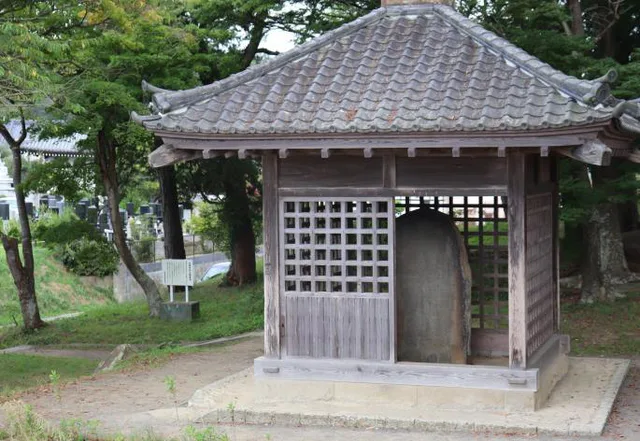
But the gate is a reconstruction based on research. The nearby Taga Castle Monument is the original object that deserves equal or greater attention. Its inscription records the castle’s foundation in 724 and repair in 762, and it was designated a National Treasure in August 2024. If you have to cut the 60-minute route shorter, keep the monument before adding another stretch of open ground.
The stamp is the hard deadline: 09:00–16:30 at the new Guidance Facility
Taga City moved the official Japan 100 Famous Castles stamp to the Taga Castle Site Guidance Facility in April 2025. The facility stands on the south side of the reconstructed South Gate and currently opens 09:00–16:30, closing from December 28 through January 4. The city explicitly warns that older guidebooks may still name the former Taga Castle Site Management Office.
This is the key failure mode for collectors. Save the Guidance Facility itself in your map, not just “Taga Castle.” If a train delay pushes you beyond 16:30, do not assume the outdoor nature of the site gives you an after-hours stamp workaround. Rebuild the plan around the next workable facility window.
The official stamp, the ¥300 gojoin and digital seals are different products
Taga Castle currently has several similarly named souvenir or digital items that can be confused with the official 100 Castles stamp. The paper Taga Castle gojoin is ¥300 — about US$1.88 at the 27 August 2026 reference exchange rate — and is a souvenir item, not the official Japan 100 Famous Castles stamp. Exchange rates move, so the US-dollar figure is only a rough orientation.
The decision rule is simple: if your objective is the No.7 stamp, you do not need to pay merely because a counter offers a gojoin. If you want the souvenir card as well, buy it as a separate collectible. Similar wording should not turn one checklist item into an unnecessary purchase.
Why Taga Castle belongs on the list even without a Sengoku keep
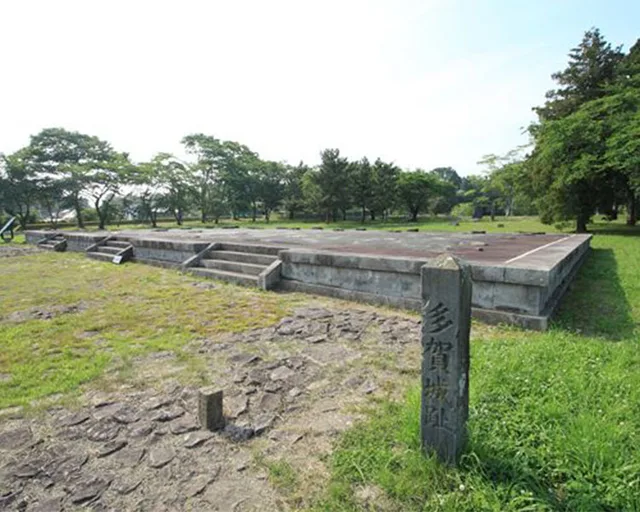
Taga Castle was founded in 724 and served as a major governmental and military-administrative centre in ancient northeastern Japan. The broader fortified administrative enclosure measured roughly 900 metres on a side, with the government-office compound near the centre. This is a fundamentally different type of “castle” from the later stone-walled daimyo fortresses most international visitors picture first.
That changes the viewing question. Do not ask where the lord’s keep stood. Ask how the central state organised movement from the South Gate toward the government compound, how boundary works defined the complex, and why an administrative centre in ancient Mutsu needed fortification at this scale.
60 minutes versus 120 minutes: the second hour buys understanding, not more spectacle
Tagajo’s tourism association publishes a roughly 60-minute historic-site model route and a longer 90–120 minute version. The difference is not that the longer route suddenly reveals a dramatic tower. It gives you enough time to connect the reconstructed entrance with the government-office core.
↔ Scroll table left or right
Time | Keep | Cut first | What you learn |
30–45 min | Stamp → South Gate → National Treasure monument | Full government-office circuit | Current logistics + entrance + original eighth-century evidence |
~60 min | Add outer boundary remains | Distant secondary remains | How the entrance sits within a large fortified administrative enclosure |
90–120 min | Add main avenue and government-office ruins | Do not cut the central administrative core | Why the site existed and how authority was spatially organised |
For a non-collector who likes archaeology or Nara-period history, the longer version is the more convincing visit. For a collector trying to fit No.7 into a transport day, the 60-minute version is a rational compromise rather than a “failed” full visit.
The government-office ruins are the part most likely to be skipped — and the part that explains the site
Near the centre of the enclosure, the government compound hosted administration and important ceremonies. If you turn around after photographing the South Gate, you have seen the most photogenic reconstruction but not the strongest answer to “why is this castle historically important?”
The longer route turns the gate from an isolated object into an entrance. The main avenue leads toward the centre of political authority, and the archaeological plan begins to read as an organised complex rather than scattered foundations.
Kokufu-Tagajo is the default rail station for the ruins — do not let the simpler name choose for you
The station-name trap is unusually easy here. Current tourism information places the historic site at roughly a 15-minute walk from JR Kokufu-Tagajo Station on the Tohoku Main Line, while JR Tagajo Station is on the Senseki Line and serves a different approach to the city. A station called simply “Tagajo” is not automatically the best station for Taga Castle.
From Sendai, choose the railway by the destination after the castle, not by name recognition. For a No.7-focused trip, Kokufu-Tagajo is the clean default. If your onward plan uses the Senseki Line, Matsushima or Shiogama, then the broader route may justify a different exit strategy — but that is an itinerary decision, not evidence that the same station is best both ways.
From Sendai, Taga is a half-day module — not a reason to move hotels
If Sendai is already your base, I would budget roughly two to three hours for transport plus either the short or long historic-site route. That keeps the visit resilient: a small train wait or a slower walk does not immediately destroy the rest of the day.
The bad version is moving luggage or changing accommodation solely to be closer to No.7. Taga Castle should strengthen a Sendai itinerary, not reorganise it. If your wider Tohoku route is still undecided, the Tohoku autumn leaves itinerary can help decide whether Sendai already deserves a base night.
A paid day tour only makes sense when you want the whole route, not because Taga Castle needs a ticket
Taga Castle itself is free. A commercial day tour therefore buys transport integration and itinerary simplification, not castle admission. There is a current tour combining Taga Castle, Shiogama Shrine and Matsushima. For a collector whose only objective is No.7, JR plus the 60–120 minute site route is usually the leaner solution. The tour becomes more rational when all three areas are already on your wish list and you value having the cross-town transport packaged.
ValueNavi may earn a commission if you complete an eligible booking through an affiliate link, at no additional cost to you.
Compare the Taga Castle + Shiogama + Matsushima day tour
Weather, mobility and night photos: three cases where the default plan changes
Rain: the Guidance Facility helps, but the historical payoff is still mostly outdoors. If weather is poor, use the short route rather than forcing a 120-minute archaeological walk.
Limited mobility: do not assume every segment of a broad archaeological site is equally easy because the map looks flat. Make the Guidance Facility, South Gate and National Treasure monument the minimum viable route and confirm current accessible paths before committing to the government-office circuit.
Evening: photographs of an illuminated South Gate are date-specific. Taga City states that lighting is tied to designated events, so do not wait for night illumination unless it is officially confirmed for your date. The official stamp window already ends at 16:30.
Final verdict: one of the easiest specialist castle stops from Sendai, provided you respect the stamp deadline
For a collector, the answer is straightforward: Taga Castle is worth adding from Sendai. Save the new Guidance Facility, arrive before 16:30, and choose the 60-minute or 90–120 minute route based on whether you want to complete No.7 or understand the ancient administrative complex.
The red-team case is the traveller who wants a dramatic keep, interior exhibits and a panoramic tower. The South Gate reconstruction does not transform Taga into that kind of castle, so I would lower its priority for that traveller. For someone interested in ancient Tohoku, archaeology or the evolution of what “castle” means in Japan, the same absence of a keep is exactly what makes No.7 unusually valuable.
Official facts to recheck before travel
South Gate status and event illumination: Taga City — Taga Castle South Gate. Current official stamp location and 09:00–16:30 hours: Taga City — Japan 100 Famous Castles stamp. Guidance Facility: Taga City — Taga Castle Site Guidance Facility. Model walking routes: Tagajo City Tourism Association. Recheck temporary closures, preservation work and event schedules shortly before travel.