
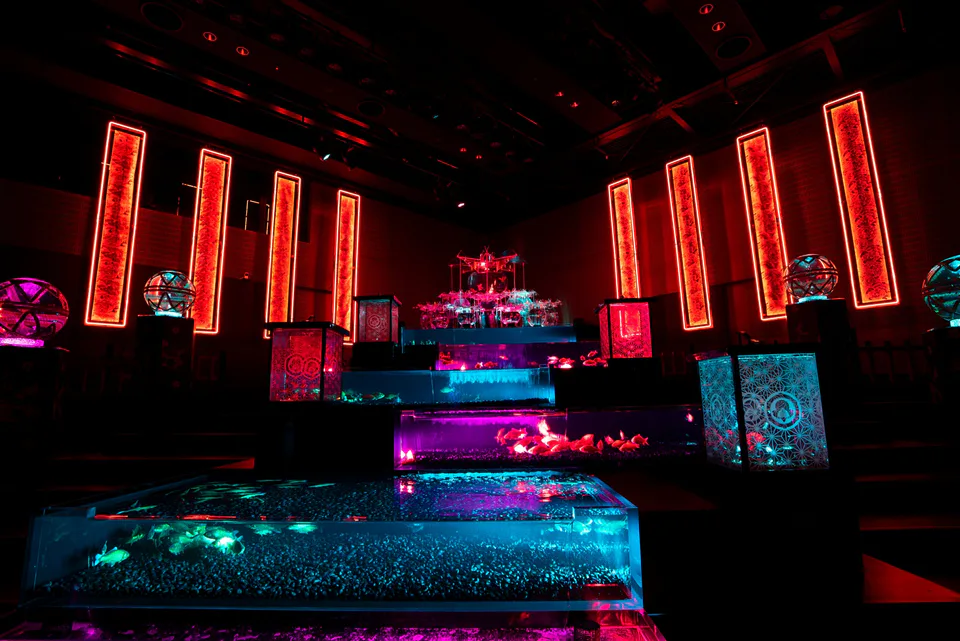
Art Aquarium Nagoya 2026 is worth a 60–90 minute Sakae slot when immersive visual art is already part of your trip; it is easy to skip when Nagoya is mainly a gateway to Takayama, Shirakawa-go or Kamikochi. The exhibition runs through September 23, 2026, with roughly 4,000 live goldfish across 12 areas and 21 works. The official adult web ticket is ¥2,100 (about US$13), versus ¥2,300 (about US$14) at the venue.
The bigger decision is not the ¥200 (about US$1.25) ticket difference. It is whether this is the best use of a limited Nagoya block—especially if the same Japan trip also includes Tokyo. Art Aquarium Museum GINZA currently charges ¥2,500 (about US$16) online, and its 2026 summer exhibition continues through September 30. If both cities are already on your route, most first-time visitors do not need both. Choose the edition that fits the city where you have more usable time; do both only if comparing the installations is itself part of the experience.
The 2026 Nagoya edition contains 12 areas and 21 works, including the large Kinyo Ryoran Grand Stage.
Art Aquarium Nagoya 2026: the 30-second decision
↔ Scroll table left or right
Your trip | Decision | Why |
Already spending half a day in Sakae | Go if immersive art / photography appeals | Direct Sakae access makes the extra transport cost low |
Nagoya is only one night before the Japanese Alps | Usually skip | The 60–120 minute opportunity cost matters more than the ¥2,100 (about US$13) ticket |
Same trip also includes Tokyo before Sep 23 | Usually choose Nagoya or Ginza, not both | The concepts overlap enough that the second visit needs a specific reason |
Repeat Art Aquarium visitor / serious photographer | Nagoya can justify itself separately | The 2026 Nagoya edition has Nagoya-specific and first-in-Nagoya works |
Expect a conventional aquarium | Skip | This is an immersive live-goldfish art installation, not a marine-life museum |
Live animals used in aesthetic displays are a values boundary | Skip | Price and convenience do not solve that ethical preference |
First decide whether you want an aquarium — or a goldfish art show
Art Aquarium is easy to misunderstand from the name. It does not compete with a conventional aquarium on sharks, penguins, ecosystem interpretation or species education. The organiser describes it as a modern expression of Japan's long culture of goldfish viewing, combining shaped tanks with light, sound, flowers, fragrance and theatrical staging.
That makes it a strong fit for travellers who photograph exhibitions, enjoy immersive lighting or want a polished indoor break during a hot Nagoya afternoon. It is much weaker for visitors whose aquarium expectation is primarily animal education or broad marine-life variety.
The practical deletion test is simple: if you would not replace another Sakae shopping or indoor block with this exhibition, do not add it merely because September 23 is approaching.
Nagoya vs Ginza: most first-time visitors should choose one
This is the decision the ticket pages do not answer. In late summer 2026, Nagoya and Ginza are simultaneously offering Art Aquarium experiences. Nagoya runs to September 23 at Chunichi Hall in Sakae and costs ¥2,100 (about US$13) online for a general adult ticket. The current Ginza online ticket is ¥2,500 (about US$16); the Ginza summer exhibition runs through September 30.
Buying both adult web tickets costs ¥4,600 (about US$29) before you count travel time, and two visits can easily consume three or more usable hours once admission, walking and photography are included. That second visit therefore needs a purpose.
↔ Scroll table left or right
Situation | I would choose | Reason |
Nagoya has a relaxed Sakae afternoon; Tokyo is packed | Nagoya | Use the exhibition where it displaces lower-value time |
Nagoya is a transfer gateway; Tokyo has a flexible Ginza day | Ginza | Protect the Central Japan transport day rather than forcing a temporary exhibition into it |
You arrive Nagoya after Sep 23 but Tokyo before Sep 30 | Ginza | The Nagoya edition is already over while the Ginza summer exhibition is still running |
You want to compare installation design / photograph different works | Both can make sense | The comparison itself is now the activity, rather than accidental duplication |
The important point is not that the two venues are identical—they are not. Nagoya 2026 has 12 areas and 21 works, including Nagoya-specific or first-in-Nagoya presentations. Ginza's 2026 summer exhibition also has its own new areas. The question is whether those differences matter enough to your trip to justify a second block built around the same live-goldfish immersive-art format.
ValueNavi rule: for a first visit, choose by itinerary geometry first and edition-specific works second. For a repeat fan, reverse that order.
One ethical boundary comes before price
These are live goldfish, not projections or only sculptural objects. The organiser frames the exhibitions as a contemporary continuation of goldfish-viewing culture. The official visitor pages explain the concept, works and logistics, but they do not provide enough husbandry detail for this guide to independently settle every animal-welfare question a visitor may have.
That is not evidence of mistreatment, and this article does not make that claim. It means the ethical question cannot honestly be answered by saying the exhibition is attractive or culturally framed. If using live animals primarily within an immersive aesthetic installation is already outside your preferences, treat that as a hard skip condition for both Nagoya and Ginza rather than using one venue as the workaround.
What the Nagoya ¥2,100 (about US$13) ticket buys
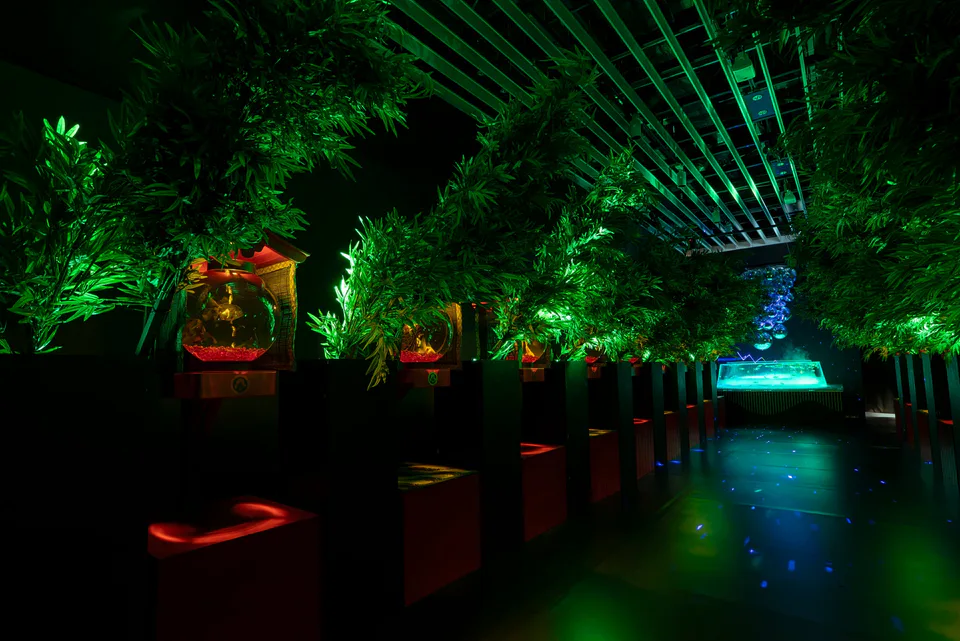
The 2026 Nagoya edition is not simply a travelling copy. Official material lists 12 areas and 21 works. The large Kinyo Ryoran Grand Stage is one visual anchor, while works such as Hanamai, Lantern Alley and Kinyo no Iori – Bosuian create different room-scale experiences. Several works are new to Nagoya or presented there for the first time.
That matters most for repeat visitors. Someone who already saw a previous Nagoya or Ginza edition has a concrete reason to compare this year's work list before deciding. A first-time visitor does not need to research every tank name; the more important question is whether this type of immersive art deserves the city time.
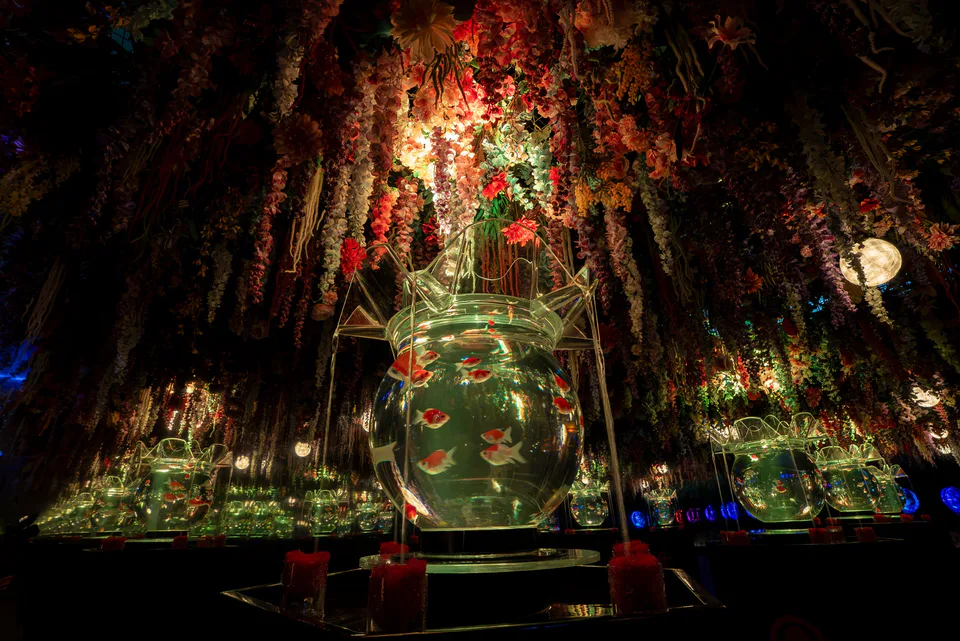
Hanamai uses flowers, lighting and the goldfish tanks as one staged room-scale work.
Official web ticket vs walk-up: ¥200 (about US$1.25) is not the important difference
The current adult price is ¥2,100 (about US$13) for the official timed web ticket and ¥2,300 (about US$14) at the venue. The organiser also warns that sold-out web time slots can limit same-day admission, so a visitor who already knows the Sakae day gains little from waiting to buy at the door.
The official ticket system allows a purchased admission date/time to be changed from the purchase history before the reserved admission time, subject to the current rules and availability. Cancellations are generally not the same thing as changing a slot. Recheck the live ticket conditions before payment.
That built-in change function is important when comparing marketplace “open-date” products. Do not pay an open-date premium automatically if the normal official ticket already provides enough flexibility for your itinerary.
Klook timed vs open-date: pay for flexibility only when you need it
Klook's current Nagoya product offers timed and open-date options, and package conditions can change. The open-date product can be useful if your Nagoya day genuinely cannot be fixed, but it should be compared with the official ¥2,100 (about US$13) ticket and its change function rather than assumed to be the better product.
The order should be: first decide whether Art Aquarium deserves the time, then decide how much schedule flexibility you actually need, then compare the live final checkout terms.
Compare the current Art Aquarium Nagoya ticket options on Klook
Sakae access is why the Nagoya edition can fit without becoming a transport project
The venue is on the sixth floor of Chunichi Building in Sakae. The official access information connects it through the underground area from Sakae Station / Sakaemachi Station. This makes it easy to pair with a Sakae or Hisaya-odori block rather than creating a separate cross-city excursion.
Current exhibition hours are 10:00–18:00 with final admission at 17:00. For itinerary design, 17:00 is the hard number: a late-running shopping block cannot simply push Art Aquarium into the evening.
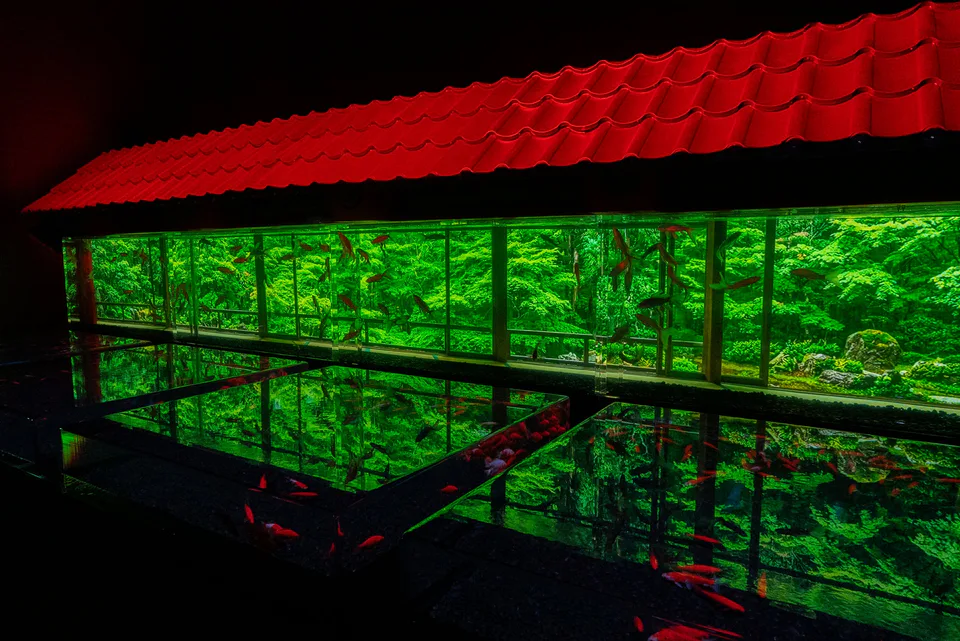
Different rooms change the visual rhythm, so photographers usually need more time than visitors walking straight through.
How much time should you actually reserve?
The organiser does not publish one universal “average visit time.” For planning, allow around 60–90 minutes as a sensible baseline; photographers waiting for cleaner compositions or portraits should allow closer to 90–120 minutes. Those are ValueNavi planning allowances, not venue limits.
Photography and video are allowed under the venue rules, while flash, extra lighting, monopods and tripods are prohibited. That is why visit length depends heavily on behaviour. Someone who wants only a quick visual walk-through should value the attraction differently from someone who plans to photograph 21 works.
No luggage storage inside: gateway travellers should solve the suitcase first
The official ticket information says suitcases are not allowed into the Ginza museum and that there are no lockers there; the Nagoya guide likewise should not be treated as a luggage-storage stop. If Nagoya is mainly a gateway before Takayama, Shirakawa-go or Kamikochi, solve large luggage before building a timed exhibition into the transfer day.
Use the Takayama day trip or overnight from Nagoya and Takayama–Shirakawa-go–Kanazawa route to settle the larger travel structure first. A temporary Sakae exhibition should fill a genuine gap; it should not create a rushed mountain departure.
Only one full day in Nagoya? Use a replacement test
Art Aquarium is easy to over-add because Sakae is convenient. With only one city day, do not ask “can I squeeze in 90 minutes?” Ask “what am I willing to remove for it?”
If you would happily replace an ordinary shopping block, another indoor attraction or a long café break, the exhibition can be efficient. If every existing stop already feels essential, the September 23 deadline is not enough reason to make the day worse.
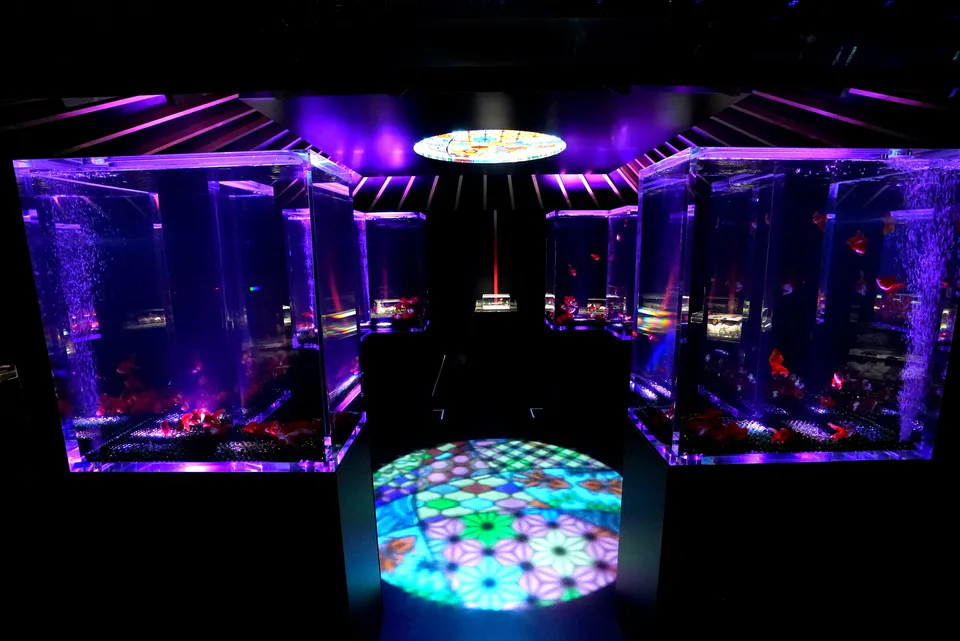
September 23 is a real cutoff
The Nagoya 2026 edition ends September 23. A traveller arriving on September 24 cannot move it to another day. Search snippets, social posts and ticket pages can remain visible after temporary events end, so check the official event page before finalising the route.
The Nagoya-vs-Ginza branch becomes especially useful here: the current Ginza summer exhibition continues through September 30. For September 24–30 travellers who will also be in Tokyo, the decision has already been simplified—Nagoya is no longer available.
Kinyo no Iori – Bosuian is one of the reasons repeat visitors may treat Nagoya as a distinct edition rather than a substitute for Ginza.
Final verdict
Go to Art Aquarium Nagoya 2026 when you already have a comfortable Sakae block and immersive visual art is worth replacing something else in the itinerary. The ¥2,100 (about US$13) web price is not the real barrier; the scarce resource is 60–120 minutes of Nagoya time before the September 23 cutoff.
If the same trip also includes Tokyo, most first-time visitors should choose one Art Aquarium. Choose Nagoya when Sakae has more slack or the Nagoya-specific 2026 works interest you. Choose Ginza when Nagoya is only a gateway and Tokyo has a more natural museum block. Do both only when comparing the editions, photographing different works or following Art Aquarium itself is a trip objective.
Skip either venue if you are expecting a conventional marine aquarium or if the use of live fish in an aesthetic installation is already a values boundary. No ticket discount or itinerary convenience reverses those conditions.
References
Art Aquarium Nagoya 2026 official site · Official Nagoya opening announcement — dates, works and prices · Art Aquarium Museum GINZA official ticket — current ¥2,500 (about US$16) web admission · GINZA summer exhibition 2026 — June 26 to September 30. Checked August 26, 2026. USD conversions are approximate at roughly ¥160 per US$1. Ticket inventory, opening notices and package terms can change; verify the actual visit date before payment.