
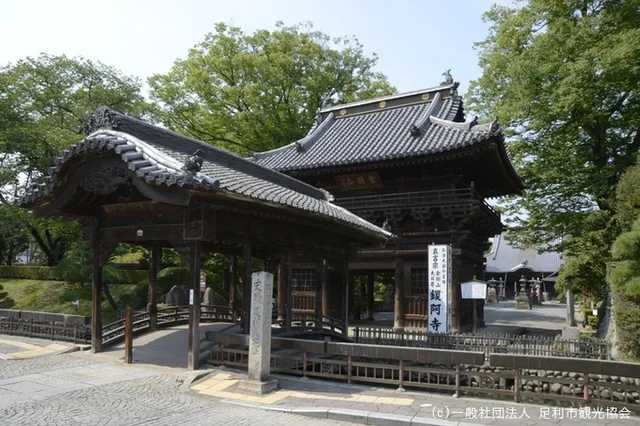
Ashikaga Residence is one of Japan’s 100 Famous Castles, but the easiest way to misunderstand it is to stand in front of Banna-ji Temple’s Main Hall and ask, ‘Where is the castle?’ There is no keep to find. The castle is the nearly square enclosure around you: the moat, earthworks and gate line of a medieval warrior residence that later became Banna-ji. If you want photogenic towers, this stop can feel understated. If you collect the 100 Castles or want to understand what a Kamakura-period samurai residence actually looked like, it is one of the clearest places on the list.
For 2026, the main planning problem is not admission but timing. The temple grounds are free, and the 100 Castles stamp is kept at the temple office beside the Main Hall, where amulets are sold. The current official tourism information gives the stamp location but does not publish one fixed year-round stamp window on the same page. That means the safe order is simple: deal with the stamp first, then spend the flexible part of your visit walking the moat and earthworks.
30-second decision: stamp run, first proper visit, or a wider Ashikaga history walk?
↔ Scroll table left or right
Your goal | Best order | Time to allow |
Complete the castle stamp with minimum risk | Temple office first → Taiko Bridge and moat → earthworks | About 45–60 minutes |
Actually understand Ashikaga Residence | Taiko Bridge → outer moat and earthworks → Main Hall → stamp | About 75–90 minutes |
Add Ashikaga’s wider medieval history | Ashikaga Residence → Ashikaga School | About 2–2.5 hours |
Visiting during the 2026–27 roof works | Keep Banna-ji as the priority; add Ashikaga School only after checking the restricted areas | Adjust on the day |
If you are choosing a day trip from Tokyo rather than collecting castles specifically, compare it against the bigger alternatives first in Tokyo Day Trips Compared. Ashikaga Residence is not a default first-trip choice. It makes more sense when medieval history, the Ashikaga clan or the 100 Castles project is already part of your reason for going.
Why is a Buddhist temple on a castle list? Because Banna-ji sits inside the former Ashikaga clan residence
The Japan Castle Foundation lists Ashikaga Residence as a flatland castle dating from the late Heian to early Kamakura period and associates its construction with Ashikaga Yoshikane. Today the site is Banna-ji Temple. Yoshikane built a private Buddhist hall inside the residence in 1196, and the third-generation Ashikaga Yosh氏 developed the temple complex further. The religious site grew, but the enclosure did not disappear.
Ashikaga City describes the historic residence as a large, almost square enclosure of roughly 40,000 square metres, surrounded by a moat and earthworks. That geometry is the key to the visit. You are not visiting a temple and then looking for a castle ruin next door; the temple precinct itself occupies the former fortified residence. If you photograph only the Main Hall and skip the perimeter, you miss the feature that explains why this place belongs on the castle list.
Walk the moat before the Main Hall if you want this ‘castle without a keep’ to make sense
Ashikaga Residence rewards the opposite approach from a castle such as Himeji or Matsumoto. At those sites, the keep gives you an immediate visual anchor. Here, the outer frame has to do that job. Start around Taiko Bridge, identify the water-filled moat, notice the rise of the earthworks and keep the almost-square plan in mind before you move deeper into the temple grounds.
That sequence changes the experience. If you tour Banna-ji exactly as you would any old temple and only afterwards try to find ‘the castle,’ the history can feel abstract. Once you have mapped the moat and earthworks in your head, the Main Hall, bell tower and sutra hall become later layers inside a much older defensive enclosure rather than unrelated religious buildings.
The 100 Castles stamp is at the Main Hall temple office — but do not assume temple access equals stamp access
Ashikaga City Tourism Association currently states that the stamp is at Banna-ji’s temple office beside the Main Hall, at the amulet counter. What the same official information does not give is a single fixed stamp time that can safely be applied to every day of the year.
That distinction matters most if you arrive late. The outdoor enclosure may still be physically walkable even when the office is no longer handling visitors. For a stamp-focused visit, reverse the usual sightseeing instinct: confirm the office first, then use the moat, earthworks and outdoor precinct as the flexible part of the schedule. If you expect to reach Ashikaga in the late afternoon, recheck the temple or tourism association information before departure.
The grounds are free, but that does not mean every interior is freely open
Banna-ji’s grounds are currently free to enter, so you do not need a ticket simply to understand the castle enclosure or collect the main outdoor evidence. The Issaikyo Hall has a separate ¥300 admission when it is open on Sundays and public holidays. Interior visits to the Main Hall and Issaikyo Hall with a priest are a different, paid, advance-reservation arrangement and can be affected by temple ceremonies.
For castle collectors, none of those paid options should be treated as mandatory. The decision changes if your interest is Buddhist architecture, the Ashikaga clan’s family temple or the National Treasure Main Hall. In that case, check what is actually open on your date rather than assuming every historic interior is part of normal free entry.
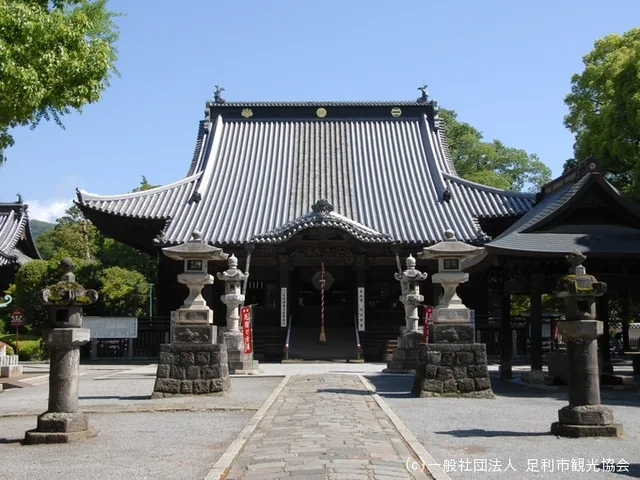
The National Treasure Main Hall is not a side attraction — it connects the residence to the Ashikaga clan’s own story
Ashikaga Yoshikane established a Buddhist hall within the residence in 1196. The present Main Hall was rebuilt in 1299 by Ashikaga Sadauji, father of Ashikaga Takauji, the founder of the Muromachi shogunate. Ashikaga City describes it as an important medieval esoteric Buddhist hall that also adopted then-new Zen-style architectural techniques.
That is why the site works better as a layered historical visit than as a search for surviving fortifications alone. Inside one square enclosure you can read the residence’s defence, the Ashikaga clan’s religious life and the architectural legacy that remained as the family rose in national importance. It is visually quieter than a reconstructed keep, but historically much denser.
45, 90 or 150 minutes? The less time you have, the more important it is to handle the time-sensitive part first
↔ Scroll table left or right
Time available | Suggested route | Best for |
About 45 minutes | Temple office and stamp → Taiko Bridge → quick moat and earthworks circuit | Collectors and transfer days |
About 90 minutes | Taiko Bridge → outer earthworks and moat → Main Hall and key buildings → stamp | First-time visitors who want to understand the site |
About 150 minutes | Full Ashikaga Residence circuit → Ashikaga School | Medieval-history travellers |
Late-afternoon arrival | Check whether the temple office can still handle the stamp → use outdoor remains afterwards | Anyone who cannot risk missing the stamp |
These are planning estimates, not official standard visit durations. The logic is risk-based: do the activity that depends on a staffed counter first, then use the free outdoor remains as your flexible buffer. The site is compact enough that the biggest failure mode is not running out of walking time; it is spending too long outside and only then discovering that the office is no longer available.
Ashikaga School is only a short walk away, but the 2026 roof works make it an optional add-on rather than an automatic one
In a normal year, Banna-ji and Ashikaga School make a natural pair in the historic centre. Ashikaga School currently charges ¥480 for a standard adult visit. Reception runs from 9:00 to 16:30 from April through September and from 9:00 to 16:00 from October through March. If you have around two hours or more, combining the warrior residence with the historic school gives the old town much more context.
The important 2026 exception starts on 21 August 2026. Ashikaga City plans to rethatch the Hojo building’s roof through 25 March 2027. During the works, the Hojo interior, the route in front of the south garden and other nearby areas will be partly restricted, and the city notes that the schedule can change with construction progress. If Ashikaga Residence is your main target, do not sacrifice a proper Banna-ji visit just to force the school into the day during the restricted period.
JR Ashikaga Station and Tobu Ashikagashi Station are different stations — decide your railway before you decide your walk
Ashikaga City Tourism Association currently gives a simple planning figure: around 10 minutes on foot from JR Ashikaga Station on the Ryomo Line and around 15 minutes from Tobu Ashikagashi Station on the Tobu Isesaki Line. The station names look deceptively similar, and they sit on different sides of the Watarase River, so it is easy to apply the wrong walking time or return timetable to the wrong station.
From Tokyo, the practical question is therefore not ‘Which Ashikaga station appears first on the map?’ but whether you are using the Tobu or JR network for the day. Once you are in the historic centre, Banna-ji and Ashikaga School are easy to combine on foot. You do not need a rental car for the castle visit itself.
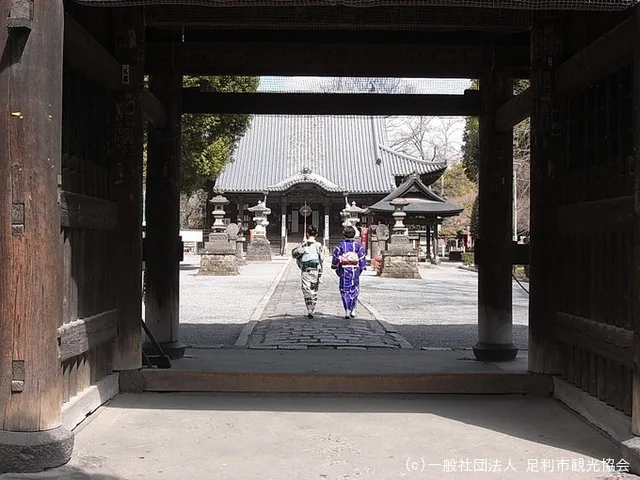
Is it worth a dedicated trip from Tokyo? Not for a dramatic castle photo — yes for the Ashikaga clan and medieval history
If this is your first Tokyo trip and you are considering Ashikaga only because it looks reachable on the map, I would not put it ahead of Kamakura, Nikko or Kawagoe. There is no giant keep, no high observation point and no single postcard view that immediately justifies the travel time.
The calculation changes completely if you are collecting Japan’s 100 Famous Castles or already care about the Ashikaga clan and the transition from the late Kamakura period into the Muromachi world. Within a compact walking area you can combine a medieval warrior-residence plan, a National Treasure temple hall and Ashikaga School. That historical density is something a large reconstructed castle cannot automatically reproduce.
If you are planning this as an autumn day trip, use Tokyo Autumn Day Trips Compared to decide whether you actually want a history-heavy day or would rather spend the day on foliage, pampas grass, kochia or an onsen route. Ashikaga Residence is strongest when you accept that trade-off instead of expecting both maximum scenery and maximum historical depth from the same half-day.
Ashikaga Flower Park is not an automatic add-on: it is worth combining only when the flower season is part of the trip
Many travellers associate the name Ashikaga with Ashikaga Flower Park, especially during wisteria season. The park and Ashikaga Residence do not form one walkable historic cluster, and the flower park is not necessary for understanding the castle site. If flowers are the main reason for your day trip, build the day around bloom timing and park access first, then see whether the historic centre still fits.
Castle collectors should make the opposite decision. You do not need to add the flower park simply because you are already in Ashikaga. The cleanest historical pairing is Banna-ji plus Ashikaga School. Add the flower park only when the seasonal display itself is worth the extra eastward movement and the additional time.
Do not buy a tour just because it says ‘Ashikaga’ — check what problem the product actually solves
A fresh search shows that Klook’s Ashikaga inventory is still dominated by Flower Park trips rather than a product built around Banna-ji or the castle site. GetYourGuide does currently list a private Ashikaga highlights day tour from Tokyo that includes Banna-ji and Ashikaga School, but that is primarily a transport-and-guide convenience product. It is not a ticket you need in order to access the free castle grounds.
For travellers who are comfortable using trains and walking, the self-guided version remains straightforward and much cheaper. A private tour only becomes a rational upgrade if door-to-door transport, an English-speaking guide and combining several dispersed Ashikaga stops are worth paying for. ValueNavi therefore does not force a booking CTA into this article without a verified matching affiliate deep link.
Verdict: the point is not whether Banna-ji ‘looks like a castle’ — it is why the temple still preserves the skeleton of a warrior residence
Ashikaga Residence is best for three groups: travellers collecting Japan’s 100 Famous Castles, visitors interested in the Ashikaga clan or medieval warrior society, and people willing to read moats and earthworks rather than judging a castle by the size of its keep. It is weakest for travellers who want a spectacular castle skyline or who are trying to squeeze every reachable Kanto destination into a first Tokyo itinerary.
Four rules are enough before you go: confirm the stamp at the Main Hall temple office first; read Taiko Bridge, the moat and earthworks before treating Banna-ji as an ordinary temple; remember that free grounds do not mean every staffed or interior area has the same access conditions; and from 21 August 2026 through the planned 25 March 2027 work period, do not assume a full Ashikaga School visit will operate exactly as usual. Follow those rules and the site stops looking like an odd temple on a castle list — it becomes one of the best places to understand what a medieval warrior residence actually was.
Official sources and verification date
Japan Castle Foundation, Japan’s 100 Famous Castles official list: confirms Ashikaga Residence as an official selection, classified as a flatland castle associated with Ashikaga Yoshikane.
Ashikaga City Tourism Association, Banna-ji and 100 Castles FAQ: confirms the stamp location at the Main Hall temple office, free grounds, current access estimates from JR Ashikaga and Tobu Ashikagashi stations, and the conditional ¥300 Issaikyo Hall admission.
Ashikaga City cultural-property pages: confirms the square moat-and-earthwork enclosure, roughly 40,000-square-metre residence site, and the history and National Treasure status of Banna-ji’s Main Hall.
Historic Ashikaga School official pages: confirms the current ¥480 adult fee, seasonal reception hours and the planned 21 August 2026–25 March 2027 Hojo roof rethatching works with partial access restrictions.
Information last verified: 20 August 2026. Temple-office stamp handling, temple ceremonies, Issaikyo Hall opening, Ashikaga School construction and temporary closures can change; recheck the official Banna-ji, Ashikaga tourism and Ashikaga School notices before departure.