
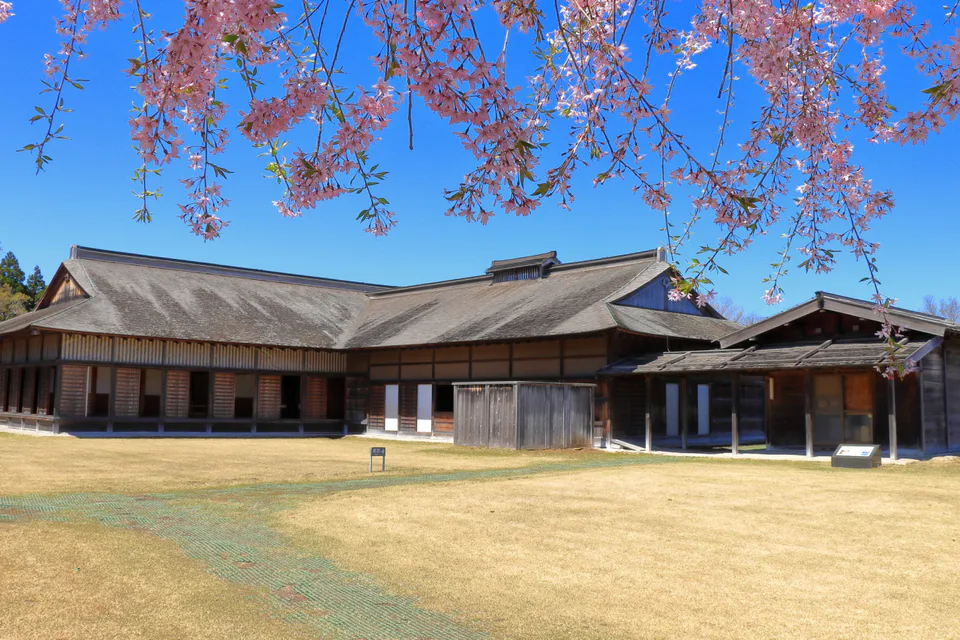
Nejo Castle is a poor choice if your definition of a Japanese castle starts with a keep, stone walls and a panoramic tower. It is a much better choice if you want to see how a medieval fortified residence actually worked. The paid main bailey reconstructs halls, workshops, stores, barns and stables from archaeological evidence, while the wider site preserves the relationship between baileys, earthworks and former defensive ditches.
ValueNavi verdict: if Hachinohe is already on your route, allow 60–90 minutes and pay the ¥250 adult main-bailey admission (about US$1.57 at the 27 August 2026 reference exchange rate). If you only need the Japan 100 Famous Castles No.5 stamp, an outdoor stamp beside Hachinohe City Museum is accessible outside opening hours. But do not confuse “I can stamp at night” with “I have seen Nejo.” The reconstructed main bailey is the information-rich part of the visit, and it closes at 17:00 with last admission at 16:30.
Choose between three different Nejo visits before you travel
↔ Scroll table left or right
Your goal | Best plan | Cash cost | Main trade-off |
No.5 stamp only | Use the outdoor stamp beside Hachinohe City Museum | ¥0 | You complete the collection task but miss the reconstructed castle-life spaces |
First castle-focused visit | Paid main bailey + free earthworks | ¥250 adult / ¥150 high-school & university | You need 60–90 minutes in daylight, not merely a quick photo stop |
Medieval history / archaeology | Main bailey + slower full-site walk, optional volunteer guide when available | ¥250 plus time | The real cost becomes 2 hours or more |
First Tohoku trip with only a few days | Skip unless Hachinohe is already a base or transfer point | ¥0 saved is irrelevant | The opportunity cost may be Oirase, Hirosaki or another higher-priority first-trip stop |
ValueNavi Score: high information gain, but only when Hachinohe already fits your route
The scores below use ValueNavi’s seven attraction-decision dimensions. Higher is better; resilience scores mean the visit is harder to derail. This is editorial analysis based on verified public information, not an official castle rating.
↔ Scroll table left or right
Dimension | Score | Why |
Money value | 9.6/10 | The main bailey is only ¥250 and the wider grounds/stamp can be used without a main-bailey ticket |
Time efficiency | 7.6/10 from Hachinohe | The bus ride is short, but a meaningful visit still needs 60–90 minutes plus the return-bus buffer |
Booking / access resilience | 9.2/10 | No reservation is normally required and the outdoor No.5 stamp remains usable outside opening hours |
Weather resilience | 6.4/10 | Reconstructed interiors help, but understanding the baileys and earthworks still requires outdoor walking |
Crowd resilience | 9.0/10 | The site is broad and usually easier to read than a compact keep interior; event weeks are the exception |
Route fit | 8.6/10 if Hachinohe is already on the itinerary; 5.4/10 as a special detour | Its value changes more with your regional route than with the ¥250 admission |
Uniqueness | 9.1/10 | Few castle visits make medieval household, production and logistics functions this legible |
Overall planning score: 8.4/10 from a Hachinohe base. The score falls substantially if you cross northern Tohoku solely for Nejo. This is a high-value specialist stop, not a universal first-trip priority.
The biggest 2026 planning mistake: Hachinohe City Museum is closed, Nejo is not
Hachinohe City Museum entered a long renovation closure on October 6, 2025 and is currently scheduled to remain closed through June 30, 2027. The city explicitly states that adjacent Nejo no Hiroba remains open, and that some museum-side services — including the Japan 100 Famous Castles stamp — continue during the closure.
This invalidates an older “museum + castle” planning pattern. A combined-ticket price may still appear on static information pages, but that does not mean you can tour both facilities normally in 2026. Build the visit around Nejo itself. Do not reserve museum time just because an older itinerary tells you the two attractions are a natural pair.
The 24-hour stamp solves a collection problem, not a sightseeing problem
Hachinohe City’s current FAQ says the official No.5 stamp is installed outside the museum entrance, so it can be used outside business hours. The main-bailey window is another stamp point during normal operation.
That makes Nejo unusually resilient for collectors: a late train does not automatically ruin the stamp task. But the reconstructed main bailey operates 09:00–17:00 with last admission at 16:30. If you arrive at 19:00, you have salvaged the stamp, not the castle visit. For anyone interested in why Nejo belongs on the original 100 Famous Castles list, daylight main-bailey time is the better default.
Why paying ¥250 changes the visit more than the price suggests
The paid main bailey is where Nejo’s editorial value becomes clear. The adult ticket is ¥250, around US$1.57 at the reference exchange rate; high-school and university admission is ¥150, around US$0.94. Exchange rates move, so plan around the yen prices.
Saving ¥250 by staying only in the free area can be rational when you have 30 minutes before a train. It is poor value when you already spent the transport time to reach Nejo and have another hour available. The reconstructed main hall, workshop, stores, barns and stables are not decorative extras: they explain governance, craft production, storage and horses inside a fortified residence.
Decision rule: if you have at least 60 minutes on site and medieval castle life interests you, pay the ¥250. If you have only a tight transport gap, protect the stamp and free earthworks instead of sprinting through every room because the ticket is cheap.
No keep is not a missing attraction — it is the wrong expectation
Nejo traces its origins to 1334 and Nanbu Moroyuki. The current site is an archaeological reconstruction rather than a surviving medieval building complex. Its strength is that excavation evidence was used to reconstruct a working late-medieval castle residence instead of adding a fantasy tower to make the skyline more dramatic.
The useful viewing sequence is therefore functional: main hall → workshop → stores/barns/stables → step outside and connect those spaces to the bailey boundaries and earthworks. If you photograph only the thatched roofs, the site can look like an open-air set. If you ask what each space allowed the lord’s household to do, the reconstruction becomes a diagram of how the stronghold operated.
From Hachinohe Station, the bus fare is now ¥250 — check the return before entering
Current Hachinohe public-transport information lists the adult fare from Hachinohe Station to Nejo (Museum-mae) at ¥250, and city-centre-bound services depart from the station’s east-side boarding area. The ride is short enough that Nejo works without a rental car.
The hidden cost is the return timetable. If you have a fixed Shinkansen or onward train, identify the bus you need back before entering the paid main bailey. A ¥250 ticket and a short outbound ride do not make a missed rail connection cheap.
If Hachinohe is acting as your northern-Tōhoku base, use where to stay in Aomori, Hachinohe or Hirosaki to decide whether this city already belongs in the route. If you are continuing toward Oirase, the Lake Towada and Oirase two-day itinerary is the better place to decide whether Nejo belongs on arrival day or departure day.
30, 90 or 120 minutes: three rational versions
↔ Scroll table left or right
Time on site | Best use | What to cut |
30–45 min | Outdoor stamp + free baileys/earthworks | Do not buy the main-bailey ticket and rush every reconstruction |
60–90 min | Main bailey + main hall + workshop/storage spaces + stamp | Skip a full outer-site circuit |
~2 hours | Main bailey + free area + slower archaeological interpretation | Do not add time merely to “complete” every signboard |
A volunteer guide can add value because Nejo does not announce its key features from a skyline. If guiding is available on your date and you have the extra time, it can help connect earthworks, bailey boundaries and reconstructed functions. On a transfer day, however, the 60–90 minute self-guided version is the safer default.
Seasonal events can improve route fit, but they should not manufacture a trip
Nejo uses seasonal free-entry and event periods, including spring and ginkgo programmes. Those dates are time-sensitive. The 2026 spring free-entry period is already over, so it should not be presented as a current benefit in late August. If you are planning around a future Ginkgo Week or another event, verify the current official event notice rather than copying last year’s dates forward.
If autumn foliage is the reason for the wider trip, do not let a lowland castle event dictate the mountain schedule. Use the Tohoku autumn leaves timing guide first, especially if the same itinerary includes Hakkoda or Oirase, where weather and elevation create much harder timing constraints.
Who should skip Nejo?
Skip it if this is a short first Tohoku trip and your remaining time is competing with Oirase, Hirosaki, Hakkoda or another destination you care about more. Also skip it if your only castle interest is surviving architecture and tall keeps. Nejo is not underperforming in those categories; it is simply solving a different historical question.
The answer reverses for Japan 100 Famous Castles collectors, medieval-history readers and travellers interested in archaeological reconstruction. Nejo is valuable precisely because it corrects the idea that every important Japanese castle is best understood through a tower.
Final verdict: use the 24-hour stamp as insurance, not as the visit
Nejo is strongest as a 60–90 minute Hachinohe stop. Pay the ¥250 if you have enough time to enter the reconstructed main bailey, because that is where the site’s governing, production and household functions become legible. Use the outdoor 24-hour stamp when transport goes wrong, not as a substitute for daylight interpretation.
The red-team case is a traveller crossing northern Tohoku solely for No.5 without any other Hachinohe reason. In that case, the route-fit score drops enough that I would not manufacture a special overnight stop unless castle collecting is a priority. When Hachinohe is already on the itinerary, however, Nejo gives unusually high information gain for very little cash.
Official facts to recheck before travel
Current opening hours and ¥250 / ¥150 admission: Hachinohe City — Historic Site Nejo no Hiroba. Long Hachinohe City Museum renovation closure and the fact that Nejo remains open: Hachinohe City — museum renovation notice. After-hours No.5 stamp: Hachinohe City — cultural-facility FAQ. Current Hachinohe Station → Nejo fare: Hachinohe public-transport portal. Recheck the event calendar and return bus for your exact date.