
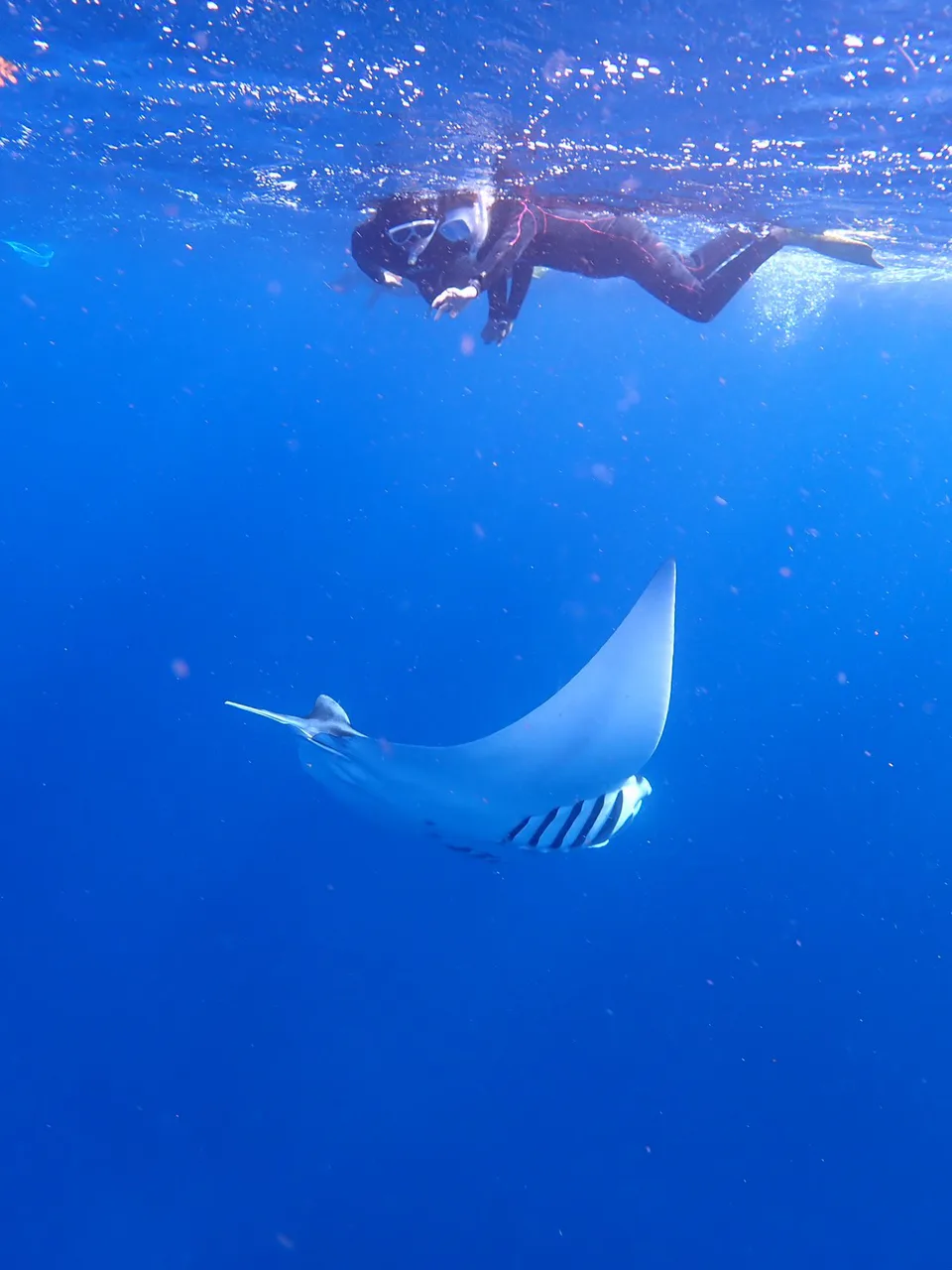
Choose a dedicated Ishigaki manta ray snorkeling tour only if seeing a wild manta is important enough that you would still accept the trip when no manta appears. If your real goal is simply a good first snorkeling half-day with coral, fish, photos and a more predictable main attraction, Blue Cave or Phantom Island is the lower-regret choice. The key difference is not necessarily price: current local operators can charge similar amounts for manta snorkeling and Phantom Island snorkeling. The difference is outcome variance.
That distinction matters because manta rays around Ishigaki are wild. VISIT OKINAWA JAPAN says reef mantas frequent the island’s waters throughout the year, with July to mid-October offering the best chances; its Yaeyama dive-site guide describes Manta Scramble as especially favorable from roughly April to November. Neither statement is a sighting guarantee for your exact half-day.
If Ishigaki, Taketomi and Iriomote are not yet placed into the trip, start with the 4-day Yaeyama itinerary. A wildlife half-day should fit the trip; it should not force every ferry, hotel and weather-sensitive activity to move around it.
ValueNavi decision table: choose by disappointment risk, not the product photo
↔ Scroll table left or right
Experience | Main thing you are buying | Outcome risk | Best for |
Dedicated Manta Point snorkel | Chance to observe wild manta rays at a known cleaning/feeding area | High: the animal may not appear and sea access can change | Manta is a real bucket-list objective |
Blue Cave snorkel | Cave/coastal setting + coral/fish | Medium: sea conditions matter, but the experience does not depend on one animal | First snorkel, mixed-confidence group |
Phantom Island + snorkel | Sandbar landing + reef snorkeling | Medium: weather/tide/boat route matter, but the visual objective is more predictable | Photos, couples, families, first Ishigaki sea day |
General coral/turtle snorkel | Broad marine-life day | Low–medium: individual wildlife still varies | You want a good sea day more than one species |
ValueNavi Wildlife Outcome Score
This is editorial analysis, not an operator or tourism-board rating. Ten means more of that characteristic for a first-time visitor.
Dimension | Manta Point | Blue Cave | Phantom Island |
|---|---|---|---|
Wildlife dependence | |||
Sea-access sensitivity | |||
Fallback value if headline outcome fails | |||
Bucket-list upside | |||
Beginner predictability |
The score explains why manta snorkeling can be the best choice and still be the riskiest purchase emotionally. If the manta is the reason you flew to Ishigaki, the upside justifies that variance. If you mainly want “beautiful snorkeling,” the lower-variance alternatives are often smarter.
Current price reality: the manta premium is not universal
Older comparisons often imply that manta snorkeling must cost dramatically more than ordinary half-day snorkeling. Current local pricing shows why that is too simplistic.
Sea Water Diving Service in Kabira currently lists its roughly three-hour manta snorkeling course at ¥8,800 (about US$55), including rental equipment, wetsuit, instruction, boat and staff support. The shop states that its departure from Sukuji Beach is about five minutes by boat from the manta area. Pushynushima Ishigaki currently lists Phantom Island landing + snorkeling at the same ¥8,800 adult price.
The useful comparison is therefore not “manta costs 1.8× more.” Price varies by operator, departure point, pickup, duration and inclusions. In some cases the manta product costs about the same as a sandbar snorkel; what you are accepting is a different risk profile.
JPY remains the booking reference. USD estimates use roughly ¥1,000 ≈ US$6.27 on August 27, 2026 and are only for orientation.
Season has two layers: manta presence and Manta Point access
VISIT OKINAWA JAPAN says huge reef mantas frequent Ishigaki waters throughout the year, with July to mid-October offering the best chances. Its Manta Scramble dive-site guide says mantas are especially likely from April to November. These can coexist: the animals may be present beyond one narrow season, while observation probability varies by site and conditions.
The second layer is access. Wind, wave height, current, cloud/rain systems and typhoons affect whether a boat can use the intended point safely. A calendar month can improve probability without guaranteeing either site access or a sighting.
↔ Scroll table left or right
Timing | Planning meaning |
Spring into early summer | Manta activity can be good; confirm the operator’s current site choice and sea conditions |
July–mid-October | Official tourism guidance identifies this as the strongest broad sighting window, but typhoon exposure also matters |
Late autumn | Manta Scramble can still be productive; north-wind days may change access |
Winter | Mantas still exist around Ishigaki, but some classic north/west sites can be harder to access depending on wind |
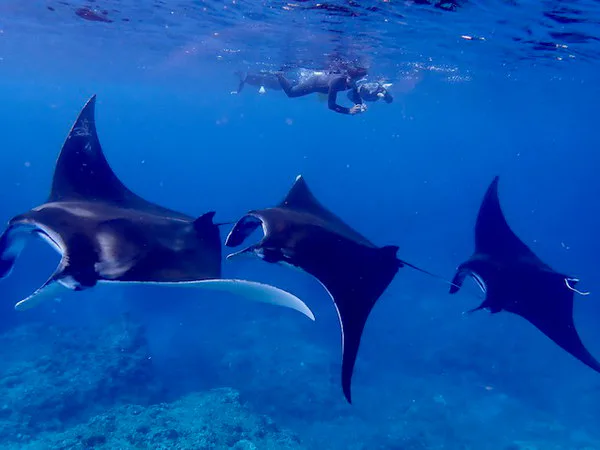
The “no manta” stress test should happen before payment
Ask one question: if no manta appears, what exactly is left?
With a strong dedicated operator, the answer may still include a boat trip from Kabira, coral, tropical fish, instruction and open-water snorkeling. If that still sounds like a good half-day, the tour passes the stress test. If your answer is “nothing—I would feel the whole payment was wasted,” your satisfaction is too dependent on a wild animal performing on schedule.
Blue Cave and Phantom Island are not risk-free, but their headline value is less biologically binary. A cave is still a cave if no turtle swims past. Phantom Island is still a sandbar-and-reef experience if no rare animal appears.
Manta Point is not a shore-swimming shortcut
Manta observation around Kabira is a boat-guided activity, not something to improvise by entering from shore. The local snorkeling guidance around Ishigaki warns that Manta Point sits away from shore, boats operate in the area and currents can carry swimmers toward open ocean. Use an operator that makes the sea-condition decision for the day.
That is also why a cheap DIY comparison is misleading. You are paying not only for fins and a boat seat, but for access judgment, briefing, flotation/safety structure and the decision to change or cancel the point when conditions are unsuitable.
Boat time can matter more than the species if you get seasick
Not every manta trip has a long boat ride. Sea Water’s current Kabira setup is a useful counterexample: it states roughly five minutes by boat from Sukuji Beach to the manta area and an overall tour of about three hours. Other operators departing from Ishigaki City can spend materially longer getting to northern/western sites.
This means “manta tour” is not one transport product. If seasickness matters, compare departure coast and boat time before comparing photos. A more expensive or less centrally located operator may still be the better fit if it dramatically reduces time on the boat.
First-time snorkelers: choose the safety structure before the animal
A current Kabira manta operator builds shallow-water practice into the experience before going offshore. That is exactly the kind of detail a nervous first-timer should prioritize: where the briefing happens, flotation, guide support, how the group enters the water and what happens if someone is uncomfortable.
If one member of the group is genuinely afraid of deep water, do not use “but mantas are gentle” as a reason to push them into the offshore plan. Choose a more forgiving first snorkel and make manta a second-trip objective.
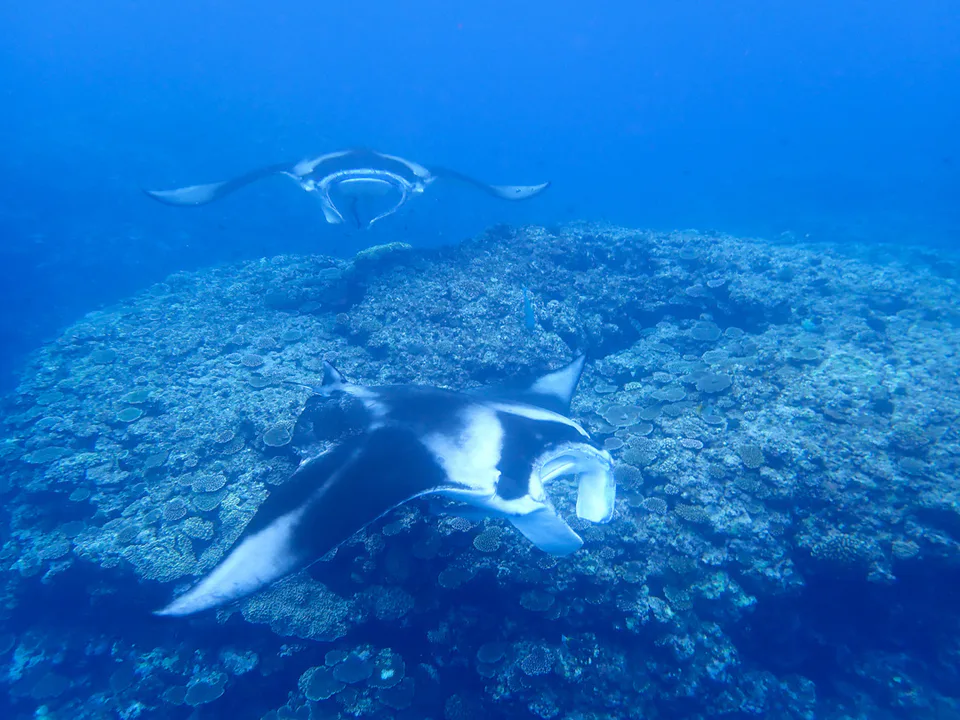
Do not buy three versions of the same sea day
A common Okinawa itinerary quietly accumulates Kerama snorkeling, Okinawa Blue Cave, Ishigaki manta snorkeling and perhaps Miyakojima turtle snorkeling. Each is different, but they compete for the same scarce resources: half-days, boat tolerance, wet-gear fatigue and weather windows.
If you already have the Okinawa Blue Cave and a Kerama marine day, the Ishigaki manta tour should stay only if manta itself adds something those experiences cannot. Fame alone is not enough.
Half-day vs full-day: more activities do not improve manta odds automatically
A full-day package can be excellent when it removes transport coordination and combines two activities you already wanted. It does not become better simply because it contains more nouns in the title. If your only objective is Manta Point, a half-day creates a valuable fallback: if the morning finishes without manta, the afternoon is still available for Kabira Bay, Taketomi or a land-based plan.
A full-day combo makes more sense when you would independently pay for both components. Otherwise, “two activities for one booking” is packaging, not necessarily value.
Where this belongs in a four-day Yaeyama trip
Put the manta half-day early enough that you have another weather window later, but not so early that it breaks arrival logistics. For a four-day trip, a morning or afternoon on Ishigaki that can swap with a land-based Kabira/Tamatorizaki block is more resilient than placing the tour immediately before a ferry or flight.
If your dates are weather-sensitive, keep the Okinawa rainy-day and typhoon Plan B ready. A good wildlife itinerary contains a real substitute, not merely the hope that another operator will run in the same rough sea.
Four NO-GO cases
NO-GO 1: the word “manta” on the product title has become a guaranteed-outcome promise in your head.
NO-GO 2: someone in the group is frightened of open water or strongly seasick, and nobody has checked departure point or boat time.
NO-GO 3: you already booked several other snorkeling days and cannot explain why manta specifically deserves another one.
NO-GO 4: the tour ends immediately before an inter-island ferry, flight or other hard deadline.
Final verdict: buy the manta objective, not the word “snorkeling”
Choose the dedicated manta tour when the possibility of a wild manta encounter is worth accepting a no-sighting outcome and sea-access uncertainty. Choose Blue Cave or Phantom Island when you want the half-day itself to remain satisfying even if no particular animal appears. Choose a general coral/turtle snorkel when the group’s priority is simply a good marine experience with less emotional dependence on one species.
The strongest new price lesson is that manta snorkeling is not always the expensive option. A current Kabira manta snorkel and a current Phantom Island snorkel can both sit around ¥8,800. The real premium is the risk you are taking with your expectations. If you are comfortable with that risk, manta snorkeling is one of Ishigaki’s most distinctive wildlife decisions. If you are not, choose the experience whose core value exists even when nature ignores the itinerary.
Next decision: place the manta half-day into your Yaeyama itinerary
Sources and current checks
Season, operator details and prices rechecked August 27, 2026. Wild-animal sightings and sea access are never guaranteed.
VISIT OKINAWA JAPAN — Ishigaki Island, manta presence and broad best-chance season
VISIT OKINAWA JAPAN — Manta Scramble and April–November high-chance guidance
Pushynushima Ishigaki — current Phantom Island landing + snorkeling reference price