
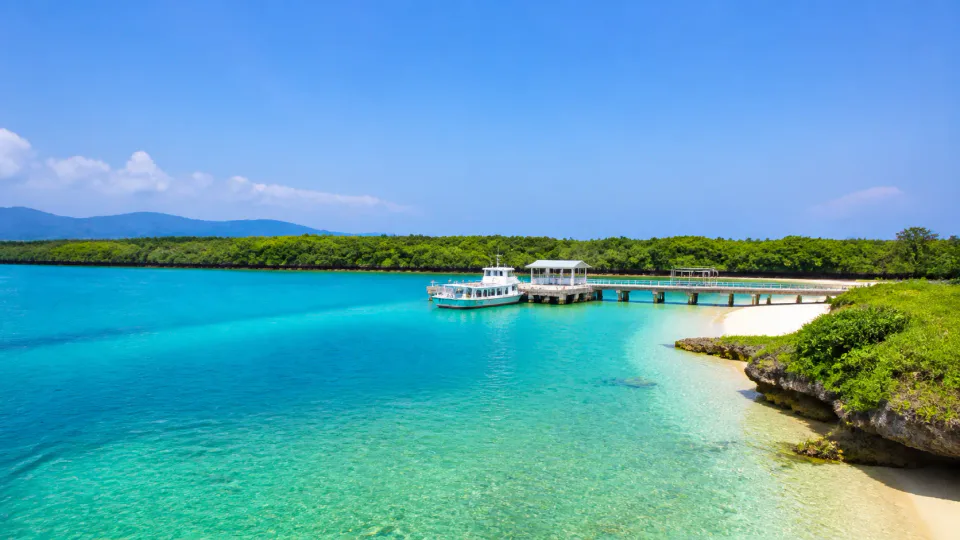
For four days, keep Ishigaki as the default hotel base and let only one day depend heavily on Iriomote transport. Use one road day for Kabira Bay and northern Ishigaki, one full Iriomote nature day, and Taketomi as the flexible half-day that can move or disappear when ferries or the flight demand it. The key upgrade to this itinerary is to stop treating “Iriomote ferry” as one risk: Uehara and Ohara are different ports with different sailing frequency and different recovery options.
In Yaeyama Kanko Ferry’s current March 1–September 30, 2026 timetable, the Taketomi route has frequent 10–15-minute crossings, the Iriomote Ohara route has six published Ishigaki departures, and the Uehara route has four. The same timetable notes a shuttle-bus service from Ohara toward Uehara when the Uehara route is cancelled. Taketomi Town Tourism Association likewise says a free shuttle may operate from Ohara when Uehara ferries are cancelled in bad weather. That makes your tour meeting port a first-order itinerary decision, not a detail to check after buying the ferry.
↔ Scroll table left or right
Day / decision | Best default | Why |
Arrival day | Stay on Ishigaki | The airport has bus links to downtown and the ferry terminal; a delayed flight should not put the first hotel or final ferry at risk |
Ishigaki road day | Kabira + one north-coast line | The car earns a full geographic job instead of sitting parked on ferry days |
Iriomote day | Choose the activity and meeting port first | Uehara and Ohara have different sailing patterns; the wrong port can create an island-crossing problem before the activity starts |
Taketomi | Use it as the flexible half-day | The crossing is short and frequent enough that it is easier to move than an Iriomote nature booking |
Departure day | Stay on Ishigaki unless the flight is late and ferry margin is large | A ferry delay should cost a sightseeing block, not the flight home |
Considering an Iriomote overnight | Add it only for a specific early/late island benefit | Four days are short; a second hotel should unlock time that a day trip cannot buy, not merely prove you slept on another island |
Why Ishigaki should remain the hotel base for most four-day trips
Ishigaki is not just the biggest island in this itinerary. It is the recovery platform. New Ishigaki Airport’s official transport map lists several route buses toward downtown, the bus terminal and ferry terminal, including a direct Airport–Ferry Terminal service. From the port, Taketomi and Iriomote branch in different directions. That means one Ishigaki hotel can absorb a late flight, a cancelled island ferry and a changed road day without forcing another accommodation change.
The alternative is seductive on paper: one night Ishigaki, one night Iriomote, one night somewhere else. In four days, however, every move adds checkout, luggage handling, ferry timing, a new check-in and another place where weather can interrupt the plan. A second hotel is worth adding only if it buys a time window that a day trip cannot realistically reproduce.
For Iriomote, that could mean an early-morning nature activity, a specific evening experience or a slower two-day island programme. For Taketomi, it could mean deliberately wanting the village after day-trippers leave and before they return. If the only benefit is “we get to sleep on the island,” keep Ishigaki as the base and spend the saved transfer time on the island itself.
Day 1: do not make the arrival flight compete with a ferry
The airport-to-port chain is straightforward enough that travellers are tempted to continue immediately to another island. That can work with a very early arrival and a large buffer, but it is a fragile default for a four-day trip.
New Ishigaki Airport’s current official transport information shows both route-bus and direct-bus links toward downtown and the ferry terminal. Use that connectivity to reach the hotel, learn the terminal and solve dinner. If the aircraft lands late, baggage is slow or the bus is missed, the itinerary should lose only an easy city evening—not the ferry that leads to tonight’s hotel.
This also gives you a practical task: find the ferry counters, confirm the next day’s operator and note where the boarding point is. A nature tour at 09:30 on Iriomote is not a 09:30 departure from your Ishigaki hotel. The ferry, port arrival, island-side transfer and operator check-in all sit before it.
Day 2: give the rental car one complete Ishigaki job
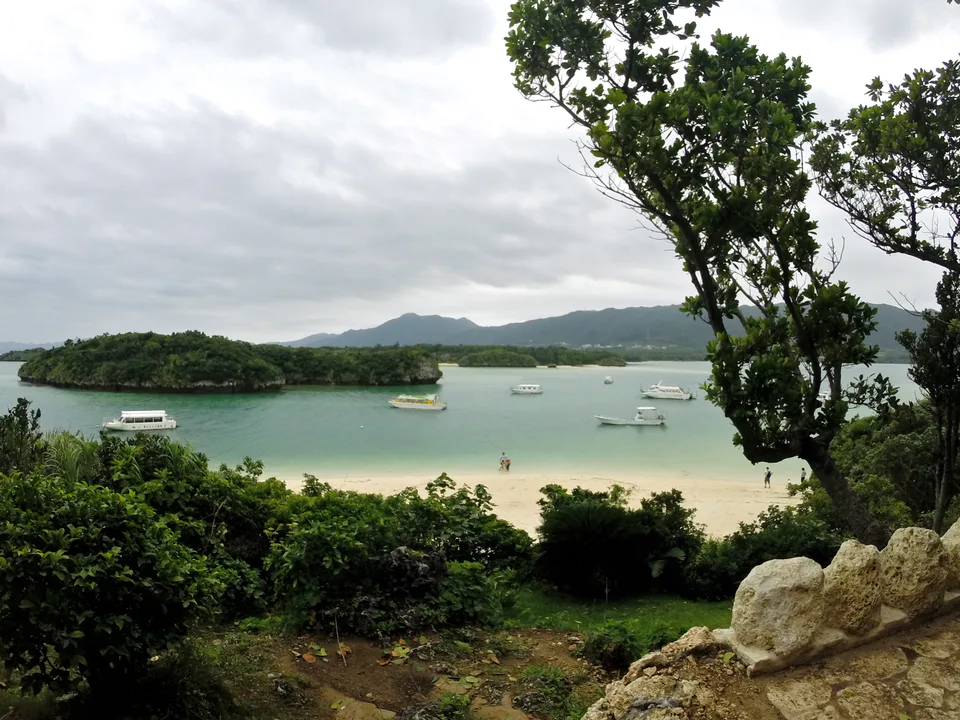
Kabira Bay and northern Ishigaki are the natural car day because this is the part of the four-day trip that does not need a ferry. Rent the car for the road block you actually need rather than automatically paying for four days of parking while you spend two days on other islands.
Kabira Bay deserves more than a photo stop, but it is not a normal swimming beach. Add one coherent north-side route rather than collecting every cape. Food, fuel, toilets and daylight become more important as you move away from Ishigaki city. Set the turn-back time before the group is tired.
The key decision is whether the car solves a full day or merely creates another piece of luggage and parking administration. If Day 3 is Iriomote and Day 4 may be Taketomi, a one- or two-day rental can be more rational than holding the car throughout. Recheck branch hours and return procedure against the Okinawa car-rental guide.
Day 3: choose the Iriomote activity before you choose the ferry
This is the most important correction in the itinerary. Iriomote has two principal ferry gateways in this comparison: Uehara on the west/north-west side and Ohara on the east/south-east side. A tour tied to one side of the island should not be booked as though either port is interchangeable.
Taketomi Town Tourism Association currently gives approximate fast-ferry times of 40–60 minutes from Ishigaki to Uehara and 35–40 minutes to Ohara. Yaeyama Kanko Ferry’s March–September 2026 timetable is even more useful for planning resilience: it publishes six Ishigaki departures to Ohara but four to Uehara. The exact seasonal timetable changes, but the principle survives: count the sailings that can actually deliver you to the correct side of the island.
Before buying, write down:
the tour’s exact meeting place;
whether it expects Uehara or Ohara;
the ferry you need to arrive comfortably before check-in;
the last return you are willing to rely on;
what the operator does if its preferred ferry route is cancelled.
That is more useful than asking only whether “ferries to Iriomote are running.”
Uehara cancellation does not always mean “Iriomote is cancelled”
Uehara is the more weather-sensitive planning branch in many itineraries because sea conditions can cancel that route while Ohara still operates. The current Yaeyama Kanko Ferry timetable explicitly notes shuttle-bus service from Ohara toward Uehara during a Uehara-route cancellation. Taketomi Town Tourism Association says a free shuttle may operate from Ohara in that situation.
That is a recovery path, not permission to ignore your tour logistics. The bus adds time across Iriomote, and your activity operator may have a specific instruction, pickup or cancellation policy. If a morning tour assumes a particular Uehara ferry, do not independently switch to Ohara and hope to arrive on time. Contact the tour operator and follow its plan.
The derived decision is important: a Uehara-side tour has a different transport risk profile from an Ohara-side tour even when the activity itself looks similar. A traveller with only one Iriomote day should compare not only waterfalls or mangroves but the route resilience of reaching the meeting point.
Do not use the last ferry as your planned return
In the current March–September 2026 Yaeyama Kanko Ferry timetable, the last published Uehara departure back to Ishigaki is 17:05, the last Ohara departure 17:35, and the last Taketomi departure 17:50. These are timetable facts for that seasonal period, not universal year-round cutoffs.
For a guided Iriomote day, the operator should normally structure the return around realistic transport. For an independent day, deliberately choose a return that leaves another workable option behind it when possible. The last ferry should be the contingency, not the plan.
This matters even more when the next morning has a flight. A ferry that arrives safely on a normal day can still be disrupted by sea conditions. Build the itinerary so an island-day problem creates an inconvenient evening, not an airline-ticket problem.
Taketomi is the flexible piece because its transport cost is lower
Taketomi Town Tourism Association gives the fast-ferry crossing from Ishigaki at roughly 10–15 minutes. Yaeyama Kanko Ferry’s current seasonal timetable also publishes frequent departures through the day. That makes Taketomi much easier to use as the adjustable half-day than Iriomote.
The island itself is small enough that walking and rental cycling are common ways to explore, with local buses also serving the port, village and beach areas. The useful itinerary role is therefore not “Day 4 must be Taketomi.” It is the half-day that can move to whichever calm, flight-compatible window remains.
If Iriomote shifts from Day 3 to Day 4, Taketomi can be deleted or moved. If the road day is rained out, Taketomi may occupy another window. If the departure flight moves earlier, Taketomi is the first island to sacrifice because the trip has already delivered a road day and a major nature day.
Departure-day Taketomi needs a stop-loss, not optimism
A late flight can make a Taketomi half-day practical, but the decision must be worked backward from the flight, not forward from the ferry schedule.
The chain is: Taketomi activity → ferry check-in → sailing to Ishigaki → move from ferry terminal to airport → airline check-in/bag drop → security. New Ishigaki Airport’s official map confirms direct and route-bus connections between the ferry-terminal/downtown area and the airport, but the existence of a bus is not a guaranteed connection for your chosen ferry.
I would only leave Ishigaki on departure day when two conditions are true: the flight is late enough that you can choose a conservative return ferry, and missing one ferry still leaves a realistic path to the airport. If the itinerary depends on the final Taketomi return sailing and a perfectly timed bus, stay on Ishigaki.
When one night on Iriomote is genuinely worth the hotel move
An Iriomote overnight should buy more than convenience. It becomes defensible when the second day creates a distinct nature block, when an early-morning activity is materially better from the island, or when the evening/early-morning atmosphere itself is part of the trip.
It is weaker when you are simply turning a full-day tour into a one-night stay without adding useful island time. In that case you pay for a ferry-day suitcase, another check-in and the possibility that weather now affects both transport and accommodation.
For a four-day first visit, the default remains Ishigaki base + Iriomote day trip. Upgrade to the overnight only when you can name the time window it unlocks. That is the same rule used for other short Japan split stays: a hotel move should create new trip value, not merely relocate the bed.
When Taketomi overnight is worth considering
Taketomi is so close to Ishigaki that transport efficiency alone rarely justifies moving. The case for sleeping there is experiential: you deliberately want the village after the day-trip rhythm drops, a quiet evening, and a morning before returning to Ishigaki.
That can be worthwhile for a slower trip, but it is difficult to justify inside a packed four-day itinerary that also includes Iriomote and a full Ishigaki road day. The second hotel consumes the same scarce luggage-and-check-in capacity that could otherwise protect ferry flexibility.
If you cannot name an evening or morning activity that depends on being on Taketomi, use it as the half-day branch from Ishigaki.
Families and older travellers should compare transfers before attractions
The three-island plan contains many small hand-offs: hotel to port, ferry boarding, disembarkation, island bus or tour vehicle, activity, ferry return, and the walk back to the hotel. A fit couple with daypacks experiences those as minor transitions. A family with a stroller or older parent may experience them as the day.
For Iriomote, choose the activity that fits walking, heat and water confidence before choosing the most dramatic waterfall name. For Taketomi, decide whether walking, cycling or a local bus fits the group. For luggage, keep the main suitcase at the Ishigaki base whenever possible rather than turning every ferry into a hotel transfer.
The Japan luggage-forwarding guide is useful for the larger Japan itinerary, but island ferry days are still easiest when the group travels with day bags.
Weather failure should shrink the route, not create a replacement ferry race
When an Iriomote sailing or activity is cancelled, use this order:
Protect the flight and Ishigaki hotel.
Ask the activity operator whether another port or day is officially supported.
If the Iriomote day moves, swap in the Ishigaki road day or Taketomi only if its own ferry conditions are good.
If sea conditions are broadly poor, stop trying to replace one island with another sea-dependent day. Stay on Ishigaki.
This is why the plan intentionally keeps Ishigaki as a meaningful destination rather than treating it as an airport and ferry terminal. A resilient island itinerary needs somewhere good to be when the sea says no.
Use the Okinawa rainy-day and typhoon guide for wider disruption logic. If live ferry status is important, prepare the Okinawa eSIM before the trip and save critical booking details offline.
Three four-day versions
A: first-time default — one base, one major ferry day
Day 1: Ishigaki city / terminal orientation. Day 2: Kabira + north road day. Day 3: Iriomote guided nature day via the correct port. Day 4: Taketomi half-day only if flight timing and ferry status are comfortable. Best for most first visits.
B: Iriomote is the real purpose
Day 1: Ishigaki. Day 2: ferry to Iriomote + first nature block + overnight. Day 3: second Iriomote block + return to Ishigaki. Day 4: Ishigaki road block or airport-safe city time. Skip Taketomi unless it fits without compressing the flight.
C: weather-first flexible version
Keep Days 2 and 3 interchangeable between the Ishigaki road day and Iriomote. Treat Taketomi as the smallest movable piece. This is the strongest structure in a forecast with mixed wind/sea conditions because only one day is structurally dependent on the longer ferry branch.
Final verdict
Four days are enough for Ishigaki, Taketomi and Iriomote when Ishigaki remains the recovery base and Iriomote gets one protected full day. Choose the Iriomote activity before the ferry, because Uehara and Ohara are not interchangeable. Treat the Uehara-cancellation shuttle as a recovery mechanism, not a self-designed connection. Keep Taketomi as the flexible half-day, and do not make the flight home depend on a final ferry.
If the plan needs three ferry-dependent days, three hotels and perfect sea conditions to work, the problem is not that four days are too short. The problem is that the itinerary has no place to fail.
Lake Towada Oirase 2 Day Itinerary: Buses, Walks, Cruise and Hotels
Beppu Hells 2-Day Itinerary: Route, Transport and Onsen Tips
5-Day Hokkaido Autumn Leaves Itinerary: Driving, Public Transport and Where to Stay

References
Yaeyama Kanko Ferry — current timetables and operating status · Taketomi Town Tourism Association — island access and Iriomote transport guidance · New Ishigaki Airport — current airport transport information. The ferry counts and times discussed above use Yaeyama Kanko Ferry’s March 1–September 30, 2026 timetable; schedules, cancellations and shuttle operation can change, so verify the exact travel date and follow the activity operator’s instructions.