
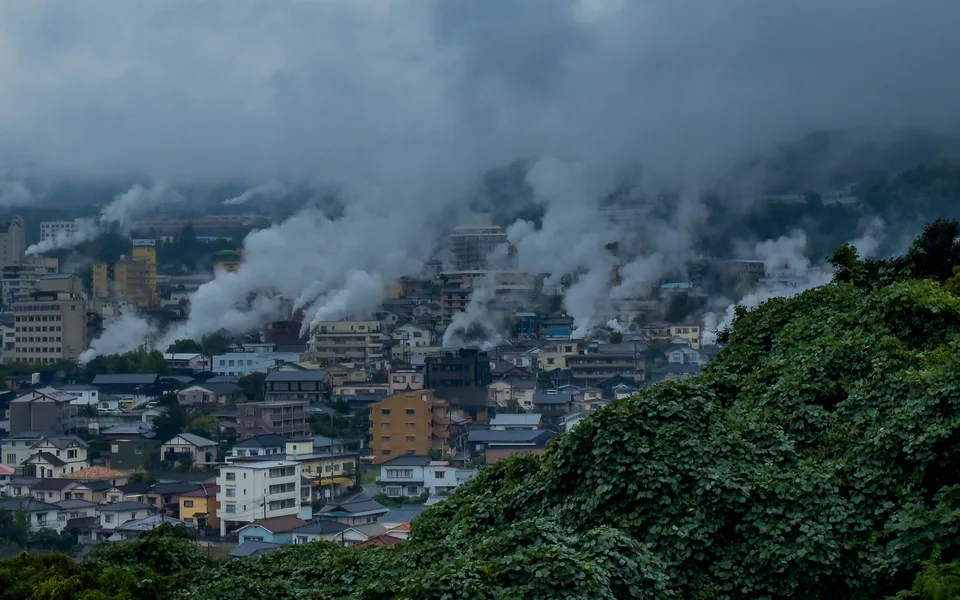
You do not need two full days just to see the seven Beppu Hells. For a mobile traveller who starts in the morning and treats the hells as the main sightseeing task, one day is usually enough. Two days become worthwhile when the extra night buys something different: a real onsen session, a Kannawa evening, less luggage handling, a late arrival, an early departure, or a slower pace for children or older travellers.
The cleanest two-day structure is to treat the hells as the two clusters they actually are. Five—Umi Jigoku, Oniishi Bozu Jigoku, Kamado Jigoku, Oniyama Jigoku and Shiraike Jigoku—sit around Kannawa and are walkable from one another. Chinoike Jigoku and Tatsumaki Jigoku form the second cluster about 3 km away. Do not bounce between the clusters. Finish one, move once, then use the saved time for bathing, dinner or the next transport leg.
There is also a useful ticket rule that makes a slow two-day visit practical: the official seven-hell common ticket is currently valid for the purchase day and the following day, with one admission to each hell. You do not need to rush all seven on Day 1 just because you bought the pass.
↔ Scroll table left or right
Your situation | Best plan | Why |
Arrive before 09:00, good mobility, hells are the main goal | One day is enough | 8:00–17:00 opening hours give a full operating day; five sights are walkable in one cluster |
Arrive around lunch or later | Use two days | The common ticket carries into the next day, so there is no need to sprint before 17:00 |
Want a real onsen, steam-town dinner or ryokan evening | Use two days | The extra time buys a Beppu experience rather than more sightseeing boxes |
Children, older travellers, hot weather or mobility limits | Shorter two-day split | Steam, slopes, bus waiting and repeated standing accumulate faster than the map suggests |
Early train or onward Yufuin/Kyushu transfer on Day 2 | Finish the larger Kannawa cluster on Day 1 | Day 2 can be the compact Chinoike/Tatsumaki pair or no hells at all |
First decide whether two days solve a real problem
The title “Beppu Hells 2-day itinerary” can create the wrong assumption: that seven hells require two sightseeing days. They do not. The official facilities currently open from 08:00 to 17:00 year-round, and the main five-sight cluster is deliberately walkable.
I would use one day when:
you can start around opening time;
you mainly want the seven hells rather than a slow onsen stay;
the group is comfortable walking and waiting for buses;
your hotel and luggage are already solved.
I would use two days when the second day removes another cost. Examples: you arrive at 13:00 instead of 08:00, you want a proper bath after Kannawa, a child needs a slower afternoon, or the hotel night itself is part of the Beppu experience.
Deletion test: if removing Day 2 only means “see the same seven sights faster,” Day 2 is weak. If removing Day 2 means losing an onsen evening, a ryokan dinner, a relaxed morning or a safer departure, the overnight has a job.
The common ticket is designed well for a two-day split
The Beppu Jigoku Association currently charges JPY 2,400 for an adult common ticket and JPY 1,200 for elementary/junior-high students. It covers all seven official hells. More importantly for this itinerary, the ticket is valid for two calendar days: the purchase date and the following day. Each hell can be entered once.
That changes the planning logic. If rain starts at 15:30, a child is done, or you decide the steam-town evening matters more than two more gates, stop. You are not losing the unused hells that evening; the ticket remains valid the next day.
The common ticket makes the most sense when all seven are genuinely on your plan. If you only care about a small shortlist, do not let a pass create sunk-cost sightseeing. Check the current individual-admission option at the first hell and compare it with the common ticket before paying.
Check current Beppu Hells ticket prices and validity
Why the route should be two clusters, not seven map pins
The official access guide says the five hells around Umi Jigoku in the Kannawa area are within walking distance. Chinoike Jigoku and Tatsumaki Jigoku are roughly 3 km away, and the association recommends using a bus or car between the two groups.
That means the efficient structure is:
Kannawa cluster: Umi → Oniishi Bozu → Kamado → Oniyama → Shiraike, with the exact walking order adjusted to your arrival stop and energy.
Move once.
Northern pair: Chinoike + Tatsumaki.
The weak structure is Kannawa → Chinoike → back to Kannawa for dinner → another northern trip next morning. The extra hotel night should reduce cross-town movement, not create more of it.
From Beppu Station, the larger Kannawa cluster is the natural first move
The official Hells access page currently lists about 20 minutes by Kamenoi Bus from JR Beppu Station West Exit to Umi Jigoku / Kannawa. That makes Beppu Station a strong luggage base: leave the large case at the hotel, take a day bag, then use one bus ride to begin the main cluster.
For the northern pair, the same official guide lists about 40 minutes by bus from Beppu Station to Chinoike Jigoku, compared with about seven minutes by bus from Kamegawa Station. This is why the two clusters should not be treated as identical station trips.
If Day 2 ends with a northbound JR journey, the Chinoike/Tatsumaki pair can fit neatly before using Kamegawa Station. If Day 2 ends with a southbound train or a hotel checkout at Beppu Station, check the bus/train chain before choosing that order; saving sightseeing minutes is not useful if it complicates the luggage pickup.
Day 1: use Kannawa for the five hells, then stop sightseeing
For a two-day version, I would normally give Day 1 to the larger Kannawa cluster. Starting around late morning or early afternoon still leaves enough time for a coherent walk without needing the distant pair.
A realistic structure is:
drop luggage;
bus to Umi Jigoku / Kannawa;
walk the five-hell cluster;
use a footbath if it helps the group reset;
switch from sightseeing to dinner / onsen / hotel time.
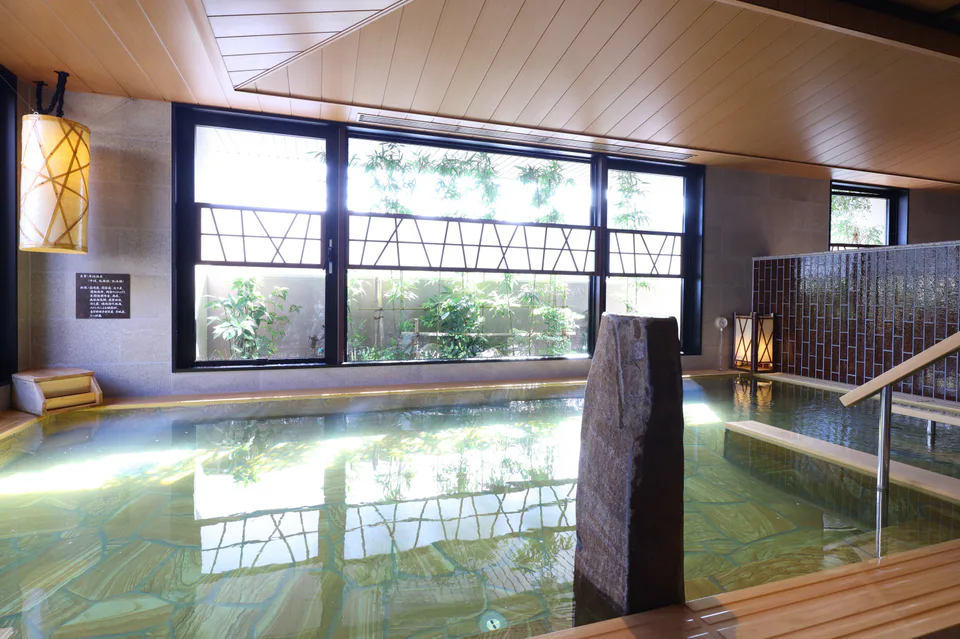
The official association currently lists free footbaths for visitors at Umi Jigoku, Chinoike Jigoku, Kamado Jigoku and Oniishi Bozu Jigoku. Those are rests, not substitutes for an actual Beppu bath. If you want a real onsen after the hells, plan it as a separate activity rather than assuming the sightseeing pools are bathing facilities.
Oniishi no Yu, beside the Oniishi area, is one example of a real paid bath; the Hells association currently lists ordinary bathing at JPY 620 for adults and private family baths from JPY 2,000–3,300 per room/hour depending on bath type. Whether that specific bath fits your route is less important than the principle: Day 1 becomes more valuable when the extra hours buy a real Beppu bathing experience.
Day 2: Chinoike and Tatsumaki are a compact pair, but Tatsumaki controls the pace
Chinoike Jigoku and Tatsumaki Jigoku sit together in the second cluster. This makes them a good departure-day block: travel there once, visit both, then leave the area.
Tatsumaki is a geyser rather than a static pool. The official site does not publish a guaranteed “every X minutes” timetable on its current visitor page; instead, it tells visitors to watch the lamp above the entrance—when the red lamp is lit, the eruption is near or already happening.
That is a small but useful scheduling detail. Do not book a train or bus assuming Tatsumaki will take exactly 10 or 20 minutes. Give the pair enough slack that waiting for the geyser does not turn into a missed onward connection.
If you have a hard departure, visit Tatsumaki first. You immediately learn whether a wait is developing; Chinoike is easier to fit around the remaining time.
Which hells should you cut if the group is tired?
The official seven-hell ticket does not mean all seven have equal marginal value for every traveller. Four—Umi, Chinoike, Tatsumaki and Shiraike—are nationally designated scenic spots, but even that designation does not mean every visitor must see all four.
For a first-time traveller who needs to shorten the route, I would protect:
Umi Jigoku as the main Kannawa visual anchor;
Tatsumaki Jigoku if the geyser itself interests you;
Chinoike Jigoku because it naturally pairs with Tatsumaki;
one or two additional Kannawa hells based on the group’s interest.
Families may value Oniyama’s crocodiles more than another coloured pool; visitors focused on geothermal landscapes may prefer Oniishi Bozu or Kamado. The important rule is that the last two hells should compete against a real onsen, lunch and the group’s remaining energy—not against a psychological need to “complete the pass.”
Beppu Station vs Kannawa: choose the base by the fragile edge of the trip
Stay near Beppu Station when arrival/departure, large luggage or an onward JR journey is the hard constraint. You pay the bus ride to Kannawa but make the hotel-transfer days much easier.
Stay in Kannawa when the evening after the hells is a major reason for being in Beppu: steam streets, ryokan dinner, private/public onsen and a quiet morning. The hotel night now adds something the Beppu Station hotel cannot imitate.
Do not split two Beppu nights between station and Kannawa merely to save one bus journey. Move hotels only if the second property buys a different evening or morning worth the luggage handling. The full area decision is in Where to Stay in Beppu.
Families and older travellers should use the two-day ticket as an energy tool
All seven official hells operate the same 08:00–17:00 window, but equal opening hours do not mean equal walking effort. The Kannawa cluster includes outdoor walking, steam and repeated standing; summer heat amplifies it. Bus waiting adds another layer for the second cluster.
The official facilities page currently lists wheelchair-accessible toilets at all seven hells and loan wheelchairs at multiple sites, but the wheelchairs cannot be reserved. Accessibility at an individual attraction therefore does not remove the transport and slope questions between attractions.
For a family or older traveller, the best use of the two-day ticket may simply be stopping after three or four sights on Day 1. The next morning is still valid. That is a better trip than finishing all seven while the last two people in the group have stopped enjoying it.
Rain changes comfort more than ticket value
Light rain does not make the geothermal sights disappear; steam can even become visually stronger. But heavy rain changes the cost of outdoor walking and waiting for buses between clusters.
Because the common ticket remains valid the next day, a two-day stay has a built-in weather option: do the walkable cluster during the better window, then move the compact northern pair to the next morning. Do not use a prepaid pass as a reason to stay outdoors in conditions that make the group miserable.
Three versions that actually make sense
Version A — one-day completion
Best for: early start, good mobility, hells are the main sightseeing goal.
Start with Kannawa’s five, transfer once to Chinoike/Tatsumaki, finish before 17:00. Stay wherever the next transport leg makes sense. Do not book two nights solely because there are seven gates.
Version B — two-day slow Beppu
Best for: first overnight visit, onsen priority, family or couple.
Day 1: Kannawa cluster → real bath / ryokan / dinner. Day 2: Chinoike + Tatsumaki → lunch / onward travel. This is my preferred two-day version because the second day buys quality, not more sightseeing quantity.
Version C — late arrival / early departure
Best for: transport-heavy Kyushu route.
Use whichever cluster fits the available half-day; do not force all seven. The common ticket’s two-day validity helps only when you actually have time on both calendar days. If the departure leaves too early on Day 2, buy the itinerary you can use rather than the itinerary the pass encourages.
Final verdict: two days should buy Beppu, not just the Hells
If all you want is the seven Hells, one well-planned day is usually enough. Use two days when the overnight adds Beppu itself: Kannawa after the day-trippers leave, a proper onsen, a ryokan dinner, slower family pacing, luggage control or safer arrival/departure timing.
The official common ticket supports that slower strategy better than many travellers realise because it remains valid on the purchase day and the following day. Split the five Kannawa hells from Chinoike/Tatsumaki, move between the clusters once, and stop sightseeing when the extra hour is more valuable as a bath or dinner than as another gate.
References and verification date
Beppu Jigoku Association — current hours, common-ticket price and two-day validity · Beppu Jigoku Association — two-cluster layout and current bus/taxi access · Beppu Jigoku Association — footbaths and Oniishi no Yu bathing prices · Tatsumaki Jigoku — current geyser visitor guidance. Checked August 25, 2026. Bus timetables and facility operations can change; recheck the travel date.