
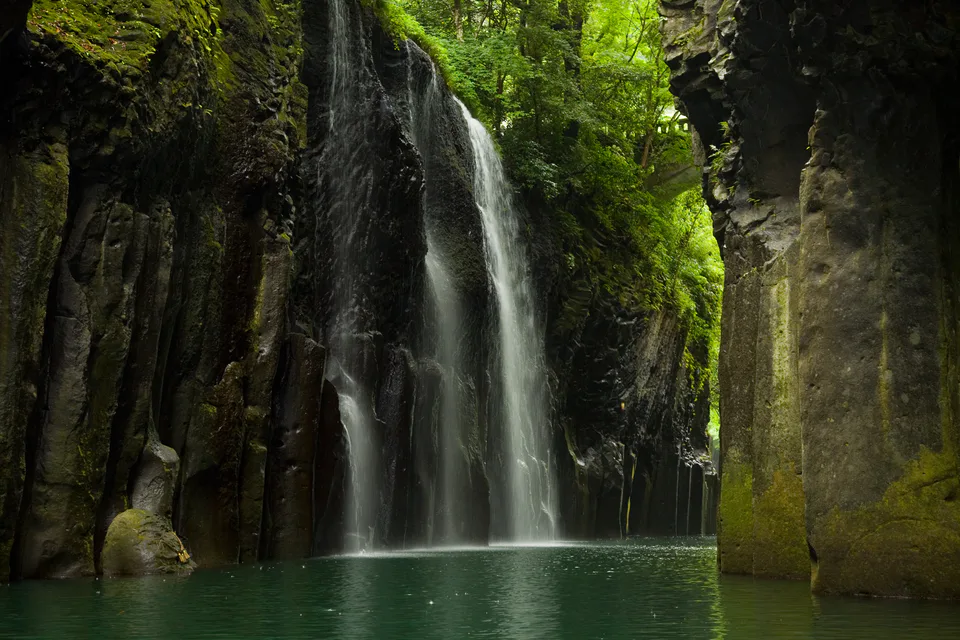
Takachiho Night Kagura is worth staying overnight for if the mythology and shrine experience are part of why you are making the detour. For a public-transport traveller, the overnight is not merely a comfort upgrade: the current 20:00–21:00 performance starts after the last direct buses have already left Takachiho for Fukuoka, Kumamoto and Aso. If you only want Takachiho Gorge and the shrines, a day trip can work. If you want the nightly kagura as well, treat the hotel night as part of the attraction.
This distinction matters because Takachiho is easy to over-plan. The gorge boat is weather-sensitive and can sell out; the bus network is sparse; the public kagura has its own reservation and seating rules. The most resilient first visit is therefore not “fit every famous sight into one day.” It is to decide whether you are buying a daytime scenery trip or a day-and-night mythology trip, then build the transport around that choice.
↔ Scroll table left or right
Your real trip | Best starting plan | Why | Main catch |
Gorge + Takachiho Shrine only, public transport | Day trip can be rational | Current intercity buses still provide a usable daytime window | You must leave before the 20:00 kagura |
Night Kagura is a priority | Stay one night | The 21:00 finish is later than the last direct buses to Fukuoka, Kumamoto and Aso | You are spending a scarce Kyushu hotel night here |
Boat is sold out or suspended | Keep the overnight if mythology still matters | Gorge walking, Takachiho Shrine, Amano Iwato and kagura still form a coherent trip | If the boat was your only reason to come, the answer can reverse |
Older traveller or anyone uncomfortable sitting on tatami | Check the performance setup before committing | The kagura hall is tatami-floored and does not lend chairs or cushions | You may bring a cushion or chair, but it must not obstruct other guests |
Self-drive trip | Overnight is still the default for a full experience | A car removes the last-bus veto, not the fatigue of a long night drive after a full sightseeing day | A short onward drive can make same-night departure more defensible |
The 21:00 finish is later than the last useful intercity buses
The strongest reason to stop treating Night Kagura as a day-trip add-on is the current timetable.
The public performance at Takachiho Shrine runs from 20:00 to 21:00. The currently published Fukuoka–Nobeoka Gokase-go timetable lists the final Takachiho Bus Center departure toward Fukuoka at 18:37, arriving Hakata Bus Terminal at 21:51 and Tenjin at 22:05. The currently published Takachiho-go timetable lists the direct departure toward Kumamoto at 16:57. The current Aso–Takachiho service leaves Takachiho for Aso at 15:30 under the July 2026 timetable.
In other words, for those three common public-transport directions, the return problem is not “the bus after kagura is inconvenient.” There is no normal same-evening direct bus after the performance.
That creates a clean decision rule:
No kagura: evaluate Takachiho as a day trip.
Kagura included: book a Takachiho-area bed unless you have a separately confirmed private transfer or are deliberately driving onward yourself.
This is the decision gap that headline travel times hide. A destination can be reachable from Fukuoka or Kumamoto during the day without being returnable after its most important evening experience.
A day trip still works if you deliberately give up the kagura
Skipping the overnight does not make Takachiho a bad trip. It simply changes the product.
The current Gokase-go schedule can place an early Fukuoka departure into Takachiho Bus Center at 11:41 and has the last return at 18:37. That is almost seven hours between bus-center arrival and departure before local movement is deducted. From Kumamoto, the current direct bus arrives Takachiho at 12:19 and returns at 16:57, leaving a much tighter four-hour-38-minute bus-center window.
Those numbers should not be mistaken for sightseeing time at Manai Falls: you still need the local transfer between the bus center, gorge and shrine. But they show why “Takachiho is impossible as a day trip” is too broad. It is possible to build a daytime-only visit from major Kyushu bases. What the day trip cannot absorb is a performance that begins at 20:00.
If a first Kyushu itinerary is already crowded, this is the correct trade-off to make explicit. Do not add a hotel merely because Takachiho is famous; add it because the extra night unlocks hours you otherwise cannot buy.
The online kagura reservation now changes both certainty and seating area
Takachiho Tourist Association currently runs the public kagura every night at the kagura hall inside Takachiho Shrine, normally from 20:00 to 21:00. The one-hour programme presents four representative dances from the traditional 33.
Current admission is JPY1,000 per person, with elementary-school-age children and younger free. The organiser currently divides capacity into roughly 230 online-reservation places and 50–60 same-day places, for about 300 people in total.
Online reservations open around 10:00 thirty days before the performance and remain available until 17:00 on the day, with advance credit-card payment. Reserved guests can check in from 19:00; same-day tickets are sold from 19:30 if capacity remains.
There is now another reason to reserve rather than treating the same-day allocation as equivalent: the organiser currently separates the seating areas. Online reservations use the front area; same-day ticket holders use the rear area. That does not mean every front position is perfect, but the advance booking is buying more than admission certainty.
There are calendar exceptions. The regular public performance is closed on December 31 and January 1, and the organiser says the normal nightly performance is not held on November 22–23 when the annual mythology kagura festival is usually scheduled. If kagura is the sole reason for the overnight, confirm the exact date before locking a non-refundable room.
The seating setup can matter more than the JPY1,000 ticket price
The kagura hall is a tatami-floored space. The organiser currently does not lend chairs or cushions. Guests may bring their own cushion or chair as long as it does not inconvenience other visitors.
For many travellers this is a minor detail. For an older parent, someone with knee or hip problems, or anyone who cannot sit comfortably on the floor for an hour, it is a real fit question.
This is also a useful example of why “family-friendly” or “cultural experience” is too vague. A JPY1,000 attraction can still be the wrong activity when the physical seating arrangement does not suit the traveller. Solve that before letting the mythology decide the itinerary.
The gorge boat should be booked first—but it should not control the overnight
Takachiho Gorge boat reservations are more fragile than the kagura booking. The tourist association currently accepts advance online boat reservations from two weeks before the ride until two days before at 09:00. There is no telephone reservation and no waiting list. Same-day tickets depend on remaining inventory after advance sales, and the daily operating status is normally updated around 08:00 because water level, weather and safety can stop the boats.
This creates two separate questions:
Do I still want Takachiho if the boat disappears?
Do I still want the overnight if the boat disappears?
If the answer to the second question is yes because Takachiho Shrine, Night Kagura, Amano Iwato Shrine and Amano Yasugawara are also central to the trip, keep the hotel. If the only thing that justified the detour was rowing beneath Manai Falls, the overnight may no longer deserve one of your limited Kyushu nights.
That is more resilient than treating a boat reservation as the foundation of the entire trip. A weather-sensitive activity should be removable without collapsing every other paid booking around it.
The peak-day gorge shuttle is not an evening kagura shuttle
Takachiho Tourist Association currently runs a gorge-area shuttle on selected busy dates in 2026. The published operating window is 08:30–17:00, with roughly 20–30-minute intervals.
That shuttle is designed around daytime gorge congestion and parking. It does not solve transport to or from a 20:00–21:00 performance. If the hotel is not comfortably walkable from Takachiho Shrine, confirm the hotel shuttle, local taxi or your own car plan separately.
This is a small but important failure mode: “there is a tourist shuttle” does not mean there is an evening transport network.
For one night, protect the two time-sensitive windows rather than chasing every sight
A strong one-night sequence gives each half of the trip one job.
Day 1: gorge first, then protect the 19:00–21:00 kagura block
Use the daylight for Takachiho Gorge and the boat if you have one. Move to Takachiho Shrine and hotel check-in later rather than adding every mythological site before dinner. If your kagura reservation matters, treat the 19:00 reserved-guest reception time as the start of the evening block rather than planning dinner to finish at 19:55.
The hotel’s location now matters more than its star rating. A room that lets you eat and reach Takachiho Shrine without another fragile transport hand-off can be worth more than a nicer property farther away.
Day 2: use Amano Iwato for the morning mythology sequence
Amano Iwato Shrine and Amano Yasugawara fit naturally after the previous night’s dances because the story continues rather than restarting the trip with another unrelated attraction. This also stops Day 1 becoming gorge → boat → multiple shrines → hotel → dinner → kagura, which is exactly the sort of compressed rural itinerary that looks efficient only on paper.
If the wider route continues toward Aso, use the Fukuoka to Aso decision guide and current bus timetable before assuming Takachiho and Aso can be stitched together around any departure you like.
Nightly Takachiho Kagura and village Yokagura are different products
The one-hour public performance is designed to make the tradition accessible throughout most of the year. The wider village night-kagura tradition is seasonal, community-based and can continue through the night. The tourist association describes the traditional season as roughly mid-November to early February.
Do not rank them as “tourist version” versus “authentic version” and assume the longer event is automatically better. A village performance has different dates, access, etiquette and recovery costs. For a first Takachiho visit inside a wider Japan trip, the nightly one-hour performance often provides the better balance between cultural context and itinerary resilience.
When I would skip the overnight
I would not automatically spend a scarce Kyushu night in Takachiho in four cases:
Kagura is low priority: you mainly want the gorge and can use a clean daytime bus window.
The boat is your only must-do and it is unavailable: reassess whether the remaining attractions justify the detour.
The next morning has a hard long-distance connection: a later hub such as Kumamoto, Fukuoka or another route-progressing base may protect the wider trip better.
The performance seating does not suit someone in the party: do not force a cultural activity simply because it is famous.
Conversely, if the mythology is why Takachiho is on the itinerary, the overnight is doing real work. It converts a scenery stop into an evening-and-morning destination that a day trip cannot reproduce.
Final verdict
For public-transport travellers, the current timetables create a clean dividing line: Takachiho Gorge can be a day trip; Takachiho Night Kagura should be planned as an overnight. The 20:00–21:00 performance begins after the last direct buses to Fukuoka, Kumamoto and Aso have already left.
Reserve the kagura online when it matters, both for entry certainty and the current front-area seating allocation. Book the gorge boat separately and accept that it can sell out or be suspended. Build Day 1 around the gorge and evening performance, then use Day 2 for Amano Iwato rather than compressing every mythological site before dinner.
The answer reverses when kagura is not important. In that case, keep the hotel night for somewhere else in Kyushu and use Takachiho as a daytime-only excursion. The overnight is valuable because it unlocks the night—not because Takachiho automatically deserves a hotel.
References and verification
Takachiho Tourist Association — current public kagura schedule, admission, reservation, seating and venue rules · Takachiho Tourist Association — Night Kagura tradition · Takachiho Tourist Association — gorge boat reservation and operating-status rules · Highwaybus.com — current Gokase-go timetable · Kyushu Sanko Bus — Takachiho/Kumamoto timetable · Kyushu Sanko Bus — Aso/Takachiho timetable. Checked August 25, 2026. Bus times, performance exceptions, gorge operation and seasonal shuttles can change; recheck the exact travel date.