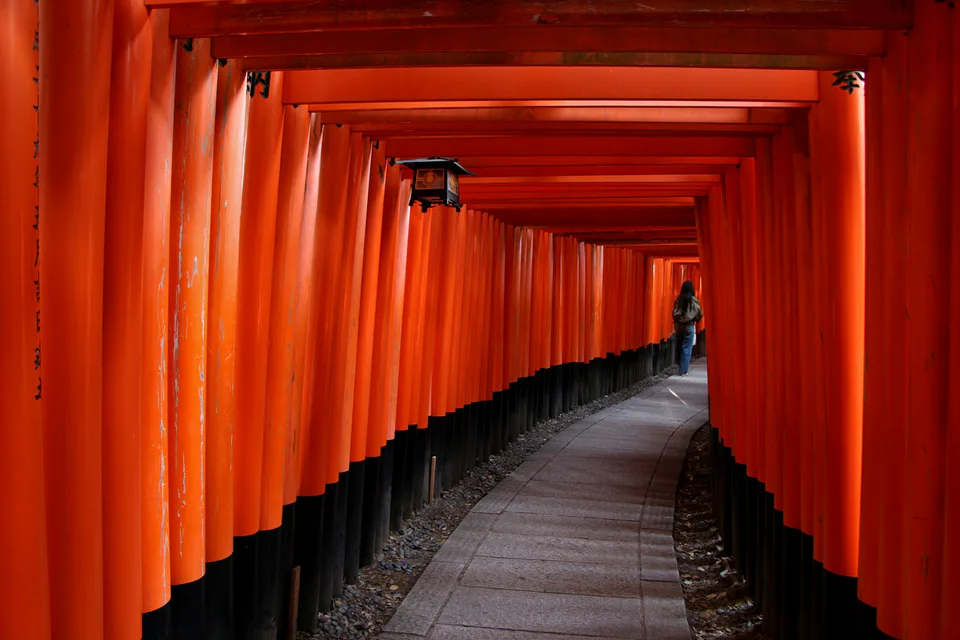

Most first-time visitors do not need to complete Mount Inari to get the highest-value Fushimi Inari experience. Use the lower shrine and Senbon Torii when the gates, shrine atmosphere and photographs are the priority. Continue toward Yotsutsuji when you want the climb itself to become part of the morning. Complete the full mountain circuit only when the sacred mountain walk is worth giving up another major Kyoto attraction.
Kyoto City’s current official tourism information describes the full Inariyama circuit as roughly 4 km and about two hours. Fushimi Inari Taisha identifies Ichinomine as the highest peak at 233 m, but its official description is of a sacred worship site rather than a scenic observation attraction. That distinction matters: do not continue simply because you assume the summit must provide the best view.
↔ Scroll table left or right
Turnaround | Planning allowance | Best for | Stop if… |
Main shrine + Senbon Torii + Okusha | About 45–75 minutes | First trip, photos, Nara pairing, short Kyoto stay | The next hour is more valuable in another district |
Continue toward Yotsutsuji | Roughly 90–120 minutes with pauses | Travellers who want both torii and a real climb | Heat, knees, daylight or a fixed reservation is becoming the constraint |
Full Inariyama circuit | Official benchmark: about 4 km / about 2 hours before generous photo and rest time | Hikers, repeat visitors, shrine/mountain-focused mornings | You are continuing only to “finish” rather than because the mountain itself is the experience |
Night visit | Keep the route deliberately short unless you already know the mountain | Lower-shrine atmosphere after dark | The plan has quietly turned into an improvised summit hike |
The 45–75 and 90–120 minute ranges are ValueNavi planning allowances, not official shrine timings. The official benchmark used here is the roughly 4 km / two-hour full mountain circuit.
ValueNavi Attraction Decision Score: the best Fushimi Inari visit is not always the longest
Fushimi Inari now uses the same ValueNavi attraction framework as other major sightseeing decisions: uniqueness 20%, route fit 20%, time efficiency 15%, weather resilience 15%, booking flexibility 10%, crowd resilience 10%, and money value 10%. Each factor is scored from 0 to 10. These are scenario scores, not a spiritual or cultural rating of the shrine.
Visit pattern | ValueNavi score | Why |
|---|---|---|
Lower shrine + Senbon Torii + Okusha on a first trip | Very high uniqueness and route fit with limited time cost; easy to pair with another south/east Kyoto stop. | |
Continue to Yotsutsuji when you enjoy the climb | The mountain becomes part of the experience, but weather, stairs and opportunity cost start to matter more. | |
Full circuit for a first-time visitor who mainly wants the iconic torii | The extra mountain time adds less decision value if the lower precinct already delivered the main goal. | |
Full circuit for a hiker / repeat visitor focused on sacred mountain landscape | The same time cost is now the product rather than a detour from other Kyoto sightseeing. | |
Lower shrine after dark with a fixed turnaround | Distinct atmosphere and no booking pressure, but staffed services and route flexibility are lower at night. |
I use 8.5+ as a strong scenario fit, 7.5–8.4 as conditional, and below 7.5 as a sign that the visit is consuming more trip time than the traveller’s stated goal requires. The score can rationally reverse for hikers because time efficiency should matter less when the hike itself is the reason to visit.
ValueNavi Return-on-Climb Matrix: what does each extra section actually buy?
↔ Scroll table left or right
Stopping point | What you gain | What the extra climb costs | Decision signal |
Okusha / lower torii | The signature shrine, Senbon Torii and the most recognisable first-visit experience | Lowest walking and opportunity cost | Default success condition for short Kyoto stays. |
Yotsutsuji | A real mountain climb, quieter route character and a natural reassessment point | More stairs, heat/weather exposure and less schedule flexibility | Continue when the climb itself is still enjoyable. |
Ichinomine / full circuit | Completion of the sacred-mountain loop and deeper pilgrimage-style landscape | Largest time and physical commitment | Continue for the mountain, not because you assume a summit panorama payoff. |
The matrix is intentionally not a “higher = better” ladder. Official shrine material describes Ichinomine as the highest sacred site; it does not position the summit as an observation deck. The return on climbing therefore depends on whether you value the sacred mountain walk itself.
The decision is how far to hike, not simply what time to arrive
“Go at 6 a.m.” is incomplete advice. An early start is useful only if you know whether Fushimi Inari is a one-hour iconic stop or a half-day mountain walk. Without a turnaround point, the visit expands, breakfast moves later, and the early start that was supposed to create margin can consume it.
Choose the success condition before leaving the hotel. If seeing the main shrine, Senbon Torii and the lower sacred precinct would already make the visit worthwhile, treat everything above that as an optional upgrade. If walking through Inariyama’s torii, worship stones and former shrine sites is the purpose, then the longer route is not wasted time; it is the attraction.
For most first trips, the lower shrine and Senbon Torii are enough
I would use the lower route as the default for travellers with only two or three Kyoto sightseeing days. Visit the main shrine, walk through Senbon Torii and continue to the Okusha area. At that point ask a simple question: would I rather spend the next hour climbing, or arrive an hour earlier at the next place?
This short version works especially well before Nara. Fushimi Inari and Nara share the JR Nara Line, but that geographic convenience disappears if the shrine becomes a full mountain hike. The common failure mode is to keep climbing because the torii continue, then reach Nara late enough that Todaiji, Kasuga Taisha and Naramachi start competing for the remaining daylight and opening hours.
If the summit circuit is genuinely important, keep it and give Nara another day. A shared railway does not make two large sightseeing programmes fit into one calendar day.
Yotsutsuji is the best escalation point for travellers who are enjoying the climb
Yotsutsuji is useful because it turns “walk until tired” into a deliberate decision. By the time you reach the mid-mountain junction, the iconic lower-torii experience is already behind you and the next section should be justified by the mountain itself.
Reassess four variables there: legs, heat/weather, daylight and the next fixed commitment. If all four are comfortable and the sacred mountain walk is still the best use of your time, continue. If one has become the dominant constraint, turn around without treating the visit as incomplete.
This is especially important for mixed-mobility groups. A summit should never become the mechanism by which an older parent’s knees, a child’s fatigue or summer heat finally forces everyone to stop.
Do not climb to Ichinomine just because you expect a “summit viewpoint” payoff
Fushimi Inari Taisha’s official site identifies Ichinomine as the highest peak of Inariyama at 233 m and describes it as a sacred site where Suehiro Okami is worshipped. The shrine’s broader mountain description emphasises pilgrimage, torii, otsuka worship stones and former shrine sites.
That leads to an important ValueNavi distinction: the full circuit is primarily a sacred-mountain and hiking experience, not a guaranteed panorama upgrade. If your motivation after Yotsutsuji is simply “the summit must have the best view,” the extra time has a weak decision basis. Continue because you value completing the pilgrimage-style loop, the quieter mountain character or the walk itself.
This is also why “I am already halfway, so I may as well finish” is poor itinerary logic. The remaining time still has an opportunity cost even after you have climbed partway.
Early morning protects the most crowd-sensitive part: the lower torii
Early morning is most valuable around the lower shrine and Senbon Torii, where visitors concentrate around the same iconic paths. Higher on the mountain, the route naturally spreads people out more. Use your quietest hour on the section that benefits most from it instead of assuming the entire mountain has to be completed before breakfast.
From Kyoto Station, Kyoto City’s current official access guidance recommends the JR Nara Line and gives the trip to Fushimi Inari at about 9 minutes, with JR Inari Station immediately beside the shrine. This corrects older shorthand that often quotes roughly five minutes for the rail leg. From Gion-Shijo, Kyoto’s official guide recommends Keihan to Fushimi-inari Station, followed by about a five-minute walk.
Kyoto City also specifically advises avoiding City Bus South No. 5 from Kyoto Station for this journey because travel-time variation can exceed 24 minutes. That is a useful first-visit rule: use rail for Fushimi Inari when rail is available. A bus that is theoretically direct is not automatically the more resilient option.
“No closing time” does not mean every shrine service is available around the clock
Kyoto’s official listing currently shows no closing time for the shrine grounds. It separately lists prayer/reception hours around 08:30–16:30 and the amulet office around 08:00–18:00.
A 05:30 visit is therefore excellent for walking and atmosphere but not operationally identical to a daytime visit. The same is true late at night. If a goshuin, amulet, formal prayer or another staffed service is important, schedule that requirement inside the relevant current service window.
Night visit: buy the atmosphere, not an improvised mountain challenge
The lower shrine and torii after dark can be a compelling experience. For a first-time visitor, the strongest night plan is short and pre-decided: main shrine, lower torii, fixed turnaround, train back.
Darkness changes the same stairs, junctions and forest paths that are straightforward by day. That does not mean the precinct is inherently “unsafe at night”; it means the navigation task is different and staffed services are reduced. If the purpose is atmosphere, the lower route already supplies it.
I would not recommend deciding after dinner to complete the full mountain circuit simply because the grounds do not close.
Fushimi Inari + Nara works only if you cap the shrine
The pairing is geographically strong, but only under a strict route definition. For a Nara day where Todaiji, Kasuga Taisha, deer and Naramachi matter, keep Fushimi Inari to the lower shrine / Senbon Torii / Okusha block and leave before the mountain becomes the main event.
If the full Inariyama circuit is the priority, separate Nara. The two-hour official mountain benchmark comes before extra photo time and transport; trying to hide that inside a full Nara itinerary is how a neat rail pairing becomes an overloaded day.
Fushimi Inari + Tofukuji is better geography than Fushimi Inari + Arashiyama
If you still want another Kyoto attraction after a medium-length visit, keep the day geographically coherent. Tofukuji lies on the same south/east corridor and can form a sensible block. In peak autumn it has its own crowd and timing constraints, so use the Tofukuji–Fushimi Inari–Uji route rather than assuming all three can be added without trade-offs.
Arashiyama is the opposite geometry. Both areas benefit from early hours but sit on different sides of Kyoto. Trying to give both the “early morning slot” in one day defeats the purpose. Use the Arashiyama guide on a different morning unless the rest of the day is intentionally light.
Families and older travellers should define success below the summit
The lower shrine and torii corridors deliver the signature experience with far less commitment than the sustained stairs and slopes higher on Inariyama. For a mixed-mobility group, define the lower section as a successful visit and treat further climbing as optional.
A practical split is to walk the lower route together, then let stronger walkers continue only if the group has a clear meeting point and communication plan. Do not use a summit target that makes one person’s fatigue the reason everyone finally turns around.
The shrine’s visitor guidance also says not to leave strollers unattended except in designated areas. The mountain route should not be treated as a normal step-free attraction.
Heat, rain and winter darkness should lower the planned turnaround point
Weather should change the route, not just the packing list. In humid summer conditions, early morning reduces both crowd pressure and heat load. In sustained rain, a shorter lower-shrine visit becomes more rational because the longer stair-and-forest circuit carries a higher walking cost. In winter, a late-afternoon start can turn a daylight plan into a night hike before intended.
Keep the full circuit as an earned option. If conditions are good and everyone still wants more at Yotsutsuji, continue. If not, the shrine has already delivered its most distinctive first-visit experience.
Photography: do not turn Senbon Torii into a private photo set
Fushimi Inari Taisha asks visitors not to obstruct worshippers on narrow paths while taking photographs or video. That matters particularly in Senbon Torii, where waiting for a perfectly empty corridor can tempt visitors to stop the flow.
The better strategy is temporal: go earlier, keep moving when the path is busy and use natural gaps. An empty-looking photograph is not worth blocking a sacred approach.
Large luggage: solve the bag before using Fushimi Inari as a transfer-day stop
JR Inari Station being beside the shrine does not make a large suitcase appropriate for the mountain route. On a Kyoto checkout day, leave luggage with the hotel or a confirmed storage service, or forward it when the delivery timing fits the next hotel.
A short shrine visit with a day bag can be an elegant stop before Nara or Osaka. A two-hour mountain circuit carrying everything you own is a completely different itinerary. Use the Japan luggage-forwarding guide before deciding the hiking length.
Three sensible first-visit versions
Iconic Kyoto morning
Arrive early, visit the main shrine, Senbon Torii and Okusha, then turn back after roughly 45–75 minutes of shrine time. Best when Fushimi Inari is one major Kyoto experience among several, or when Nara follows.
Hike-first morning
Arrive early, move through the lower torii, continue to Yotsutsuji and reassess. Complete the circuit only if the mountain itself remains the priority. Keep the afternoon light.
Night-atmosphere visit
Use the lower precinct and torii after dinner, keep a fixed turnaround and return by rail. Best for atmosphere, not for collecting a summit after dark.
Final verdict: stop when Fushimi Inari has already delivered what you came for
For most first-time visitors, the summit should not be the default goal. The lower shrine and Senbon Torii are the highest-value short version. Yotsutsuji is the best escalation point when the walk itself is becoming the attraction. Complete the full Inariyama circuit when you value the sacred mountain, pilgrimage-style loop and hiking time enough to replace another Kyoto sight.
The recommendation reverses for hikers, repeat Kyoto visitors and travellers whose primary interest is shrine landscape rather than sightseeing coverage. But if you are climbing only because “the summit must be the best part,” stop and reassess: the official descriptions frame Ichinomine as the highest sacred site, not as a guaranteed observation-deck payoff.
References
Fushimi Inari Taisha — official precinct map · Fushimi Inari Taisha — Inariyama · Fushimi Inari Taisha — Ichinomine · Kyoto City Official Travel Guide — 4 km / two-hour circuit and service hours · Kyoto City Official Travel Guide — current rail access and bus reliability guidance. Checked August 26, 2026.