
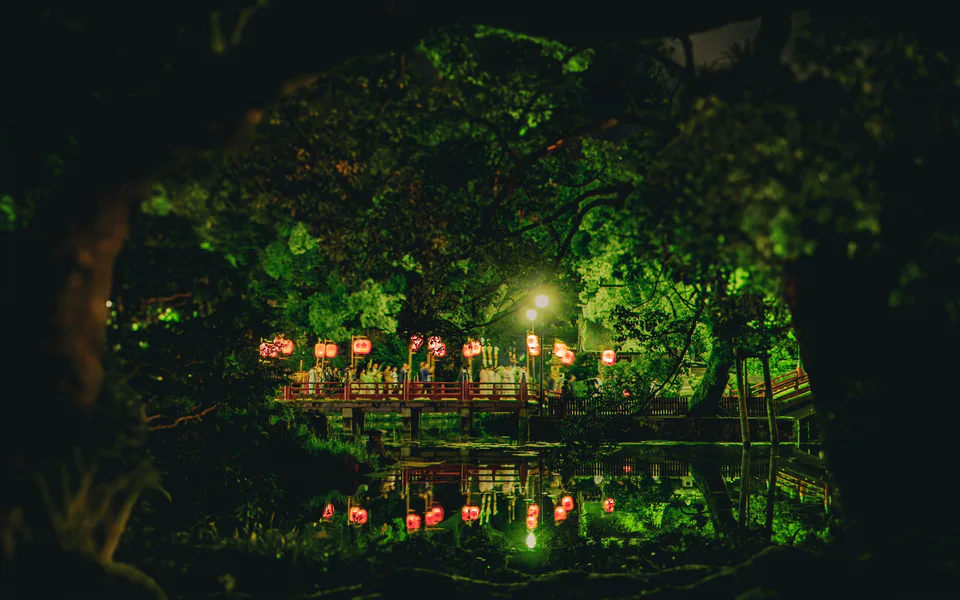
If you can attend only one part of Dazaifu’s Jinkoshiki in 2026, choose September 22 for the moving night procession and September 25 for the shortest, most visually concentrated candlelight experience. They are not interchangeable festival nights. The September 22 procession runs from 19:00 to 22:00 and carries the deity from Dazaifu Tenmangu toward Enoki Shrine. September 25 closes the festival with the Thousand Candles Ceremony and candlelight kagura from 20:00 to 20:30. September 23 is the better choice when you want the return procession in daylight and early evening rather than a late night.
For most visitors, stay in Fukuoka and make Dazaifu a deliberate afternoon-and-evening trip. The festival does not automatically justify moving hotels. A Dazaifu overnight becomes useful when you specifically want an early shrine morning the next day, have mobility or family reasons to avoid a late return, or want to photograph the area after the crowd has dispersed. Otherwise, the hotel move can cost more time than the festival transport saves.
Dazaifu Jinkoshiki 2026: choose the ceremony, not just the date
↔ Scroll table left or right
Date | Official programme | Choose it when | Main trade-off |
Sep 22, Tuesday | 19:00–22:00 night procession toward Enoki Shrine | You want the strongest moving-procession experience, lanterns, music and Heian-period costumes after dark | Latest finish; the return to Fukuoka needs to be planned before the event |
Sep 23, Wednesday | 14:00–19:00 return procession to Dazaifu Tenmangu | You prefer daylight photography, an earlier finish or are travelling with children/older family | Less of the night-procession atmosphere |
Sep 25, Friday | Festival rites through the day; Thousand Candles and kagura 20:00–20:30 | You want the candlelit Shinji Pond scene and a compact evening finale | You are not seeing the 2.5 km grand procession |
The shrine’s official Jinkoshiki page lists festival activity from September 21–25, but the two grand-procession movements are specifically September 22 and September 23. This matters because a visitor who books September 25 expecting the full mikoshi procession has chosen the wrong night; September 25 is the candlelight finale, not a repeat of September 22.
September 22 is the best one-night choice for the procession itself
Dazaifu Tenmangu describes the September 22 procession as the outward journey of Sugawara Michizane’s spirit from the shrine to Enoki Shrine, his former home about 2.5 kilometres away. Priests and parishioners in Heian-period costume accompany the mikoshi with bells, drums and Shinto music.
For a visitor, that means the event is spatial rather than stage-based. The value comes from seeing the procession move through Dazaifu, not from finding one “best seat.” Pick one or two points along the official route and let the procession come to you. Chasing it through narrow streets usually creates worse photographs, more walking and more interference with the ceremony.
The 19:00–22:00 timing also makes this the most transport-sensitive choice. If you are based in Tenjin or Hakata, save the live Nishitetsu return route before the procession starts. Do not wait until 22:00 to discover which Dazaifu Line train connects best at Nishitetsu-Futsukaichi.
September 23 is underrated for families and photographers
The return procession runs from 14:00 to 19:00. That produces a different visual day: more natural light for costumes and street scenes, followed by late-afternoon and early-evening atmosphere as the mikoshi returns to Dazaifu Tenmangu.
If you are travelling with a young child, an older parent or anyone who dislikes standing outside until late at night, September 23 can be the more rational choice even if September 22 looks more dramatic in photographs. The festival value is not reduced to darkness; the moving ritual and historical route are still the main event.
It also leaves more margin for dinner in Tenjin or Hakata after returning. That can make the whole day better than forcing a 22:00 festival finish into a short Fukuoka trip.
September 25 is a 30-minute visual climax, not an all-evening street festival
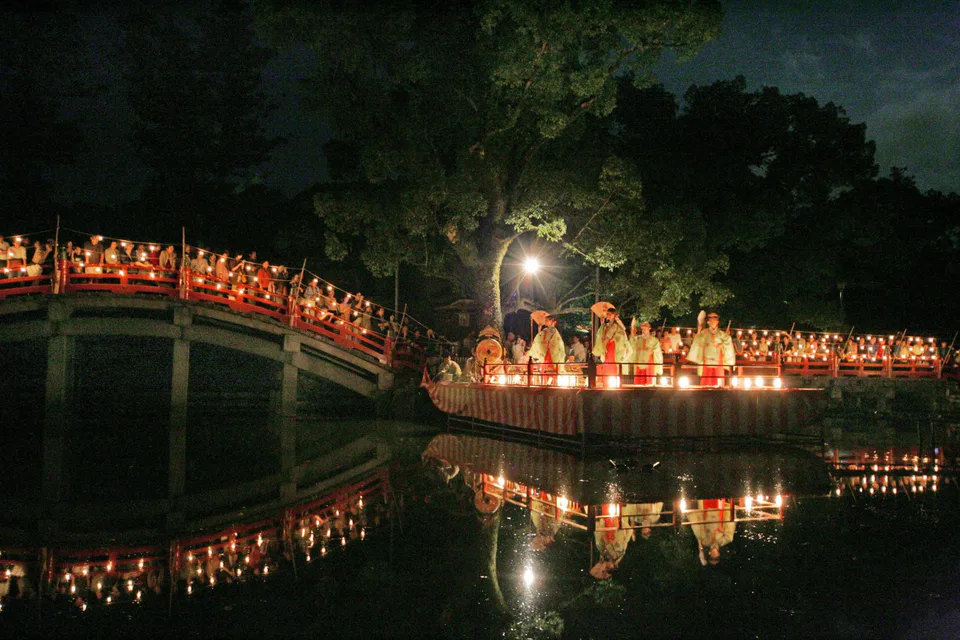
Dazaifu Tenmangu currently lists the Candlelight Kagura on September 25 from 20:00 to 20:30. Candles are placed around Shinji Pond and the taiko-bashi bridges, and shrine maidens perform kagura on a temporary stage over the water.
This is the strongest choice for a traveller who wants one concentrated candlelit scene without following a 2.5 km procession. It is also easier to pair with a normal daytime Dazaifu visit: shrine grounds and food in the afternoon, a long dinner/coffee break, then return to the pond before 20:00.
The important correction is that 20:30 is not automatically a “stay in Dazaifu” finish. For a Fukuoka-based visitor, the sensible default is still to return by Nishitetsu after the ceremony. Check the current Friday timetable for September 25 and allow crowd time between the pond and Dazaifu Station, but do not add a hotel merely because the ceremony happens after dark.
Fukuoka base or Dazaifu overnight?
Most English-language festival planning overvalues proximity and undervalues the hotel move. Dazaifu is close enough to Fukuoka that the question should be: what does sleeping in Dazaifu unlock that the train cannot?
Stay in Fukuoka when:
Dazaifu is one afternoon/evening inside a wider Fukuoka trip;
you are attending September 23 or September 25 and can return without a fragile final connection;
your hotel, luggage and next morning are already anchored in Hakata or Tenjin;
you would otherwise check out, store bags, travel to Dazaifu, check in again and reverse the process the next day.
Consider a Dazaifu overnight when:
September 22 is the core reason for the trip and you do not want to watch the final train clock during a 22:00 finish;
you want Dazaifu Tenmangu again early the next morning before the normal day-trip rhythm returns;
the group has mobility constraints, very young children or photography equipment that makes a late transfer disproportionately tiring;
the hotel itself has a reason to be part of the trip rather than serving only as a bed near the shrine.
For most first-time visitors, that test still points back to Fukuoka.
Tenjin is the cleaner festival base than Hakata when Nishitetsu is doing the work
Dazaifu belongs to the Nishitetsu network. From central Fukuoka, the natural rail origin is Nishitetsu Fukuoka (Tenjin) Station, usually with a change at Nishitetsu-Futsukaichi for the Dazaifu Line. A Hakata hotel can still work well, but the final journey includes the city connection between Hakata and the Nishitetsu side of central Fukuoka.
Do not choose your entire Fukuoka hotel only for one festival evening, though. If Hakata is already the better base for Shinkansen, JR day trips and luggage, keep it and accept one extra urban connection. If Dazaifu is one of several Nishitetsu-heavy days and your evenings are around Tenjin, the Hakata vs Tenjin comparison may naturally lean toward Tenjin.
The direct Dazaifu–Hakata bus is not the late-night fallback to assume
Nishitetsu operates direct Dazaifu liner buses toward Fukuoka Airport International Terminal and Hakata Bus Terminal during the day, but a festival visitor should not build the 22:00 September 22 return around a daytime sightseeing bus. Use the live rail timetable as the primary late-evening plan unless Nishitetsu publishes festival-specific service.
This is a broader rule for Japanese festivals: a route that looks “direct” on a tourism page can stop operating before the event’s most valuable hour. Match the transport product to the event finish, not the destination name.
How to photograph the procession without turning it into a chase
The September 22 procession is ceremonial and mobile. A phone or small camera is easier than a large tripod in narrow sections. Choose a place with space behind you, avoid flash into participants and follow staff instructions when the route needs to clear.
For September 25, arrive before 20:00 if the candle reflections matter. The Shinji Pond and bridges are compact compared with the procession route, so the crowd pressure is concentrated. A single fixed composition is rarely worth blocking circulation.
In both cases, the strongest image normally includes context—the shrine approach, bridge, pond, lanterns or architecture—rather than isolating one costume or candle.
Do not pair this with another long-distance day trip
A festival evening already changes the energy budget of the day. Dazaifu works well with its own approach street, food, nearby historical sites and an unhurried afternoon. It works poorly as the final checkbox after Yufuin, Karatsu or another two-hour excursion.
If you need to choose between festivals rather than stack them, the Hita Sennen Akari guide solves a different problem: a bamboo-lantern town that is far enough from Fukuoka for the return clock to materially shorten the evening. Dazaifu is much easier to keep as a Fukuoka-based event.
Final decision
Choose September 22 if the grand night procession is the reason you are travelling. Choose September 23 if you want the procession with an earlier, easier day. Choose September 25 if you want the candlelit pond and kagura rather than the 2.5 km mikoshi route.
For most visitors, keep the hotel in Fukuoka. The recommendation reverses only when the late September 22 finish, mobility needs or an intentional early-next-morning Dazaifu visit gives the overnight stay a job that the train cannot do. Recheck Nishitetsu’s live timetable and any festival-specific service shortly before travel; the ceremony times are annual shrine information, but transport patterns can change.
Continue planning
Use the Fukuoka transport pass guide for Nishitetsu vs subway/JR decisions, the Dazaifu food guide for the daytime block and the Fukuoka three-day itinerary if this festival has to fit inside a short city stay.
References
Dazaifu Tenmangu — Jinkoshiki Grand Procession · Dazaifu Tenmangu — Candlelight Kagura · Nishitetsu — current railway routes and timetables. Checked August 25, 2026. Recheck the September 22, 23 and 25 transport timetable and any special festival operation before travel.