
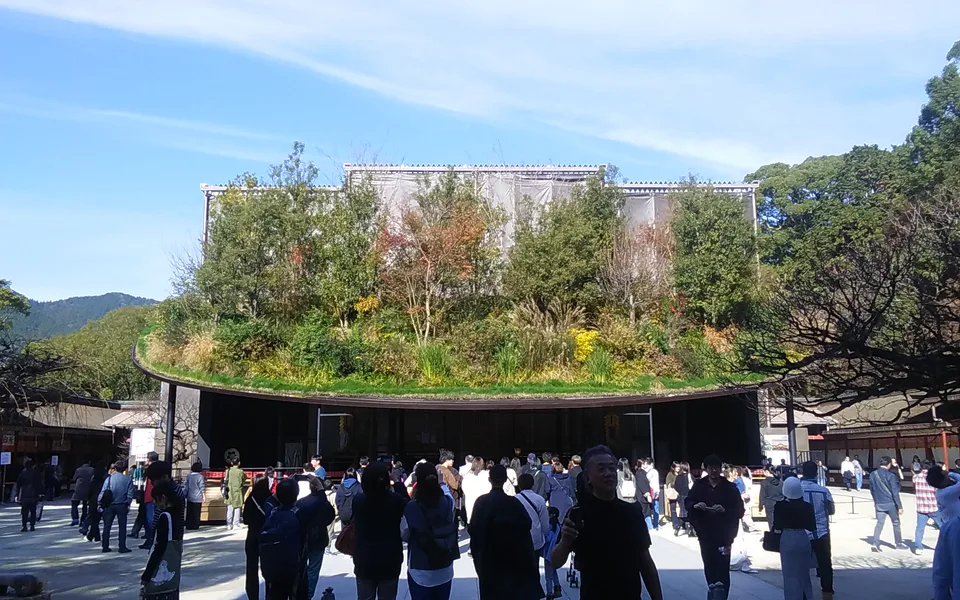
For most first-time Dazaifu visits, do not turn Omotesando into a three-shop umegae-mochi tasting race. Visit Dazaifu Tenmangu first, then choose one food job on the return: one freshly grilled umegae mochi, one seated tea break, or one proper lunch. Add a second food stop only when the stay is a true half-day and the second stop solves a different need.
The names also need separating. Yasutake Honten (やす武本店) is an umegae-mochi shop on the approach road, currently open 08:30–18:00. Soba Yasutake (蕎麦 安武) is a separate soba restaurant near the shrine, currently open only 11:00–14:00, closed Sundays, Mondays and public holidays, cash only, and it asks families with children younger than elementary-school age not to visit. Treating “Yasutake” as one generic lunch/snack option can produce the wrong itinerary.
↔ Scroll table left or right
Your Dazaifu plan | Start with | Why | Main catch |
2–3 hours, shrine is the priority | One umegae mochi after the shrine | Protects the main visit and keeps the return walk flexible | Do not spend the first part of the visit comparing queues |
Want the classic busy approach-road stop | Kasanoya | Directly on the main approach; current umegae mochi price JPY 180 and hours 09:00–18:00 | Popularity can turn the snack into a queue |
Need a seated tea break | Teradaya or Kasanoya café space | Both have documented sit-down options rather than only takeaway | Seats are limited and café hours are shorter than shrine access |
Want an early umegae mochi before other shops open | Yasutake Honten | Current opening time is 08:30 | This is the mochi shop, not Soba Yasutake |
Proper soba lunch is part of the half-day | Soba Yasutake | Lunch becomes a deliberate sit-down experience rather than another snack | 11:00–14:00 only, cash only, closed Sun/Mon/holidays, no preschool-age children |
Kyushu National Museum also included | Half-day structure | There is finally enough time for shrine + museum + one proper food block | Do not keep the original 2–3 hour time budget |
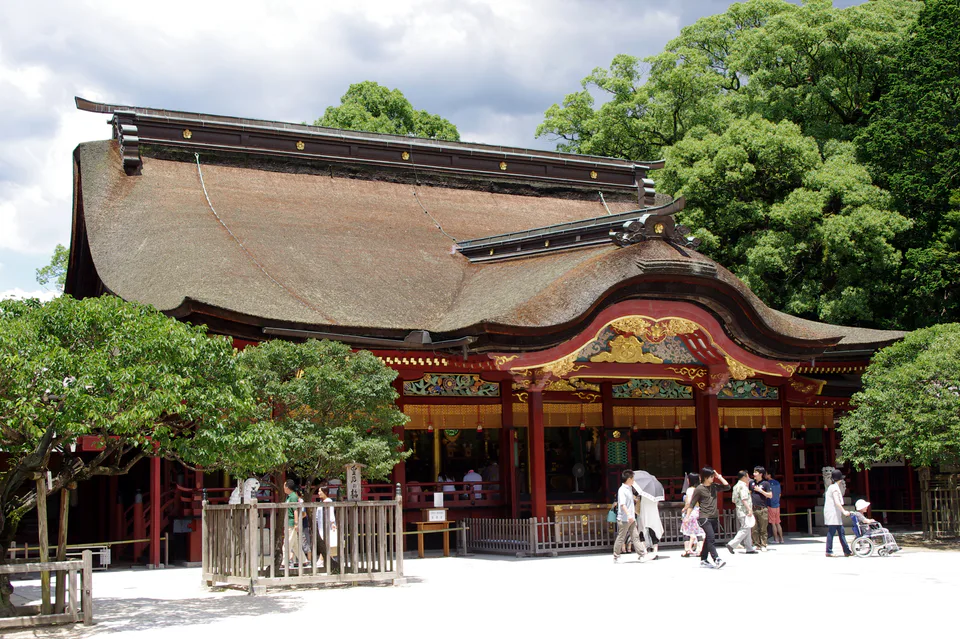
Do the shrine before the food comparison unless food is the reason for the trip
Dazaifu Tenmangu opens much earlier than the commercial approach road. The shrine currently opens at 06:00 from the spring equinox and 06:30 from the autumn equinox, while most shops on the approach close around 17:00 according to the shrine’s own FAQ. In summer the shrine itself can stay open until 19:30.
That creates a useful asymmetry: early shrine time is scarce; snack time is not. On a normal day trip from Fukuoka, go to the shrine while the morning is still useful, then make food decisions on the way back toward Dazaifu Station. The reverse sequence is only better when a specific breakfast/food shop is the actual attraction.
This also protects the visit from queue creep. A ten-minute food line can quietly become twenty or thirty minutes. If that happens before the shrine, the queue is stealing from the least replaceable part of the trip. If it happens after the shrine, you can decide whether the snack is still worth the wait without risking the main purpose of Dazaifu.
Kasanoya: choose it for route convenience, not because one shop must be “the best”
Kasanoya is on the main Dazaifu Tenmangu approach and the Dazaifu Tourism Association currently lists umegae mochi at JPY 180 each, opening 09:00–18:00 with no regular closing day. Its nearby Gallery Kasanoya has a seated café space, currently 09:30–17:30 with last order at 17:00.
That makes Kasanoya operationally easy: snack-only and sit-down versions exist in almost the same part of the route. You do not need an invented taste ranking to justify it.
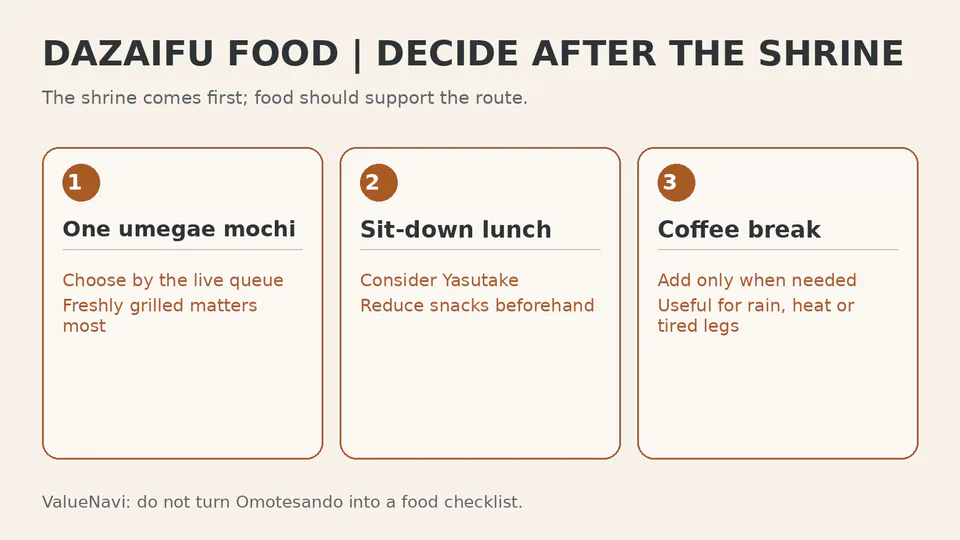
Choose the takeaway shop when you want one hot mochi and to keep walking. Choose the café/gallery when the group needs a seat, shade, rain protection or a deliberate tea break. The same brand solves two different problems.
The red-team question is queue length. If the only goal is to taste umegae mochi and another open shop can hand you one immediately, waiting a long time for Kasanoya is not automatically better value. The product is local to Dazaifu; the itinerary does not need to prove loyalty to one storefront.
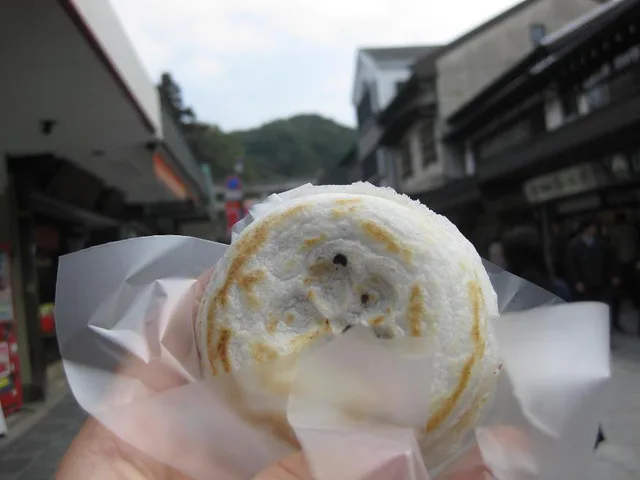
Teradaya: stronger when the seat and garden are part of the purchase
Teradaya sits closer to the shrine end of the approach. The current tourism listing gives 09:00–17:30, 14 indoor seats and eight garden seats when weather permits. It also publishes drink-and-umegae-mochi sets, including tea, coffee and matcha options.
That makes Teradaya a different product from a pure takeaway stop. If an older traveller, child or heat-weary group needs a real pause, a seated set can be more useful than walking to another “famous” mochi counter.
The trade-off is time. Sitting for tea is not a five-minute snack. On a two-hour Dazaifu visit, a café stop can consume the same block that would otherwise go to the shrine grounds or museum connection. Use it when the rest itself has value.
Teradaya’s current regular closure pattern is the first and third Wednesday from April through December; January–March can be irregular. Check the actual date instead of assuming the approach-road shops all share the same opening calendar.
Yasutake is two different businesses: this changes family and timing decisions
The current Dazaifu tourism listing for Yasutake Honten gives 08:30–18:00, no regular holiday and umegae mochi as the core product. The shop’s own site also highlights special mochi on the 17th and 25th of each month: ancient-rice umegae mochi on the 17th and mugwort umegae mochi on the 25th.
Soba Yasutake, however, is at a different address and follows a very different operating model. The official restaurant site lists 11:00–14:00, closed Sundays, Mondays and public holidays, cash only, no dedicated parking, and a policy asking guests with children younger than elementary-school age not to visit. It also offers a limited soba-course format that requires advance reservation.
This is not a minor naming footnote. It changes who should choose the stop:
Family with preschool child: Yasutake Honten mochi can fit; Soba Yasutake does not fit under the current child policy.
Early 09:00 visit: the mochi shop is available; the soba restaurant is not.
Cashless-only traveller: do not build the soba lunch around card payment; the official restaurant currently says cash only.
Sunday Dazaifu half-day: do not assume the soba lunch is open just because the mochi shop is.
For a short guide, this distinction is more useful than claiming one Yasutake dish “tastes better.”
One mochi is enough for most three-hour visits
Umegae mochi is inexpensive enough that travellers often turn comparison into the activity: Kasanoya, then Teradaya, then another shop. The financial cost is small; the appetite and time cost are not.
Use a purpose test:
You simply want to try the Dazaifu speciality: buy one fresh piece from a convenient open shop.
You genuinely enjoy comparing wagashi or grilled mochi: split two pieces between two people and compare two shops.
You have lunch soon: stop after one.
You want souvenirs: separate the “eat hot now” decision from the “carry home” decision.
The goal is not to prove that three shops differ. The goal is to enjoy Dazaifu without making the food list erase the shrine and the rest of the Fukuoka day.
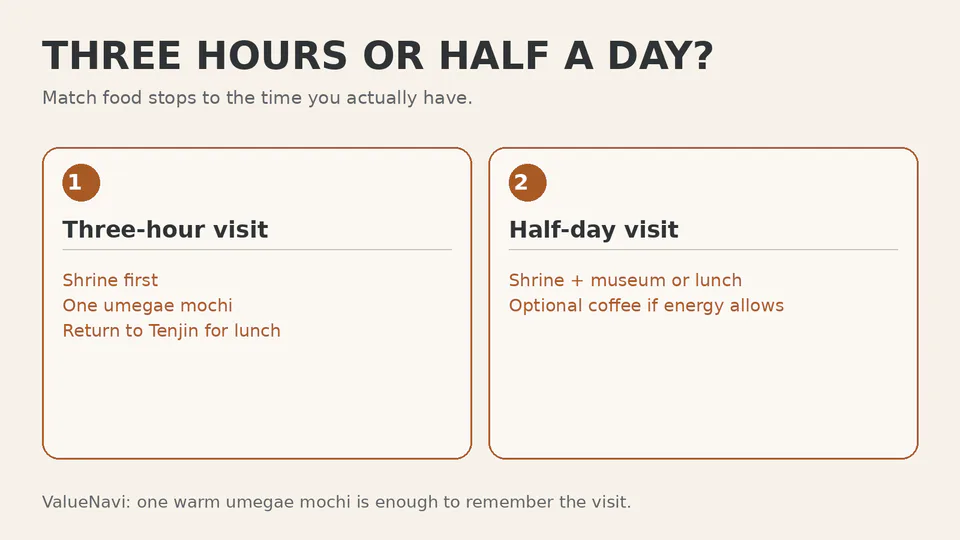
Three-hour Dazaifu: one snack, no formal lunch unless lunch is the point
A compact Dazaifu visit works best as:
Dazaifu Station → approach road without stopping for a long queue.
Dazaifu Tenmangu and the shrine grounds.
One umegae mochi or one short café break on the return.
Return toward Fukuoka for the next major meal.
This preserves the city’s scarce time. If you add Soba Yasutake, a long café stop and several mochi comparisons, it is no longer a three-hour visit in any meaningful sense.
If the broader Fukuoka itinerary is tight, use the Fukuoka 3-day itinerary before expanding Dazaifu simply because every food stop looks small in isolation.
Half-day Dazaifu: this is where lunch or the museum can earn a place
A half-day is a different product. You can visit the shrine, connect to the Kyushu National Museum, and still allocate one proper meal or café break without compressing everything.
The cleanest structure is to choose one primary extension:
Museum extension: shrine → Kyushu National Museum → one snack/tea stop.
Food extension: shrine → deliberate soba or another lunch → one umegae mochi.
Slow/rest extension: shrine → seated café/garden → easy shopping on the return.
Trying to do museum + proper lunch + two cafés + several mochi shops recreates the same checklist problem at a larger scale.
17th and 25th of the month can legitimately change the shop choice
Yasutake Honten officially promotes special umegae mochi on two recurring dates: ancient-rice mochi on the 17th and mugwort mochi on the 25th. If your visit happens to fall on one of those dates and comparing the special version matters, the shop itself can become a more meaningful choice than usual.
That is a good example of a condition that can reverse the normal “pick whichever queue is shortest” rule. The speciality exists only on that date, so it has lower substitutability than ordinary umegae mochi.
Do not rearrange an entire Fukuoka itinerary merely for it unless wagashi is a real interest. But if you are already visiting Dazaifu that day, the special batch is a rational tiebreaker.
Heat, rain and mobility can make a café more valuable than another food stop
Dazaifu’s approach road is compact, but summer heat, rain and crowding change the value of a seat. A café is not wasted time when it keeps an older parent, child or heat-sensitive traveller comfortable enough to finish the shrine visit.
That is why Teradaya or one of Kasanoya’s café spaces can be the correct “food choice” even if the group is not hungry. The purchase is partly a controlled rest indoors.
In cool weather with a mobile group and a short visit, the opposite applies: standing in another café queue can be lower value than eating one warm mochi and continuing.
Final verdict
Visit Dazaifu Tenmangu first, then let one food stop do one job. Kasanoya is a low-friction main-approach choice with both takeaway and café options. Teradaya gets stronger when a real seated tea break is valuable. Yasutake Honten is useful for an earlier mochi stop and has special versions on the 17th and 25th. Soba Yasutake is a separate, much narrower lunch product with its own hours, cash-only rule and child-age restriction.
For a two- to three-hour visit, one umegae mochi is enough for most travellers. For a half-day, add either a proper lunch, museum or café block. The food should make Dazaifu easier to enjoy, not turn a shrine visit into transport between shop names.
Okinawa Trip Cost: 5-Day Budget for Hotels, Car and Activities
Kishiwada Danjiri October 2026: Districts, Transport and How to Plan the Day
Tofukuji Fushimi Inari Uji Day Trip: JR, Keihan, Foliage and Crowds
Asakusa Samba Carnival 2026: When to Arrive, Where to Stand and What Not to Bring
Japan Autumn Leaves 2026: Forecast Calendar, Regions and Route Planning
References
Dazaifu Tenmangu — current shrine hours · Dazaifu Tourism Association — Kasanoya · Dazaifu Tourism Association — Teradaya · Dazaifu Tourism Association — Yasutake Honten · Soba Yasutake — official hours and visitor rules. Checked August 25, 2026. Shop hours and temporary closures can change; verify the exact visit date.