
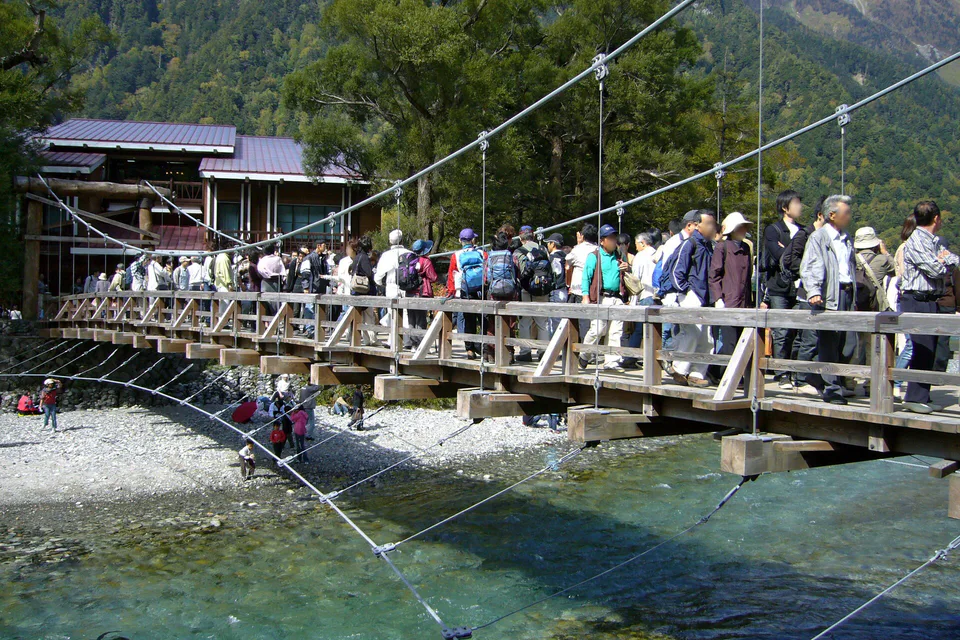
For a first Kamikochi day trip, reserve or choose the return bus first, then let the amount of usable park time decide the walk. From Matsumoto, my default is Taisho Pond → Tashiro Pond → Kappa Bridge → Bus Terminal. Add Myojin only when you reach Kappa Bridge with roughly three hours of genuine slack before your own return buffer. Do not make Tokusawa a normal first-visit add-on: the official walk from Kappa Bridge to Tokusawa is a little over two hours each way before stops.
There is one important 2026 correction to older advice: the Matsumoto/Shin-Shimashima–Kamikochi buses are currently reservation-priority, not universally “reservation required.” Travellers without a reservation may board if seats remain. That does not make advance planning optional on a scarce day trip: a non-reserved traveller has no seat guarantee, and the late services have fewer recovery options.
↔ Scroll table left or right
Your real constraint | Best starting plan | What not to force |
2–3 usable hours inside Kamikochi | Taisho Pond → Tashiro Pond → Kappa Bridge → Bus Terminal | Skip Myojin; protect lunch, photos and the return |
4–6 usable hours | Complete the Taisho–Kappa core, then decide at Kappa Bridge | Add Myojin only if time, weather and energy all agree |
6–8+ usable hours, strong walker | Taisho Pond → Kappa Bridge + Myojin loop | Tokusawa still needs a walking-first day, not leftover time |
Older traveller / limited mobility / young child | Bus Terminal → Kappa Bridge + a short Tashiro Bridge or Tashiro Pond loop | Do not use Myojin as the definition of a complete visit |
Large luggage stored at the Bus Terminal | Build the day around the 17:00 baggage-counter close | Do not treat the 17:55 final Matsumoto-side bus as extra walking time |
Want Tokusawa, dawn light or two weather windows | Consider an overnight | Stop forcing an overnight-style objective into a transport-limited day trip |
The hardest deadline is not always the last bus
ALPICO’s 2026 Matsumoto–Kamikochi service runs from April 17 through November 15. The current return timetable lists departures from Kamikochi toward Shin-Shimashima through the day, with the final published departure at 17:55. The route is reservation-priority: passengers with reservations board first, while passengers without reservations may board only when seats remain.
For most day trippers, that is enough reason to secure a return before walking far from Kappa Bridge. I would normally keep a personal buffer of roughly 30–45 minutes near the Bus Terminal before the planned bus, and more on peak foliage weekends, during Obon, in poor weather or with children. That buffer is ValueNavi planning, not an operator requirement.
There is a second deadline that ordinary itinerary tables miss. Kamikochi’s official baggage counter at the Bus Terminal currently operates from 06:00 to 17:00. If you stored a suitcase there, a 17:55 bus does not give you 55 extra minutes of walking: the bag must already have been collected before the counter closes. On a transfer day with luggage, the baggage counter can therefore become the real hard edge of the afternoon.
This produces a useful hierarchy:
No stored luggage + secured late return: the bus time is the main edge.
Stored luggage: 17:00 baggage collection becomes an additional hard edge.
No bus reservation: build more margin because “a departure exists” and “you have a seat” are different statements.
Reservation-priority is not the same as mandatory reservation
The current ALPICO Japanese timetable explicitly labels the Matsumoto/Shin-Shimashima–Kamikochi route as reservation-priority. Reserved passengers have priority, and unreserved passengers may still board first-come, first-served when space remains. The English operator page likewise says same-day tickets can be available for non-direct buses but warns that services can fill quickly.
That distinction matters because the correct advice is neither “you can just show up” nor “you are forbidden to travel without a reservation.” For a high-value mountain day, the rational answer is to reserve the bus section when your schedule depends on it, while understanding that limited same-day fallback may exist.
ALPICO currently operates direct National Park Liner buses from Matsumoto Bus Terminal at 05:30 and 10:15 and says they are commonly fully booked, so advance purchase is especially sensible. On the standard route, the Matsumoto → Shin-Shimashima railway itself does not need a seat reservation.
September 1, 2026 changes how some return-boardings work
ALPICO has published a specific rule change for Kamikochi → Shin-Shimashima services from September 1, 2026. Between Kamikochi and Sawando Ohashi, those services become boarding-only for passengers travelling toward Shin-Shimashima; the intermediate Kamikochi-side stops can be selected as boarding points for reservation, and passengers cannot use that section simply to ride down and get off within the Sawando-side corridor.
For a standard first-time route that finishes at the Kamikochi Bus Terminal, the main lesson is simple: recheck the exact boarding point when travelling on or after September 1. For a more unusual route that plans to finish at Taisho Pond or another intermediate stop and board the Matsumoto-side service there, the change is material enough that an old screenshot should not be trusted.
This is another reason to design the walking route around the transport product actually used on the travel date rather than around a generic “last bus from Kamikochi.”
From Matsumoto, the early departure buys route options rather than bragging rights
The standard Matsumoto-side chain is Matsumoto Station → Shin-Shimashima by Alpico Railway, then bus to Kamikochi. ALPICO currently lists the local-rail fare at JPY 710 and notes that the Matsumoto Station ticket machines for this journey are cash-only: IC cards and credit cards are not accepted at those machines.
The practical advantage of leaving early is not simply “more hours.” It buys optionality. If the weather is excellent and everyone is moving well, Myojin can be added. If breakfast runs late, a trail is slow or rain develops, the route can contract without destroying the day.
The 10:15 direct National Park Liner can still produce a good first visit, but a later arrival changes the definition of success. Taisho Pond → Kappa Bridge becomes the product. Myojin stops being something you have to fit merely because it appears on a longer itinerary online.
Taisho Pond → Kappa Bridge is the best first route because the bus removes the backtracking
Kamikochi’s official walking guide gives the Taisho Pond–Kappa Bridge corridor at roughly 75–80 minutes one way, depending on the bank. Its short-route guidance puts Taisho-ike Bus Stop → Tashiro Pond → Tashiro Bridge → Kappa Bridge → Bus Terminal at roughly 70 minutes of walking before rests and photography.
That makes the bus stop itself a route-design tool. Get off at Taisho Pond and walk north. You see the classic pond, marsh and Azusa River sequence without walking south from Kappa Bridge and then retracing the same distance.
The answer reverses in poor conditions. If visibility is bad, rain is heavy, someone already feels unsteady or the group is unsure about trail surfaces, stay on the bus to the terminal. A short Kappa Bridge / Tashiro Bridge loop keeps food, toilets, transport and shelter closer.
As of this update, the Azusa River course between Tashiro Marsh and Tashiro Bridge reopened on July 18, 2026 after restoration work following the 2024 heavy-rain damage. Both the riverside and forest alternatives can therefore be considered again, but live trail notices should still override this article.
Kappa Bridge is the go / no-go checkpoint for Myojin
The official walking guide gives Kappa Bridge → Myojin at about 50 minutes on the left bank or about 60 minutes on the right bank. That is roughly two hours of walking for the round trip before you allow time for Myojin Pond, the shrine area, rests or food.
I would only add Myojin when you reach Kappa Bridge with roughly three hours of usable slack before your own transport/baggage buffer. The three-hour threshold is ValueNavi analysis, not an official cutoff: it combines the official walking baseline with time for the destination and a non-rushed return.
At Kappa Bridge ask:
How much time remains before I need to be back at the terminal?
Does the 17:00 baggage counter apply to me?
Is the weather stable enough that the return pace is likely to remain normal?
Is everyone still walking comfortably, not merely willing to continue?
If one answer is weak, skip Myojin. You already completed the highest-value first-time corridor.
Tokusawa is not “Myojin plus one more stop”
The official Kamikochi guide says Kappa Bridge → Tokusawa takes a little over two hours one way. Myojin → Tokusawa alone is about 60 minutes. A Kappa Bridge–Tokusawa return therefore consumes roughly four to five hours of walking before lunch, photos or the Taisho Pond section.
That makes Tokusawa a different product. It is reasonable for a strong walker whose main purpose is a long day on foot and who has an early arrival plus a deliberately late return. It is not a normal extension for a first visitor who also wants Taisho Pond, Kappa Bridge, lunch and an unhurried afternoon.
If Tokusawa is the part you are most excited about, an overnight often solves the problem more cleanly than walking faster.
Half-day visitors should delete geography, not delete breaks
Kamikochi’s official guide publishes short central routes precisely because a good visit does not require reaching the farthest named point. Useful baselines include roughly 55 minutes for Bus Terminal → Kappa Bridge → Tashiro Bridge → Bus Terminal and roughly 70–80 minutes for a one-way Taisho Pond → Kappa Bridge route.
Do not respond to a late arrival by keeping Myojin and deleting lunch, toilets, photographs and the return buffer. That converts every normal delay into a transport problem.
A compact first visit can still contain Taisho Pond, Tashiro Pond, the Azusa River and Kappa Bridge. The missing kilometres are not a failure.
Matsumoto, Hirayu and Takayama solve different route shapes
Matsumoto is the natural east-side base when the wider trip comes from Tokyo or central Nagano. The public-transport chain is predictable once the bus seat is handled: local rail to Shin-Shimashima, then the mountain bus.
From the west, Hirayu is a much closer gateway. The current Hirayu–Kamikochi service runs during the same April 17–November 15 season, with frequent direct buses on the mountain section. Travellers coming from Takayama normally reach Hirayu first, then continue to Kamikochi.
This changes hotel sequencing. If the wider itinerary is Takayama / Okuhida → Kamikochi → Matsumoto, returning to Takayama after the walk merely because the previous hotel was there can create unnecessary backtracking. A transfer-day crossing can be more rational—but only when the suitcase problem is solved before entering the park.
A transfer-day Kamikochi visit is only elegant if the luggage has a plan
The Bus Terminal has an official baggage-storage counter. That makes a Takayama/Hirayu → Kamikochi → Matsumoto transfer day possible without walking the park with a suitcase. The current counter runs 06:00–17:00 and charges by size; the official guide currently gives indicative daily rates from JPY 350 for small bags to JPY 600 for extra-large items.
But storage is not infinitely elastic. The official site notes that racks can fill during peak summer periods. It should therefore be treated as useful infrastructure, not a guaranteed personal locker.
For a high-stakes transfer day, forwarding the main suitcase to the next hotel can be cleaner. Use the Japan luggage-forwarding guide and verify the receiving hotel and delivery timing rather than assuming same-day forwarding.
Driving changes the gateway, not the no-car rule inside Kamikochi
Private cars, rental cars and motorcycles cannot enter central Kamikochi. From the Matsumoto side, drivers park around Sawando and continue by shuttle bus or taxi. From the Takayama side, the equivalent gateway is the Hirayu / Akandana side.
Kamikochi’s official Sawando information currently lists parking at JPY 800 per day and says the shuttle normally runs at roughly 15–20 minute intervals, taking about 25 minutes to the Bus Terminal. The shuttle is non-reserved. During Golden Week, Obon and autumn-colour weekends, official guidance warns that parking can fill from around 08:00–09:00.
That means a rental car can improve the wider Nagano–Gifu itinerary while still creating a queue-sensitive final approach. “We have a car” is not permission to schedule Kappa Bridge like a roadside viewpoint.
Families and older travellers should choose the route that is still pleasant on the return
Central Kamikochi walking is relatively gentle, but roots, boardwalks, mud, wet leaves and cumulative distance can change the experience for limited mobility, young children or anyone already tired from a long Japan trip.
Start with a 55–80 minute official route and expand only after the first section proves comfortable. The failure mode is not walking slowly. It is reaching Myojin because the outbound leg felt fine, then turning the return into a deadline-driven march.
For a mixed-ability group, I would rather leave Myojin for another trip than spend the final hour watching the bus clock.
Weather should contract the route before it cancels the whole day
Mountain access can change quickly. In 2026 Kamikochi temporarily lost road access during heavy-rain disruption before transport resumed, and one of the Taisho-area walking courses only reopened on July 18 after restoration work. Saved screenshots are therefore weaker than same-day operator and trail notices.
Use a contraction ladder:
Stable weather: Taisho → Kappa core, then consider Myojin.
Light rain / lower visibility: keep the core short and reassess at Kappa Bridge.
Heavy rain / access warnings / poor footing: stay near the Bus Terminal and Kappa Bridge or move the mountain day if the wider itinerary allows.
If several outdoor days are competing for the same forecast window, the Japan rainy-day backup guide can help decide what should move.
When is one night in Kamikochi actually worth the hotel move?
Stay overnight when the hotel unlocks scarce hours rather than merely reducing transport time. The strongest reasons are dawn around Taisho Pond or Kappa Bridge, an evening after day trippers leave, a relaxed Myojin/Tokusawa walk, two chances at mountain weather, or a west-to-east traverse that already changes hotels.
A day trip remains the efficient answer when the classic Taisho Pond → Kappa Bridge scenery is enough and you can secure an early-enough arrival plus a comfortable exit.
Use the same deletion test as any other Japan hotel move: if you remove the dawn/evening/long-walk benefit and the overnight still only saves a bus journey, the extra hotel may not have earned its place.
Final verdict: reserve the exit, then earn the extra kilometres
For most first-time visitors from Matsumoto, start with an early service, secure a return if the schedule matters, get off at Taisho Pond and walk one way to Kappa Bridge. Treat Kappa Bridge as the decision point. Add Myojin only when you still have roughly three hours of real slack after accounting for the return bus, the 17:00 baggage counter if relevant, weather and the group’s pace.
Use Tokusawa only when walking itself is the day’s purpose or when an overnight removes the transport deadline. From Takayama/Okuhida, use Hirayu as the western gateway instead of automatically returning to Matsumoto. If driving, remember that the car stops at Sawando or Akandana and the final approach is still by bus or taxi.
The goal is not to walk the farthest. A successful Kamikochi day is the longest route that still leaves the group calm when the return transport arrives.
Official sources
ALPICO — Matsumoto / Shin-Shimashima / Kamikochi 2026 timetable and reservation-priority rules · ALPICO English — Matsumoto ⇆ Kamikochi · Kamikochi Official — walking times and routes · Kamikochi Official — baggage storage · Kamikochi Official — private-car restrictions · Kamikochi Official — July 18, 2026 Azusa River course reopening. Checked August 25, 2026. Bus seats, road access, trail conditions and operating rules can change; verify live information for the travel date.