
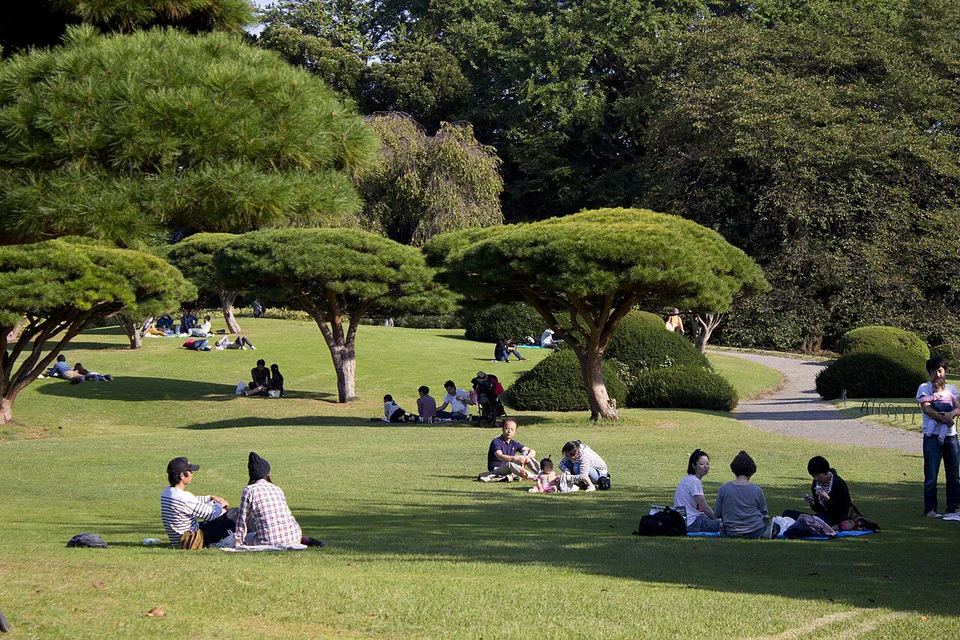
Choose Shinjuku Gyoen when you want the highest chance that one autumn half-day still works even if a particular tree type is early or late. Choose Meiji Jingu Gaien when the goal is one concentrated golden-ginkgo city image. Choose Rikugien when you want maples inside a traditional pond garden and are willing to trade some flexibility for atmosphere. These are not three versions of the same foliage stop. They have different tree mixes, walking styles, closing times and failure modes.
The most important 2026 planning rule is to choose from current colour, not a generic “Tokyo autumn peak” date. Ginkgo, mixed garden foliage and maple-heavy pond scenery do not move on the same clock. Three to five days before the visit, check dated official photos/notices and let the strongest current condition win.
↔ Scroll table left or right
Your priority | Best first choice | Why | Main failure mode |
First Tokyo foliage visit / mixed-age group | Shinjuku Gyoen | Mixed gardens, broad paths, ginkgo, maples, lawns and an indoor greenhouse create several ways for the visit to succeed | Large grounds can turn a short visit into unnecessary walking if you enter without a route |
One iconic ginkgo photo + Aoyama day | Meiji Jingu Gaien | The value is concentrated in the avenue rather than spread across a large garden | If the ginkgo is green, bare or overcrowded, there is little foliage value to rescue |
Traditional Japanese garden + maple atmosphere | Rikugien | Pond, bridges, tea-house views and maples form one coherent garden scene | Narrower routes and popular viewpoints are less forgiving at peak crowd times |
Rain / older travellers / need indoor fallback | Shinjuku Gyoen | Wider route choices, rest facilities and greenhouse create more fallback value | Autumn hours are short, so a late start still loses daylight quickly |
Night illumination is the reason for going | Rikugien only after 2026 event is officially announced | Previous years had special night viewing, but those dates are not reusable | As of August 25, 2026 the official 2026 event list has not announced the autumn night event |
Shinjuku Gyoen is the safest one-stop answer because it has more than one foliage product
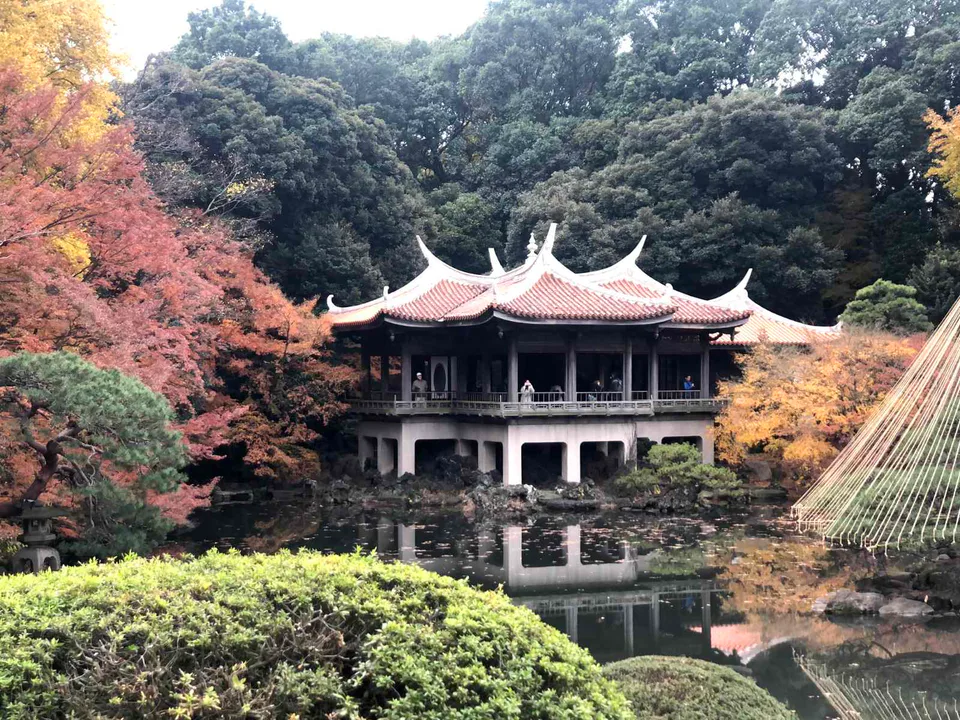
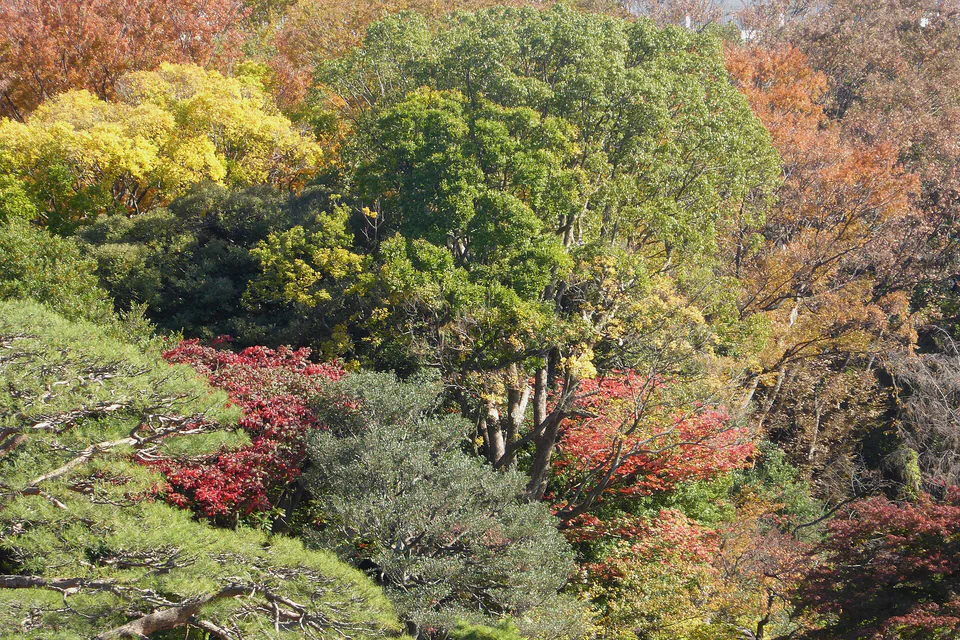
Shinjuku Gyoen combines a Landscape Garden, Formal Garden and Japanese Traditional Garden rather than relying on one single avenue or maple cluster. The current official autumn map shows the same practical advantage: visitors can find different foliage types across the grounds instead of asking one tree species to carry the whole visit.
That diversification matters when weather shifts the season. If one ginkgo group is early, another maple area may still be useful. If foliage is weaker than expected, the greenhouse, museum, tea/rest facilities and broad garden structure still give the ticket a job.
Current admission is JPY 500 for adults, JPY 250 for students and visitors aged 65 or over with appropriate ID, and free for junior-high-school-age children and younger. From October 1 to March 14, the garden operates 09:00–16:30 with final entry at 16:00; the greenhouse closes earlier, with final entry at 15:30.
The current closed-day rule is normally Monday, or the following weekday when Monday is a public holiday, plus December 29–January 3. There is a useful autumn exception: Shinjuku Gyoen currently opens every day from November 1 through November 15. Do not reject a Monday in that period from an old generic opening-hours note.
Use a 2–3 hour core route, not the entire perimeter
Shinjuku Gyoen is large enough that “walk around until we have seen everything” is a poor autumn strategy. The purpose is foliage, not perimeter completion.
For a first visit, build a two-to-three-hour core around:
the strongest current foliage area;
the Japanese Traditional Garden;
one lawn / ginkgo section;
the greenhouse only if weather, fatigue or plant interest justifies it.
Families and older travellers should cut distance before cutting the whole garden. A broad accessible path and a shorter route normally preserve more value than adding every corner because the admission feels inexpensive.
ValueNavi boundary: choose Shinjuku Gyoen for variety, but do not turn variety into a four-hour obligation when the rest of Tokyo day is already full.
Meiji Jingu Gaien is the highest-reward, highest-binary foliage stop
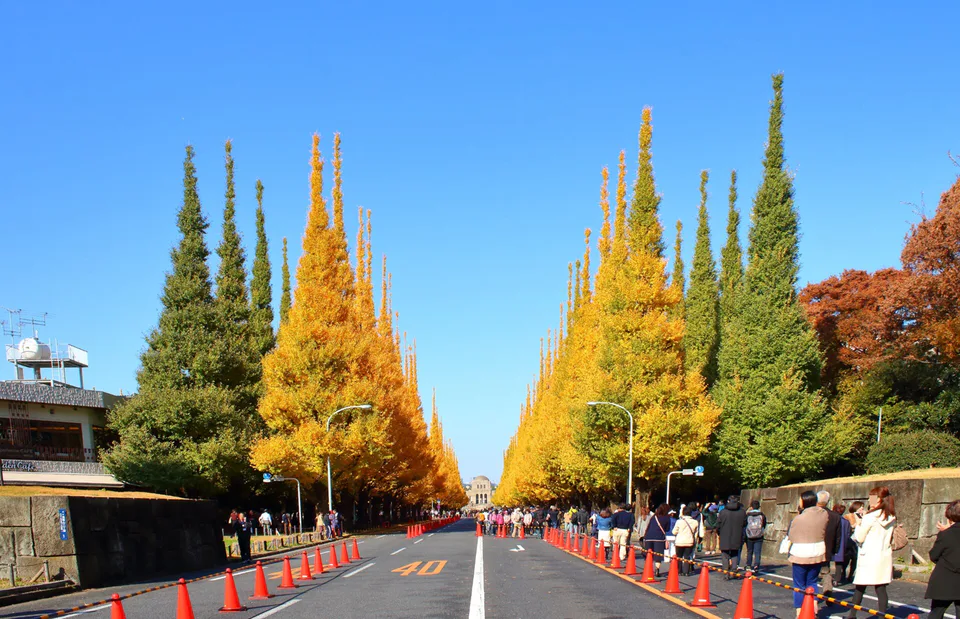
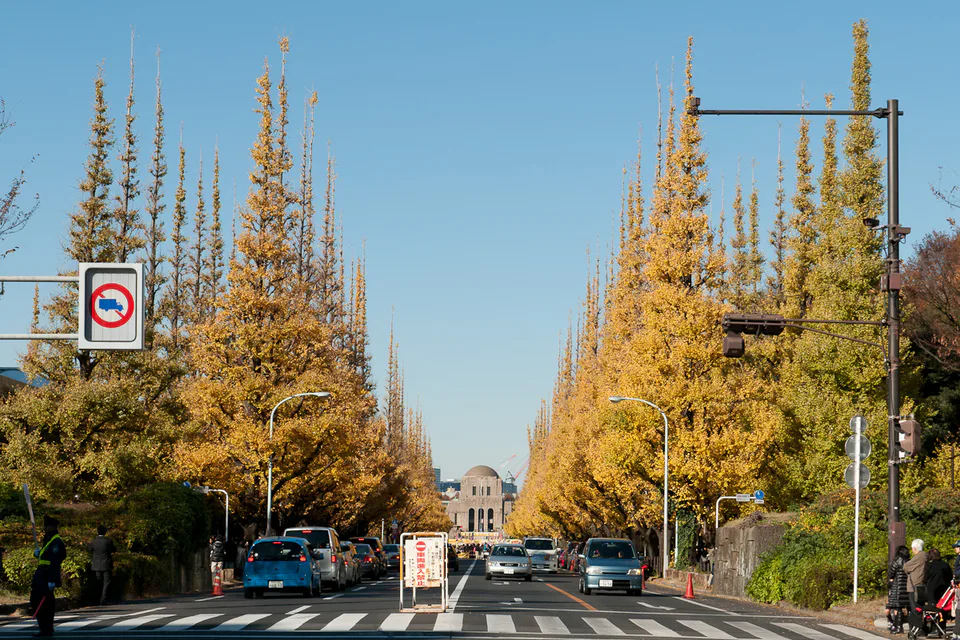
Gaien’s famous ginkgo avenue is not a ticketed garden that gives you several different landscape zones. Its autumn value is much more concentrated: a long urban perspective of yellow ginkgo leading toward the Meiji Memorial Picture Gallery.
That is why it can be an excellent 45–90 minute stop and a poor two-hour recovery project. If current images show strong yellow colour and enough leaves on the branches, the avenue can deliver the exact photograph people came for. If the trees are still mostly green or a storm has stripped the leaves, walking the same road for longer does not restore the missing foliage.
The official Gaien access page lists Aoyama-itchome and Gaienmae among the useful metro stations, along with JR Shinanomachi/Sendagaya and National Stadium Station. The broader Gaien facilities are roughly 15 minutes from the listed stations depending on destination. For the ginkgo avenue specifically, choose the station that fits the next stop rather than crossing the whole district simply to reuse the arrival station.
Gaien therefore works best as part of an Aoyama / Omotesando / National Stadium direction. It is not worth changing a whole Tokyo hotel base for one seasonal photograph.
Rikugien is the strongest atmosphere choice — but the least interchangeable
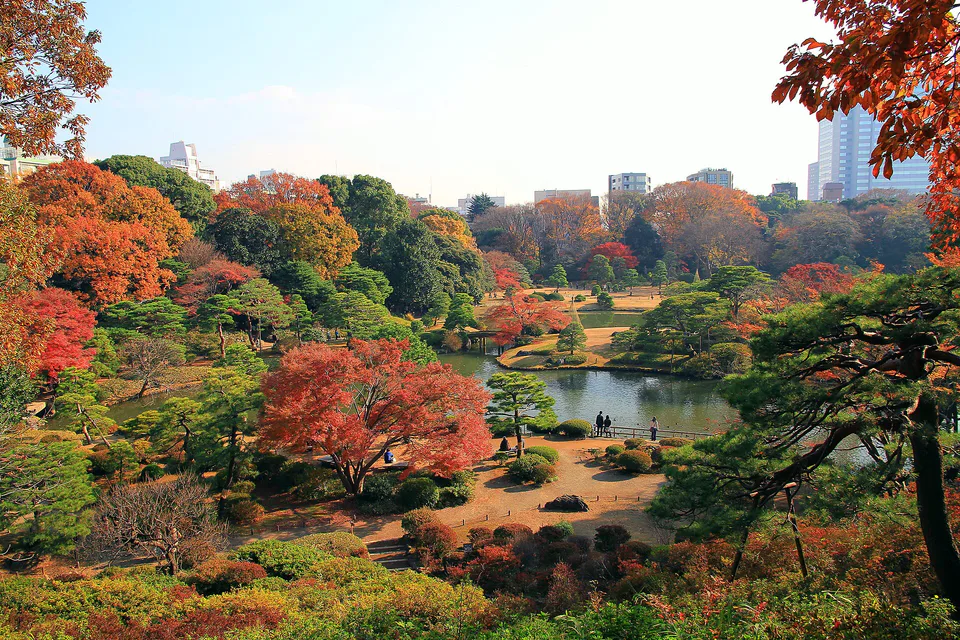
Rikugien is a Special Place of Scenic Beauty built around a large pond, artificial hills, bridges and composed garden viewpoints. Its autumn value is not “more trees than Gaien.” It is the way maple colour sits inside a traditional daimyo-garden composition.
Current standard opening is 09:00–17:00 with final admission at 16:30. Adult admission is now JPY 300, JPY 150 for visitors aged 65 and over, with free admission for elementary-school-age children and younger plus qualifying Tokyo middle-school students. The garden closes December 29–January 1.
For a first visit, protect roughly 90 minutes to two hours. The garden is smaller than Shinjuku Gyoen but narrow paths and popular pond viewpoints can slow movement. Trying to race through in 45 minutes strips out the thing Rikugien is selling: composed views rather than landmark collection.
Rikugien gets weaker for travellers who need a wide, highly flexible family park. It gets stronger for couples, photographers and travellers whose autumn goal is specifically a traditional Japanese garden.
Do not use last year’s Rikugien night dates as a 2026 plan
This is the most important time-sensitive correction in the comparison. Rikugien held a special autumn night-viewing event in 2025 from November 28 to December 9, but those dates belong to 2025.
As checked on August 25, 2026, Rikugien’s current official 2026 event/news page does not yet list the 2026 autumn night-viewing event. It may be announced later, but until the operator publishes the current year’s dates, ticket type, entry gate and route rules, treat evening viewing as unconfirmed.
If night illumination is the entire reason you prefer Rikugien over Shinjuku Gyoen, do not book a non-refundable Tokyo day around a previous-year pattern. Wait for the 2026 official announcement.
One half-day: choose the foliage product, not the famous name
Choose Shinjuku Gyoen for variety, a first foliage visit, children, older travellers or uncertain current colour. It has the strongest fallback structure.
Choose Gaien for the one ginkgo avenue photograph and a day already moving through Aoyama / Omotesando. It has the lowest time commitment when conditions are strong.
Choose Rikugien when the traditional garden itself matters. It is the strongest “autumn atmosphere” choice but should not be selected because a previous year had illumination.
This is also the answer for travellers with only one morning. Do not visit all three to hedge the season. Pick the site whose current condition and experience style match the trip.
Two-site day: Shinjuku Gyoen + Gaien is the only obvious pairing
Shinjuku Gyoen and Gaien sit on the same western/central side of Tokyo and create two genuinely different foliage products: mixed garden first, concentrated ginkgo avenue second. That makes them the cleanest two-site day when both current conditions are good.
A practical sequence is Shinjuku Gyoen after opening, lunch, then Gaien/Aoyama. If Gaien colour is poor, replace the second stop with an indoor museum, shopping or Omotesando rather than crossing the city to chase another tree.
Rikugien belongs to a different geographic day. Pair it with Ueno, Yanaka, Kyu-Furukawa Gardens, Komagome, Ikebukuro or another northeastern/central destination. Adding Rikugien after Shinjuku Gyoen and Gaien turns foliage comparison into transit collection.
Three sites in one day is a deletion-test failure
It is technically possible to visit all three, especially with early starts. It is usually poor travel design.
Three gardens/avenues create repeated station walks and destroy the main value of Rikugien and Shinjuku Gyoen: slowing down enough to notice landscape composition and colour variation. If the goal is to say you saw all three, the plan works. If the goal is to have a strong autumn day, remove one or two.
The correct hedge against uncertain foliage is current information, not more transport.
Rain and wind change the ranking differently
Light rain: Shinjuku Gyoen remains the most resilient because the greenhouse and rest facilities provide indoor breaks. Rikugien can still look atmospheric, but wet stone and narrower paths raise the mobility cost. Gaien is the weakest if the main goal is a clean avenue photograph.
Strong wind: all three lose value because leaves can fall quickly, but Gaien’s single-species visual is particularly exposed to a rapid change in condition.
Heavy rain: do not cross Tokyo for a foliage checklist. Stay near the hotel base and use a museum, department store, observatory or other indoor plan. The Tokyo rainy-day guide is a better use of the day.
Families and older travellers: walking surface matters more than entrance price
Shinjuku Gyoen is the easiest default for mixed mobility because broad paths, seating/rest options and wheelchair availability make route shortening straightforward. The adult ticket being JPY 500 rather than free is a small cost relative to not overloading the group.
Gaien is flat but crowd density and road crossings can become the real difficulty. Rikugien is compact but narrower garden paths and popular viewpoints make it less forgiving when mobility is limited.
The best autumn site for a family is therefore not the one with the cheapest child ticket. It is the one where the weakest walker can still reach the strongest current foliage without turning the whole half-day into crowd management.
Final verdict: pick one autumn product and let live colour break the tie
Shinjuku Gyoen is the best first-choice garden for most travellers because it has multiple landscape styles, more tree variety and stronger fallback value. Gaien is the best short ginkgo stop when current conditions are genuinely strong. Rikugien is the best traditional-garden choice when the pond-and-maple atmosphere is what you want.
The answer should still reverse when current foliage does. If Shinjuku is early and Gaien is fully yellow, choose Gaien. If wind has stripped the ginkgo but Rikugien maples are strong, choose Rikugien. Autumn planning should be conditional by design.
Most importantly, do not schedule a 2026 Rikugien night visit from a 2025 event date. As of August 25, 2026, wait for the current official announcement.
Related planning
Tokyo Autumn Leaves Timing and Regions · Japan Autumn Leaves Calendar and Route Planning · Tokyo Autumn Day-Trip Comparison
References
Shinjuku Gyoen — official visitor information · Shinjuku Gyoen — facilities and seasonal hours · Meiji Jingu Gaien — official English site · Rikugien — current hours, admission and 2026 notices. Checked August 25, 2026. Autumn colour and event schedules remain weather- and year-dependent.