
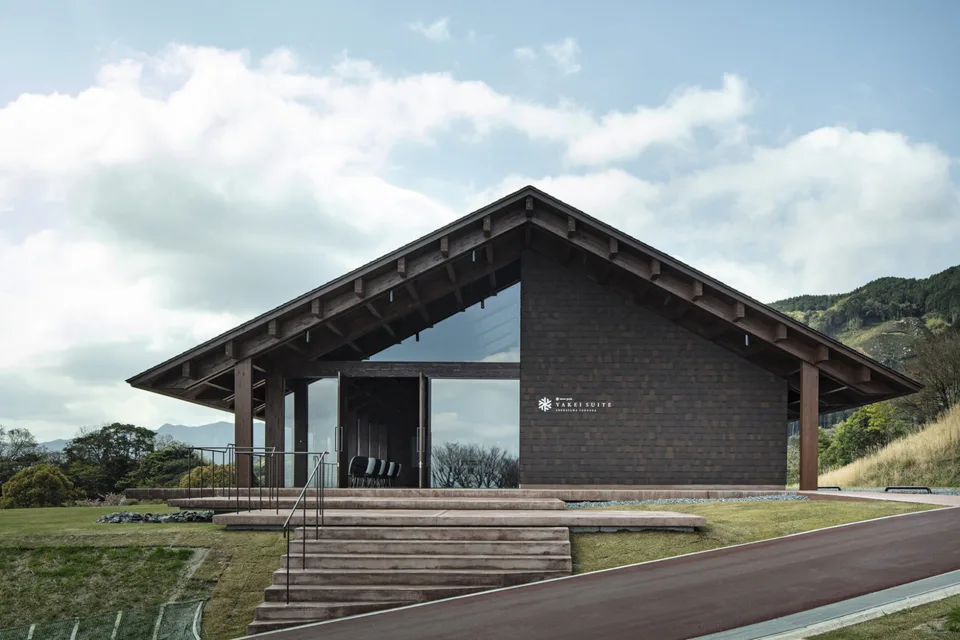
Snow Peak YAKEI SUITE ABURAYAMA FUKUOKA is a destination stay inside ABURAYAMA FUKUOKA, not a station hotel for repeated city trips.
Snow Peak YAKEI SUITE ABURAYAMA FUKUOKA is worth replacing one Fukuoka city night when the stay itself is the evening plan. The strongest version is simple: arrive around check-in, keep dinner on site, use the room or private sauna if your category has one, spend the night around the view and fire lounge, then leave after breakfast rather than trying to squeeze another Hakata or Tenjin night around it.
The weak version is also easy to identify. If you still want a late Nakasu dinner, shopping in Tenjin, a flexible return after 21:00, or an early train the next morning, staying on Aburayama creates more transport friction than it removes. The official FAQ currently says there is no station or airport shuttle, vehicle entry and exit stop from 21:00 to 07:00, check-in starts at 15:00, arrivals after 17:00 should be notified in advance, and room-only stays are not offered. Those are not footnotes. They define the product.
Checked August 26, 2026 against the official YAKEI SUITE room, FAQ and experience pages. Room inventory, plans, meal details and restrictions can change, so recheck the live plan before payment.
The 30-second decision: destination night or city hotel?
↔ Scroll table left or right
Your actual Fukuoka night | Better starting choice | Why |
You can reach Aburayama by mid-afternoon and want dinner, sauna/view and a slow morning on site | YAKEI SUITE | The hotel itself replaces the evening itinerary instead of competing with it |
You want Nakasu/Tenjin dinner, bars or shopping after 20:00 | Hakata / Tenjin city hotel | The 21:00–07:00 vehicle gate and no city shuttle make late city movement structurally awkward |
Early Shinkansen, airport departure or long Kyushu transfer next morning | City hotel usually | Sleeping near the departure spine protects the morning that has a hard deadline |
Couple wanting a private sauna and outdoor-living room | COTTAGE | 50㎡, two-person capacity, private sauna and water bath without buying the four-person VILLA scale |
Up to four adults, privacy and two bedrooms matter | VILLA | 150㎡, two bedrooms, bath, private sauna and the most self-contained stay |
You want the most camp-like product and accept shared sanitary facilities | LAND CAVE | 75㎡ tent format for up to six, but no private sauna and showers/toilets are in a separate sanitary building |
If you are still choosing the city alternative, compare Hakata vs Tenjin as a Fukuoka base first. YAKEI SUITE only becomes a fair comparison after you know what city evening you are giving up.
The real cost is not one hotel night — it is the city evening you replace
A room-price comparison understates the decision. The opportunity cost of Aburayama is the part of Fukuoka that no longer fits naturally around the stay.
On a city night, you might finish sightseeing at 18:00, eat in Tenjin or Nakasu, shop after dinner and walk back to the hotel whenever everyone is tired. At YAKEI SUITE, the official dinner service is currently arranged in four starting windows from 17:30 to 19:00, and the site does not sell a room-only plan. The evening is therefore already spoken for.
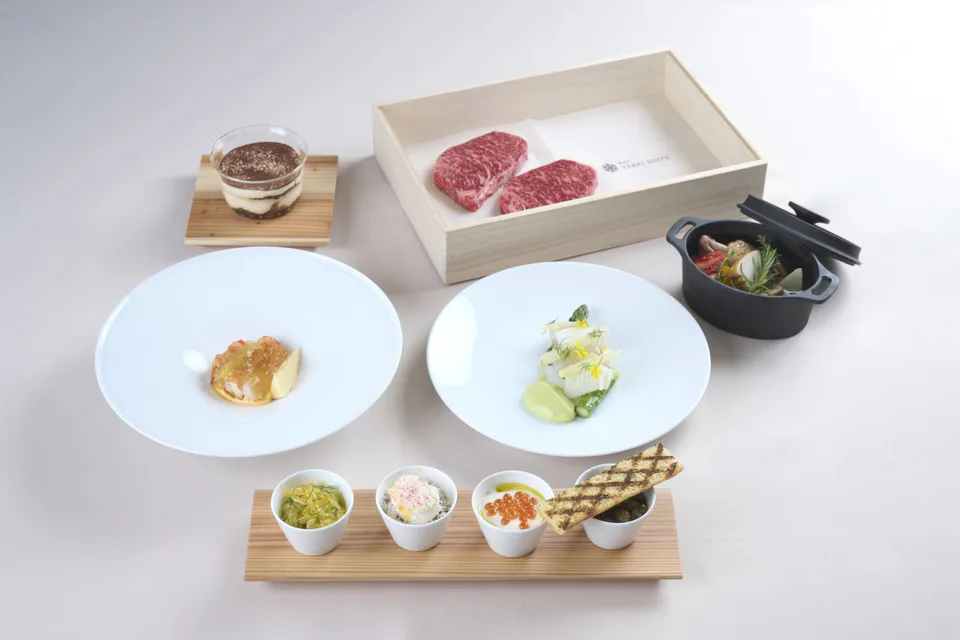
That is a feature when you want it. Dinner is served in the room, with a French-led menu that incorporates Snow Peak cooking gear for some dishes. The fire lounge currently runs 19:30–22:30. A guest who wants an intentionally self-contained night gets a coherent sequence: check-in → room / sauna → dinner → fire lounge → night view.
But if your mental plan is “check in, then go back downtown for dinner,” you are fighting the hotel design. You would be paying for an included on-site food experience while spending the scarce evening hours elsewhere, then racing a hard vehicle gate on the way back.
True time cost: protect roughly 15:00 through the next morning
The official model stay is revealing. It suggests arriving around 14:00 to use ABURAYAMA FUKUOKA before the 15:00 check-in, then breakfast around 08:00, more site time around 09:00 and checkout at 11:00. You do not have to copy that schedule, but it shows what the property expects the room to do.
↔ Scroll table left or right
Time block | What YAKEI SUITE is trying to sell | What conflicts with it |
14:00–15:00 | Arrive early, use ABURAYAMA FUKUOKA | A full-distance day trip that returns late |
15:00–17:30 | Check-in, room, outdoor living, sauna for VILLA/COTTAGE | Trying to add another city attraction after check-in |
17:30–19:00+ | In-room dinner | Nakasu/Tenjin restaurant reservation |
19:30–22:30 | Fire lounge, night view, room time | Returning from city nightlife before the 21:00 vehicle gate closes |
07:00–11:00 | Breakfast and slow morning | Very early airport/train departure |
ValueNavi rule: do not ask whether the hotel deserves eight sleeping hours. Ask whether it deserves the roughly 15:00-to-morning block that gives the experience a chance to work.
The 21:00 gate is a hard itinerary boundary, not a suggestion
The current official FAQ says vehicles may enter or exit until 21:00 and again from 07:00. The gate is closed from 21:00 to 07:00. That turns an otherwise short drive from central Fukuoka into a scheduling constraint.
Three plans become weak immediately:
Late downtown dinner: the evening now depends on leaving the city early enough to reach the gate before closure.
Uncertain arrival from another Kyushu city: a delayed train, rental-car pickup or sightseeing stop can push the final approach into the restricted window.
Pre-07:00 departure: if you need to drive out before the gate opens, the stay is incompatible with the morning plan unless the property confirms a different current arrangement for your booking.
The official FAQ also says there is no shuttle from the station or airport and recommends taxi or other self-arranged transport. Inside ABURAYAMA FUKUOKA the property can shuttle guests to nearby on-site facilities, but that is not a substitute for a city-centre transfer.
This is why a Fukuoka subway or rail pass is not the main transport solution here. If you are otherwise planning a rail-first city stay, use the Fukuoka transport guide to solve the rest of the trip, then treat the Aburayama final mile as a separate decision.
VILLA vs COTTAGE vs LAND CAVE: these are three different products
The original “which room looks nicest?” framing is too shallow. The categories change capacity, bathroom setup, climate exposure and whether a private sauna exists.
↔ Scroll table left or right
Room type | Official capacity / size | Key facilities | Best fit |
VILLA | 4 guests / 150㎡ | Two bedrooms, indoor bath + shower, private sauna, water bath, kitchen/dining, outdoor living | Two couples, adult family, or travellers paying for maximum privacy and indoor comfort |
COTTAGE | 2 guests / 50㎡ | Shower, private sauna, water bath, outdoor living; no bathtub | Couple who wants the sauna/view product without the scale of VILLA |
LAND CAVE | 6 guests / 75㎡ | Tent bedroom/living, seasonal spot AC/heating; separate sanitary building; no shared guest sauna | Group that actively wants a luxury-camping rhythm rather than a conventional hotel room |
One subtle but important correction: LAND CAVE is not the cheap version of the VILLA/COTTAGE sauna experience. The FAQ explicitly says LAND CAVE guests do not have a shared sauna. Showers and other sanitary facilities are in a separate building. If the private sauna is the reason you are moving out of Fukuoka, LAND CAVE does not solve that goal.
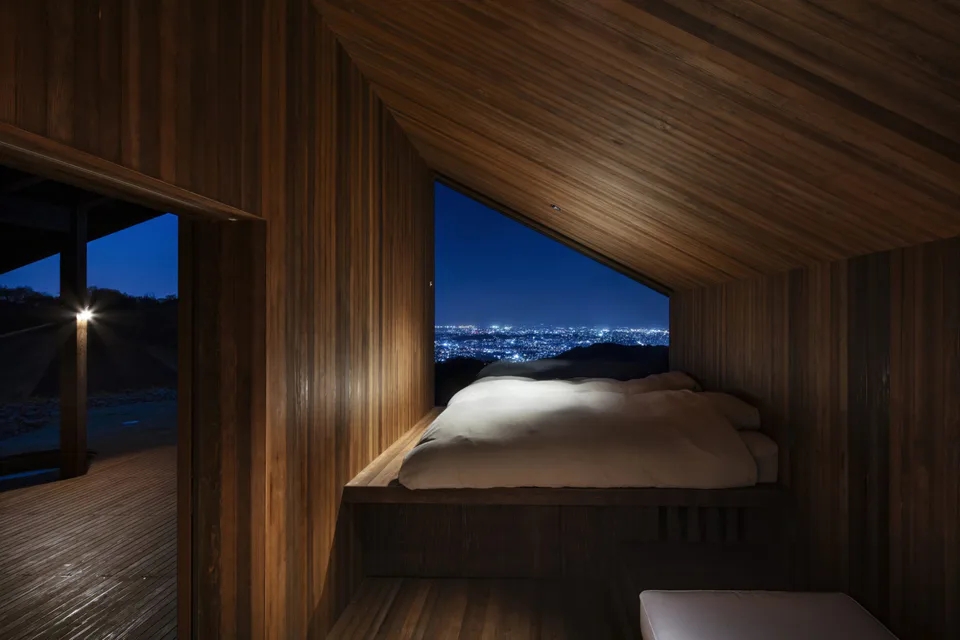
Room type changes the stay more than a simple size upgrade: VILLA, COTTAGE and LAND CAVE have different bathroom and sauna setups.
COTTAGE is the cleanest default for two adults — unless a bathtub matters
For a couple, COTTAGE is the most coherent baseline because it matches the two-person capacity and preserves the two facilities that make the mountain move easiest to justify: an outdoor-living view and a private sauna/water bath.
The reversal condition is the bathroom. COTTAGE has a shower but no bathtub. If a long soak is part of the recovery plan, do not infer one from the “luxury” label. VILLA has an indoor bath; LAND CAVE relies on the sanitary building for showers.
That small detail can matter more than another ten square metres because the entire point of this night is to spend time at the property rather than use it as a bed between attractions.
VILLA makes most sense when four-person privacy actually has a job
VILLA is one 150㎡ unit for up to four guests, with two bedrooms and four double-size mattresses across the two rooms. That is a very different use case from simply giving a couple more floor area.
It gets stronger when two couples or an adult family can share one destination stay while retaining bedroom separation, and when the indoor bath, kitchen/dining area and private sauna are all likely to be used.
There is also a current 2026 VILLA-only private-stay plan that reinforces the category’s purpose: the operator introduced a one-group-per-day plan with in-room check-in/out, both meals served in the VILLA, a private fire setup beside the room and all-inclusive service. Do not assume those inclusions apply to every VILLA rate; treat them as plan-specific and verify the exact package at checkout.
LAND CAVE should be chosen for the outdoor exposure, not because six people fit
LAND CAVE is the category most likely to be misread by a group. Capacity up to six can make it look like the obvious per-person value option, but capacity is not the same as hotel equivalence.
The official description is explicit that the tent is designed to let guests feel wind, rain sounds and outside temperature through the fabric. Seasonal spot air-conditioning or heaters are provided, and winter covers improve airtightness, but the property still tells guests to dress for the season because outdoor-living areas can be hot in summer and cold in winter.
Choose it when that exposure is the point. Do not choose it for a traveller who expects a sealed, climate-controlled suite with an ensuite bathroom and private sauna just because the wider property name contains “SUITE.”
Families need to check the age rule before comparing room capacity
The normal stay rule currently allows guests from elementary-school age upward and does not accept preschool children. The operator makes an exception on separately designated Kids Days, when younger children can stay under the special conditions for those dates.
This is a classic capacity trap. A VILLA may physically hold four standard guests, and LAND CAVE may hold six, but that does not mean every family composition is bookable on every date.
If you travel with a preschool child, search the live calendar for a Kids Day before you compare room rates. If the date is not eligible, the correct answer is not a larger room — it is a different hotel night.
Dining is part of the booking, so do not double-book your evening
Dinner is part of the destination-stay logic, not a gap that needs a separate downtown restaurant reservation.
The property currently does not accept room-only stays. Dinner is served in the room, with current start times at 17:30, 18:00, 18:30 or 19:00 depending on the operating setup. This makes the accommodation decision unusually clear.
If you have a must-eat restaurant in Hakata, Tenjin or Nakasu that same night, keep the city hotel. If your main food goal is a relaxed on-site dinner and you are happy for Fukuoka nightlife to disappear, YAKEI SUITE gets much stronger.
Allergy requests also have a real deadline. The FAQ asks guests to notify the property by three days before the stay and states that same-day handling is not available. That matters more here than at a flexible city hotel because dinner is embedded in the stay rather than easily replaced by the next restaurant on the street.
One night is usually the correct length
For most first-time Fukuoka trips, I would treat YAKEI SUITE as a one-night insertion rather than a base.
The argument is structural:
the property is designed to reward time on site;
the dinner format repeats rather than changing automatically on consecutive nights;
there is no station/airport shuttle;
city evening flexibility is reduced;
and Fukuoka itself has strong reasons to keep at least some nights in Hakata or Tenjin.
Two nights can make sense when the objective is specifically a resort-style retreat, you want time for the wider ABURAYAMA FUKUOKA facilities, or you are deliberately avoiding a city-heavy itinerary. For a normal sightseeing trip, the second night often spends another Fukuoka evening without creating a second distinct hotel experience.
Where should the Aburayama night sit in a Fukuoka itinerary?
The best position is usually between flexible city days, not before a hard departure.
↔ Scroll table left or right
Sequence | Verdict | Reason |
Hakata/Tenjin → Aburayama → Hakata/Tenjin | Good if you accept one hotel move each way | Both edges are flexible and the mountain night is deliberately isolated |
City sightseeing → Aburayama → Yufuin/Beppu | Conditional | Works by car if the next route is coherent; weaker by rail because you must first solve the transfer back to a transport hub |
Late regional arrival → Aburayama | Weak | 17:00 notification and 21:00 gate make delay risk unusually expensive |
Aburayama → early Fukuoka Airport flight | Usually no | The stay spends the wrong morning on a hard airport deadline |
Aburayama → relaxed Fukuoka city afternoon | Strong | You can use breakfast/check-out without treating 11:00 as late |
If the larger trip continues into hot-spring country, compare the Fukuoka–Hita–Yufuin–Beppu hotel sequence before inserting Aburayama. A destination hotel should simplify the emotional rhythm of the trip, not turn every night into a different luggage move.
Driving vs taxi: the important difference is control of the departure time
Driving is the cleanest transport match because VILLA and COTTAGE have dedicated parking after check-in, while LAND CAVE guests use the reception-area guest parking. Overnight guest parking is free according to the current FAQ.
A taxi can remove the need for one person to drive, but it does not remove the lack of public-transport flexibility or the 21:00 vehicle gate. If you are not driving, arrange the final transport rather than assuming a taxi will be as effortless at every hour as it is in central Fukuoka.
Winter adds another condition: the property warns that winter tyres or chains may be needed and that heavy snow can cause temporary closure. That is another reason not to put this stay immediately before a non-replaceable flight.
Direct booking deserves a check before OTA comparison
The official room page currently advertises a 10% best-rate guarantee for the same online plan when booked on the property’s own website. That does not mean the official site is always the cheapest final transaction across every coupon, membership benefit or cancellation condition. It does mean an OTA should not be the automatic first click.
Compare the same room type, same meal plan, same number of guests and same cancellation rule. A cheaper-looking rate is not comparable if it drops an inclusion or changes the cancellation window.
The property’s standard cancellation policy currently escalates from 10% at 8–14 days before arrival to 50% at 2–7 days, 80% the day before and 100% on the day/no-show, while the FAQ warns that specific plans or booking channels can differ. For a weather-sensitive mountain stay, that policy difference can matter more than a small headline discount.
Next action: after you choose VILLA, COTTAGE or LAND CAVE, check the official room and live-plan page first, then compare an OTA only on identical terms.
Who should book it?
Book it if at least three of these are true:
you can arrive by mid-afternoon rather than after a long uncertain travel day;
you are happy for dinner to be the hotel meal rather than a downtown restaurant;
the night view, outdoor-living space or private sauna is a major reason for the stay;
you are driving or have deliberately arranged the taxi/final-mile transfer;
the next morning has no pre-07:00 driving requirement and no tight transport deadline;
the exact room category matches the facilities you want.
Who should keep the city hotel?
Keep Hakata or Tenjin when the night’s value comes from city mobility: yatai, shopping, a restaurant list, late check-in, spontaneous bars, an early airport run or an early Shinkansen. In those cases, a distinctive room on Aburayama is solving the wrong problem.
A city base also wins when you only have two or three Fukuoka nights and moving hotels would consume too much of the trip. Use the Tenjin/Nakasu hotel comparison or Hakata Station hotel comparison if the decision is really about late returns and luggage rather than mountain time.
Final verdict
Snow Peak YAKEI SUITE ABURAYAMA FUKUOKA is not a more scenic Fukuoka city hotel. It is a deliberate one-night destination stay. The strongest booking is one where you can protect the afternoon, eat on site, use the facilities your exact room actually includes, accept the 21:00–07:00 vehicle boundary and wake without a hard early departure.
For two adults, COTTAGE is the cleanest default when the private sauna/view product matters and a bathtub does not. VILLA earns its premium when four-person space, two bedrooms, an indoor bath or the more private 2026 plan has a real job. LAND CAVE should be chosen because you want the camp-like exposure, not because you assume it includes the same private sauna and bathroom setup.
The deletion test is simple: if the room had no mountain view, sauna or fire-lounge evening, would you still move out of Hakata or Tenjin just to sleep there? If no, protect enough time to use those features. If your itinerary cannot give them that time, keep the city night.
Official sources
Snow Peak YAKEI SUITE ABURAYAMA FUKUOKA — official FAQ, access and stay rules · official room specifications and direct-booking rate statement · official stay-flow and experience page · Snow Peak/JR Kyushu Regional Design — 2026 VILLA private-plan announcement. Checked August 26, 2026.