
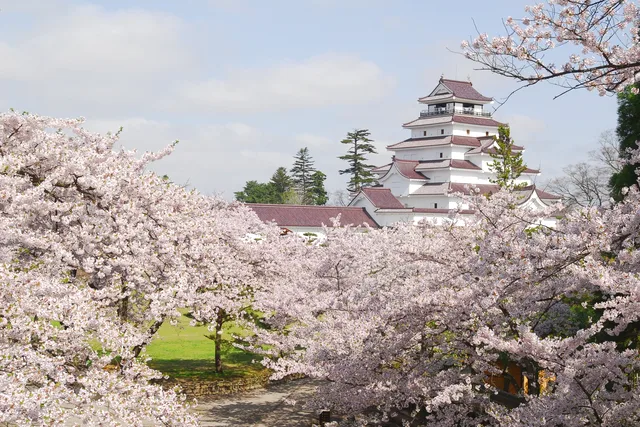
Tsuruga Castle’s three adult ticket prices look so close that the ¥730 option can feel automatically “best value.” That is the trap. The ¥410 keep ticket, ¥520 keep + Rinkaku ticket and ¥730 three-site ticket all have small cash gaps, but the time gaps are much larger. Oyakuen is not another room inside the keep; choosing the full bundle changes the shape of your Aizuwakamatsu day.
ValueNavi verdict: ¥410 is enough for the No.12 stamp, museum and upper-level view. For a first visit, ¥520 is the most interesting upgrade because another ¥110 (about US$0.69 at the 27 August 2026 reference exchange rate) adds Rinkaku without sending you across town. Buy ¥730 only when Oyakuen was already in your half-day or full-day plan. The real deadline is 16:30, when last admission to the keep ends.
¥410, ¥520 or ¥730? Compare the extra time, not only the extra yen
↔ Scroll table left or right
Ticket | Approx. USD* | Best for | Hidden cost |
¥410 keep | ~US$2.57 | No.12 stamp, museum, Boshin War/Aizu history and the fifth-floor view | You skip Rinkaku’s tea-history layer |
¥520 keep + Rinkaku | ~US$3.26 | Best-balanced first visit | Rinkaku needs its own walking/reading time; it is not simply a ¥110 add-on in seconds |
¥730 keep + Rinkaku + Oyakuen | ~US$4.58 | Half-day/full-day Aizu history route | Oyakuen adds another site and transfer, so the real premium is time |
Castle grounds only | ¥0 | Photography, stonework and exterior-first visitors | No keep museum, upper-level view or easy indoor interpretation |
*US-dollar figures use the 27 August 2026 reference rate and will move. Plan around the yen prices.
ValueNavi Score: high information density, but the bundle can overfill a short Aizu stop
The score uses ValueNavi’s seven attraction-decision dimensions. Higher is better; resilience means less likely to be derailed. It is editorial analysis based on current public information, not an official rating.
Dimension | Score | Decision reason |
|---|---|---|
Money value | Even the three-site adult ticket is only ¥730; the main cost is time, not admission | |
Time efficiency | The keep is compact enough for a focused visit, but Aizuwakamatsu Station is not beside the castle and the ¥730 bundle adds another site | |
Booking / access resilience | No timed reservation is normally required; the main hard cutoff is 16:30 last admission | |
Weather resilience | The keep museum provides a substantial indoor visit, while the park/stonework remain outdoor | |
Crowd resilience | The site handles ordinary tourism well, but Aizu Festival and seasonal peaks can transform the Honmaru into an event space | |
Route fit in an Aizuwakamatsu day | The castle is a natural anchor for a city-history itinerary with Rinkaku, Oyakuen and other Aizu sites | |
Uniqueness | Red-tiled reconstructed keep, surviving historical stonework, Boshin War interpretation and tea history form a distinctive combination |
Overall planning score: 8.3/10. It rises when Aizuwakamatsu is already a half-day or full-day destination and falls when you try to squeeze the castle into a short rail connection.
The ¥520 upgrade is cheap enough to tempt everyone — but who actually benefits?
Rinkaku costs ¥210 on its own, while the combined keep + Rinkaku ticket is ¥520. That is only ¥110 above the ¥410 keep ticket. The value is not “more rooms for almost no money.” Rinkaku adds a different historical layer: Gamo Ujisato, Sen no Rikyu’s son Shoan and the preservation of tea tradition in Aizu.
If your interests stop at castle architecture, stone walls and the Boshin War, ¥410 is clean. If you want the cultural-political story around Gamo Ujisato, ¥520 has unusually high information gain for a tiny cash premium. If you are travelling with someone who dislikes tea history and wants to keep moving, the cheap upgrade still costs them time.
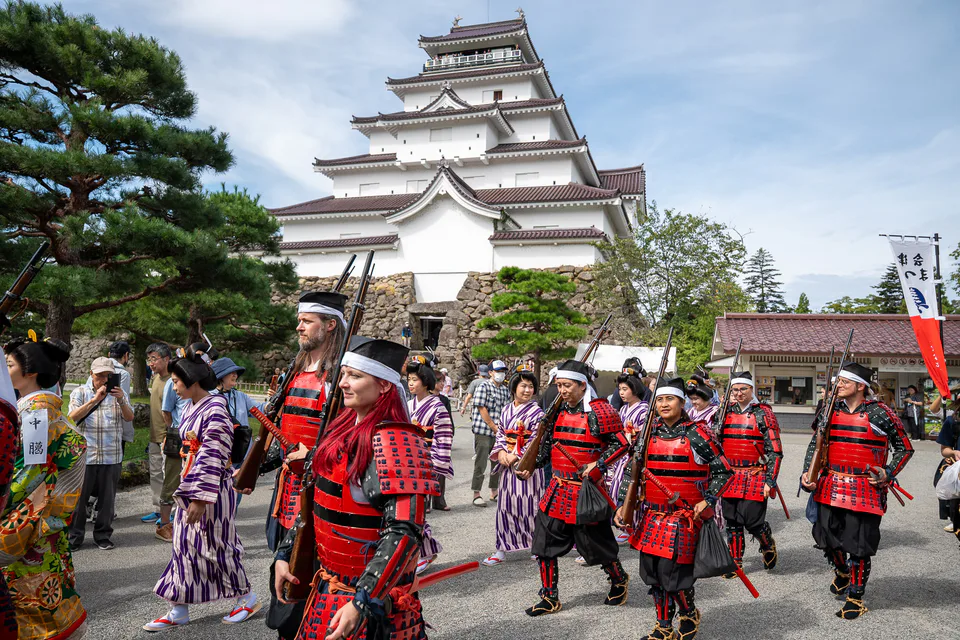
The ¥730 ticket is where “value” becomes an itinerary problem
The three-site ticket adds Oyakuen for only ¥210 above the ¥520 combination. In cash terms, that looks almost impossible to reject. But Oyakuen is a separate garden, so the decision should be made at itinerary level.
Suppose you have 90 minutes at Tsuruga Castle. The extra ¥210 is irrelevant if using the third site means rushing the keep museum or missing your next bus. Suppose instead you have four hours in central Aizu and already want Oyakuen: then the bundle becomes rational because the time cost was already in your plan.
Decision rule: never add Oyakuen because the marginal ticket price looks small. Add the ¥730 ticket because Oyakuen is already a real destination.
Do the time-limited indoor task before the flexible outdoor task
Tsuruga Castle keep currently opens 08:30–17:00, with last admission at 16:30. The grounds can still be enjoyed outside the museum visit, but an exterior sunset photograph does not preserve your ability to enter the keep and complete the museum task.
For collectors, this creates a priority order: museum/stamp route first, then Rinkaku if included, then exterior stonework and photographs. If you reverse the order late in the afternoon, the part you can do any time steals time from the part with a hard cutoff.
The No.12 stamp is by the museum-shop route — do not improvise around the exit
The official Tsuruga Castle notice places the Japan 100 Famous Castles stamp at the entrance/exit area of the castle museum shop. The shop itself is listed as free to enter. If you are entering the keep anyway, the simplest plan is to follow the normal museum route and stamp at the end.
If you are stamp-only, ask staff for the current access route instead of walking backward through a museum exit. The stamp’s physical location near a free shop should not be interpreted as permission to ignore day-of visitor flow.
The reconstructed keep is not the whole historical value
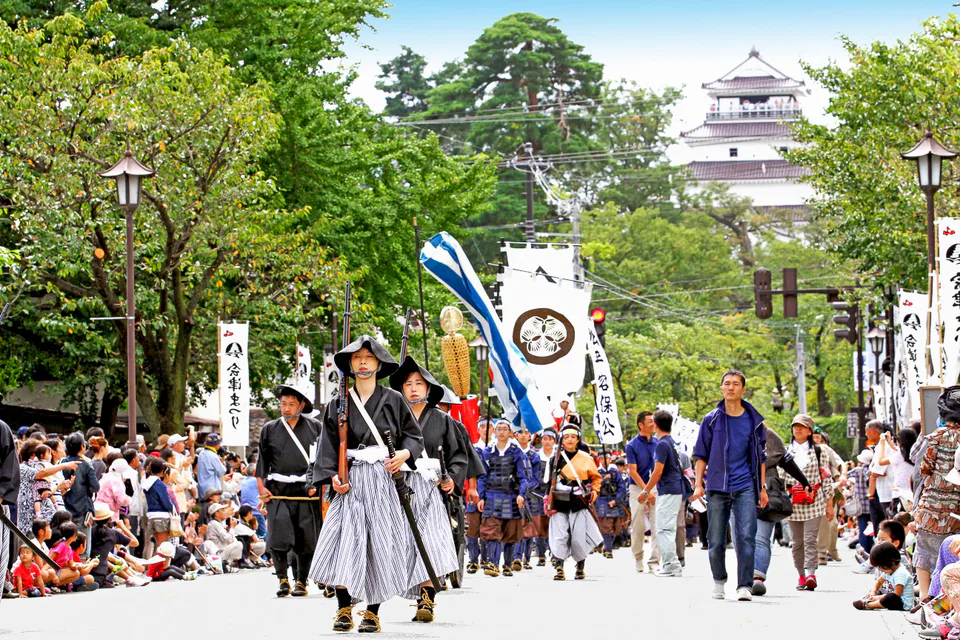
The current keep is a 1965 exterior reconstruction based on early-Meiji photographs; the roof returned to its distinctive red-tile appearance in 2011. Earlier castle buildings were dismantled after the Boshin War period, so the visible tower is not an original Edo structure.
That does not make Tsuruga Castle a “fake castle.” The site’s historical value is layered: surviving stonework and castle plan, the reconstructed landmark, and a modern museum that interprets Aizu’s lords, the Boshin War and regional identity.
A photography-first visitor can rationally walk the free grounds without entering. A history-first visitor gets far more from the ¥410 museum because the indoor interpretation gives the exterior a political and military context.
Aizuwakamatsu Station is not a castle-front station
The official tourism route uses the Haikara-san / Akabe loop buses to the Tsurugajo entrance area, followed by a short walk. This makes Tsuruga Castle easy inside a city day but poor as a “45-minute gap between trains” attraction.
Door-to-door time matters more than the ¥110 or ¥210 ticket differences. If you are deciding whether Aizu belongs in a wider Tohoku trip, use the Tohoku itinerary to make the regional time decision before optimising a few hundred yen at the ticket window.
60, 120 or 240 minutes: the ticket should follow the time block
↔ Scroll table left or right
Available time | Best ticket/route | What to cut |
~60 min | ¥410 keep → stamp → short Honmaru/stonework loop | Rinkaku tea service and Oyakuen |
90–120 min | ¥520 keep + Rinkaku → exterior stonework | Oyakuen unless it is genuinely important |
3–4 hours+ | ¥730 three-site ticket if Oyakuen already fits the route | Do not add more city sights simply to “maximise” the pass |
After 16:30 | Exterior castle grounds only | Do not count on finishing the keep museum that day |
Accessibility can reverse the “best-value” ticket
Official tourism information states that the keep interior is stair-based, while parts of the castle park have accessible facilities and Rinkaku has more accommodating access. That means the full ¥730 bundle is not automatically best for a traveller with mobility limits.
A bundle is only good value when its components are realistically usable. If stairs make the keep unsuitable, prioritising accessible parts of the grounds and Rinkaku can be more rational than paying for a package whose headline attraction is physically difficult.
September 19–21, 2026 is not a normal castle visit
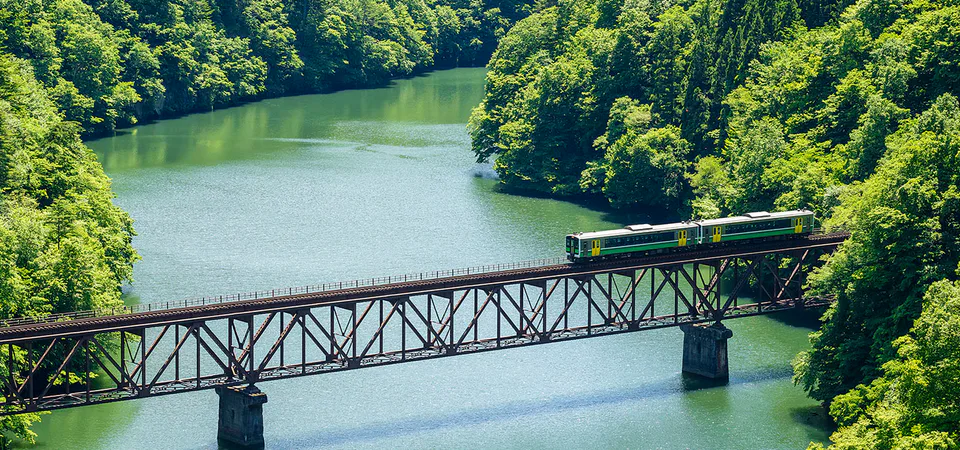
The 2026 Aizu Festival is confirmed for September 19–21. The main historical events include the September 20 Aizu Domain Lords Procession, with Tsuruga Castle Honmaru used as an important event point. Festival activity therefore changes crowd flow, timing and the meaning of the site.
If your date overlaps, do not use a normal “90-minute castle” assumption. Decide whether you want the castle as a museum attraction or as part of the festival itself. Our Aizu Festival 2026 guide is the better place to make that event-day decision.
Prebooking is optional — use it only after choosing the package
An exact Tsuruga Castle ticket product exists on Klook. That can be useful once you have already decided to enter, but prebooking does not remove the need to understand package scope. The official attraction itself has ¥410, ¥520 and ¥730 choices, so confirm what the product for your date includes rather than assuming every voucher equals the full three-site package.
Compare the Tsuruga Castle ticket available for your date
This article may contain affiliate links. If you make an eligible booking through one of these links, ValueNavi may earn a commission at no extra cost to you.
Final verdict: ¥520 is the best first-visit upgrade, not the automatic cheapest or fullest option
For a collector or a visitor mainly interested in the museum and view, ¥410 is enough. For most first-time history travellers with 90–120 minutes, I would choose ¥520: the extra ¥110 is tiny, Rinkaku adds a genuinely different cultural story, and it does not force a second city attraction into the schedule.
The red-team case is a three-to-four-hour Aizu history day where Oyakuen was already on the route. In that situation, recommending ¥520 would be too conservative and ¥730 becomes the logical choice. The point is not that one ticket is “best”; it is that the correct ticket follows your time block and interests, not the size of the discount.
Official facts to recheck before travel
Current ¥410 / ¥520 / ¥730 tickets, 08:30–17:00 hours and 16:30 last admission: Tsuruga Castle official visitor guide. Current No.12 stamp location: Tsuruga Castle — 100 Famous Castles stamp notice. Rinkaku details: Rinkaku official guide. 2026 Aizu Festival dates: Aizu Festival Association. Recheck event-day access and temporary programmes for your actual date.