
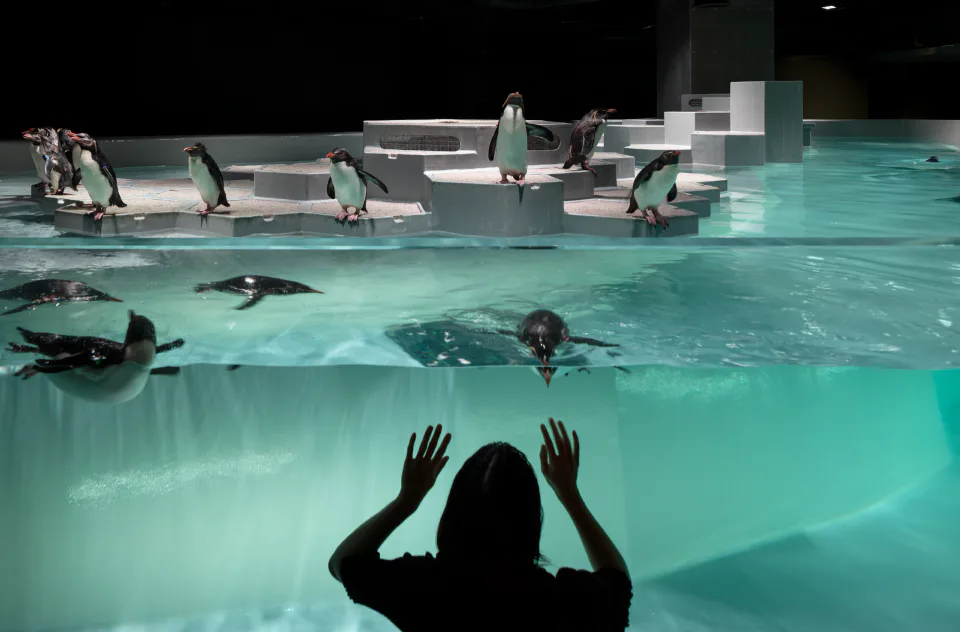
AOAO SAPPORO is most valuable after dark because it lets you keep Hokkaido daylight for something that actually needs daylight. The aquarium currently opens 10:00–22:00 with last admission at 21:00 and sits in central Sapporo near Odori and Tanukikoji. I would use it as a one- to two-hour evening, arrival-day or bad-weather block, not as a replacement for a destination aquarium.
The strongest 2026 planning detail is easy to miss: AOAO's current FAQ says same-day re-entry is possible if you speak to staff, there is no fixed maximum stay within opening hours, and the current floor guide says food and drinks may be consumed throughout the aquarium. That makes AOAO more flexible than a normal “enter once and spend two hours” attraction. The itinerary can move around it.
↔ Scroll table left or right
Your real situation | Better choice | Why |
Full Hokkaido sightseeing day, free evening in central Sapporo | AOAO | 10:00–22:00 hours let you use otherwise lower-value evening time |
You want a conventional aquarium with marine-animal programmes | Otaru Aquarium | It is a larger daytime destination with a traditional aquarium and animal-programme structure |
Rain/snow creates a 1–2 hour hole in central Sapporo | AOAO | Indoor, central and easy to compress |
Otaru is already a full-day destination and its aquarium is a priority | Otaru Aquarium | The transport cost is already partly paid by the Otaru day |
Only one short Sapporo day | Usually skip AOAO | Use scarce daylight for core city or regional priorities first |
You want a flexible evening with a food/drink break | AOAO gets stronger | Food and drinks are allowed throughout, and re-entry can be requested from staff |
AOAO should be judged by daylight saved, not tank size
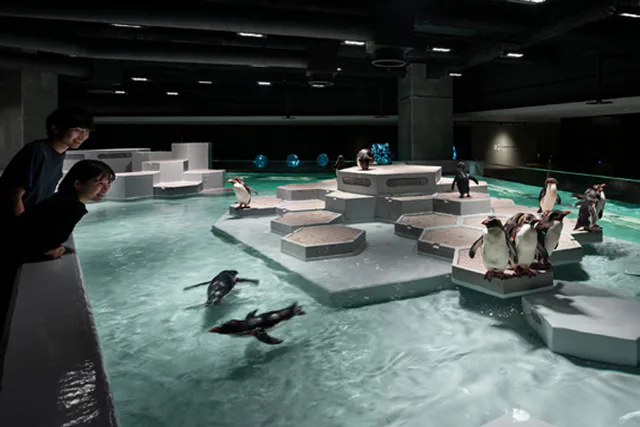
AOAO occupies the 4th to 6th floors of moyuk SAPPORO. The official facility material describes a compact urban aquarium with laboratory spaces, planted aquascapes, penguins, jellyfish, digital ocean imagery, food and seating. It is not trying to win a “largest tank” contest.
That changes the value equation. A JPY 2,200 ticket can be good value at 19:00 after Otaru, skiing or a long JR day because the alternative might be a tired shopping loop or an early return to the hotel. The same ticket can be poor value at 13:00 on your only sunny Sapporo day because it displaces daylight you could use elsewhere.
This is why “better after dark” is conditional rather than absolute. The aquarium itself does not improve after sunset; its opportunity cost falls.
AOAO vs Otaru Aquarium: the JPY 400 ticket gap is the least important difference
AOAO's current headline adult admission is JPY 2,200. Otaru Aquarium's 2026 normal-season adult admission is JPY 1,800. If those were identical products beside each other, Otaru would be the obvious value winner.
They are not identical products. Otaru Aquarium's 2026 normal operation runs 09:00–17:00 through October 15, shortening to 16:00 from October 16 through November 23, with limited selected late-opening dates. Its location at Shukutsu also makes the aquarium part of an Otaru transport day rather than a quick downtown Sapporo stop.
AOAO currently runs until 22:00, last admission 21:00, and is about three minutes from Odori Station. Its comparative product is therefore time flexibility.
↔ Scroll table left or right
Decision dimension | AOAO SAPPORO | Otaru Aquarium |
Adult ticket baseline | JPY 2,200 | JPY 1,800 in 2026 normal season |
Normal time role | Evening / 1–2 hour indoor block | Daytime anchor or half-day |
Location cost | Central Sapporo | Shukutsu; needs an Otaru-area trip |
Style | Observation-led urban aquarium with digital/design elements | Traditional aquarium plus marine-animal programmes |
Best use | Protect Hokkaido daylight | Make the aquarium itself a daytime destination |
My substitution rule: if you already have a full Otaru day and marine animals are a priority, choose Otaru Aquarium and do not force AOAO into another evening just to collect both. If the Otaru day is built around canals, food and town walks and you only want a compact aquarium experience, keep Otaru daylight for Otaru and use AOAO after dark in Sapporo.
Re-entry changes the best evening strategy
AOAO's current FAQ says visitors who want to re-enter should speak to a nearby staff member. It also says there is no specified maximum stay duration within operating hours. That removes one of the usual costs of a paid indoor attraction: you do not necessarily have to build the evening as one uninterrupted block.
A practical pattern is:
First pass: enter after a day trip and use the slower 4F/5F exhibits while everyone still has attention.
Main animal block: spend the largest share of time on the 6F penguins, jellyfish and BLUE ROOM if those are the group's priorities.
Food / city break: eat inside, or—only after confirming the staff procedure—step back into Tanukikoji/Odori and return before the allowed cut-off.
This is ValueNavi itinerary analysis, not a promise of unlimited multi-entry. Ask staff before leaving and follow the current same-day procedure.
Food and drinks make the late closing more useful
The current AOAO floor guide says food and beverages are permitted on all floors. SHIROKUMA BAKERY & sells croissants, drinks and evening bar items, and its operating hours follow the aquarium.
That means hunger does not automatically terminate the visit. For adults, a drink and a slow aquarium block can replace another bar stop. For families, light food can buy enough time to finish the floor everyone actually cares about.
Do not mistake this for a full restaurant. If a proper child dinner, allergy handling or a substantial Hokkaido meal matters, build that separately around Tanukikoji, Odori or Susukino.
One hour, two hours or three hours?
AOAO does not publish a fixed visit duration, and its FAQ says there is no specified time limit during opening hours. I would therefore size the visit from the itinerary rather than the ticket price.
About one hour: late arrival, after-dinner visit or family backup. Move quickly through the slower floors and spend most time on the 6F headline exhibits.
About two hours: strongest first-visit default. Enough time to notice the laboratory/aquascape sections and still linger upstairs.
About three hours: only when you genuinely enjoy reading, sitting, photography and the food/drink spaces. Do not stay longer merely because the ticket was paid.
The sixth floor is where a short visit should spend the most time
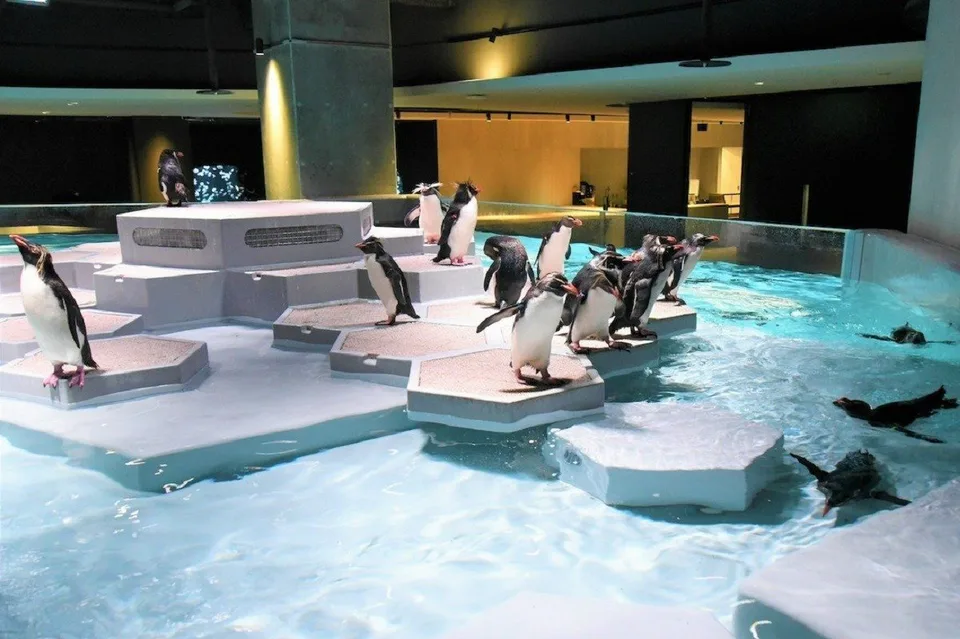
If the visit has to be compressed, the 6F experience gives the clearest return: penguins, the Plankton Room with jellyfish and the BLUE ROOM digital ocean. The official English material describes the BLUE ROOM as a Shiretoko-ocean projection environment with life-size killer-whale and sperm-whale imagery. Those whales are digital, not live animals.
The 4F and 5F areas are slower and more museum-like. Visible aquarium work, smaller tanks, aquascapes and books reward people who like observation. A group that needs constant spectacle may move through quickly, and that is useful information before buying—not a reason to force the visit to last longer.
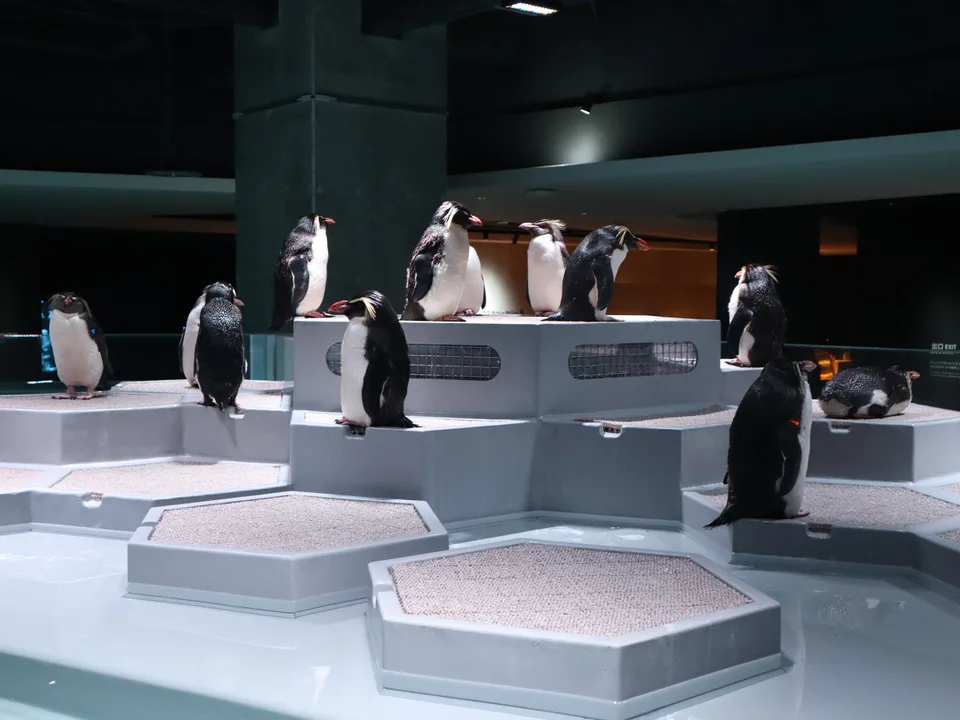
The current floor guide also notes that the GREEN ROOM began a renewed exhibition from July 24, 2026. If a specific exhibit matters, check the live floor guide rather than relying on a review written earlier in the year.
Give the daylight to the activity that cannot move
AOAO's late closing means it should normally lose a scheduling contest against a weather-sensitive or daylight-dependent Hokkaido activity. Otaru town walking, outdoor viewpoints, skiing, Furano/Biei driving and seasonal scenery cannot simply be moved to 20:00. AOAO can.
That does not mean deliberately waiting until dark on an empty day. If heavy rain ruins the outdoor plan at noon, go at noon. If a child is happiest before dinner, use the afternoon. The rule is:
give the scarce daylight or weather window to the thing that requires it; let AOAO absorb the lower-value indoor window.
This is especially useful in a winter Hokkaido itinerary or a car-free Hokkaido route, where weather and transport can reshuffle the day.
Location is the second half of the value
AOAO is inside moyuk SAPPORO at Minami 2-jo Nishi 3-chome. The official access page gives roughly three minutes on foot from Odori Station and about one minute from the Tanukikoji streetcar stop. There is no dedicated aquarium parking.
That means there is no suburban bus timetable or final hotel shuttle to protect. From an Odori or Susukino hotel, AOAO can remain a genuine late-day decision. From Sapporo Station it is still easy, but it becomes a more deliberate city-centre trip.
If the hotel base is still open, use Where to Stay in Sapporo: Station, Odori or Susukino. The aquarium should fit the base; it should not determine the base.
Families: AOAO is strongest when the escape hatch matters
AOAO's current headline prices are JPY 1,100 for elementary/junior-high students and JPY 200 for children aged three and above; children under three are free. The family advantage is not only price. It is the ability to make the visit short.
A child who likes penguins, jellyfish and close observation may get plenty from 60–90 minutes. A child who needs rides, large marine mammals and constant entertainment may fit Otaru Aquarium or another attraction better.
The re-entry and food rules reduce the sunk-cost pressure further. If the family needs a break, ask staff what re-entry procedure applies instead of assuming the ticket is lost the moment everyone steps outside.
Do not use marketplace cancellation policy as a permanent product feature
Third-party e-ticket pages can be convenient, but their cancellation, date-change and promotional terms can change independently of the aquarium. Compare the exact product on the exact day you buy it.
For a weather-sensitive Hokkaido trip, flexibility can be worth more than a small ticket discount. If the AOAO date is still a backup rather than a fixed plan, do not prepay solely because one marketplace is cheaper today. If the date is locked, a QR ticket can remove one small transaction from the evening.
Check AOAO SAPPORO admission for your date
When I would skip AOAO completely
You have only one useful Sapporo daylight block and have not yet done the city priorities you actually came for.
You are already committing a substantial part of an Otaru day to Otaru Aquarium and do not have a specific reason to see a second aquarium.
Your group expects dolphin/sea-mammal programmes or a giant destination-aquarium scale.
The evening is your only chance for a Sapporo food or nightlife experience that matters more.
AOAO's late hours are valuable because they reduce opportunity cost. They do not make every Sapporo evening expendable.
Final verdict: AOAO is an itinerary-pressure valve
Choose AOAO SAPPORO when you want an aquarium experience without surrendering a Hokkaido daylight block. Its 10:00–22:00 operating window, central Odori/Tanukikoji location, staff-managed re-entry and all-floor food/drink policy make it unusually easy to bend around the rest of the day.
Choose Otaru Aquarium when the aquarium itself should be a daytime destination. The 2026 adult ticket is JPY 1,800, and the traditional aquarium programme is a different, larger time commitment.
If both appear in a short first-trip itinerary, red-team the duplication. One aquarium slot is usually enough. Use Otaru for the destination experience or AOAO for the flexible evening—not both simply because both are in Hokkaido.
Tokyo Dome Hotel: Is Walking Back After a Concert Worth the Premium?
Ise Ninja Kingdom Is Still Closed in 2026 — Don’t Build Your Ise Day Around an Old Calendar
Otsuka Museum of Art 2026: ¥3,300 Isn’t the Real Cost — Your Half-Day Is
Hotel Emion Sapporo vs Keio Prelia Hotel Sapporo: Which Works Better with Snow and Large Luggage?
References
AOAO SAPPORO — current hours and admission · AOAO SAPPORO FAQ — re-entry and visit-duration rules · AOAO SAPPORO floor guide — exhibits and all-floor food/drink policy · AOAO SAPPORO access · Otaru Aquarium — 2026 admission · Otaru Aquarium — 2026 operating calendar. Checked August 25, 2026. Hours, exhibits, animal programmes and third-party ticket terms can change; recheck the live date before visiting.