
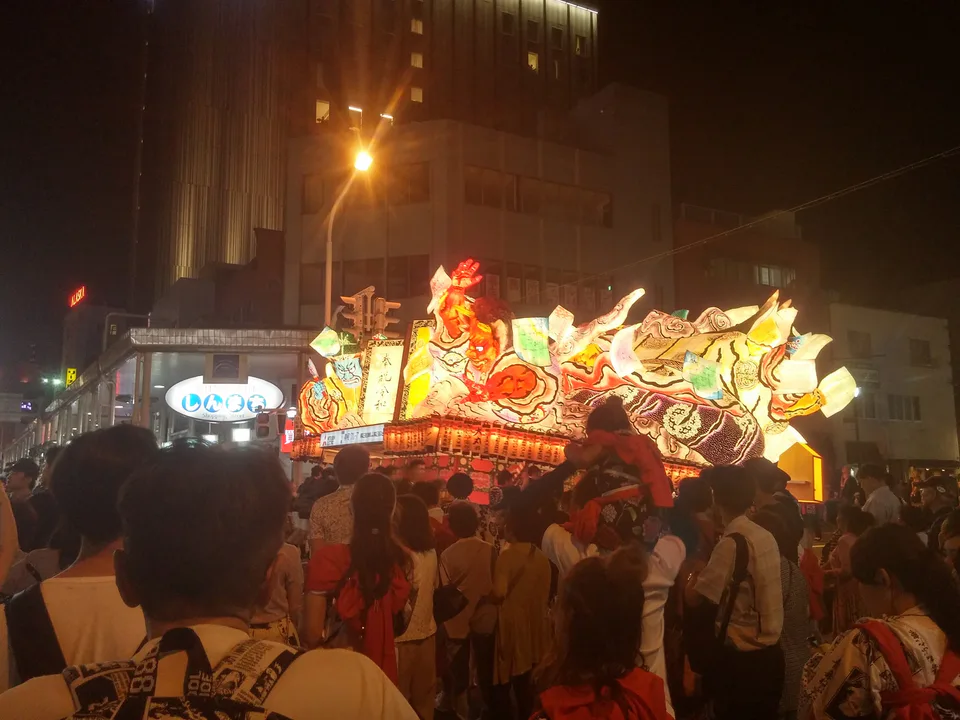
Aomori Nebuta 2026 is over, but the Haneto decision is unusually reusable because participation itself is open. The official festival rules do not require advance registration, team membership or an on-the-day application. You wear the formal Haneto costume, join a Nebuta group while it is waiting before departure, follow the operating staff and complete the route with the group.
If you have only one future Nebuta night and the illuminated floats are the main reason you came, I would watch rather than dance. If participating is itself the bucket-list experience, join as Haneto and accept the trade: you gain immersion but give up a stable spectator sightline, photography freedom and some energy for the next morning. With two nights, the cleanest sequence remains watch once, dance once. What I would not plan is “watch first, then join later that same night”: the organiser says Haneto should gather before departure, and joining mid-route may be refused depending on crowding.
The 2026 festival has finished. The participation rules below were rechecked against the official Aomori Nebuta site on August 27, 2026. Approximate USD conversions use JPY 1,000 ≈ US$6.28 only for orientation; exchange rates move. Future parade times, costume-shop prices and route operations must be checked again for the actual festival year.
↔ Scroll table left or right
Your priority | Choose | Why | Main trade-off |
Only one night; seeing the floats properly matters most | Watch | You see complete floats, musicians and Haneto from a stable outside perspective | You miss being inside the procession |
Participation itself is the reason for the trip | Dance as Haneto | No advance registration is required when you join correctly in formal costume | Less photography freedom, more physical load |
Two Aomori nights | Watch first, dance second | The first night teaches you the route, scale and rhythm before you enter it | Requires another peak-festival hotel night |
Older traveller, injury, heat sensitivity or uncertain stamina | Watch | Haneto involves repeated bouncing outdoors in August | You trade participation for energy resilience |
Photographer | Watch | A moving participant cannot reliably stop, reverse direction or frame every float | Less immersive than joining |
ValueNavi Participation Score: spectating wins control; Haneto wins immersion
This is an editorial decision model, not an official festival rating. Every score uses the same direction: 10 means the option is stronger or lower-friction for that named travel need. It compares a normal roadside-spectator role with participating as Haneto. It does not try to declare one experience universally “better,” and I would not average the columns into one headline score because one veto—photography, stamina or the desire to participate—can matter more than the other six dimensions combined.
Decision dimension | Watch | Dance as Haneto | What drives the gap |
|---|---|---|---|
Float / parade visual coverage | A spectator can study complete floats from outside; a participant experiences the procession from inside it | ||
Immersion | Haneto puts you inside the movement, chant and group rather than beside it | ||
Photography control | Participants are expected to move with the group instead of stopping or reversing for a shot | ||
Physical resilience | Haneto adds repeated bouncing, festival footwear, August heat and a post-event recovery cost | ||
Exit flexibility | A spectator can choose an exit strategy; a Haneto participant follows the moving group and staff instructions | ||
Pre-start simplicity | No Haneto registration is needed, but formal costume, dressing and reaching the pre-departure joining point still require planning | ||
One-night first-visit fit | Watching protects the broadest view of the festival; Haneto becomes the better one-night choice when participation is the trip goal itself |
The useful information gain is the shape of the score, not the decimals. Haneto dominates one dimension—immersion—but deliberately gives up control in several others. That is why a two-night visitor can avoid the compromise by separating the jobs: one night to see the festival, one night to become part of it.
The one-night failure mode: “watch first, join later” is not a reliable plan
Haneto is open participation, but open participation is not the same as open entry at any point on the route. The official rule tells participants to be at the Haneto gathering point around the Shinmachi–Yanagimachi intersection on the sea side before their Nebuta group departs. It also says mid-route joining can be refused when the Haneto area is crowded.
That matters because a one-night visitor may imagine a perfect hybrid: watch the floats from the roadside, take photographs, then step into the procession once satisfied. Operationally, that plan puts the most important part—the actual participation—behind a crowd-dependent gate you do not control. If dancing is the non-negotiable goal, protect it by dressing and joining correctly before departure. If visual coverage is the non-negotiable goal, stay a spectator and do not treat Haneto as a guaranteed late-night add-on.
This is also why “watch first, dance second” works best across two nights, not two phases of one night.
ValueNavi time-cost model: Haneto starts before the parade and ends after it
For 2026, the official schedule listed the first departure at about 19:00 on August 2–3 and 18:45 on August 4–6. Those are parade start points, not safe participant arrival times. Haneto must be dressed and gathered before the relevant group departs. Future years can change, so use the latest official schedule rather than copying these times into a new trip unchanged.
↔ Scroll table left or right
Time block | Watch | Dance as Haneto | Decision effect |
Late afternoon | Positioning is flexible unless you have a reserved-seat entry time | Costume pickup/dressing, luggage drop, food and hydration need to happen before joining | Haneto consumes useful pre-parade time that a spectator can spend elsewhere |
Before departure | You can choose where to watch | You need to reach the designated gathering area before your group leaves | Late arrival is a participation risk, not just a worse viewing position |
During the route | You control photography and can choose an exit strategy | You move with the group and follow staff instructions | The participant trades control for immersion |
After the circuit | You can leave when your viewing goal is met | You still need to disperse, cool down, change and return gear or get back to the hotel | The true Haneto time cost extends beyond the advertised parade window |
From an itinerary perspective, I would treat a first Haneto attempt as a late-afternoon-to-night commitment, not as a two-hour attraction that can be dropped into the evening after a full sightseeing day. That conclusion is derived from the official joining rule and parade structure; it is not a claim of measured on-site timing.
“No registration” does not mean “no advance planning”
The official rule is simple but structured. Haneto may participate without belonging to a Nebuta organisation and without advance registration or same-day reception, provided they wear the formal costume. Participants should join a Nebuta group that is waiting before departure.
The organiser asks Haneto to gather before groups depart at the designated meeting point around the Shinmachi–Yanagimachi intersection on the sea side. Joining halfway around the operating route can be refused depending on crowding.
There is a useful distinction here: the festival does not require Haneto registration, but the official costume-rental page recommends reserving rental clothing in advance. “No registration” therefore removes an event-entry barrier; it does not remove the need to secure the costume or organise the afternoon.
If you want to dance, build the afternoon around dressing, food, hydration, luggage storage and reaching the start area in time.
The costume is effectively the participation ticket—and the real rental cost can exceed JPY 4,000
The official costume includes the flowered hanagasa hat, colourful tasuki sash, shigoki sash, white-based yukata, okoshi layer, white tabi socks and zori sandals tied securely with the traditional cloth.
The official participation page gives rough guidance of about JPY 10,000 (about US$63) to buy an outfit and around JPY 4,000 (about US$25) to rent. The more detailed official rental page adds an important caveat: the roughly JPY 4,000 rental does not necessarily include tabi, zori or the hanagasa; those can be charged separately. It also recommends booking in advance and lists current rental shops.
So “Haneto is free to join” is true only about registration. A first-time visitor should budget for the actual costume package, dressing help if needed, and any separately charged items. Recheck the chosen shop before travel because the organiser's figures are approximate, not a guaranteed all-in price.
ValueNavi Participation Cost: the fee is only one line
The more useful budget is not “Haneto costs JPY 4,000.” Use this planning equation instead:
Haneto participation cost = costume package + dressing / pre-start time + physical recovery + spectator coverage you give up
The last two terms are opportunity costs rather than cash. They are still real. A traveller who dances, then needs a slow morning, has spent part of the next day on the experience. A photographer who joins the procession has spent some of the night’s best stable viewing opportunities. Neither cost means “do not participate”; it explains why a nominally registration-free activity can still deserve its own half-day planning block.
This also changes the comparison with a second festival night. If you already wanted two nights in Aomori, the first night can buy visual coverage and the second can buy immersion. If you are adding a second peak-rate hotel night only because you feel you “should” do both, include that accommodation premium in the decision too.
Watching and dancing expose different parts of the same festival
From the roadside, Nebuta works as visual theatre: you can study the fronts and backs of the giant illuminated floats, musicians, handlers and waves of Haneto. Inside the procession, the experience shifts toward rhythm, movement and the people around you.
Neither is automatically “more authentic.” They solve different goals. The mistake is trying to do both fully on one night. A Haneto participant is expected to move with the group and follow staff instructions; stopping repeatedly or moving backward for photographs conflicts with the role.
For a first visit, the deletion test is useful: if you would regret leaving Aomori without properly seeing the floats as complete artworks, watch first. If you would regret leaving without ever joining the chant and movement, dance.
The physical cost belongs in the itinerary, not in a footnote
The official Japanese participation page jokingly warns that your legs may feel like sticks afterward. Treat that as real planning information. Haneto means repeated bouncing, summer heat, festival footwear and a crowded moving route.
I would not combine a first Haneto night with a full daytime hike, an aggressive city checklist or the earliest possible train to another major Tohoku festival the next morning. The event does not end when the group completes the route; you still need to cool down, change and return to the hotel.
The recommendation reverses for a fit traveller who deliberately leaves the daytime light. In that case the physical intensity is part of the reason to participate.
A central Aomori hotel becomes more valuable on a Haneto night
A camera bag, shopping haul or large backpack that is easy enough as a spectator becomes a nuisance while bouncing inside a moving group. Leave normal travel luggage, spare shoes and non-essential gear at the hotel before dressing.
This gives a central hotel a second job beyond “being near the festival”: it becomes your changing room, storage point and post-parade recovery base. A cheaper property that creates another late rail or bus leg can erase some of the savings on the night you participate.
The procession rules reduce your freedom on purpose
The official rules ask Haneto to follow operating staff, not reverse direction during the parade, avoid unrelated whistles, and disperse promptly after their group completes one circuit. Fireworks, firecrackers, large sake bottles and throwing cans are prohibited.
This is why Haneto should not be described as an open street party where visitors can drift in and out at will. You are entering a moving festival role with a defined flow. If freedom to reposition, leave early or photograph from multiple angles matters more, remain a spectator that night.
One night, two nights or more?
One night: choose your identity before the evening. Watch if the visual spectacle is the main goal. Dance if participation is the main goal. Do not base the plan on guaranteed mid-route switching between the two.
Two nights: watch first, dance second. The first night gives you context for the second and avoids compromising either experience.
Three or more nights: add another Aomori night only when a different programme layer earns the peak hotel cost. More festival nights are not automatically better than recovery time or another Tohoku destination.
What must be rechecked for the next festival?
Current parade start times and participant gathering timing.
Current Haneto gathering location and route.
Whether the no-registration participation rule is unchanged.
Current costume-rental shops, availability and full all-in price.
Weather, heat and traffic restrictions.
The official 2026 rules are a strong planning reference, but they are not a promise that every operational detail will remain identical.
Final verdict
Haneto participation is worth choosing when becoming part of Aomori Nebuta matters more than having the best possible view of every float. The barrier to entry is low in administrative terms—no advance festival registration—but not zero in practical terms. You need the formal costume, enough time to join before departure, physical energy and willingness to follow the moving group's rules.
For most first-time visitors who care equally about the spectacle and the participation, two nights remain the strongest answer: watch first, dance second. The one-night hybrid is weaker because mid-route participation is not guaranteed. And when budgeting the second night, do not stop at “about JPY 4,000 (about US$25) costume rental”; the official rental guidance says tabi, zori and hanagasa can be additional charges.
Yamaga Lantern Festival 2026 Seats: Refund Deadline, Ticket Types and What You Get Back
Nishimonai Bon Odori 2026 Is Over: What to Reuse for 2027 Planning
35 Best Things to Do in Osaka 2026: What’s Worth Your Time by Area, Budget and Trip Style

References
Aomori Nebuta Festival — official Haneto participation rules · Aomori Nebuta Festival — official parade schedule and route · Official Haneto costume guide · Official costume purchase/rental list and pricing caveat. Checked August 27, 2026. Recheck the actual festival year before participation.