
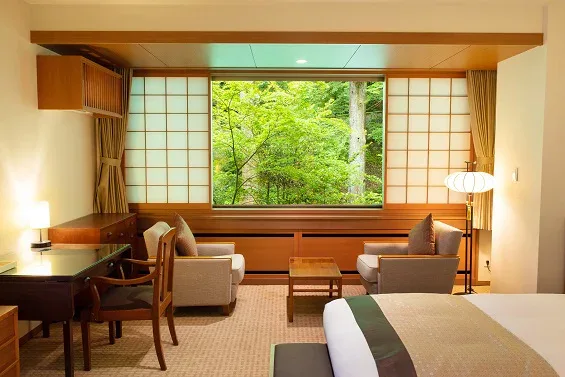
Fujiya Hotel is worth choosing when the hotel itself is one of your Hakone experiences, not merely the place where you sleep between trains. For most first-time visitors, the best default is the 41 m² Forest Wing if luggage space, a predictable modern layout and easy access to the guest spa matter most. Choose the Main Building or Western Building when historic architecture is the reason you are paying the premium. Move up to Flower Palace only when the room itself is part of the trip.
The important correction is that “Fujiya Hotel” is not one uniform room product. The property has four accommodation buildings with very different room sizes and character, while all 120 guest rooms receive natural Miyanoshita hot-spring water in their bathrooms. A cheaper historic room and a larger Forest Wing room can therefore solve completely different needs even on the same date.
↔ Scroll table left or right
Your priority | Start with | Why | Main trade-off |
Two large suitcases, first Hakone stay | Forest Wing Twin | 41 m² gives the most predictable standard-room space and the spa is in the same building | Less of the Meiji-era room atmosphere |
Historic architecture is the main reason to stay | Main Building or Western Building | You sleep inside the older heritage accommodation blocks | Room shapes vary more and the smallest historic categories are tighter |
Anniversary / room itself is a destination | Flower Palace | Large heritage rooms and distinctive architecture make hotel time part of the experience | The premium is wasted if you arrive late and leave early |
Late arrival, early departure | Reconsider Fujiya Hotel | You lose gardens, dining, spa and architecture time | A simpler Hakone-Yumoto or station-side hotel may perform the transport job better |
Lake Ashi sunrise / lake access is the priority | Compare a Lake Ashi base first | Miyanoshita is central to the mountain route, not lakeside | You give up Fujiya's heritage-hotel experience |
Choose the building before you compare the room rate
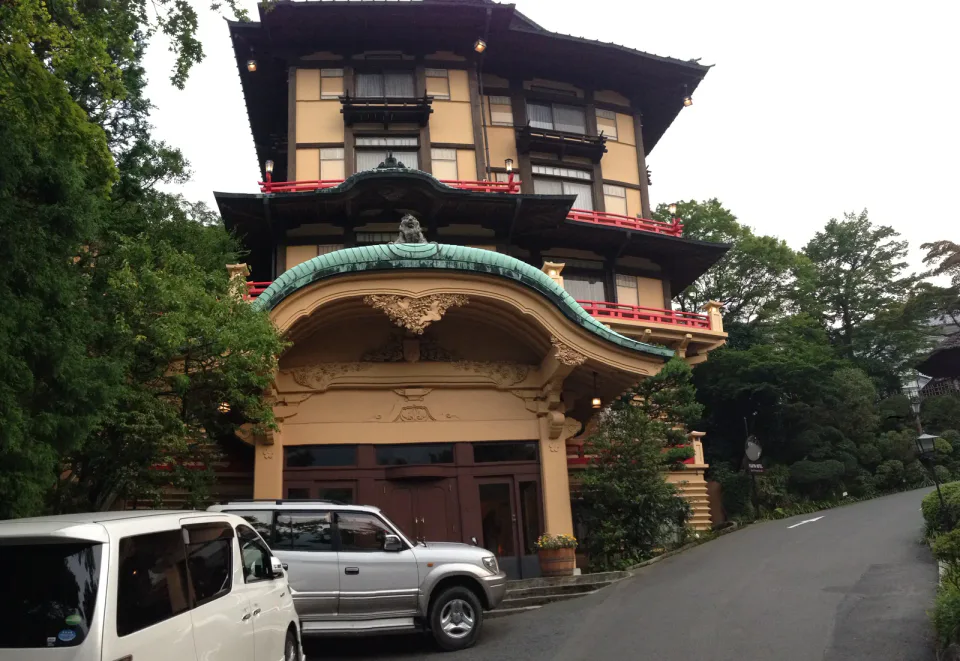
Fujiya Hotel's official room inventory is split across the Main Building, Western Building, Flower Palace and Forest Wing. The name on a booking screen therefore tells you less than the building and exact room category.
↔ Scroll table left or right
Building | Useful room-size reference | Best for | Decision risk |
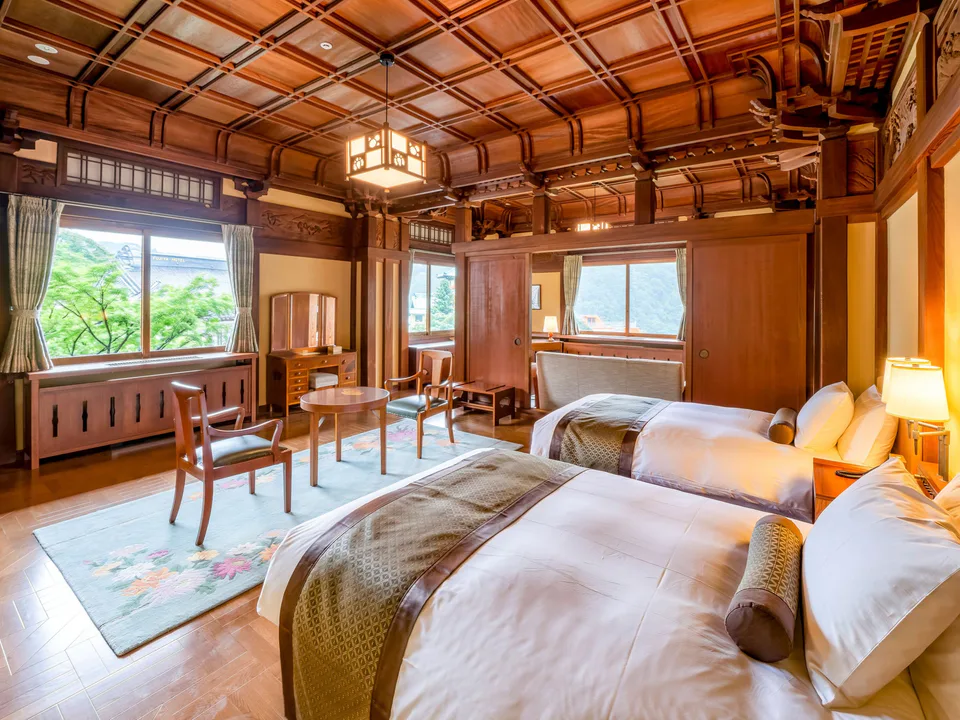
Main Building | Historic Twin 29–36 m²; Historic Double 28 m² | Most direct connection to Fujiya's 1891 heritage | Layout differs by room; do not infer identical free floor space from the category |
Western Building | Historic Twin 33–35 m²; Deluxe Twin 41–49 m²; Suite 60–64 m² | Historic atmosphere with more room-size steps to choose from | “Historic” still does not tell you the exact layout |
Flower Palace | Deluxe Twin 35–49 m²; Junior Suite 63–68 m²; Heritage 69–74 m² | Architecture-focused stays, celebrations, meaningful hotel time | Large-room premium can exceed the value of an ordinary one-night sleep stop |
Forest Wing | Most standard Twins 41 m²; Premier Suite 82 m² | Luggage, modern room function, same-building spa access | It is the functional choice, not the strongest historic-room choice |
ValueNavi rule: decide what you are buying first—heritage, floor space or hotel-as-destination time. Only then compare same-date rates. Otherwise a cheaper room can look like a bargain while solving the wrong problem.
For two large suitcases, 41 m² is a more useful starting point than a five-star label
The Main Building Historic Twin ranges from 29 to 36 m², while Forest Wing's standard twin categories are 41 m². That does not prove an exact suitcase layout, but it does give the Forest Wing a more dependable area advantage when two travellers want to keep large luggage accessible.
For a couple with one carry-on each, the Main Building's smaller room may be the more valuable purchase because the heritage itself is the point. For two travellers on a 10- to 14-day Japan trip with two full-size cases, I would start with Forest Wing or a larger Western Building category before paying extra for architectural character.
This is a better distinction than “old room vs new room.” The real trade-off is historic-room premium versus circulation-space premium.
Every room has hot-spring water, so you do not need Forest Wing just to bathe privately
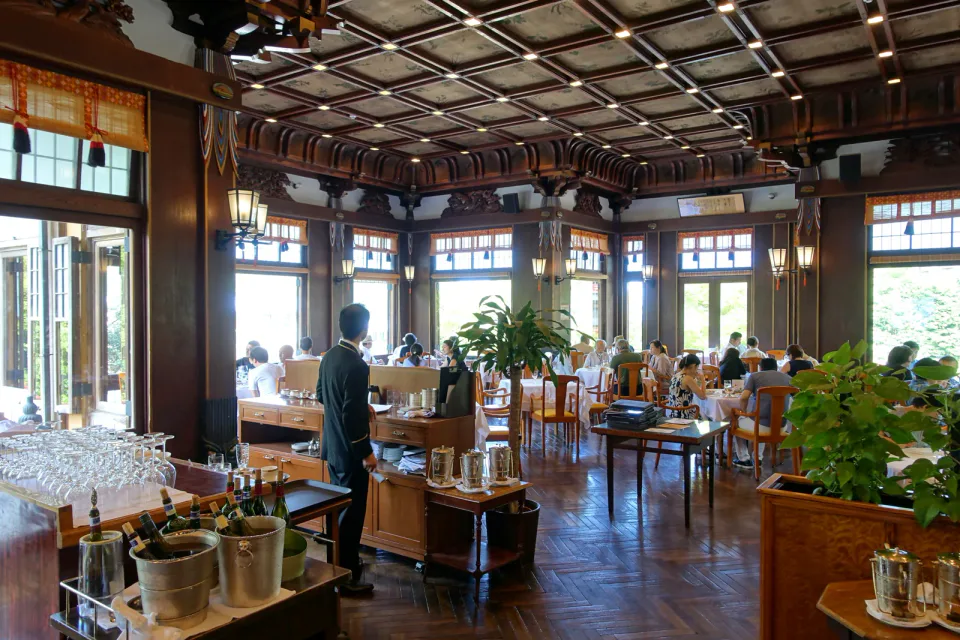
Fujiya Hotel's official spa information says all 120 guest-room bathrooms receive natural Miyanoshita hot-spring water. Forest Wing also contains the guest spa on the sixth floor, with indoor and semi-open-air baths and a sauna, currently open 14:00–25:00 and 05:00–11:00.
That creates two different bath products:
In-room hot spring: private, available regardless of accommodation building, useful for travellers who do not want a shared bath.
Forest Wing guest spa: larger shared-bath experience with views and sauna, but guests in other buildings must move through the property to reach it.
If spa proximity is important every evening and morning, Forest Wing gets extra value. If private bathing is the priority, do not overpay for Forest Wing on the false assumption that other buildings lack hot-spring water.
Miyanoshita access is central, but it is not station-front
The hotel currently gives about seven minutes on foot from Miyanoshita Station. From Odawara, its official reference route is about 47 minutes by Hakone Tozan Railway via Hakone-Yumoto. The bus alternative is operationally interesting with luggage: the hotel lists roughly two minutes on foot from the “Hotel-mae” bus stop.
For a traveller with heavy luggage, rain or an older companion, a short taxi can also change the calculation. Fujiya Hotel currently gives reference taxi costs of about ¥3,100 from Hakone-Yumoto (about US$19) and ¥6,000 from Odawara (about US$38). Exchange-rate conversions are approximate and taxi time/price can vary.
The useful decision is not whether seven minutes sounds short. It is whether you want to spend one of Hakone's luggage-heavy transfers on a mountain walk. If not, use the bus, taxi or luggage forwarding rather than letting the final 500 metres define the whole hotel stay.
One night works only if you protect enough awake hotel hours
Fujiya Hotel is easiest to overpay for when the itinerary uses it like a business hotel. Check-in begins at 15:00 and checkout is 11:00. If you arrive at 21:00 and leave at 08:00, much of the architecture, garden, dining and spa value never gets consumed.
↔ Scroll table left or right
Stay pattern | My call | What the room night must buy |
15:00 arrival → next-morning sightseeing | Strong one-night use | Garden / architecture + dinner + bath + breakfast or morning hotel time |
18:00 arrival → normal checkout | Still workable | Pre-booked dinner and evening bath need to be intentional |
21:00+ arrival → early departure | Weak value | You are mainly buying a bed in an expensive heritage property |
Two nights with one full Hakone day | Strong when the hotel matters | One evening/morning can belong to the hotel instead of being squeezed around the loop |
Two nights are not automatically better. Add the second night only when it removes a hotel move, creates a genuine slow hotel session or fits the wider Hakone route. If the second day is entirely Lake Ashi and the next morning leaves from the lake side, another base may reduce backtracking.
Dinner is a hard clock; do not treat Miyanoshita as a late-night dining district
Main Dining Room The Fujiya currently serves dinner 17:30–20:30 with last order at 19:00 and requires reservations. Japanese dining at Kikka-so also lists dinner 17:30–20:30 with last order at 19:00 and reservation required.
This matters because a “one-night hotel experience” can fail before check-in if the day's sightseeing runs too late. Owakudani, Lake Ashi and ropeway delays are not good reasons to assume a heritage-hotel dinner can simply slide later.
For a meal-inclusive stay, plan the afternoon backwards from the dinner reservation. For room-only, confirm an outside dinner before you depend on an evening walk through Miyanoshita. The hotel bakery is currently open 08:00–17:00; it is not a late-dinner fallback.
When Miyanoshita is the wrong Hakone base
Fujiya Hotel sits well inside a Hakone loop, but the best hotel can still be in the wrong area. Use the Hakone-Yumoto vs Gora vs Lake Ashi accommodation guide before optimising the room.
Choose Hakone-Yumoto instead when arrival/departure simplicity and evening restaurant choice matter more than the heritage hotel.
Choose Gora instead when repeated cable-car / Owakudani movement and a Gora-centred ryokan experience dominate the stay.
Choose Lake Ashi instead when dawn lake scenery, lakeside time or an early lake-side departure is the main purpose.
For autumn, also use the Hakone autumn guide. Different elevations do not peak on the same day, so a beautiful Fujiya Hotel booking should not force an inefficient foliage route.
Three reasons I would not pay the Fujiya premium
1. The hotel is only a late sleep stop. Its premium features need awake time.
2. The route is lake-first or station-first. Miyanoshita's central position is useful, but it is not automatically the best starting point for every Hakone objective.
3. The exact historic room is more important than the hotel name, but your booking does not specify it clearly. The buildings and room sizes differ too much to buy “Fujiya Hotel” as a generic product.
Final verdict
For a first stay with two large suitcases, I would start by pricing a 41 m² Forest Wing Twin against a historic category on the same date. If the historic room premium is modest and architecture is the reason for staying, move to the Main or Western Building. If the room itself is a celebration, Flower Palace can justify a much larger premium—but only when you will actually spend time there.
One night is enough when you arrive around check-in, protect dinner and use the hotel before the next day's Hakone loop. Two nights become stronger when the second night buys a separate hotel session or removes a route-breaking move. The recommendation reverses when your trip is really about Lake Ashi, a late arrival or an early departure: in those cases, Fujiya can be the more beautiful hotel and still the weaker travel decision.
Check Fujiya Hotel room categories for your dates | Booking.com
Sources and verification date
Checked August 26, 2026 against Fujiya Hotel's official room-building overview, access page, guest-spa information and Main Dining Room operating information. Room availability, rates, restaurant closures and transport conditions can change; verify the exact date and room category before booking.