For most first-time visitors with only three or four full Tokyo days, choose teamLab Borderless. Its Azabudai Hills location is easier to combine with Roppongi, Tokyo Tower and central Tokyo, and the experience does not require barefoot water zones or clothing changes. Choose teamLab Planets instead when the physical water-and-body experience is the reason you want teamLab, when Toyosu is already part of the day, or when you specifically want to see Planets before its officially announced end in 2027.
The key 2026 correction is that Planets now has a real scarcity factor while Borderless does not: teamLab lists Borderless as permanent and Planets as running through the end of 2027. That can legitimately reverse the answer for a repeat visitor who expects another Tokyo trip after 2027. It should not, however, turn a two-day first Tokyo itinerary into a cross-city rush.
↔ Scroll table left or right
Your real priority | Choose | Why | What can reverse it |
First Tokyo trip, 3–4 full days | Borderless | Central location and lower clothing/physical friction | The barefoot water experience is a personal must-do |
Repeat visitor who may return after 2027 | Planets gets stronger | The official run is currently scheduled only through the end of 2027 | Adding Toyosu would displace a higher-priority Tokyo day |
Barefoot water, mirrors and body-led immersion | Planets | The physical route is the product, not an accessory | Wet clothing, mobility or stroller constraints make the route inconvenient |
Roppongi / Tokyo Tower / Azabudai day | Borderless | About 2 minutes from Kamiyacho and 6 minutes from Roppongi-Itchome via underground connections | Toyosu is already a separate itinerary anchor |
Young children with one adult | Usually Borderless | Planets allows one adult for every three children; Borderless currently allows one adult for every five children at elementary-school age or below | The children specifically love water and the group meets the ratio |
Wheelchair user / mobility constraint | Check both before buying; Borderless is usually lower-friction | Both have inaccessible works, but Planets adds water-area wheelchair transfers and detour routes | The specific desired works are accessible under the venue’s current route |
Borderless and Planets are not two versions of the same museum
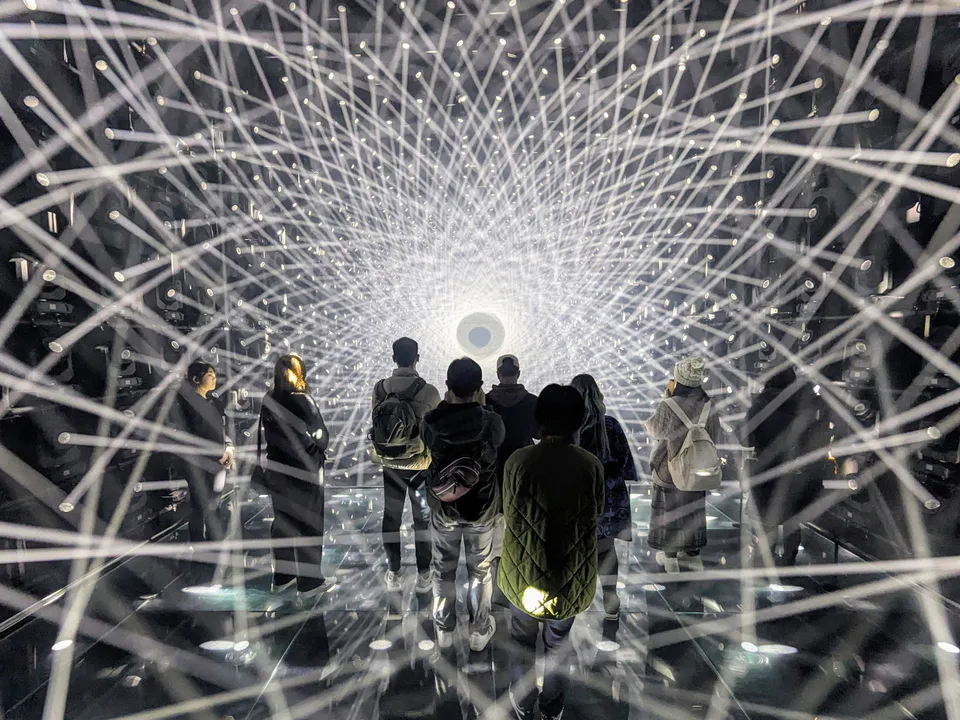
Borderless is a museum without a conventional map. Works move across spaces, connect with other works and can reappear in places you have already visited. The experience rewards wandering, doubling back and deciding when to leave a room.
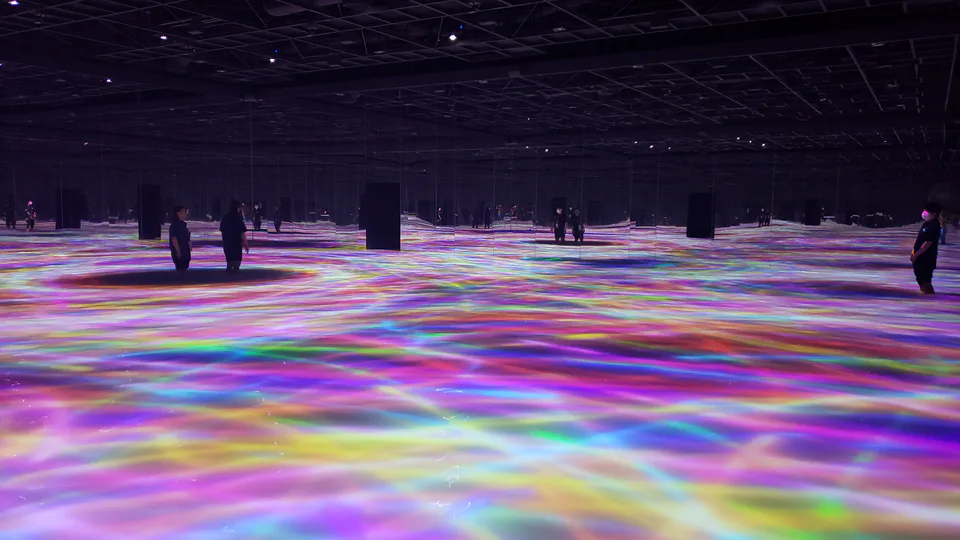
Planets is more physically prescriptive. Visitors remove their shoes, move through water and soft or unusual surfaces, and encounter mirrored environments that make clothing and mobility part of the visit. Water can reach adult knee height in some areas. teamLab recommends that small children wear clothes that can get wet or bring a change of clothes.
That difference should decide the ticket before reviews or social-media photos do. If wet feet sound annoying, Planets is not a challenge you need to overcome; Borderless already delivers a major teamLab experience without that constraint. If entering water and feeling the artwork through the body is exactly the appeal, Borderless cannot fully substitute for Planets.
Planets ending in 2027 creates scarcity — but not an excuse for bad itinerary design
teamLab’s current official listing gives Planets a run from July 7, 2018 through the end of 2027. Borderless at Azabudai Hills is listed as permanent.
This matters most to repeat visitors. Suppose you are in Tokyo in 2026, have time for only one teamLab and expect to return in 2028 or later. Planets has a time-limited advantage: under the currently announced schedule, postponing it may mean losing the option entirely, while Borderless can be deferred.
That is a rational scarcity argument, not a FOMO instruction. If you have only two Tokyo days and Planets creates a long Toyosu detour that replaces your real priorities, the end date does not make the itinerary better. Use the end date as a tiebreaker when the two museums already fit reasonably well.
Borderless wins the geography test for most first-time itineraries
Borderless is in Azabudai Hills Garden Plaza B. teamLab currently lists it about two minutes from Kamiyacho Station Exit 5 and six minutes from Roppongi-Itchome Station Exit 4, with both stations connected through underground passages. That makes it easy to combine with Roppongi, Tokyo Tower, Toranomon or an Azabudai dinner without turning the museum into a standalone cross-city mission.
For a first trip, this matters because the best attraction is often the one that does not fragment the rest of the day. A central afternoon can become museum → dinner → evening view without another major transfer.
The museum itself is also mapless, so do not attach a fixed booking immediately afterward. ValueNavi would allocate roughly 2.5–3.5 hours for a first visit, including room to wander rather than treating every space as a checklist. That is an editorial planning allowance, not an official minimum duration.
Planets works best when Toyosu is already doing another job
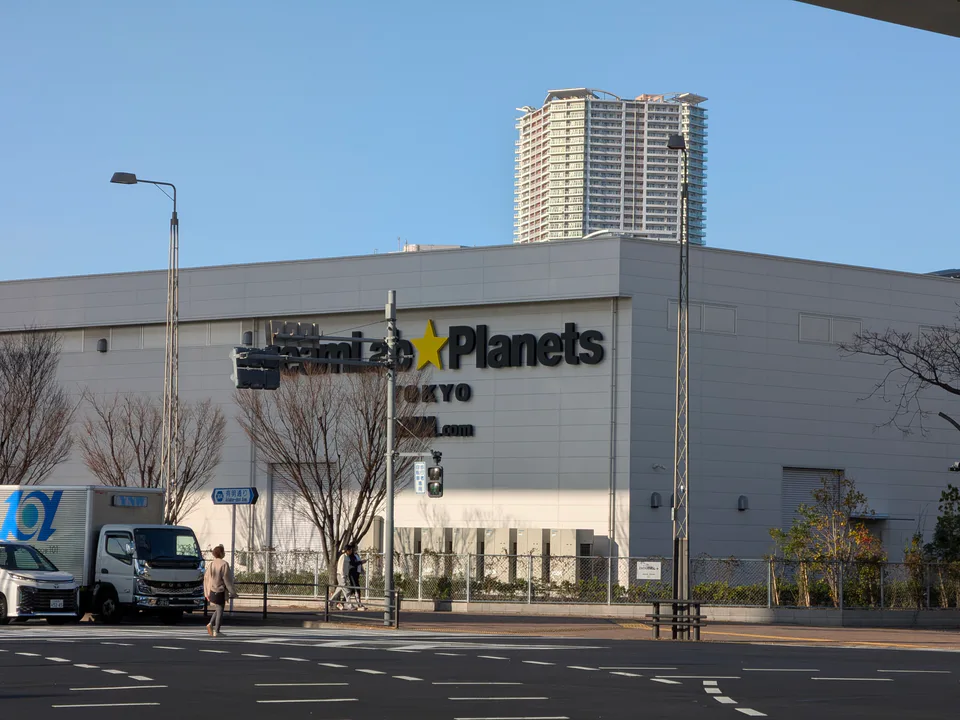
Planets is at Shin-Toyosu. The current official site lists opening hours of 08:00–22:00 with last entry one hour before closing, subject to date-specific changes and closures. teamLab also now operates a paid dedicated shuttle between GINZA SIX and Planets, while warning that the Toei bus from Tokyo Station, Ginza and Tsukiji toward Shin-Toyosu is experiencing heavy congestion.
The itinerary implication is simple: use rail or a confirmed shuttle rather than treating a scheduled city bus as a friction-free timed-ticket connection. Planets becomes much more efficient when Toyosu Market, the waterfront or another bay-area stop is already part of the same half-day.
ValueNavi would allocate roughly 2–3 hours for a first Planets visit, with additional buffer for children, clothing changes or accessibility routing. Again, that is a planning allowance rather than an official time limit.
Families: both ban strollers inside, but Planets adds more hard constraints
Neither museum should be sold as a stroller-through indoor attraction. Borderless requires strollers to be stored in its luggage room. Planets requires visitors to leave strollers in the designated stroller area before entering; baby carriers are accepted.
The supervision ratios differ. Borderless currently requires children at elementary-school age or below to be accompanied by an adult aged 18 or over, with one adult for every five children including free-entry children. Planets is stricter: children under 13 cannot enter without an adult aged 18 or over, and there must be one adult for every three children, including children who enter free.
Planets also introduces wet-clothing risk. Some water reaches adult knee height, and the venue recommends spare clothing for small children. If clothing becomes wet enough, staff can require a change or drying before the next work. For a parent carrying a toddler, managing another child and trying to keep the rest of the Tokyo day dry and organised, that is a real operational cost.
Borderless still contains darkness, flashing light, mirrors, unstable footing and sensory intensity. It is not automatically the easier museum for every child. But for a family that wants fewer wardrobe and water variables, it is usually the lower-friction choice.
Wheelchair access: “both are indoors” is not a useful answer
Borderless permits wheelchair entry via elevator, but the official venue guidance says some artworks cannot be entered or experienced because wheelchairs cannot pass through them safely. The number of wheelchair users admitted at one time can also be limited, which may create waits.
Planets has more specific route consequences. Wheelchair access is available, but some works are inaccessible. For two water-based works, wheelchair users may transfer to a special wheelchair designed for water areas; staff do not push the wheelchair inside those works, so a companion is required. Other works can only be viewed from designated areas or bypassed through detour routes.
From a planning perspective, Borderless is usually the lower-friction starting point for a wheelchair user because it does not build the core experience around water-area transfers. That is a ValueNavi inference, not an official accessibility ranking. If one specific artwork is the reason for visiting, check that work’s current access rule before buying either ticket.
Clothing is a Planets decision variable, not a small packing tip
At Planets, shoes and socks come off for the Water Area. Some mirrored floors also make skirts and loose clothing more relevant; the venue provides free shorts and wraps. Certain works cannot be experienced in unsupported sandals or high heels, and complimentary rental shoes are available.
This matters to the rest of the itinerary. A formal dinner, business meeting or winter outfit that is awkward to roll above the knee makes Planets a less natural mid-day stop. Borderless also uses mirrored floors and can provide a wrap skirt, but it does not ask the whole visitor group to organise itself around a barefoot water route.
If Planets wins, build clothing around the museum rather than trying to make the museum fit whatever you planned to wear elsewhere.
Tickets: both start at ¥3,600, so price does not solve the choice
As of August 25, 2026, both museums list adult entry from JPY 3,600 under current variable-pricing structures. Planets lists JPY 2,800 for junior-high/high-school students, JPY 1,500 for ages 4–12 and free entry for ages three and under. Borderless uses the same standard child and teen prices, with its own date-based adult pricing.
Official direct-purchase tickets at both venues are generally non-cancellable once purchased. Borderless currently allows eligible direct tickets to change date/time up to three times, with a two-hour deadline before the reserved slot for an Entrance Pass. Planets likewise allows official Ticket Store purchases to be changed up to three times, no later than two hours before the admission time, subject to availability and other stated conditions.
That similarity reinforces the main point: do not choose by a tiny ticket-price difference. Choose by the experience, the neighbourhood and the constraints. Third-party tickets follow the seller’s own cancellation and change rules.
Check current Borderless ticket slots
Check current Planets ticket slots
Rain does not make the two museums equally convenient
Both are primarily indoor attractions, so rain does not remove the main museum experience. The difference is the day around the ticket. Borderless can connect underground from Kamiyacho or Roppongi-Itchome and leaves you in a dense central district with other indoor options. Planets is stronger when the rest of the Toyosu/bay plan also survives the weather.
Planets also still involves water by design, so “rainy day” does not remove the clothing and barefoot considerations. If the weather is forcing a full-day reshuffle rather than simply replacing one outdoor stop, use the Tokyo rainy-day itinerary and decide which neighbourhood should absorb the day.
If you have five Tokyo days, doing both can make sense — but separate them
Borderless and Planets are different enough that an immersive-art fan can justify both. The mistake is booking them back-to-back as though the second ticket is simply “more teamLab.” Visual fatigue and cross-city movement can flatten the differences.
With five or more Tokyo days, or on a repeat trip, let each museum anchor its own neighbourhood: Azabudai/Roppongi for Borderless and Toyosu/bay for Planets. With three or four days, one is usually enough unless immersive digital art is a top-tier priority.
If Kyoto is also on the itinerary, add teamLab Biovortex Kyoto to the opportunity-cost calculation. Three teamLab tickets across one first Japan trip can become repetition unless immersive art is itself a major theme of the holiday.
Final verdict: Borderless is the default; Planets wins on physicality or scarcity
Choose Borderless for a first Tokyo trip when you want the easiest high-impact teamLab fit: central location, dry exploration, no map and fewer clothing variables. Choose Planets when barefoot water immersion is specifically what you want, when Toyosu already belongs in the route, or when the announced end-of-2027 date matters because you may not return before then.
For families, do not ignore the one-adult-per-three-children rule at Planets or the fact that both museums require strollers to be left outside the exhibition route. For wheelchair users, check the exact works rather than assuming an indoor digital museum is fully accessible.
The best one-museum decision can be made with three questions: Which neighbourhood fits the day? Do you actively want the water-and-body experience? And does Planets’ 2027 end date matter to your future travel plans? If the first answer is central Tokyo and the second is no, Borderless is the cleaner choice.
Best MiraCosta Room: Which View, Balcony or Terrace Should You Book?
Okinawa Blue Cave Snorkeling: Boat vs Shore Entry — Which Should You Book?
teamLab Borderless Tokyo Review: Is It Worth 2–3 Hours of Your Tokyo Trip?
References
teamLab Borderless Tokyo — official venue, tickets, access and visitor rules · teamLab Planets Tokyo — official venue, operating term, hours and visitor rules · teamLab Planets official ticket-store help — ticket changes and accessibility routes. Checked August 25, 2026. Prices, hours, artwork access and visitor rules can change; verify the actual visit date before purchase.