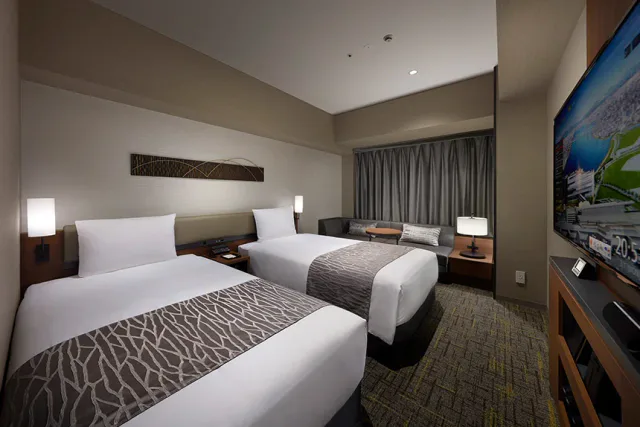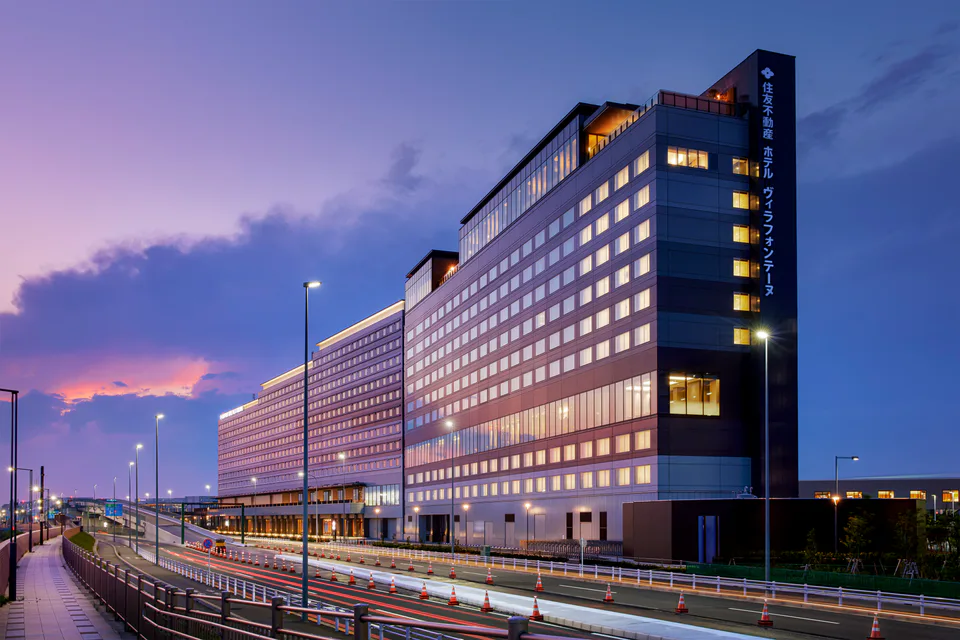
For most one-night Terminal 3 stays, I would start with The Royal Park Hotel Tokyo Haneda when the goal is simply to get from the terminal to bed with the least possible decision-making. Choose Villa Fontaine Grand Haneda Airport when the airport stay is meant to do more than provide sleep: you want a shoes-off Japanese-Western room, the Haneda Airport Garden complex, or you will genuinely use the paid hot-spring facility.
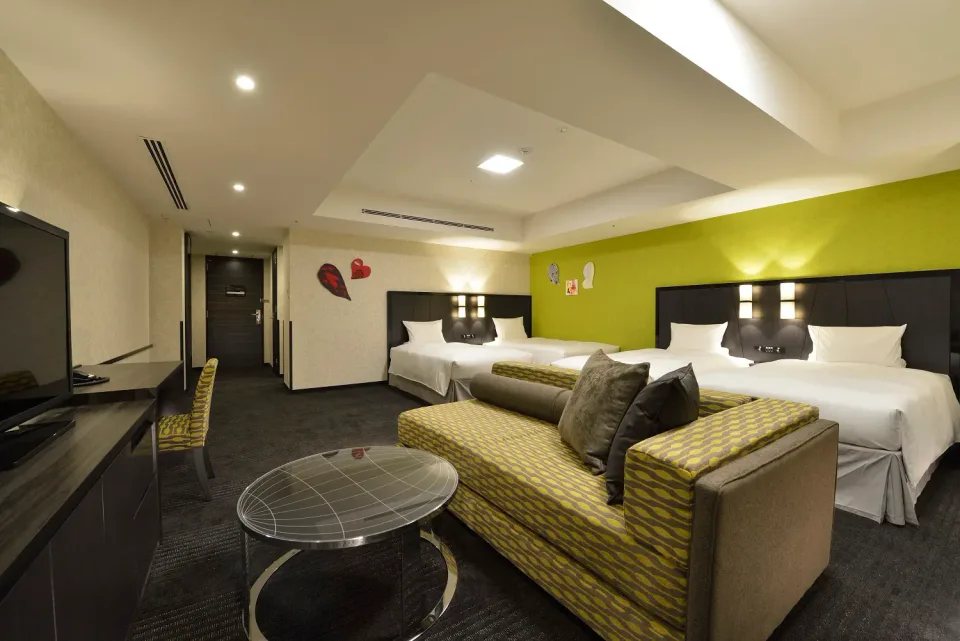
There is one important exception to the usual “Villa Fontaine for families” shorthand. The Royal Park currently has a 56.5 m² Family Room with four permanent 110 cm beds and capacity for up to six guests using a sofa bed and extra bed. Villa Fontaine Grand’s standard Family Room is 36 m² with four permanent 100 cm beds and a maximum of four guests. For four adults—or five or six people who insist on one room—Royal Park can therefore be the stronger room-fit choice despite being the more terminal-focused hotel.
Checked August 25, 2026. Both hotels are directly connected to Haneda Airport Terminal 3. The Royal Park’s landside hotel entrance is inside the Terminal 3 third-floor departure lobby. Villa Fontaine Grand is connected through Haneda Airport Garden. Royal Park currently lists its Family Room at 56.5 m² for four to six guests; Villa Fontaine Grand lists a 36 m² four-bed Family Room and 29–42 m² Japanese-Western options for up to four. Villa Fontaine Grand guests currently pay ¥2,500 per adult and ¥1,250 per elementary-school child to use IZUMI TENKU no YU; children aged 0–3 and guests wearing diapers cannot use the facility. Current room inventory, facility charges and operating rules can change.
Villa Fontaine Grand vs The Royal Park: the 30-second decision
↔ Scroll table left or right
Your real constraint | Start with | Why | Main catch |
Late Terminal 3 arrival; just sleep | The Royal Park | Hotel entrance is inside the Terminal 3 building; simplest sleep-first product | Fewer reasons to linger if you want a broader airport-stay experience |
Early Terminal 3 international departure | The Royal Park | Direct Terminal 3 departure-lobby geography | If your flight is actually Terminal 1 or 2, reopen the comparison |
4 adults want four permanent beds | Royal Park Family Room first | 56.5 m² with four 110 cm permanent beds | Specific Family Room inventory may be limited |
5–6 guests want one room | The Royal Park | Family Room currently sleeps up to six | Guests five and six use sofa / extra beds |
3 adults want three regular beds | Villa Fontaine Grand | Superior Triple is 28–30 m² with three 100 cm beds | Do not overpay for a family category you do not need |
2 adults + children want a shoes-off room | Villa Fontaine Grand | Japanese-Western rooms add tatami and futon flexibility | Still max four guests in current Grand room list |
Hot spring is part of the recovery plan | Villa Fontaine Grand | IZUMI TENKU no YU is integrated with the complex | It is not included for Grand guests; age/diaper restrictions apply |
The first decision is whether you are buying sleep or an airport stay
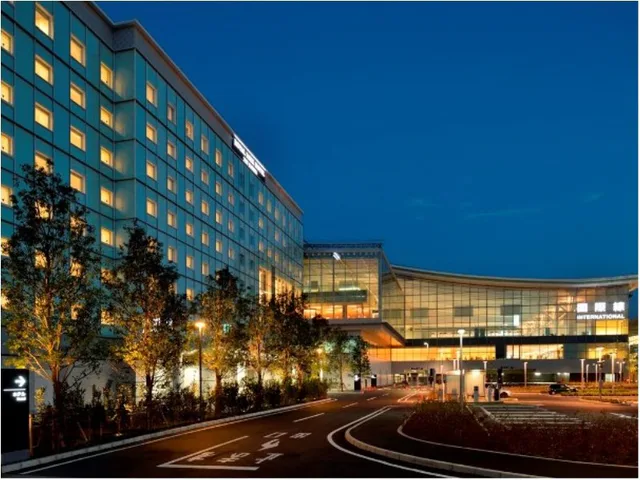
These hotels are both “connected to Terminal 3,” but they solve different versions of the airport-night problem. Royal Park is easiest to understand as a sleep-first product. Its hotel entrance is inside the Terminal 3 third-floor departure lobby, beyond airline check-in counter N. After an international arrival, the job is simple: leave the arrivals process, move through the terminal to the hotel and stop traveling.
Villa Fontaine Grand is connected to Terminal 3 as part of Haneda Airport Garden. That gives the stay a broader ecosystem—restaurants, shops, a bus terminal and the hot-spring facility—but it also means the hotel’s value depends more on whether you will actually use that ecosystem. A traveler arriving at 01:30 and leaving at 06:00 should not value a large connected complex the same way as a family arriving at 18:00 with an evening to recover.
This is why I would not ask “which hotel is better?” first. Ask how many awake hours the airport stay contains. If the answer is “almost none,” directness gets a very high weight. If the answer is “an evening, a full night and a slow morning,” room type and facilities matter much more.
Royal Park has the stronger four-adult Family Room than the old comparison suggests
The biggest factual correction is room fit. Royal Park currently lists a 56.5 m² Family Room for four to six guests. The base arrangement uses four 110 × 196 cm beds. A fifth guest uses a 97 × 196 cm sofa bed, and a sixth can use a 100 × 183 cm extra bed. The bathroom has a bathtub with a separate washing area.
For four adults, the useful comparison is not merely “room sleeps four.” Royal Park gives all four travelers a permanent 110 cm bed in a 56.5 m² room. That is a very different product from a compact airport twin with auxiliary beds.
Villa Fontaine Grand’s current Family Room is 36 m² with four permanent 100 × 203 cm beds. That is still a clean four-bed solution, but Royal Park provides 20.5 m² more published room area and 10 cm more bed width per permanent bed. Across four travelers, that is 40 cm more total permanent-bed width. These are ValueNavi-derived comparisons from the hotels’ published specifications, not hotel marketing metrics.
If the Family Room is the reason Royal Park wins, book that exact room category. Do not assume a generic Royal Park four-person search result preserves the same layout.
Five or six people can end the comparison immediately
Villa Fontaine Grand’s current published room list tops out at four guests. Royal Park’s Family Room currently accommodates up to six. That makes capacity a hard veto rather than a soft preference.
The fifth and sixth Royal Park sleeping positions are not equivalent to the four permanent beds, so a six-adult group should still inspect who sleeps where. But if the alternative is booking two rooms, one 56.5 m² Family Room can materially change both price and logistics. For parents with several children, one-room supervision can also be more valuable than having the “better” hotel facilities in two separate rooms.
Do the one-room-versus-two-room calculation before comparing hot springs, restaurants or terminal walking. Capacity can remove an option before amenity preferences matter.
Villa Fontaine Grand is stronger for three adults and for shoes-off family layouts
Villa Fontaine Grand becomes more interesting when the party does not need Royal Park’s very large Family Room. Its Superior Triple is 28–30 m² with three 100 × 203 cm beds. For three adults who all want a normal bed, that is a cleaner product than paying for unused fourth-, fifth- or sixth-person capacity.
Families with younger children also get a genuinely different room style. The current Japanese-Western room is 29 m² with two beds and two futons; the Deluxe Japanese-Western room is 42 m² with the same two-bed-plus-two-futon concept. Both use tatami-style flooring, so the family can remove shoes and use the floor more naturally.
That can be more useful after a long flight than another conventional hotel room, especially with young children who sit and play on the floor. It is not objectively “better” than four permanent beds. It is a different sleep-and-living pattern. Four adults who dislike futons should prefer a true four-bed room; two adults with two children may reasonably prefer the tatami layout.
The hot spring is a paid option, not a free Villa Fontaine benefit
IZUMI TENKU no YU is one of the strongest reasons to choose the Haneda Airport Garden side, but it is easy to overvalue because the facility is physically integrated with the complex. Villa Fontaine Grand guests currently pay a special rate of ¥2,500 per adult and ¥1,250 per elementary-school child. Preschool children are free, but children aged 0–3 and guests wearing diapers are not permitted to use the facility.
For two adults, the hot-spring add-on is currently ¥5,000. For two adults and two elementary-school children, it is ¥7,500. That is real money and should be added to the room comparison if the bath is part of the reason Villa Fontaine is winning.
The facility itself is highly usable for odd airport hours: it is open 24 hours, with the large bath and sauna operating from 12:30 until 10:00 the next morning, followed by cleaning. This means a late arrival does not automatically eliminate the bath benefit. But the practical question remains whether you want to spend scarce sleep time using it.
A toddler can also reverse the value. If a child is too young to enter, the adults cannot simply treat the hot spring as a whole-family recovery activity. One parent may have to stay with the child while the other goes alone. In that scenario, the amenity can fragment the family instead of simplifying the night.
Do not confuse Grand with Premier when pricing the hot spring
Villa Fontaine Premier Haneda Airport shares the same broader complex but is a different hotel product. Current hot-spring rules list complimentary IZUMI TENKU no YU access for Premier guests, while Grand guests pay the special rates above.
This creates a booking failure mode similar to Royal Park’s Transit Hotel confusion: search results can surface closely related properties with different rules. If a rate appears to include a benefit that another source says costs extra, verify the exact hotel name before booking. “Villa Fontaine at Haneda” is not a sufficiently precise product description.
Breakfast is almost a tie, so do not use it as the main reason to upgrade
Royal Park’s TAILWIND breakfast currently runs from 6:00 to 10:00 at ¥3,200 per adult and ¥1,600 per elementary-school child. Villa Fontaine Grand’s Grand Ale breakfast also runs from 6:00 to 10:00, currently at ¥3,500 per adult and ¥1,750 per elementary-school child.
That means breakfast timing is not a meaningful differentiator for most travelers. If your departure routine requires leaving the hotel before 6:00, breakfast value is close to zero at both properties. Do not pay a room-plan premium for breakfast you physically cannot use.
For a later departure, compare the actual breakfast-inclusive rate against the room-only rate rather than assuming the bundle is automatically a saving. The difference between the two hotels is much more likely to come from room fit and facility use than from thirty minutes of breakfast logistics.
Royal Park wins the shortest-routine test, but the advantage is specific to Terminal 3
Royal Park’s landside entrance is inside the Terminal 3 departure lobby. The hotel states it is about a three-minute walk from the Tokyo Monorail station and about five minutes from the Keikyu station. For an international arrival or departure at Terminal 3, that is exactly the kind of low-friction geography an airport hotel should provide.
But if the next flight leaves from Terminal 1 or Terminal 2, neither hotel is literally inside the correct departure terminal. You will need to use Haneda’s inter-terminal transport. In that case, re-open the hotel search rather than treating “Terminal 3 connected” as a universal airport advantage.
An early Terminal 2 domestic flight, for example, changes the comparison class. The correct question may become whether a Terminal 2 hotel is better than either of these properties. Airport-hotel geography should follow the actual departure terminal, not the airport name.
Transit Hotel is the booking mistake most likely to ruin the night
The Royal Park Hotel Tokyo Haneda also operates a separate Transit Hotel in the airside restricted departure area near gate 114. It is not the same product as the landside hotel discussed here.
Royal Park explicitly states that international passengers who arrive at Haneda and enter Japan cannot use the Transit Hotel. It is for eligible departing passengers after departure procedures and certain international-to-international transit passengers who remain airside.
If you are arriving, collecting checked baggage, clearing immigration and entering Japan, make sure the reservation is for the normal landside Royal Park hotel. This is not a small room-category mistake. Booking the wrong product can make the room physically inaccessible after arrival.
Late arrival: remove every feature you will not use
A 23:50 arrivals-hall exit should produce a different hotel ranking from an 18:00 arrival. At midnight, a large shopping complex, multiple restaurants and a hot spring may look impressive on a feature list but contribute little if everyone wants to sleep immediately.
Use a deletion test. Remove every facility you realistically will not use between check-in and checkout. Then compare what remains:
Royal Park: direct Terminal 3 routine, exact room fit, breakfast if the schedule allows.
Villa Fontaine Grand: connected Terminal 3 stay, exact room fit, Airport Garden only if awake hours remain, hot spring only if the party is eligible and willing to pay/use it.
If Villa Fontaine loses most of its unique value after this deletion test, Royal Park is usually the more disciplined one-night choice. If the family still uses a tatami room, hot spring and Airport Garden time, Villa Fontaine has a clear job beyond sleeping.
One night and two nights should not use the same amenity weights
On one night, directness and bed setup dominate because there are few awake hotel hours. On two nights, the answer can change. Airport Garden, the hot spring and a larger room become easier to use repeatedly, especially if the stay includes a rest day, an early arrival or a late departure.
But two nights at an airport hotel also carry opportunity cost. If the trip is really a Tokyo sightseeing stay, moving into the city can remove repeated airport-to-city travel. Do not extend an airport hotel stay merely because the facilities are good. The airport location should still match the itinerary.
Final verdict
Choose The Royal Park Hotel Tokyo Haneda when the stay is primarily a Terminal 3 sleep-and-departure problem, or when four adults need the current 56.5 m² Family Room with four permanent beds. It is also the clear one-room option when five or six guests fit the Family Room and the sleeping hierarchy is acceptable. Choose Villa Fontaine Grand when three adults want a straightforward triple, a family prefers a tatami/futon layout, or the party will genuinely use Haneda Airport Garden and the paid hot spring. Do not count the hot spring as free, and do not assume Villa Fontaine automatically has the better family-room product.
Booking links
Villa Fontaine Grand Haneda Airport:Booking.com · Trip.com · Agoda
The Royal Park Hotel Tokyo Haneda:Booking.com · Trip.com · Agoda
Namba Family Hotel Comparison: Centara Grand Osaka vs Hotel Keihan Namba Grande
Tokyo Disney Split Stay: Move the Night Before or After Your First Park Day?
Chiikawa Park Tokyo 2026: ¥3,500 Is Not a Shopping Fee — Check the Time Slot First
Ghibli Park Tickets 2026: Before You Buy Standard, Name the Buildings You Refuse to Miss