
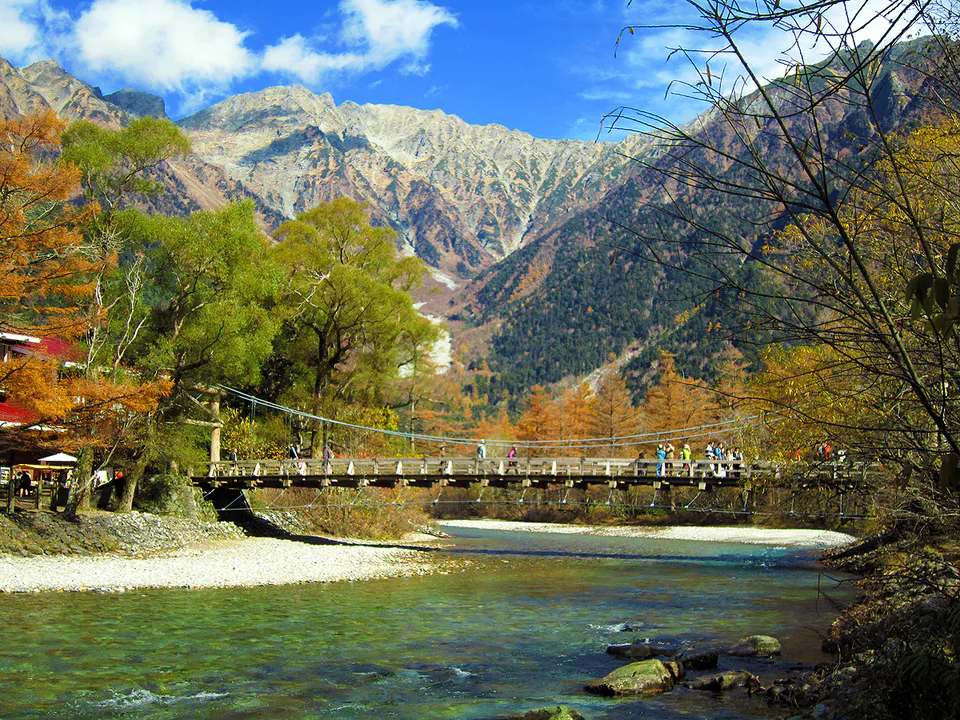
For a first Kamikochi autumn trip, do not start by asking for one “peak foliage date.” Decide which autumn layer you want, then build the transport and walk around it. Mid-October is the stronger historical target for red and orange maple colour in central Kamikochi; late October shifts the emphasis toward golden Japanese larch. A first-time day trip should normally protect the Taisho Pond → Tashiro Pond → Kappa Bridge corridor first, then add Myojin only when the return bus, weather and daylight leave genuine slack.
The 2026 transport wording also needs care. ALPICO’s current Japanese operating page labels the Matsumoto/Shin-Shimashima–Kamikochi route reservation-priority: reserved passengers board first, while unreserved passengers may board when seats remain. ALPICO’s English visitor page still says the buses “require reservations,” while also noting that same-day seats may be sold when available. For planning purposes, reserve the bus as if your day depends on it—but do not describe an unreserved passenger as automatically barred from every service.
↔ Scroll table left or right
Your real priority | Best starting plan | Main trade-off |
First visit, one day | Taisho Pond → Tashiro Pond/Marsh → Kappa Bridge → Bus Terminal | You protect the classic valley sequence rather than using the afternoon to chase distance |
Red/orange maple colour | Aim around the historical mid-October phase, then verify same-week conditions | Transport demand is high and a cold front can change leaves quickly |
Golden larch | Aim later in October | Broadleaf colour may already be thinning; mornings can be very cold |
Limited mobility / young child / poor weather | Bus Terminal → Kappa Bridge + short Tashiro Bridge/Tashiro Pond section | You see less geography but keep toilets, food and transport closer |
Want Myojin as well | Reach Kappa Bridge with about three hours of usable slack before your own return buffer | Myojin adds roughly two hours of walking before time at the pond/shrine area |
Want Tokusawa, dawn light or two weather chances | Stay overnight | Higher room cost and meal/check-in constraints, but the itinerary stops fighting the last bus |
Kappa Bridge is the easiest central checkpoint. For a day trip, use it as the place to decide whether the itinerary expands to Myojin or contracts toward the bus terminal.
There is no single Kamikochi “peak week” because different autumn layers peak at different times
Kamikochi’s official seasonal guidance describes a sequence rather than one universal peak. Late September brings stronger colour on the surrounding slopes while the central valley can still be early. Early October begins the central foliage phase. Mid-October is associated with stronger maple reds and oranges. Late October is the classic larch period, when Japanese larches turn warm yellow; the official site notes that larch generally peaks about a week later than the maples.
That changes how a first-time visitor should choose dates:
Choose earlier October if the trip is already fixed and you value mountain layers, wetland colour and a less “all-gold” landscape even if central maples are not at their strongest.
Choose around mid-October if red/orange broadleaf colour matters most and you accept heavier demand.
Choose late October if golden larch is the target. Do not call the trip a failure merely because some broadleaf trees are already past peak.
Choose early November only if you genuinely like late-autumn scenery. Bare branches, fallen leaves and early snow can be part of the landscape; they are not a guaranteed continuation of October peak colour.
The practical rule is to check same-week official images and weather rather than locking expectations to a calendar graphic published months earlier. Wind and a sharp cold front can shorten a visually strong window even when the historical timing is “right.”
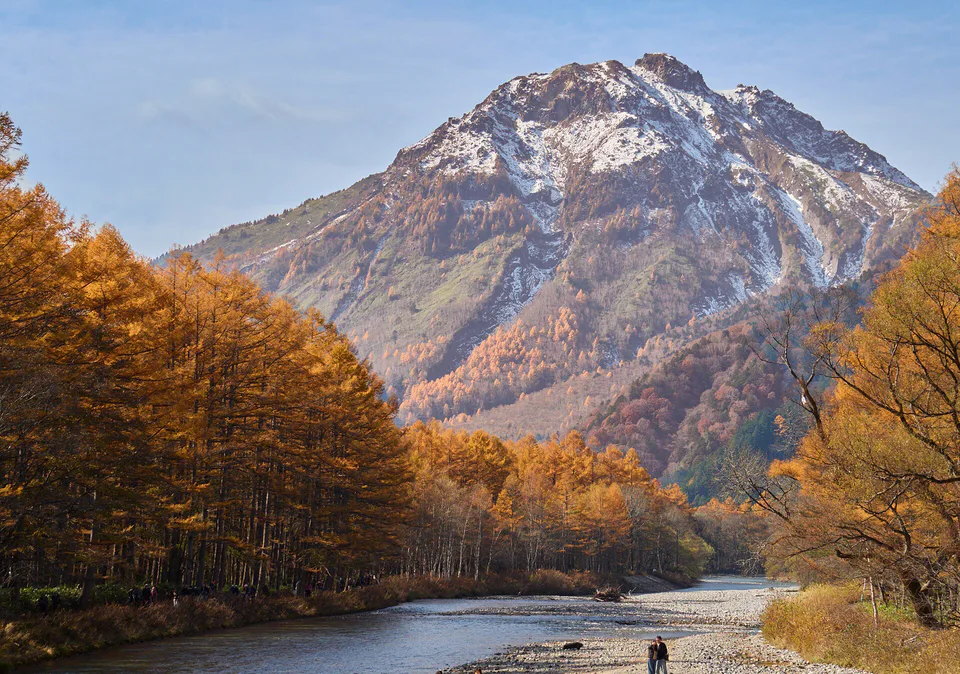
For a first visit, Taisho Pond → Kappa Bridge gives the highest return per kilometre
Kamikochi’s official walking guide gives Kappa Bridge ↔ Taisho Pond at about 75 minutes on one bank and 80 minutes on the other, covering roughly 3.8–4 km. The official short-route example from Taisho-ike Bus Stop via Tashiro Pond and Tashiro Bridge to Kappa Bridge and the Bus Terminal is about 70 minutes of pure walking.
That is why the bus stop at Taisho Pond is useful. Instead of riding all the way to the terminal, walking south and then retracing the route, you can get off at Taisho Pond and walk north. For autumn photography and a first visit, I would allow roughly 2.5–3 hours for this corridor rather than treating the official walking time as a sightseeing time. The extra time buys photographs, wetland stops, toilets, food and a non-rushed finish.
The recommendation reverses in heavy rain, icy conditions or for a group that is already tired. In that case, stay on the bus to the terminal and use a shorter central loop. Autumn colour is not worth turning the return into a forced march on wet boardwalks.
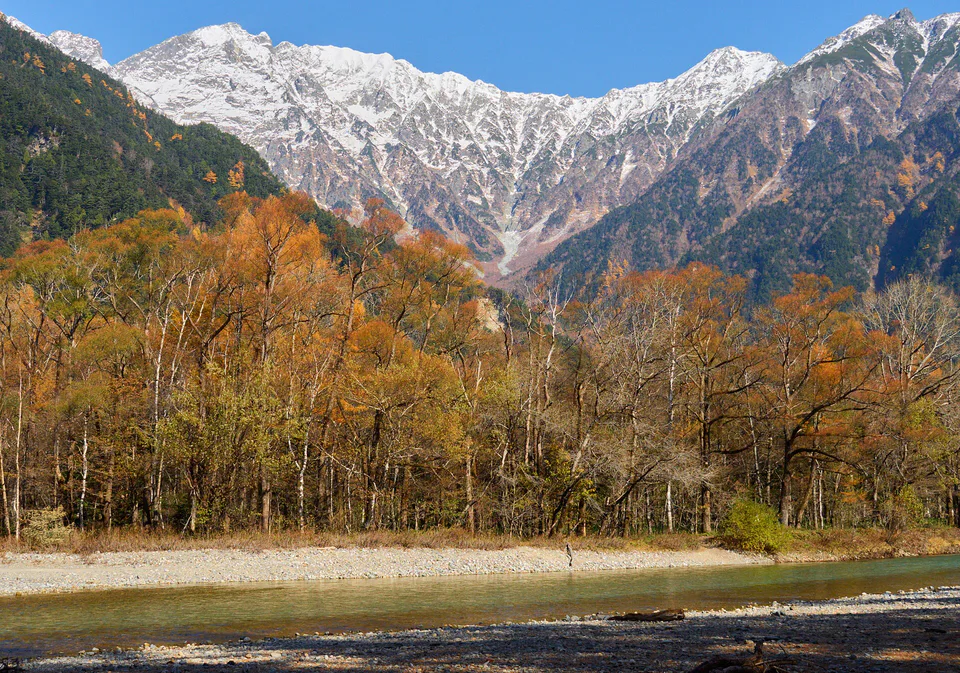
Kappa Bridge should be your Myojin go/no-go checkpoint
The official walking guide gives Kappa Bridge → Myojin at about 50 minutes on the left bank or about 60 minutes on the right bank. A brisk round trip is therefore roughly two hours before you stop at Myojin Pond, the shrine area, food or toilets.
I would only add Myojin when you arrive at Kappa Bridge with roughly three hours of usable slack before the time you personally need to be back at the bus terminal. That three-hour figure is ValueNavi planning, not an operator rule: it combines the official walking baseline with enough time to make Myojin an actual visit rather than a turnaround point.
Ask four questions at Kappa Bridge:
Is my return bus secured or am I depending on remaining same-day capacity?
Do I have luggage at the Bus Terminal that must be collected before 17:00?
Has the weather stayed stable enough that the return pace is still realistic?
Is everyone in the group still walking comfortably?
If one answer is weak, stop expanding. The Taisho–Kappa corridor already delivers the highest-value first-visit landscape.
Tokusawa is an itinerary type, not a casual extra stop
From Myojin, the official guide adds about another 60 minutes each way to Tokusawa. Starting from Kappa Bridge, a Tokusawa return therefore consumes roughly four hours of walking before lunch, photography and any Taisho Pond section.
That can be an excellent autumn day for a strong walker who arrives early and deliberately wants a long walk. It is not a normal “since we are already here” extension. If Tokusawa is the main reason for the visit, an overnight often creates a better trip because it removes the pressure to extract both the classic first-time corridor and the longer northern walk from one bus-limited day.
2026 Matsumoto buses: plan as reservation-first, but understand the wording conflict
ALPICO’s current Japanese operating page lists the Matsumoto/Shin-Shimashima–Kamikochi route for April 17–November 15, 2026 and labels both directions reservation-priority. It states that passengers with reservations board first and that passengers without reservations can board first-come, first-served when seats remain.
ALPICO’s English visitor page is stricter in its headline wording, saying that buses between Matsumoto and Kamikochi require reservations, while the same page also says same-day non-direct bus tickets can be available if seats remain. These two official pages are not perfectly aligned in English wording.
For an autumn day trip, the useful conclusion is straightforward: reserve the bus section in advance whenever the day depends on that departure. Do not deliberately arrive unreserved on a peak foliage weekend just because the Japanese operating page allows boarding when empty seats remain. But if a reservation is unavailable, do not assume the entire day is automatically impossible—check current seat availability and the operator’s same-day instructions.
Also remember that Matsumoto → Shin-Shimashima is the Alpico Railway, not JR. The train segment does not use the same reservation logic as the mountain bus.
The final bus is not always your real afternoon deadline
The Kamikochi Bus Terminal’s official baggage counter operates from 06:00 to 17:00 during the April 17–November 15 season. Current indicative daily prices run from JPY 350 for a small bag to JPY 600 for an extra-large item. The official site also warns that storage racks can fill during busy periods.
This creates an easy-to-miss failure mode: if your return bus leaves after 17:00 but your suitcase is stored at the terminal, the extra time after 17:00 is not usable walking time. Your bag has to be collected first.
For a transfer-day visit—Takayama/Hirayu → Kamikochi → Matsumoto, for example—I would treat 17:00 as a hard operational edge unless the luggage is already forwarded or handled by your accommodation. A beautiful late-afternoon larch walk is not useful if it leaves your main suitcase behind a closed counter.
Matsumoto and Takayama are not competing bases; they solve opposite route directions
Matsumoto is the cleaner east-side gateway for travellers coming from Tokyo, Nagano or the Kanto/Chubu rail network. From the west, Takayama routes normally pass through Hirayu before continuing to Kamikochi. If the larger trip already contains Takayama and Okuhida, forcing a return to Matsumoto first is unnecessary.
The better sequencing question is: which side are you entering from, and where should you sleep after the walk? A Takayama/Hirayu → Kamikochi → Matsumoto transfer day can remove backtracking. The reverse can work too. But either direction only becomes elegant when the luggage is solved before entering the trails.
Use the Japan luggage-forwarding guide if the main suitcase should skip the park entirely.
Driving still means a shuttle: private cars never remove the mountain transfer
Kamikochi is under year-round private-car restrictions. From the Matsumoto side, drivers leave the car in the Sawando area and continue by shuttle bus or taxi. The official Sawando page currently lists around 2,000 parking spaces, JPY 800 per day for a normal car and a shuttle fare of JPY 1,600 one way / JPY 3,000 round trip to the Bus Terminal.
From the Takayama side, drivers use the Hirayu/Akandana gateway. The official Akandana page currently lists around 850 spaces and JPY 600 per 24 hours for a normal car.
This matters most in autumn because official guidance specifically warns that October foliage periods can be very busy. A rental car can make the wider Alps itinerary better while still making the final Kamikochi approach queue-sensitive. “We have a car” is not a reason to arrive later.
Day trip or overnight: buy a second weather/light window only when you will use it
A day trip is enough when the goal is the Taisho Pond–Kappa Bridge core and the weather forecast is reasonable. An overnight becomes more valuable when you are buying something a day trip cannot reliably provide: dawn/morning mist, an unhurried Myojin or Tokusawa walk, quieter evening hours, or a second chance if one weather window fails.
That is a better test than “Kamikochi is beautiful, so stay a night.” Accommodation inside the valley can be expensive and meal/check-in times can constrain the day. If you will arrive late, eat, sleep and leave immediately after breakfast, the premium may not be buying much extra landscape time.
↔ Scroll table left or right
Stay pattern | When it makes sense | When it does not |
Matsumoto pre-night + day trip | You want a very early transport start without paying an in-valley hotel premium | You specifically want dawn or evening inside Kamikochi |
Kappa Bridge core overnight | First visit, photography, easy terminal access, two light/weather windows | You will spend nearly all awake hours away from the hotel |
Taisho/Tashiro side overnight | Dawn mist and quieter river scenery are the product | Your main objective is long-distance walking north of Myojin |
Myojin/Tokusawa overnight | The walk itself is the trip and you can travel light | You need easy luggage handling, flexible meals or a fast onward departure |
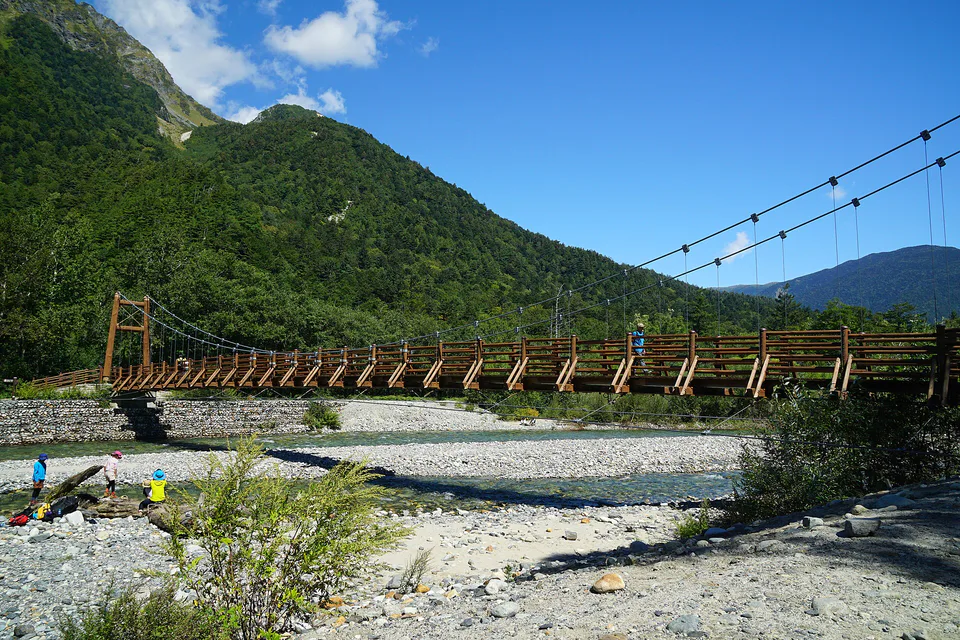
Cold, rain and early snow should change the route before they cancel the entire day
Autumn in Kamikochi is a mountain-weather trip. Cold mornings, rain, wet leaves and early snow can arrive while lower Japanese cities still feel mild. The right response is not always cancellation; it is often deleting distance.
Cold but clear: keep the route, add layers and allow for slower starts.
Steady rain: central Kappa Bridge/Tashiro sections are easier to shorten than a committed Tokusawa day.
Wind after strong colour: expect rapid leaf fall and judge the trip by river/mountain/larch scenery rather than a single maple expectation.
Snow/ice or official trail closure: official notices override this itinerary. Do not “make up time” by walking faster on unsafe surfaces.
If the foliage is earlier or later than expected, the trip can still work because Kamikochi’s value is layered: mountain snow, Azusa River reflections, wetlands and larch can compensate for broadleaf colour that is not at peak.
Final verdict
For most first-time visitors, I would plan Kamikochi autumn foliage as a transport-secured Taisho Pond → Kappa Bridge day, not as a race to Myojin or Tokusawa. Choose the date by the colour layer you actually want—mid-October for the historical maple phase, later October for larch—then verify same-week conditions. Reserve the Matsumoto-side bus even though ALPICO’s latest Japanese operating page uses a reservation-priority rather than absolute-reservation rule. Add Myojin only when Kappa Bridge still leaves about three hours of real slack, and treat 17:00 as a hard edge when your luggage is stored at the Bus Terminal.
Stay overnight when you are buying a second weather/light window, dawn/evening atmosphere or a longer northern walk. If the only reason for the hotel is “autumn is popular,” a Matsumoto or Hirayu pre-night plus a well-designed day trip can be the better use of both money and time.
Compare Kamikochi and gateway stays
Compare Kamikochi and Matsumoto stays
Shirakawa-go Autumn Leaves: Buses, Viewpoint, Luggage and Hotels
Japan Autumn Leaves Photography Guide: Timing, Weather, Lenses and Crowd Strategy
Hachimantai Autumn Leaves Guide: Scenic Drives, Buses, Onsen and Road Closures
Where to Stay for Oirase Autumn Leaves: Gorge, Lake Towada, Hachinohe or Aomori
Where to Stay in Kyoto for Autumn Leaves: Kyoto Station, Kawaramachi, Gion or Osaka?
Sources
ALPICO Japanese operating page — 2026 Matsumoto/Shin-Shimashima–Kamikochi reservation-priority rules · ALPICO English visitor page — timetable and reservation guidance · Kamikochi Official Website — historical September/October foliage sequence · Kamikochi Official Website — walking times · Kamikochi Official Website — Bus Terminal baggage storage · Kamikochi Official Website — private-car restrictions and parking gateways. Checked August 25, 2026. Transport rules, foliage conditions, trail closures and facility hours can change; recheck the exact travel date.