Kanayama Castle is easy to plan badly for one simple reason: the guidance center, the mountain-top car park, and the Japan castle stamp are not in the same place. The stamp is kept near the summit in the Minami Kuruwa rest area, while the guidance center sits down at the southern foot of the mountain and does not have the stamp. Drive or take a taxi from Ota Station to the mountain-top Motor Pool and the core ruins are relatively close; walk from the station instead and you are committing to a much longer uphill day.
For a first visit, decide which trip you actually want: the fastest route to the stamp and key ruins, a fuller archaeological visit with the free guidance center first, or a proper hike from Ota. Kanayama Castle itself is free, but the real cost is time, elevation and daylight.
30-second decision: take the summit shortcut, or build the guidance center into a half-day visit?
↔ Scroll table left or right
Your situation | Best route | Main trade-off |
Short on time + collecting the stamp | Taxi/drive to the Motor Pool → walk to Minami Kuruwa → continue to Honmaru | Fastest option, but you skip the guidance center |
First visit + want to understand the stonework | Visit the free guidance center first → hike the Nishiyama route to the castle | About 30 minutes uphill from the center to the main castle area; treat it as a half-day |
Hiking is part of the trip | Walk from Ota Station to the guidance center, then continue uphill | Ota Station to the guidance center alone is about 50 minutes |
Driving | Use P-7 Motor Pool for the castle; use the separate guidance-center car park if visiting the museum | The guidance-center lot is for its visitors, not a one-stop parking solution |
Arriving late in Nov–Dec | Shorten the route and descend early | Official guidance warns of sunset around 16:30 and no lighting in the mountain area |
If you are still deciding whether this is worth a day outside central Tokyo, compare it with other Tokyo day trips first. Kanayama Castle makes the most sense for castle collectors, Sengoku fortification fans, or travelers already heading toward Gunma or Ashikaga—not as a default first-trip excursion.
The Japan castle stamp is at Minami Kuruwa near the summit — not at the guidance center
Ota City currently places the Japan 100 Famous Castles stamp inside the Minami Kuruwa rest area near the summit, in Nakajima Memorial Park. The city also explicitly says the stamp is available year-round. The important correction is that the guidance center at the foot of the mountain does not have this stamp.
From the Motor Pool, the route to the stamp is roughly 600 meters if you follow the castle remains along the ridge. A parallel paved management road takes about 15 minutes each way. If your main objective is to collect the stamp with limited time, finish Minami Kuruwa first, then use whatever time remains for Hinoike, the Ote entrance and Honmaru.
This is the opposite of Minowa Castle, where the stamp is kept away from the ruins. If you are collecting several castles across Gunma, remembering which side of the mountain the stamp actually lives on matters more than memorizing the castle number.
From Ota Station, the real choice is whether to walk to the foot of the mountain or skip straight to the summit access
Ota City's current access guidance separates the routes clearly. From Tobu Ota Station's north exit, it is about 25 minutes on foot to Daikoin and about 50 minutes to the Kanayama Castle Ruins Guidance Center. From the guidance center, the Nishiyama hiking route to the main castle area takes roughly another 30 minutes. Walking all the way from the station is therefore not a casual 'station-to-sight' stroll; it is a hike with real elevation.
If you do not want to spend your energy on the urban approach, a taxi changes the day substantially. Ota City lists the station-to-Motor-Pool trip at about 4.6 km and roughly 12 minutes by taxi, compared with about seven minutes to the guidance center. In summer heat, with luggage, or on a multi-stop day, the taxi-to-Motor-Pool option can save the part of the walk that contributes least to understanding the castle.
Drivers should treat the mountain-top P-7 Motor Pool as the practical starting point for the main ruins. City material lists 36 spaces there. The lower slopes have several other municipal parking areas, including the guidance-center lot, but that P-6 lot is for guidance-center visitors. If you want both museum and castle, think of them as two separate parking and walking nodes.
Should you visit the guidance center first? Skip it on a stamp-only sprint; keep it for a first serious visit
The value of the Kanayama Castle Ruins Guidance Center is not admission—it is free—but context. The exhibits explain the relationship between stone walls, baileys, the two ponds and the ridge-line defenses before you see them on the mountain. Current hours are 09:00–17:00 with last admission at 16:30. It closes on Mondays, or the following day when Monday is a public holiday, plus December 29 to January 3.
If you only have about 90 minutes and the stamp is non-negotiable, starting at the guidance center is usually inefficient because the stamp is not there. Go to the Motor Pool, reach Minami Kuruwa and use the remaining time for the main ruins. If your real question is why a Kanto mountain castle has so much visible stonework, however, the guidance center earns its place because it helps separate archaeological evidence from later conservation and reconstruction.
Kanayama Castle is not about a keep — its real story is how much stone appears in a Sengoku-period Kanto mountain castle
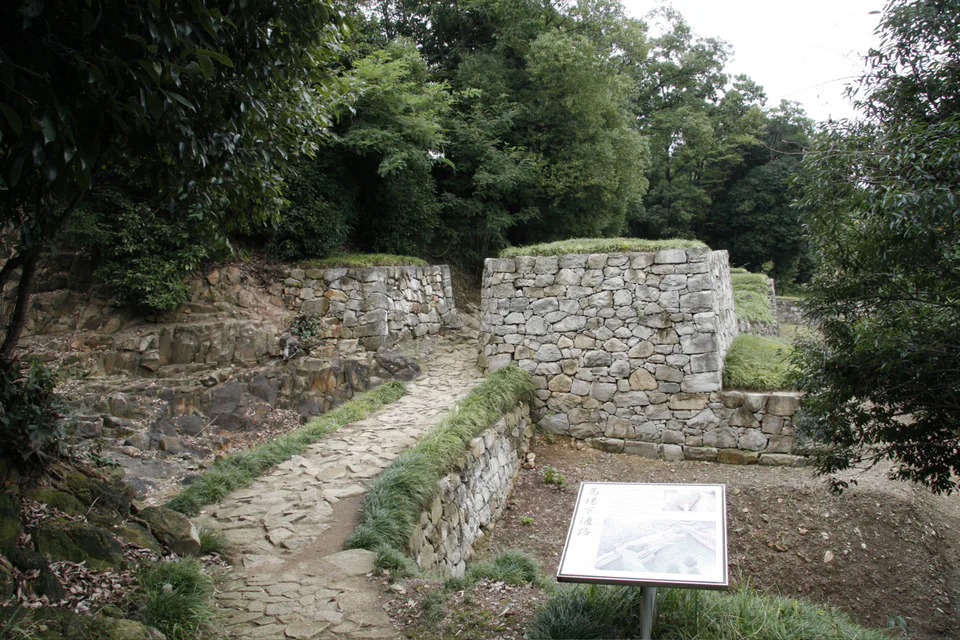
Kanayama Castle was founded in 1469 around the 239-meter summit of Mt Kanayama. Its defenses spread along the surrounding ridges, where baileys were strengthened with dry moats, earthworks and—most unusually—extensive stone walls and stone paving. Ota City highlights that archaeological work here challenged the old assumption that Sengoku-period mountain castles in Kanto lacked substantial stone fortifications.
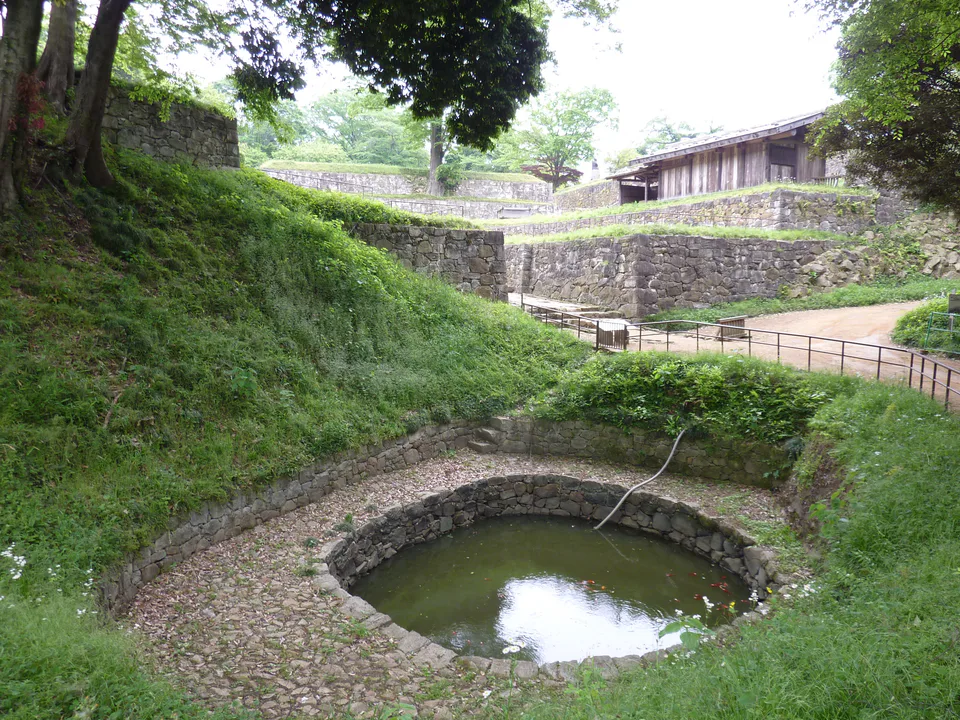
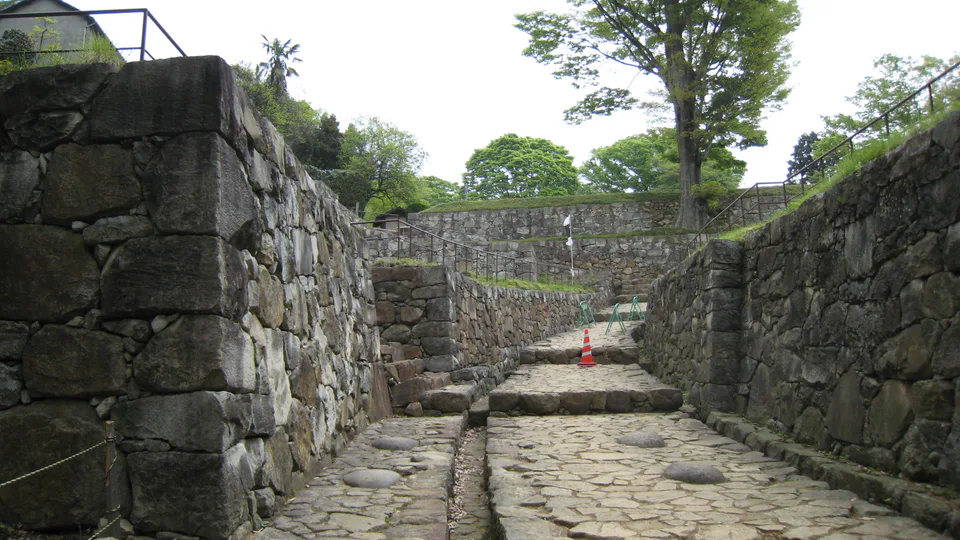
That is why searching for a castle keep misses the point. The bent approach at the Ote entrance, stone-paved passages, Hinoike and Tsuki-no-Ike, Minami Kuruwa, Honmaru and the connected ridge-top baileys are the main attractions. The two large ponds close to the summit are particularly unusual for a mountain castle and are interpreted in relation to water use and ceremonial space.
There is one more useful caution: not every stone you see today has simply sat untouched since the 1500s. Ota City's conservation material explains that excavated original remains are protected and reused where possible, while sections are restored according to archaeological measurements. The better way to read the site is as an archaeological reconstruction of defensive space, not as an entirely untouched ruin.
Ota City says 1–1.5 hours for the main summit area; a detailed visit can take 2–3 hours
The city's own timing estimate is more realistic than many quick sightseeing plans. Starting from Nishi-jo and the Motor Pool, allow roughly 1 to 1.5 hours for the principal remains around the main castle and Nitta Shrine. For a detailed visit, the official guidance says two to three hours. That is the clearest reason '15 minutes from parking to the stamp' should never be read as '15 minutes to see Kanayama Castle.'
↔ Scroll table left or right
Time available | Suggested visit | Best for |
60–90 min | Motor Pool → Ote entrance → Tsuki-no-Ike/Hinoike → Minami Kuruwa stamp → Honmaru/Nitta Shrine → return | Travelers already on the mountain prioritizing the stamp and core ruins |
1.5–2 hr | Take the prepared trail through defensive cuts, lookout areas, Baba Kuruwa, Ote entrance, both ponds, Minami Kuruwa and the main castle | First-time visitors who want to understand the defense line |
2–3 hr | Use the city’s “detailed visit” scale and slow down for stonework, baileys and ridge topography | Castle enthusiasts, photographers and archaeology-focused travelers |
Guidance center + castle | Add museum time plus roughly 30 minutes of uphill hiking from the center to the main castle area | Plan a half-day rather than borrowing the 1–1.5 hour summit estimate |
If you walk all the way from Ota Station, add the station-to-foothill approach and the return descent on top of those estimates. The official summit visit time is not the total trip time from the railway station.
In November and December, the critical limit is not autumn color — it is sunset around 16:30 with no lighting on the mountain
Ota City's castle page specifically warns that sunset is around 16:30 in November and December and that there is no lighting in the mountain area. That turns daylight into a safety constraint, not a photography preference. If you arrive late, cut the outer remains rather than squeezing Honmaru and the descent into darkness.
If you are comparing autumn excursions from Tokyo, use the Tokyo autumn day-trip comparison as a reality check. Kanayama Castle is strongest for history and mountain-castle terrain, not as a foliage destination; the early sunset can change the day more than the percentage of leaves in color.
The 2026 summer–autumn goshuin is sold at the guidance center — but it is not the Japan castle stamp
For visits through September 27, 2026, the guidance center is separately selling a seasonal Nitta Kanayama Castle goshuin for ¥300. Distribution runs during the center's 09:00–17:00 hours, with last entry at 16:30, and it is not sold on the center's closed days such as Mondays. This paper castle seal is a different product from the Japan 100 Famous Castles stamp at Minami Kuruwa.
If you want both, you must satisfy two different conditions: the guidance center's opening hours for the seasonal goshuin and the mountain route for the official castle stamp. After September 27, 2026, ignore this seasonal offer and re-check Ota City's current notices rather than assuming the same design remains available.
Can you combine Kanayama Castle with a Gunma onsen? Better as the next leg of the trip than a rushed same-afternoon add-on
Kanayama Castle sits in Ota in eastern Gunma. If you want to continue toward a hot-spring stay, compare Kusatsu, Ikaho and Shima Onsen before deciding where the next night should be. None of those onsen towns is a simple “few stops after the castle” extension, so they work better as a cross-day connection than as a rushed post-castle detour before ryokan dinner.
If the ryokan is the real priority, keep Kanayama Castle as a morning or previous-day block. If the castle collection is the priority, finish Minami Kuruwa and the core ruins first, then decide whether the guidance center, other Ota cultural sites or an onsen belongs in the remaining itinerary.
Who should make a dedicated trip to Kanayama Castle — and who can skip it?
The strongest fit is for three groups: travelers collecting Japan's major castle sites, people interested in the evolution of Sengoku mountain-castle stonework, and visitors willing to spend one to three hours actually reading ridges and baileys. For them, the Ote entrance, the two ponds and the restored stone defenses provide a clear payoff, while admission itself costs nothing.
It is a weaker choice for travelers who only want an extant keep, expect a five-minute walk from transport to the main sight, or have very few day-trip slots on a first Tokyo trip. Kanayama Castle is not underwhelming; it simply depends on whether stone walls, gate approaches and mountain defenses are what you came to see. If not, the travel time from Tokyo carries a high opportunity cost.
Verdict: choose your way up the mountain first, then decide whether the guidance center is worth the extra leg
The most efficient Kanayama Castle plan does not begin by walking to the guidance center and asking what to do. It begins by deciding the purpose of the visit. For stamp plus core ruins, go straight to the Motor Pool, walk roughly 15 minutes toward Minami Kuruwa and extend to Honmaru as time allows. For a deeper understanding of Kanto stone fortification and the archaeology behind the restored spaces, put the free guidance center first and accept the longer mountain route.
Four facts are enough to prevent most mistakes: the Japan castle stamp is at Minami Kuruwa, not the guidance center; Ota Station to the guidance center is about a 50-minute walk; the city recommends at least 1–1.5 hours for the main summit area and 2–3 hours for a detailed visit; and in November–December, sunset is around 16:30 with no lighting on the mountain. Get those four conditions right and Kanayama stops being 'a ruin with reconstructed stone walls' and becomes a very readable Sengoku defensive landscape.
Official sources and verification date
Ota City Cultural Properties Division, Kanayama Castle Ruins: used to verify the stamp location at Minami Kuruwa, the roughly 600-meter route or 15-minute paved-road walk from the Motor Pool, Ota Station access, the official 1–1.5 hour / 2–3 hour visit estimates, November–December sunset warning, no-lighting caution and municipal parking layout.
Ota City, Kanayama Castle Ruins Guidance Center / Kanayama Regional Exchange Center: used to verify 09:00–17:00 opening, 16:30 last admission, Monday and year-end/New Year closures, free admission and station-to-center access.
Ota City cultural-property overview: used for the 1469 foundation, 1590 abandonment, Iwamatsu / Yokose-Yura / Hojo succession, extensive stonework and the unusual Hinoike and Tsuki-no-Ike features.
Ota City's 2026 summer–autumn goshuin notice: used to verify the July 18–September 27, 2026 sales period, ¥300 price and guidance-center distribution. This is a seasonal goshuin, not the Japan 100 Famous Castles stamp.
Image sources were checked against Wikimedia Commons for Nitta Kanayama Castle in Ota, Gunma. Two photographs are public domain; the Taketarou photograph is licensed CC BY-SA 1.0. Information last checked August 20, 2026. Opening days, goshuin distribution, access conditions and hiking conditions may change, so re-check Ota City's latest notices before travel.
Image-license links: Kanayamajyo.jpg (public domain); Kanayamajo-ato.JPG (public domain); KanayamaCastle.jpg (Taketarou, CC BY-SA 1.0); CC BY-SA 1.0 license.


