
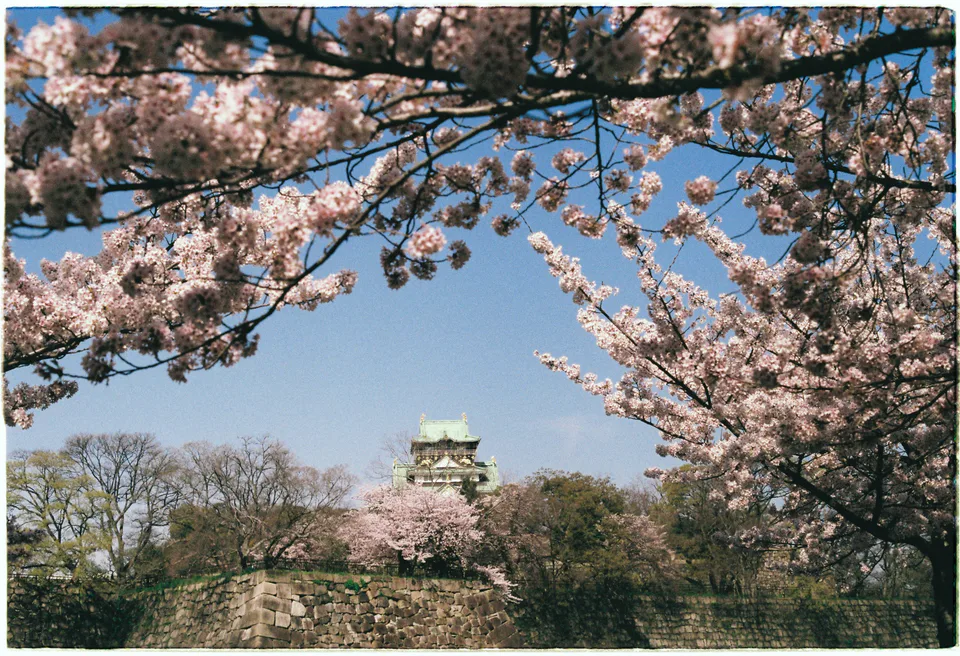
If cherry blossoms are the reason you are going to Osaka Castle, do not start by buying the castle-museum ticket. Start with the free park and Nishinomaru Garden, then add the museum only if the indoor history displays and upper-floor view are independently worth your time. The park, Nishinomaru and museum are three different products; treating them as one attraction is what turns a two-hour spring visit into an accidental half day.
There is also an important date correction. The 2026 Nishinomaru Nighttime Cherry Blossom Viewing ran from March 20 to April 12, 2026 and is already over. As of August 26, 2026, this guide should not present those dates as an upcoming event or reuse them for 2027. Use the 2026 programme only as a planning reference, then wait for the next official spring announcement before booking a night around the illumination.
↔ Scroll table left or right
Your real goal | Start with | Why | What to skip first |
Classic castle + blossom photos | Free park + Nishinomaru | The exterior, moat and lawn compositions are the spring product | Castle museum if history is not a priority |
Japanese castle history / indoor exhibits | Castle museum + exterior loop | The ¥1,200 ticket pays for exhibitions and the elevated view, not closer blossoms | Long garden stay if foliage is secondary |
Daylight + night blossom atmosphere | Nishinomaru in late afternoon | One paid garden can deliver daylight, blue-hour and illuminated versions when a night event is running | Extra park zones that force backtracking |
Only about two hours | One exterior route + Nishinomaru or museum | There is not enough time to do the full park, museum and a separate night session well | Whichever paid component matters less |
Rain / poor blossoms | Reassess before paying for the garden | The museum retains indoor value while the outdoor photography premium falls | Waiting hours for a weak night-view payoff |
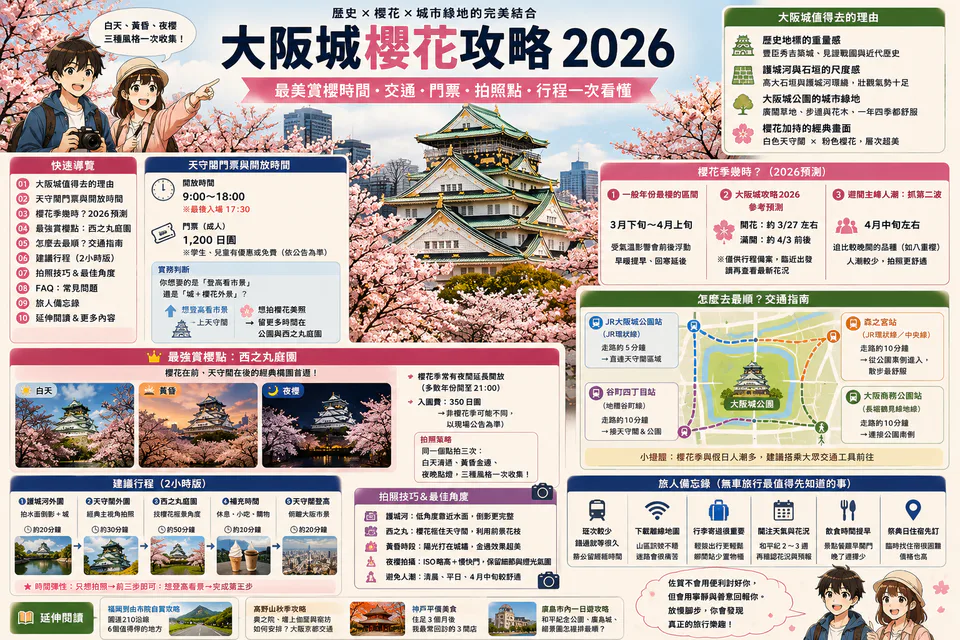
The first decision is free park, ¥300 garden or ¥1,200 museum
Osaka Castle Park itself is free. The two paid choices solve different needs.
Osaka Castle Museum: currently ¥1,200 for an adult (about US$7.50 at the August 25 exchange rate), open 09:00–18:00 with last admission at 17:30. This is the indoor history-and-view product.
Nishinomaru Garden: from April 1, 2026, the official standard adult fee is ¥300 (about US$1.90). This is the lawn, moat and castle-composition product.
2026 Nighttime Cherry Blossom Viewing: the finished March 20–April 12 event used a special ¥350 admission (about US$2.20) and extended Nishinomaru to 21:00, last entry 20:30. Do not assume the next spring will repeat the same dates or price.
Exchange-rate conversions are approximate. The important comparison is not ¥300 versus ¥1,200; it is which paid space changes your visit. If you only want an exterior photo of Osaka Castle with blossoms, paying for the museum does not make the flowers better. If the garden is crowded or the bloom is weak, the museum can still justify itself on history.
Nishinomaru is worth paying for when the composition is the point
Nishinomaru sits west of the main tower and has roughly 300 cherry trees according to official Osaka tourism information. Its advantage is not simply “more sakura.” The broad lawn, moat and tower sightline make it easier to build a coherent castle-and-blossom composition than wandering the whole 105-hectare park looking for one perfect angle.
That creates a useful boundary condition: if the trees are not the main reason for the visit, Nishinomaru is optional. The free park already gives you stone walls, moats, bridges and seasonal trees. Pay for the garden when you want to spend time there, not because it appears on a checklist.
The castle-museum ticket buys history, not blossom priority
The current adult museum ticket is ¥1,200 (~US$7.50). The museum is inside the reconstructed main tower and its value is the exhibition sequence and upper-level perspective. During cherry season, queues and vertical movement can turn the museum into a much larger time block than the ticket price suggests.
ValueNavi time-cost rule: if you have only two usable hours and the blossoms are the trip priority, keep the museum optional. If you have half a day and genuinely want the history, do the museum while the outdoor light is less important, then use Nishinomaru later when the light improves.
For a wider city-time decision, use the four-day Osaka itinerary decision before giving Osaka Castle half a day simply because the museum ticket is available.
The 2026 night event is now a reference case, not a live booking window
The official Osaka Castle Spring Festival page confirms that the 2026 Nishinomaru night event ran from March 20 through April 12, with the garden open 09:00–21:00 and final entry at 20:30. It also confirms the special ¥350 adult admission during that event. Those facts are useful for understanding how a future night programme may work, but they are historical as of August 2026.
The lesson for the next spring is to separate event dates from bloom dates. In 2026, Osaka's designated cherry tree at Nishinomaru was officially observed in bloom on March 26, after the night-viewing event had already begun. An event window is deliberately wider than peak bloom. Never treat every night in the published event period as equal blossom quality.
If the next spring illumination is a must-do, wait for the new official programme and then check live bloom conditions close to the date. Do not copy March 20–April 12 into a 2027 itinerary.
Use a daylight-to-night route only when the night event is confirmed
When a future Nishinomaru night programme is officially running, the cleanest route is not “see everything twice.” Use daylight for the outer moat, stone walls and one approach to the main tower. Put the museum in the middle only if you actually want it. Enter Nishinomaru late enough that you can see the garden before and after the light changes without spending several dead hours waiting for darkness.
↔ Scroll table left or right
Time available | Best shape | Main mistake |
90–120 minutes | Outer moat + one paid choice | Trying museum + garden + full park |
3–4 hours, daytime | Exterior route + museum + Nishinomaru if bloom is worthwhile | Crossing the park repeatedly for different stations |
Late afternoon + confirmed night event | Exterior → optional museum → Nishinomaru through dusk | Entering the garden too early and waiting for hours |
Rainy evening | Museum first; reassess garden after | Treating a prepaid spring plan as non-negotiable |
Choose the station by the route you want to walk
Osaka Castle has several useful stations rather than one front door. Official guidance lists Tanimachi 4-chome, Temmabashi, Morinomiya and Osakajokoen among the approaches, with roughly 15–20 minutes on foot to the main tower depending on the direction. The Tanimachi 4-chome / Otemon side is comparatively useful when Nishinomaru is the first priority; Osakajokoen works well when you want the park walk itself.
Do not choose a station from straight-line distance alone. Pick an entrance and an exit that create a one-way route. If you are staying in Namba or Umeda, compare the wider base decision in Namba vs Umeda rather than changing hotels for one castle visit.
Rain and weak bloom change which ticket is worth buying
Heavy rain reduces the value of long outdoor photography and lawn time. It does not automatically make Osaka Castle a bad visit because the museum remains an indoor option. Likewise, a weak or late blossom stage makes the ¥300 garden less important unless you also value the lawn and viewpoint.
This is the useful failure plan: keep the free park fixed, make Nishinomaru conditional on blossom/weather value, and make the museum conditional on historical interest. That prevents one disappointing variable from cancelling the entire half day. For broader alternatives, use the Japan rainy-day itinerary guide.
Final verdict
For cherry-blossom-first travellers, I would prioritise the free park and Nishinomaru, then add the castle museum only when its history is independently worth the time. The 2026 night event is already finished, so future visitors should not build a trip around its dates. Wait for the next official announcement, then use a daylight-to-night Nishinomaru visit only if the new event and live blossom conditions both support it.
The red-team condition is simple: if the bloom is weak, the weather is poor or the night programme is not confirmed, do not spend hours trying to recreate a photograph from another year. Osaka Castle still works as a historical visit; it just becomes a different product.
Official sources
Osaka Castle Museum — current hours and admission · Osaka Castle — Nishinomaru fee revision from April 1, 2026 · Osaka Castle Spring Festival 2026 — completed night-viewing dates and hours · OSAKA-INFO — Osaka Castle Park overview and access.
Checked August 26, 2026. Spring event dates, special opening hours, admission and blossom conditions change by year; verify the next official spring announcement before making a non-refundable plan.