
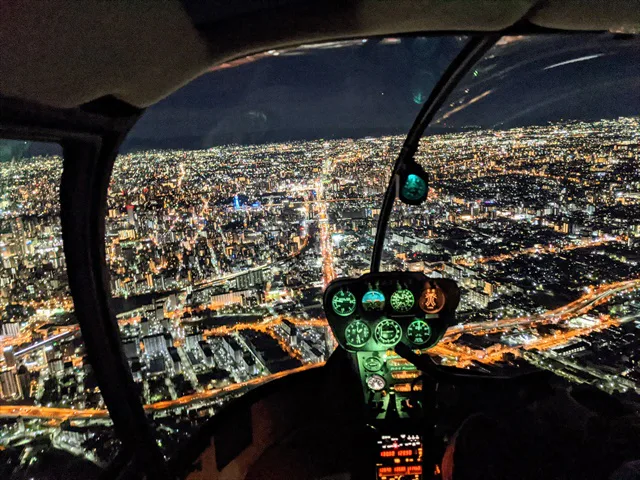
For most first-time visitors, the Osaka Downtown helicopter course is the first route I would compare—not because ten airborne minutes is inherently “better,” but because those minutes add Namba, Dotonbori, Abeno Harukas and Kyocera Dome to the bay/USJ geography. Choose the shorter Universal City or Bayside products when the waterfront is genuinely all you want. Move to a charter only when the added route buys Osaka Castle, Kobe or the Mozu-Furuichi tombs that you specifically care about.
Do not compare plans by the large “duration” number. OSAKA-INFO currently lists total experience windows of roughly 25–40 minutes while actual airborne time ranges from 4 minutes to about 20 minutes. Check the line that says flight time.
↔ Scroll table left or right
What you want to see | Start with | Main trade-off |
USJ only / very short first flight | Universal City day course | Only about 4 minutes airborne; this is an overflight, not a broad Osaka panorama |
USJ + Tempozan + bayfront | Bayside | About 7 minutes airborne; downtown landmarks are not the point |
First-time Osaka skyline | Downtown | About 10 minutes airborne but much more recognisable city geography |
Osaka Castle / Kobe / Mozu-Furuichi | 15–20 min charter | Much higher price; only worthwhile when the extra geography matters |
Solo budget traveller | Reconsider entirely | Several plans are priced for the aircraft for 1–3 people, so solo carries the whole fixed cost |
The new 4-minute Universal City course changes the bottom of the comparison
The current OSAKA-INFO listing now includes a Universal City day course with about 25 minutes total experience time but only 4 minutes of flight, covering Osaka Heliport to the Universal Studios area. It includes a drink and an optional/shared shuttle from JR Sakurajima Station.
That can be a rational low-commitment product for someone already staying around USJ who simply wants to experience a helicopter. It is not a discounted Downtown flight. If “Osaka from the air” in your head means Dotonbori, Abeno or Osaka Castle, four minutes over the USJ side is the wrong purchase.
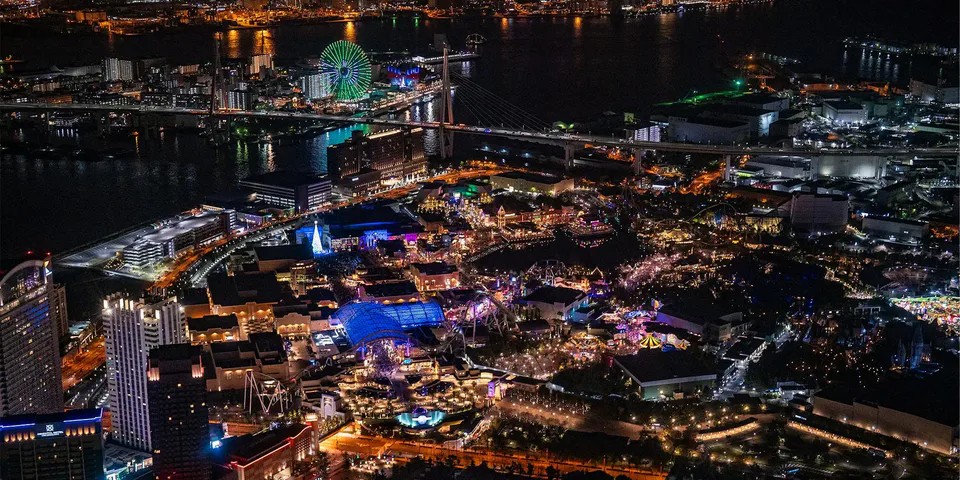
7-minute Bayside: buy the waterfront, not “a cheaper Osaka tour”
The current Bayside course is about 30 minutes total with about seven minutes airborne, covering Nanko, Tempozan and Universal Studios. It works when your day is already around Konohana/USJ or the bay.
It fails when the traveller expects the dense downtown skyline. Saving money on a route that does not pass the landmarks you care about is not value.
10-minute Downtown: the strongest first-flight default
The Downtown course currently remains about 30 minutes total with roughly ten minutes airborne. Its route adds Namba/Dotonbori, Abeno Harukas and Kyocera Dome to Nanko/Tempozan and USJ.
The extra three minutes versus Bayside matter because the route changes category. A first-time visitor can recognise places already walked on the ground. This is why cost per airborne minute is a weak metric: three minutes that add the city centre can be worth more than ten minutes in an irrelevant direction.
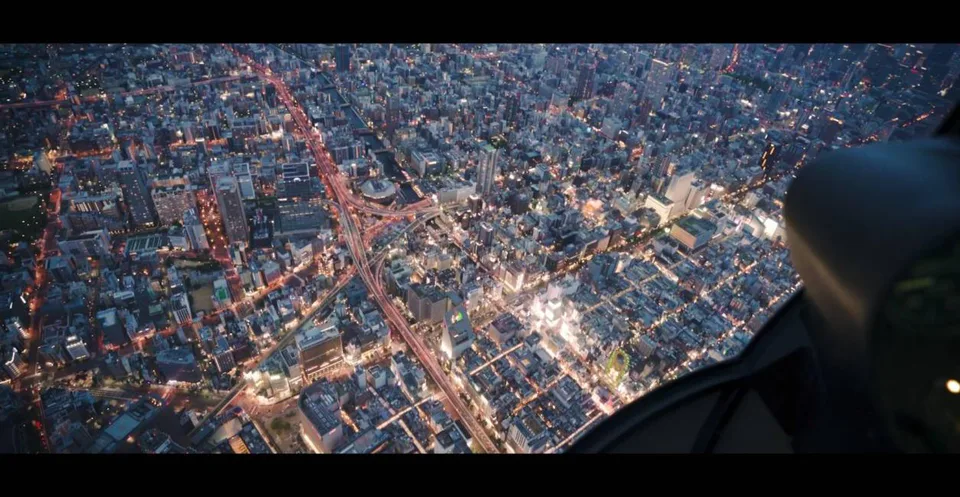
15–20 minute charters: upgrade only for a named landmark
The longer charter products add directions such as Osaka Castle, Kobe and, on the daytime 20-minute route, the Mozu-Furuichi tombs. That is a valid reason to pay more.
“The longer one must be more premium” is not. If Osaka Castle is not important to you, do not buy a charter just to increase the airborne clock. If the tombs are the objective, the daytime route has a stronger geographical case than a night flight where ancient landscape form is much harder to read.
There is a current official-page inconsistency on the 20-minute night charter
This is exactly why high-ticket experiences should be verified at checkout. During this August 25, 2026 check, the OSAKA-INFO English page showed the 20-minute Night Charter in one plan block as roughly 35 minutes total / 15 minutes flight, while the Japanese and Traditional Chinese versions showed 40 minutes total / 20 minutes flight.
ValueNavi will not silently choose which official-language page is “correct.” If that top night tier is the plan you want, confirm the exact airborne time and route on the final booking screen or with the operator before paying.
The same principle applies whenever a product title and detail line disagree: the expensive part of the booking is the flight time/route you expect, not the label “20-minute charter.”
One to three passengers can pay the same aircraft price
OSAKA-INFO currently states that its listed plans cover one to three people without changing the price by passenger count. That radically changes per-person value.
A couple who both genuinely want the flight can justify the fixed aircraft cost more easily than a solo traveller. Three friends reduce the effective per-person share further. But do not put an unwilling third person on a small aircraft simply to improve the arithmetic.
If one passenger fears heights or gets motion sick, the “cheaper per person” calculation is irrelevant. The group price only creates value when all passengers value the experience.
Departure logistics are part of the premium evening
The OSAKA-INFO plans depart from Osaka Heliport in Konohana. The listing currently offers an on-request shared shuttle from JR Sakurajima Station. That makes the product much easier for USJ/Universal City guests than for someone who imagines a helicopter pad in Namba.
Count hotel → Sakurajima/heliport → check-in → flight → return shuttle → next venue. A ten-minute flight can consume a much larger evening block.
This is why I would not place a hard-timed, non-refundable dinner immediately after the flight. The experience is weather- and operations-sensitive and the ground transport is part of the chain.
Day versus night: night is atmosphere, day is legibility
Night flights give Osaka a dense field of lights and make the Downtown route particularly emotional for anniversaries or one large “memory” purchase. Daylight is better when the actual geography—coast, rivers, Osaka Castle or the keyhole shape of the Mozu-Furuichi tombs—is the purpose.
Do not pay a night premium simply because “night” sounds more luxurious. Choose the light conditions that serve the landmark.
Check the hard eligibility rules before building the evening around it
The current OSAKA-INFO notes say passengers who have been drinking alcohol cannot board. Passengers over 120 kg who cannot secure the seat belt cannot board. The operator may cancel for bad weather or aircraft/maintenance issues, and late arrival can also prevent boarding.
Only valuables and cameras may be brought onboard under the current notes; ordinary baggage should not be treated as cabin luggage. If this is a transfer day with suitcases, solve storage before heading to the heliport.
The listed cancellation wording is also restrictive (“Full Refund Not Accepted”). Read the exact booking terms for your selected plan before paying rather than assuming a weather-sensitive premium activity has generous voluntary cancellation.
Three situations where I would skip the helicopter
Four-day Osaka/Kyoto trip already overloaded: the ground-transfer + flight + buffer block has a real opportunity cost.
Solo traveller choosing it mainly because the aircraft price is “only a little more” than another premium activity: fixed aircraft pricing works against you.
You cannot leave schedule buffer for weather/operations: a helicopter is the wrong anchor before a flight, last train or critical reservation.
Final verdict
Buy the route, not the largest duration number. Universal City for a minimal USJ overflight, Bayside for waterfront landmarks, Downtown for the strongest first-time Osaka panorama, and a charter only when Osaka Castle, Kobe or Mozu-Furuichi is specifically worth paying to add.
For the highest night tier, confirm the final booking details because the current official-language pages are not fully consistent about the advertised total/airborne duration. On an expensive short experience, that is exactly the kind of ambiguity worth resolving before payment.
Official sources and verification
OSAKA-INFO EXPERIENCE — current English helicopter plans and safety notes · Japanese plan page · Traditional Chinese plan page.
Checked August 25, 2026. Routes, aircraft, weather operation, timings and booking terms can change; confirm the exact selected plan at checkout.