
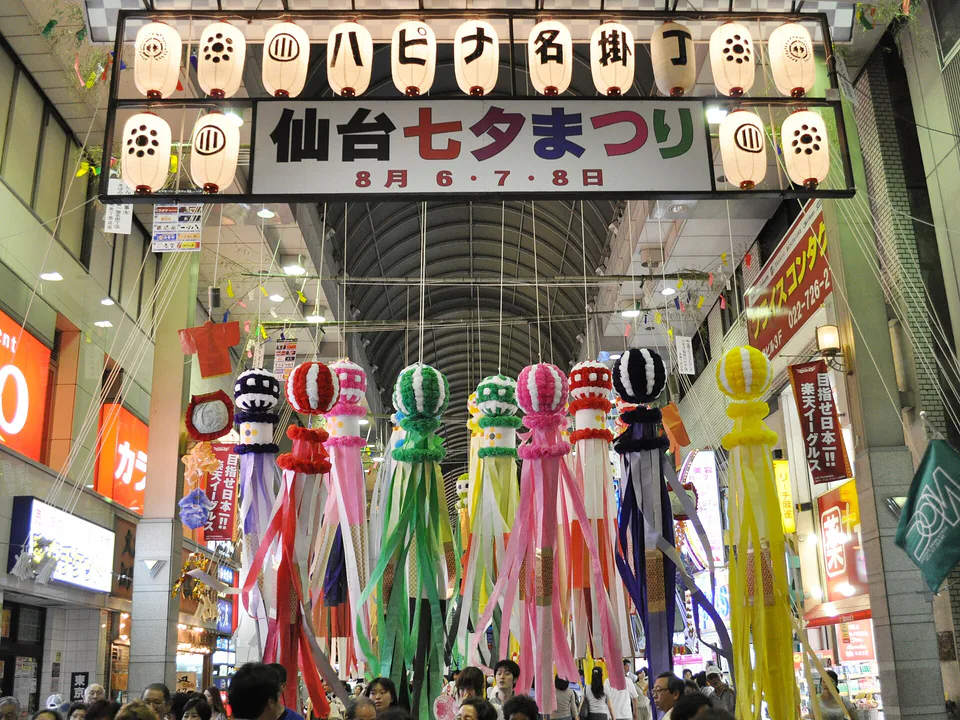
Sendai Tanabata 2026 has already ended: the festival ran August 6–8 and the organiser later confirmed that the three-day event finished successfully. The useful question now is not how to attend a date that has passed, but what the 2026 operation teaches about planning a future first visit. The strongest structure is still simple: make the central shopping arcades the main festival block, protect a hotel break, and treat Matsushima or Aobayama as a second decision rather than something automatically added to the same day.
The dates themselves are unusually stable. The official festival outline says Sendai Tanabata is held every year from August 6 to August 8. What does not carry forward automatically is the side programme: night events, shuttle buses, traffic restrictions, guided tours and special installations are year-specific. Use 2026 as a route model, then recheck the official programme for the year you actually travel.
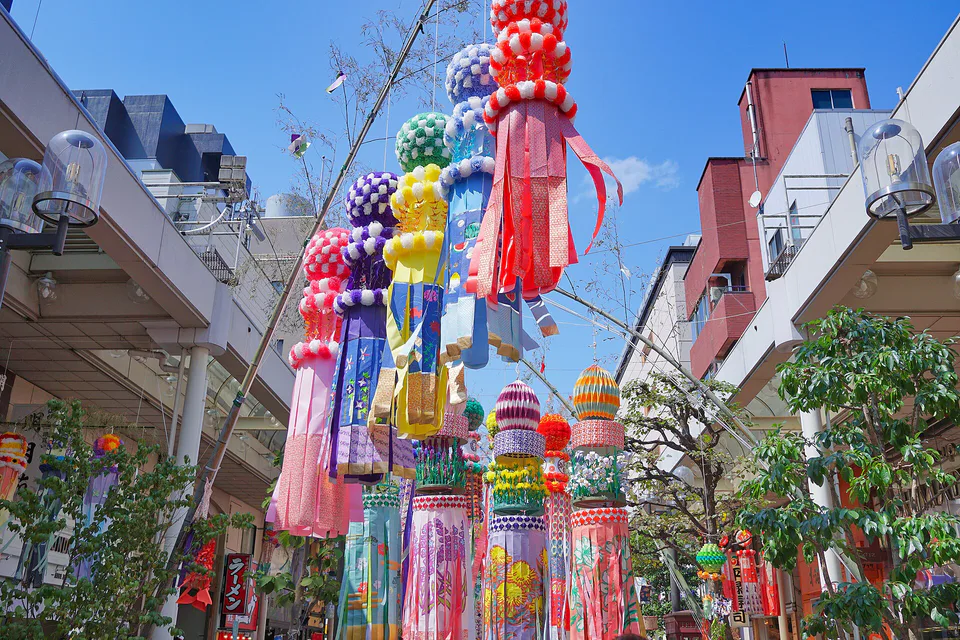
The covered central arcades are the festival's core experience; side trips should be judged by what they remove from this block.
The 30-second decision: protect one complete arcade block first
↔ Scroll table left or right
Your trip | Best structure | What not to force |
One festival day only | Central arcades + hotel break + return downtown | Matsushima and a distant night event on the same day |
Two nights in Sendai | Festival core on one day; Matsushima on the preceding/following half-day | Repeated hotel moves |
Arcades already feel complete by early evening | Consider the current year's Aobayama night programme | Going uphill merely because another event exists |
Heat, rain or low stamina | Shorten the second block first | Protecting every planned venue after conditions change |
Festival-heavy Tohoku week | Use Sendai as the lower-friction visual festival day | Adding a late night simply because the calendar allows it |
Why the central arcades should remain the first commitment
The official festival outline defines the main viewing corridor from the Sendai Station side through the central shopping streets, including Chuo-dori and Ichibancho. That geography is the durable part of the event. It gives a first-time visitor a clear one-direction route instead of a collection of unrelated pins.
The mistake is measuring the festival by kilometres. Walking slowly under the decorations, stopping for photographs, dealing with crowd flow and taking food breaks makes the same central corridor consume far more time than an ordinary shopping-street walk. A map that says two points are close does not mean the festival can be rushed between them.
ValueNavi route rule: walk the decorated core in one direction, then decide whether the day still has enough energy for a second act. Do not start by booking the second act and squeeze the defining experience around it.
If Sendai is one stop inside a larger Tohoku festival week, use the Tohoku summer festival one-week itinerary before fixing hotel nights. The hard constraint is usually recovery and hotel geography, not the train timetable.
2026 proved that “night festival” is a separate transport product
In 2026, the Aobayama-area Sendai Tanabata Night Fest ran on August 6–8 with lighting from 19:00 to 21:00. The organiser provided special evening transport: Loople Sendai departures from the station side between 17:15 and 21:00 at roughly 15-minute intervals, plus a free temporary shuttle between Aobayama Park and the Sendai Castle site.
The 2026 Loople fare was ¥260 (~US$1.60) per adult and ¥130 (~US$0.80) per child for one ride. Those numbers are useful only as evidence that the night event required a real transfer; they are not a promise for another year. Future visitors should recheck the current service and fare.
This creates an important itinerary boundary. Aobayama was not “one more nearby light-up” to tack onto an unfinished downtown walk. It had its own transport window, its own event geography and a 21:00 end time. Moving there made sense only after the central decorations had already delivered enough value.
The same logic should be used in future years:
Stay downtown if you still want the arcades after dark, dinner flexibility or an easier hotel return.
Move to Aobayama if the main route is complete and the current year's night programme is genuinely different enough to justify the transfer.
Do not reuse the 2026 shuttle timetable without checking. The durable lesson is that the night programme needs its own transport budget in both minutes and energy.
Matsushima creates a bigger conflict than the train map suggests
Matsushima is close enough to Sendai to tempt travellers into combining it with the festival core. That can work on a two-night stay, but it is a poor default for the only festival day.
The true cost is not simply the rail journey. It is:
hotel → station → train → Matsushima walking/sightseeing → station → train → Sendai crowd re-entry → arcade walk.
Every hand-off competes with the part of Tanabata that cannot be recreated on another ordinary Sendai day.
↔ Scroll table left or right
Plan | What it protects | Main risk |
Matsushima the day before | Full festival day and evening | Needs an extra Sendai night |
Matsushima the following morning | Festival evening with no return deadline | Onward travel later that day becomes tighter |
Matsushima + Tanabata same day | Saves one calendar day | Turns both experiences into timed fragments |
Reversal condition: same-day Matsushima becomes more reasonable when Tanabata is a secondary interest and you only want a short look at the decorations. If the festival is one of the reasons you chose August 6–8, protect the festival day instead.
The hotel is part of the heat-management plan
The 2026 organiser issued explicit heat-management guidance for visitors. That confirms a planning reality that is easy to underestimate from photos of covered arcades: August heat still controls how long a visitor can comfortably remain outside and in crowded streets.
A hotel close enough for a real mid-afternoon break can therefore have repeatable value. The break is not wasted sightseeing time if it preserves the evening. The false economy is saving on a room location, then staying outside continuously because going back feels too inconvenient.
For a one- or two-night festival stay:
Near Sendai Station: stronger for rail arrivals, luggage and an early onward train.
Closer to the central arcades: stronger when a midday reset and easy evening return are the priority.
Choose the base from the repeated walking pattern, not only the arrival journey. If luggage is driving the wrong hotel decision, use the Japan luggage-forwarding guide instead of carrying a transfer-day suitcase through the festival.
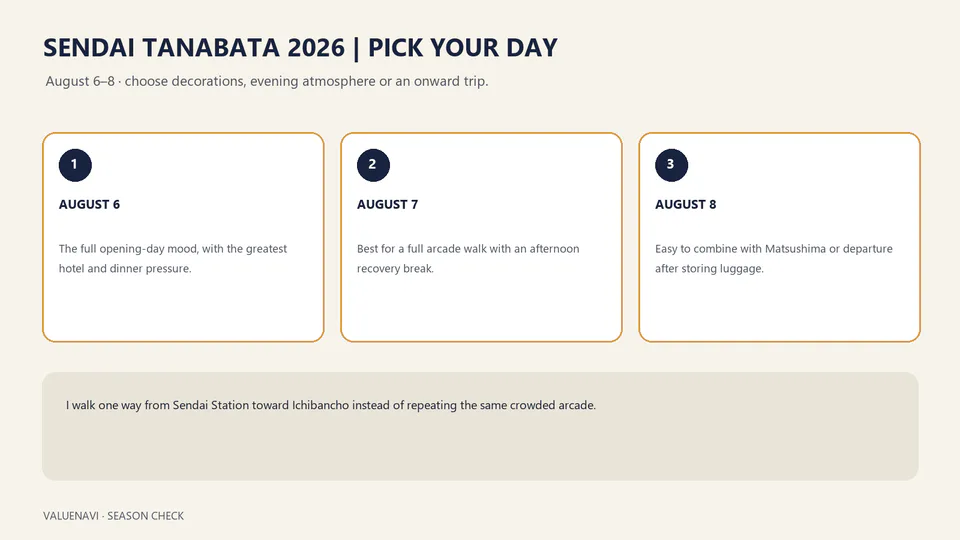
What 2026 side events should and should not be copied into a future plan
The official 2026 programme included more than the hanging decorations. Examples included the Aobayama night events, an August 7 Suzume evening dance with around 200 scheduled participants, cultural activities and special displays. These are useful evidence that the festival can support a second layer beyond the arcades.
But they are also exactly the pieces that should not be copied blindly into another year's itinerary. Treat them as examples of event types:
↔ Scroll table left or right
2026 element | Reusable lesson | Recheck next time |
Aobayama Night Fest | Night programme can justify a second district | Dates, hours, bus/shuttle operation |
Suzume evening dance | A special one-night performance can change which festival day is best | Whether it returns and on which date |
Special exhibitions/workshops | Useful rain/heat relief when near the route | Venue, capacity, registration and closing time |
The annual August 6–8 festival dates are the stable shell. The side programme is the variable layer.
One day versus two nights: the real difference is recovery capacity
One festival day is enough to understand Sendai Tanabata if you protect the arcades and do not overfill the schedule. Arrive with luggage already solved, walk the central route, take a proper break, then choose either downtown evening atmosphere or a current night event.
Two nights are stronger when Matsushima matters, when you are arriving from another Tohoku festival, or when heat sensitivity makes a long continuous day unrealistic. The extra night buys recovery and route flexibility more than additional Tanabata “content.”
That distinction matters on a summer-festival trip. Four festivals in four cities do not become easy just because every train is bookable. If the wider route is still open, compare Japan summer festivals before turning every famous event into a compulsory late night.
Final verdict
The 2026 festival is over, but its planning lesson is reusable: make the central arcades the non-negotiable block and let every side trip prove that it deserves the time it removes. Matsushima is best on another half-day when the festival matters. Aobayama is a second act, not an automatic extension. A centrally useful hotel can be a heat-management tool rather than merely a place to sleep.
For a future visit, start with the stable fact—Sendai Tanabata is held every August 6–8—then wait for the official year-specific programme before locking night events, special buses or one-off performances. That protects the trip from the most common festival-planning error: building around last year's timetable.
Official sources and 2026 status
Sendai Tanabata Festival official outline — annual August 6–8 dates and central shopping-street location.
Official 2026 post-event archive — confirms the August 6–8, 2026 festival concluded.
Sendai Tanabata Night Fest 2026 — 19:00–21:00 lighting, 2026 Loople service and temporary shuttle details.
Official 2026 festival guide — year-specific side events and programme examples.