Tokyo → Kyoto or Osaka same-day luggage delivery is worth ¥13,200 when the bag is blocking a transfer day you genuinely want to use. It is not a fee you need to pay simply because your suitcase is large. If carrying the case directly from one station-side hotel to another is manageable, reserving the correct Shinkansen baggage space can solve the problem without a five-figure delivery charge. If you can live from a small overnight bag, ordinary forwarding is usually the better-value hands-free option.
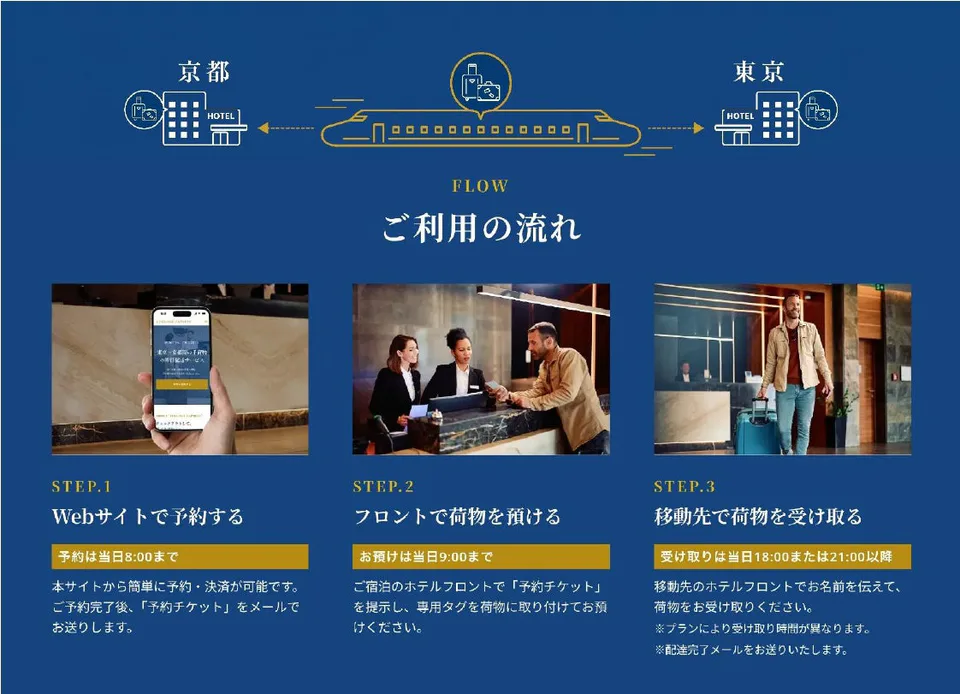
The current LUGGAGE EXPRESS product makes the decision more specific than it was at launch. As of August 2026, Tokyo ⇄ Kyoto/Osaka has three main same-day plans: Regular ¥13,200 per item, drop-off by 10:00 and delivery by 20:00; Express ¥16,500, drop-off by 10:00 and delivery by 18:00; and Late Check Out ¥16,500, drop-off by 12:00 and delivery by 20:00. The premium should therefore be judged by the hours it actually buys, not by the word “express.”

The 30-second decision: delivery, normal forwarding or carry it?
↔ Scroll table left or right
Your transfer day | Start with | Why |
Tokyo checkout → several hours sightseeing → Kyoto/Osaka hotel that evening | LUGGAGE EXPRESS | The fee buys back a real luggage-free block at both ends of the Shinkansen trip |
Direct hotel → station → Shinkansen → station-side hotel | Carry the bag | A reserved baggage-area seat may solve the only real problem for no additional baggage-space charge |
You can manage one night without the main suitcase | Normal forwarding | Yamato normally delivers the next day or in two days, depending on the route, at a much lower service category than premium same-day delivery |
The painful part is only Kyoto/Osaka Station → hotel | Carry to Kansai, then use storage/local delivery | Do not pay to remove the suitcase from the entire intercity day when only the final local leg is difficult |
Your accommodation is not an eligible partner hotel | Remove LUGGAGE EXPRESS from the shortlist | Hotel delivery is limited to eligible accommodation selected in the booking flow |
First compare ¥13,200 with the free Shinkansen baggage-reservation alternative
JR Central’s current rule creates the most important counterfactual. On the Tokaido Shinkansen, luggage with total dimensions of 160 cm or less does not require an oversized-baggage reservation. Luggage with total dimensions of 161–250 cm requires a reserved seat with an oversized baggage area or applicable baggage compartment. Reserving that seat does not add a separate baggage-space charge to the reserved-seat fare.
If you board with oversized baggage without the required reservation, JR Central currently charges a JPY 1,000 baggage fee and directs the bag to a space designated by staff. That is a failure condition, not a sensible way to save a reservation. Reserve the correct seat in advance.
This means a 170 cm suitcase does not make ¥13,200 delivery automatically rational. You have two different products:
Carry it with the correct Shinkansen reservation: you keep the bag, pay no separate oversized-baggage-space premium, but the suitcase follows you through the whole transfer day.
LUGGAGE EXPRESS: you pay to remove the bag from your day and receive it at the destination hotel that evening.
The delivery fee is therefore buying hands-free time, not permission to ride the Shinkansen.
There is also a size band where LUGGAGE EXPRESS is not the answer
The current LUGGAGE EXPRESS limit is a combined three-side measurement of 200 cm or less and a weight below 30 kg. JR Central, by contrast, permits ordinary passenger baggage up to 250 cm in combined dimensions under its carry-on rules, with oversized-baggage reservation required above 160 cm.
That creates a useful boundary:
Up to 160 cm: ordinary Shinkansen baggage; same-day delivery is purely a convenience decision.
161–200 cm: either reserve Shinkansen oversized-baggage space or use LUGGAGE EXPRESS if the service fits.
201–250 cm: the bag can fall within JR’s carry-on limit but outside LUGGAGE EXPRESS’s current size limit. Use the correct Shinkansen reservation or another delivery product.
Over 250 cm: JR Central says it cannot be brought onto the Shinkansen as ordinary passenger baggage; solve the logistics before travel day.
This is why “I have oversized luggage” is not enough information to choose the service. Measure the actual bag first.

Regular vs Express vs Late Check Out: the extra ¥3,300 should have a job
The current plan structure makes the upgrade decision unusually easy to quantify.
Regular: 10:00 drop-off → 20:00 delivery, JPY 13,200.
Express: 10:00 drop-off → 18:00 delivery, JPY 16,500.
Late Check Out: 12:00 drop-off → 20:00 delivery, JPY 16,500.
Express costs JPY 3,300 more per bag to receive the luggage two hours earlier. Late Check Out costs the same JPY 3,300 premium to keep the luggage for two additional hours at the origin before sending it. As a simple derived comparison, that is JPY 1,650 per shifted hour per bag.
Do not use that as a universal “value per hour” formula. Use it to expose weak upgrades. If you will not reach the Kyoto hotel until 21:00, paying for 18:00 delivery achieves nothing. If your Tokyo hotel checkout is 11:00 and those extra two hours let you avoid a separate station-counter trip, Late Check Out can solve a real problem.
Upgrade only when you can name what those two hours protect.
Two suitcases change the economics faster than two travellers change the inconvenience
LUGGAGE EXPRESS is priced per item. Two Regular bags cost JPY 26,400; two Express or Late Check Out bags cost JPY 33,000. Three Regular bags reach JPY 39,600.
The inconvenience of a second suitcase is real, especially for a family, but the fee also doubles exactly. This is where the decision should be re-opened rather than automatically multiplying the one-bag answer.
For a couple travelling directly from a Tokyo Station hotel to a Kyoto Station hotel, JPY 26,400 can be a very high price to remove a relatively simple movement. Reserve suitable Shinkansen baggage seats and carry the cases unless mobility or another constraint changes the answer.
For parents managing children, a stroller and two large cases while deliberately using the transfer day for sightseeing, the same JPY 26,400 can buy a much more meaningful reduction in hand-offs. The premium is strongest when the group would otherwise keep touching the luggage throughout the day.
You can also send fewer bags than the number of travellers when that genuinely reduces the burden. Sending one difficult case and carrying one manageable case is not fully hands-free, but it can still remove the bag that creates the worst station and local-transport friction.
Hotel eligibility is a hard veto, not a detail to confirm after payment
The live LUGGAGE EXPRESS service currently covers eligible hotels and ryokans in Tokyo, Kyoto City and Osaka City, plus designated drop-off counters at Tokyo, Kyoto and Shin-Osaka stations. When a hotel is used as the origin or destination, the service is only available to guests who already have a reservation at an eligible partner property. The eligible hotel is selected in the booking process.
Station counters are drop-off points, not delivery destinations. You cannot build the evening around “I will collect the bag at Kyoto Station” unless the specific service you booked explicitly provides that function—it currently does not under the normal LUGGAGE EXPRESS hotel-delivery model.
This makes accommodation type a pre-booking filter. If your final stay is outside Kyoto City or Osaka City, a vacation rental, or simply not on the eligible list, remove the service from the plan before you optimise the rest of the day.
The current service is broader than the original November 2025 launch
The original launch was Tokyo ⇄ Kyoto with morning drop-off. The live service has since expanded. It now advertises Tokyo ⇄ Kyoto/Osaka, a noon Late Check Out plan, and a separate Osaka ⇄ Kyoto Regional service. The Regional service is currently JPY 4,400 per item, 10:00 drop-off to 20:00 hotel delivery; station drop-off is not available for that short-distance route.
This matters because an older launch notice is no longer enough to plan the current product. The Tokyo–Kansai article should follow the live LUGGAGE EXPRESS booking conditions, not freeze the November 2025 launch terms.
Likewise, the temporary Kyoto Station counter that offered JPY 1,400–1,500 Kyoto City delivery and JPY 2,400–2,500 Osaka City delivery in spring 2026 operated only on specified March dates. Those prices were useful seasonal examples, not a permanent Kyoto Station tariff. Do not budget them as though the counter still operates every day.
Normal forwarding is still the default when you can carry one night of essentials
Yamato Transport’s current guidance says ordinary TA-Q-BIN generally arrives the next day or in two days, depending on the origin and destination. Same-day Yamato delivery exists only at selected counters and within the service area and cutoff of that counter.
For many Golden Route trips, that slower model remains the better-value luggage strategy: send the large case ahead and carry medication, valuables, chargers, one change of clothes and anything needed before delivery in a small overnight bag.
The decision is strongest when the next hotel can receive the luggage and your itinerary does not require the case that evening. Use the Japan luggage-forwarding guide for the broader hotel-acceptance, delivery-time and waybill workflow.
If the accommodation has no staffed reception or otherwise cannot receive a normal hotel delivery, solve that before sending. A cheap courier that cannot deliver to the accommodation is not an alternative.
Use a protected-hours test: what will you actually do without the bag?
The strongest original-value question is not “How inconvenient is a suitcase?” It is what will the luggage-free hours allow you to do that you would otherwise skip or shorten?
Count the useful block between handoff and hotel arrival:
Tokyo museum or neighbourhood time after checkout;
a long lunch where a 28-inch case would be awkward;
shopping before the Shinkansen;
Kyoto sightseeing before the hotel room is ready;
local buses or a Higashiyama transfer you would avoid with luggage;
mobility or family supervision that becomes materially easier with both hands free.
If the answer is “we will take the train immediately and check in,” the service is protecting very few hours. Carrying the bag becomes much harder to beat.
If the answer is “we will check out at 09:00, use Tokyo until mid-afternoon, take a later Shinkansen and continue straight into a Kyoto evening,” the same fee buys a completely different transfer day.

Four traveller scenarios
Solo traveller, one 28-inch suitcase, Tokyo sightseeing before Kyoto
Same-day delivery is defensible. One JPY 13,200 fee can protect most of a transfer day and remove the final Kyoto local-transport problem. Compare the hotel eligibility and 20:00 delivery against how long you would otherwise store or drag the case.
Couple, two large suitcases, Tokyo Station hotel to Kyoto Station hotel
Carry first. Reserve the correct Shinkansen baggage-area seats if the cases exceed 160 cm. The route is already simple, and JPY 26,400 Regular delivery may be solving less friction than the price suggests.
Family, stroller, two large cases, evening hotel in Higashiyama
Same-day delivery gets much stronger. The premium can remove repeated hand-offs through Tokyo, the Shinkansen and Kyoto local transport. Keep essentials with the family and verify the hotel is eligible before building the day around delivery.
One suitcase measures 210 cm in total dimensions
LUGGAGE EXPRESS is not the current solution. Its published size limit is 200 cm. If the bag remains within JR Central’s 250 cm passenger-baggage limit, reserve an oversized-baggage seat/space or use another courier that accepts the dimensions.
Failure modes to check before the transfer day
You miss the booked drop-off window: do not assume the same-day promise survives. The 10:00 and 12:00 products are different plans.
The hotel is not eligible: station counters cannot substitute as the delivery destination.
You packed something needed before 20:00: same-day is not the same as immediate access. Carry medication, passports, valuables and trip-critical items yourself.
Transport disruption affects delivery: the operator asks customers to contact support if luggage is significantly delayed. Do not put an irreplaceable dinner outfit, medicine or same-evening hard requirement entirely inside the delivery promise.
Your oversized Shinkansen baggage seat sells out: if you decide to carry instead, JR Central recommends reserving baggage-area seats in advance because availability is limited.
Final verdict: pay for the day you recover, not for the suitcase you dislike
For one bag and a deliberately sightseeing-heavy Tokyo → Kyoto/Osaka transfer day, JPY 13,200 can be a rational premium. The service is buying several hours with no intercity luggage and same-evening access to the bag.
For a simple station-to-station move, carry first. A 161–250 cm suitcase can be handled under the Shinkansen oversized-baggage reservation system, and the baggage-area reservation itself does not add a separate fee. Same-day delivery only wins if removing the case changes the day.
For two or more bags, reopen the calculation. JPY 26,400–33,000 is large enough that normal forwarding, carrying, local delivery or sending only the most difficult case deserve a fresh comparison.
The cleanest question is: how many useful hours and hand-offs does this fee remove, and are those hours worth more than the cheaper alternatives?
Related: Kyoto to Kinosaki Luggage Forwarding: Send It or Carry It?
Related: Luggage Forwarding for Kawaguchiko and Hakone: What Actually Works
References
LUGGAGE EXPRESS — current plans, prices, size limits and service areas · LUGGAGE EXPRESS — eligible counters and hotel areas · JR Central — Tokaido Shinkansen baggage rules · HANDS FREE KYOTO — original LUGGAGE EXPRESS launch · HANDS FREE KYOTO — spring 2026 temporary Kyoto Station counter · Yamato Transport — normal and same-day delivery timing. Checked August 25, 2026.