
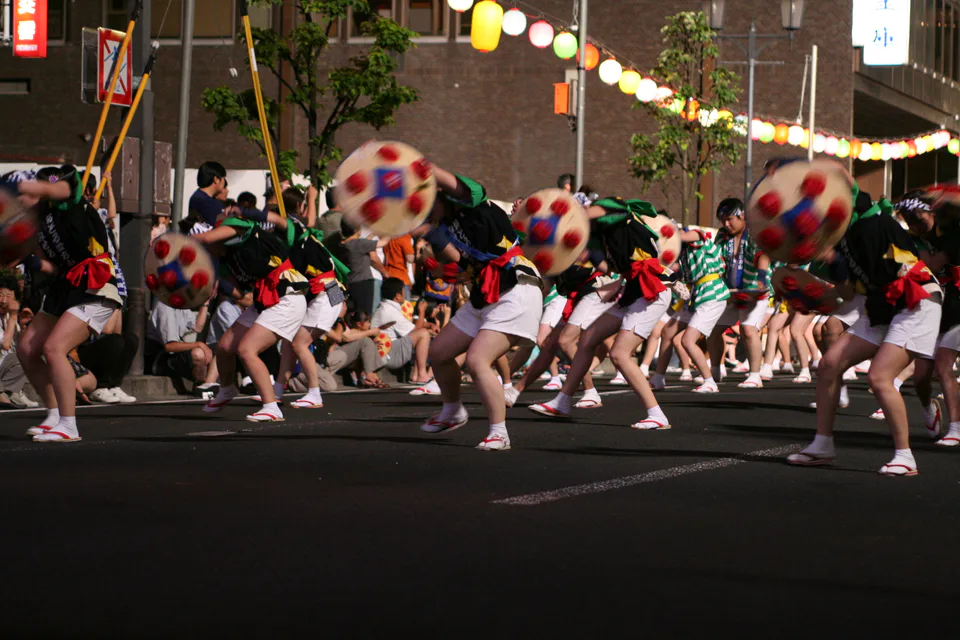
The 2026 Yamagata Hanagasa Festival is over, but it leaves a useful late-arrival rule: do not waste the remaining night trying to “start from the start.” The official route ran along Yamagata’s Main Street in this order — Tokamachi, Honmachi, Nanokamachi and Bunshokan — with the parade starting at 18:10 and ending around 21:45. If you arrived at 19:30 or 20:30, the rational goal was to intercept a workable part of that moving event and protect your remaining viewing time.
My default would be: around 18:30, you still have enough time to be selective; around 19:30, choose one convenient middle or northern section instead of backtracking; around 20:30, stop trying to “cover the route” at all. Exact group positions change with parade flow, so a clock time should decide your strategy, not pretend to predict which troupe will be standing at one exact intersection.
If your bigger question is whether paying for a fixed chair removes enough uncertainty, use the Yamagata reserved-seats vs free-viewing guide. Late arrival and seat choice are related, but they are not the same decision.
ValueNavi late-arrival table: what changes at 6:30, 7:30 and 8:30?
↔ Scroll table left or right
| Arrival time | Festival time left until about 21:45 | Best decision | What not to do |
|---|---|---|---|
| 18:30 | About 3 hr 15 min | You can still choose a southern or middle section, then move only if there is a clear reason | Walking the whole route just because it exists |
| 19:30 | About 2 hr 15 min | Prioritise the nearest useful viewing section and one sustained block of parade time | Going south purely to say you started at Tokamachi |
| 20:30 | About 1 hr 15 min | Choose one section that also makes your exit easy; watch for the final public-participation group if that interests you | Trying to recreate a three-hour itinerary in 75 minutes |
The remaining-time column is a ValueNavi calculation from the official 21:45 approximate finish, not a promise that every dancer remains on every part of the course until that minute. Its purpose is to show how quickly unnecessary walking becomes expensive.
The hidden cost of backtracking: 20 minutes matters much more at 8:30
Suppose walking to a “better” section costs 20 minutes once crowds, crossings and orientation are included. At 18:30, that uses about 10% of the 195 minutes left before 21:45. At 19:30, it uses about 15% of the 135 minutes left. At 20:30, it consumes roughly 27% of the entire remaining festival window.
↔ Scroll table left or right
| Arrival | Time left | If you spend 20 min repositioning | ValueNavi read |
|---|---|---|---|
| 18:30 | 195 min | ~10% lost | Moving can still be justified |
| 19:30 | 135 min | ~15% lost | Move only for a clear gain |
| 20:30 | 75 min | ~27% lost | Usually protect viewing time instead |
This is the core decision gap in most late-arrival advice. A route map tells you where the festival is; it does not tell you when completing the map becomes a bad use of the night.
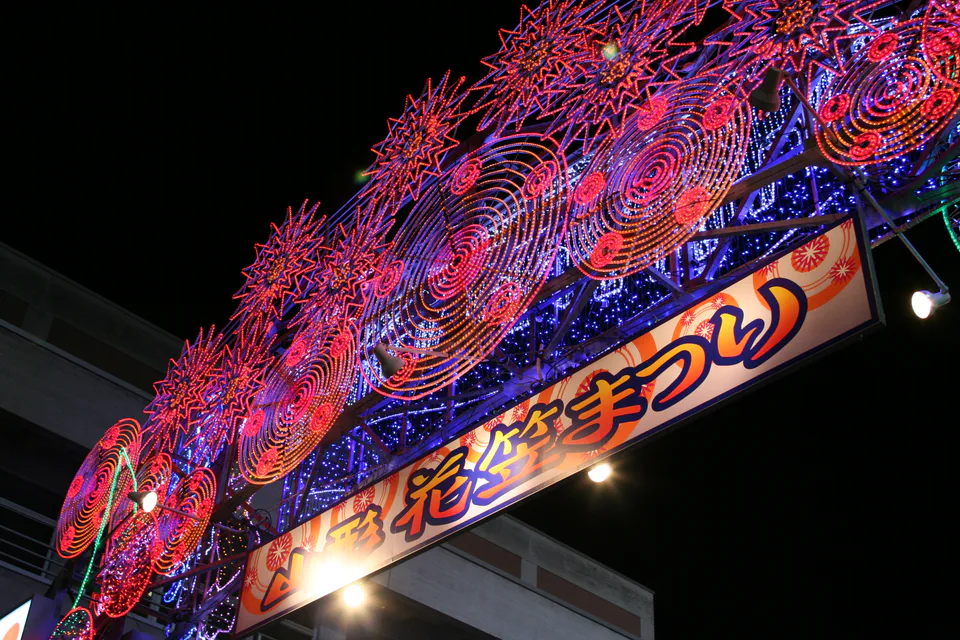
A late arrival should optimise remaining parade time, not attempt to reproduce an early-arrival route.
Around 6:30 PM: you are late to the start, not late to the festival
The parade officially starts at 18:10, so an 18:30 arrival still leaves more than three hours before the approximate 21:45 finish. This is the one late-arrival scenario where I would not over-optimise. If Tokamachi or Honmachi is convenient from where you enter, watching there can still make sense; if you are already closer to Nanokamachi, there is little benefit in walking backwards merely to reach the official route origin.
The exception is a traveller whose goal is route photography or seeing several different streets rather than maximising uninterrupted viewing. With 195 minutes left, some movement is affordable. For families, older travellers or anyone who finds standing tiring, however, a fixed section can be more valuable than geographic coverage.
Around 7:30 PM: stop chasing completeness
At 19:30, you still have a meaningful 2 hours 15 minutes before the scheduled finish, but the decision has changed. I would now choose the best viewing section near my current position or near my intended exit, rather than spend a large block of time walking south just to begin at Tokamachi.
This does not mean that one named intersection is guaranteed to have a specific parade group at 19:30. Parade spacing can vary. The useful fact is directional: the official course is a straight sequence from Tokamachi through Honmachi and Nanokamachi toward Bunshokan. A late visitor should use that structure to intercept the event rather than assume the start point remains the best place to join.
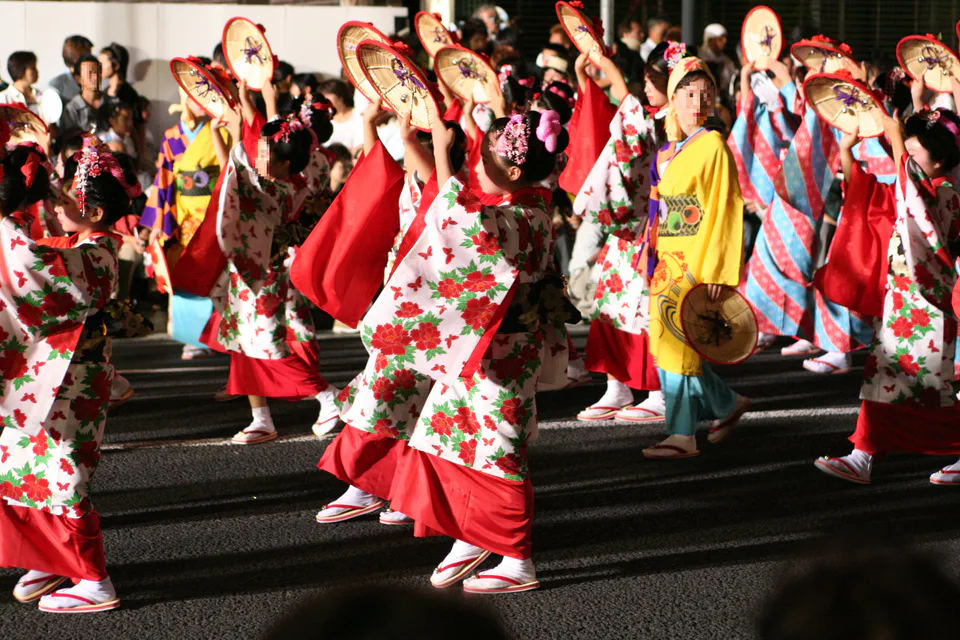
By the middle of the evening, a good fixed viewing block usually beats spending precious time chasing the nominal start.
Around 8:30 PM: make the final 75 minutes the whole plan
At about 20:30, the official programme adds something useful for late arrivals: the final public-participation group starts at the back of the parade. Visitors can join when they see the “jump into the parade” sign, and the official FAQ says participation can begin from anywhere along the course when that group reaches you.
That makes 20:30 a different kind of visit. If you want to dance, position yourself for the final participation opportunity rather than trying to see every part of the route first. If you only want to watch, pick one section and protect the remaining 75-minute window. Either way, I would treat the late arrival as a compressed experience by design, not as a failed full-length visit.
The important boundary condition is timing: “the jump-in group starts around 20:30” does not mean it instantly appears at every point on the 1.2 km course. You still need to watch the live parade flow and the sign rather than treating 20:30 as an appointment at one fixed street corner.
Bunshokan is useful as an endpoint, not a magic late-arrival pin
Bunshokan sits at the end of the official route sequence, so it is a natural reference point when thinking about the direction of travel. But I would not tell a 20:30 arrival to blindly rush there. Your best section depends on where you enter the route, where the parade flow is at that moment and where you need to go afterward.
If you are staying in the city centre and do not need to return quickly to Yamagata Station, finishing nearer the northern end can be convenient. If your priority is catching a train, a southern or more station-friendly exit may be worth sacrificing some route coverage. The “best viewing point” changes once your post-festival destination becomes time-sensitive.
Your exit plan matters more as the night gets later
The official festival information lists traffic restrictions from about 17:50 to 22:00, with release depending on parade progress, and says the venue is about a 10-minute walk from JR Yamagata Station’s East Exit. Those are useful planning anchors, but they do not mean every point on the long route is 10 minutes from the station.
For a late arrival, I would decide the exit before deciding the viewing point:
Train after the festival: bias toward a viewing area that does not require a long post-parade backtrack.
City-centre hotel: you can afford to use the northern half of the route more freely.
Dinner reservation: treat the restaurant location as the exit target; do not watch north and then discover your meal is south.
No fixed plan after: choose the best current sightline and stop optimising.
This is why the right late-arrival strategy is not “go to Bunshokan.” It is intercept the parade without creating a worse exit.
Rain makes route-chasing even less attractive
The official policy says the festival generally proceeds in rain, although the programme may change, while severe weather — including lightning — can cause cancellation. In wet conditions, the late-arrival rule becomes stronger: choose one useful section and reduce unnecessary movement.
I would not claim an exact rain-time penalty because crowd density, footwear and weather intensity vary. The decision principle is enough: if you already have only 75 or 135 minutes left, adding wet-street movement and repeated route crossings gives up a larger share of the experience than it does for someone who arrived before 18:00.
When the remaining time is short, reducing unnecessary walking matters more than completing the route.
My verdict: use an interception rule, not a fixed “best spot”
If I arrived at 18:30, I would still allow some movement because more than three hours remained. At 19:30, I would stop trying to complete the route and prioritise one strong viewing block. At 20:30, I would make a single section — or the public-participation finale — the entire plan and optimise the exit from there.
The strongest argument against this approach is that walking toward the start might give a better view of earlier groups. That can be true if the route is unusually open and your desired troupe is still accessible. But without real-time parade-position information, spending 20–30 minutes on a speculative chase is a poor default once the remaining window is only 75–135 minutes. The recommendation should reverse only when you have a specific reason to move, not because a map makes the start point look more official.
For a future edition, keep this logic but recheck the official start/end times, route, traffic controls and participation schedule. The festival is held annually August 5–7, but operational details can change.
Pair this with
Yamagata Hanagasa reserved seats vs free viewing — if certainty and sitting matter more than route flexibility.
Tohoku Summer Festival one-week itinerary — if late arrival is being caused by an over-tight intercity festival route.
Japan Summer Festivals Compared — if you are deciding which parade formats reward a fixed position versus movement.
References
Yamagata Hanagasa Festival — official English festival information, route order, schedule and participation times
Yamagata Hanagasa Festival — official schedule, access, weather policy and traffic-control information
Yamagata Hanagasa Festival — official FAQ on participation and weather