
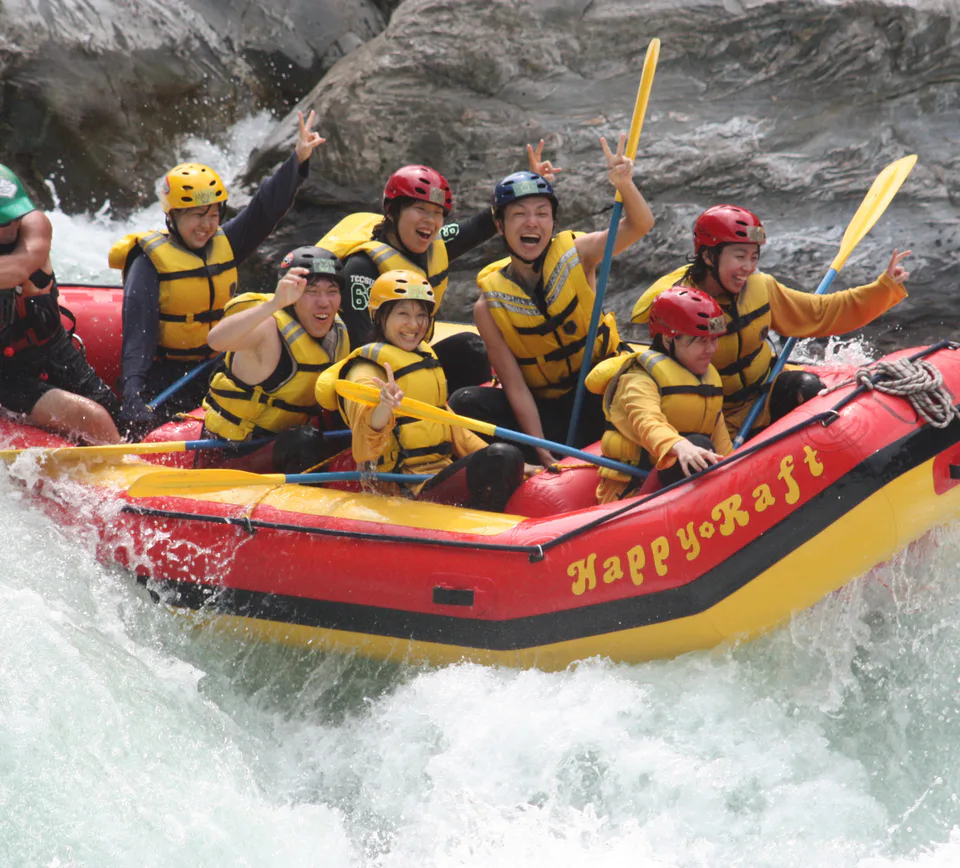
For a first Yoshino River rafting trip, choose Oboke Short when rafting must share the day with transport or sightseeing; choose Koboke Long when the white-water day itself is the reason you came. Using Happy Raft’s current 2026 products as a concrete comparison, Oboke Short is a 4 km half-day course rated 3/5 for intensity, while Koboke Long is a 9 km full-day course rated 4/5. Both accept participants from junior-high-school age, so “beginner” is not the decisive boundary. The real difference is how much river time, fatigue, schedule risk and trip time you want to commit.
The old version of this article described personal rafting sensations as though the author had completed the course. The repository does not contain evidence for that first-hand experience, so this rebuild removes those claims. The analysis below is based on current operator specifications, access information and the practical consequences of choosing a half-day versus full-day white-water product.
↔ Scroll table left or right
Your situation | Start with | Why | Main trade-off |
First rafting trip and you also want Oboke/Iya sightseeing | Oboke Short | About three hours door-to-door at the operator, leaving a usable half day | Less river time and fewer major rapids than Koboke Long |
First rafting trip, but rafting is the main purpose of the day | Koboke Long can still fit | The operator accepts first-timers from junior-high-school age and provides a full-day guided product | Roughly six hours, more fatigue and a bigger consequence if the day is disrupted |
You have younger children | Neither adult course | Happy Raft’s separate family products start from age three / 13 kg or elementary-school age depending on course | The gentler route is a different product, not simply a slower Oboke/Koboke departure |
One-night Shikoku transit stop with a fixed onward train | Oboke Short, usually | A half-day is easier to buffer around transport | Do not book the last possible connection; rafting finish time can move with river conditions and group pace |
You want the maximum white-water experience and are happy to dedicate the full day | Koboke Long | 9 km, about four hours on the river and 18 rapids on the operator’s current course description | Lunch, changing, transport and recovery make it a full-day commitment, not a “long half-day” |
Happy Raft official image. Route choice and operation can change with river conditions.
Oboke Short vs Koboke Long: compare the day you are buying, not only the rapids
Happy Raft’s 2026 Oboke Short tour currently covers 4 km. The operator describes roughly three hours from reception to finish, with about 1.5 hours on the river, four major rapids and around ten rapids in total. It rates the course 3/5 for intensity. Normal 2026 pricing is ¥8,000 (about US$50), rising to ¥8,500 (about US$53) on listed high-season dates and ¥9,000 (about US$56) during the August 13–15 Obon period; direct web bookings currently receive a ¥500 (about US$3) discount.
Koboke Long is a different scale: 9 km, roughly six hours from reception to finish, about four hours on the river, eight major rapids and 18 rapids in total. Happy Raft rates it 4/5. The normal 2026 price is ¥13,000 (about US$81), with listed high-season pricing of ¥13,500 (about US$84) and Obon pricing of ¥16,000 (about US$100); lunch is included and direct web bookings currently receive ¥500 (about US$3) off.
That creates a cleaner decision than “Oboke is for beginners and Koboke is for experts.” Oboke buys intensity per half-day; Koboke buys volume. A first-timer who actively wants a full white-water day can choose Koboke if the group meets the operator’s conditions. A repeat rafter can still choose Oboke when the itinerary only has half a day.
The most important question is whether rafting owns the day
Koboke Long currently meets at 09:45, starts around 10:00 and is scheduled to finish around 16:00. The operator warns that finishing can shift by roughly 30–60 minutes depending on river conditions and participant numbers. That means a 17:00 train, hotel dinner or long mountain drive should not be treated as a safe automatic continuation.
Oboke Short has morning and afternoon departures. Depending on the season, morning meeting is currently around 08:45 or 09:15, with scheduled finishes near noon or 12:30; the afternoon tour meets around 13:15 and normally finishes around 16:30. That flexibility is the strongest reason to choose it on a multi-purpose travel day.
ValueNavi planning rule: if the rafting tour is only one component of the day, buy the route with the bigger recovery margin. If rafting is the destination, choose the course you actually want rather than spending the full day protecting spare sightseeing time you will be too tired to use.
Do not use courage as the main route filter
Both Oboke Short and Koboke Long currently require participants to be junior-high-school age or older. Happy Raft’s general rafting page presents Oboke Short at intensity 3/5 and Koboke Long at 4/5, but the operator also explicitly says first-time participants can join the long course under its conditions.
So the useful filter is not “Who is brave?” It is:
Does everyone in the group meet the age and health requirements?
Does everyone genuinely want several hours of white water rather than simply agree with the most enthusiastic person?
Is the group comfortable following guide commands and being fully wet for a sustained period?
Does the rest of the day tolerate fatigue and a later-than-planned finish?
If one member is reluctant, downgrading the route can be a better group decision than spending the entire tour managing anxiety. If younger children are travelling, use the operator’s family courses rather than trying to make one of the adult courses fit. Its Otoyo family product currently starts from age three with a minimum body weight of 13 kg; the Oboke family product is aimed at elementary-school-age children.
The hidden family decision is that “Oboke” names more than one product
This is an easy booking mistake. Happy Raft sells an Oboke Short tour for junior-high-school age and above, but it also sells an Oboke Family product for elementary-school-age children on the same broad white-water section. It separately offers an Otoyo family course for younger children from age three / 13 kg.
Do not carry the price, intensity or participation conditions from one page to another simply because “Oboke” appears in the name. For families, choose by the youngest participant first, then compare the actual course.
Rain is not the cancellation rule; river conditions are
Happy Raft says ordinary rain does not automatically cancel rafting. The operator can change the course or cancel when weather or water level exceeds its safety standards, including severe typhoon-level conditions. If cancellation is likely, it may contact guests two or three days in advance and says it will notify by the previous day at the latest where possible, although a same-day safety decision can still happen.
When the operator cancels for weather, water level or disaster conditions, the tour fee is refunded. That is different from a traveller cancelling because the forecast looks unpleasant. Happy Raft’s current customer-cancellation schedule is 30% from seven to two days before, 50% the day before and 100% on the day.
The practical implication is important: do not self-cancel from a generic weather icon without checking the operator. But do keep the rest of the day flexible enough that a river-driven route change or cancellation does not destroy the entire Shikoku itinerary.
A late arrival is expensive because 30 minutes can become a cancellation
The access page warns that arriving more than 30 minutes after the meeting time can be treated as a same-day cancellation with a cancellation charge. This makes transport planning part of the activity, especially in a mountain area with less service frequency than central Osaka or Kyoto.
Happy Raft’s base is about a one- to two-minute walk from JR Tosa-Iwahara Station. Travellers who cannot reach Tosa-Iwahara can arrange pickup from neighbouring Oboke Station by notifying the operator of the arrival time. By car, the base is currently described as about 20 minutes from Otoyo IC and 45 minutes from Ikawa-Ikeda IC. Otoyo IC is ETC-only, which matters to rental-car drivers without ETC.
I would arrive in the Oboke area the night before for a morning Koboke Long booking if the alternative is a same-day long transfer from Osaka, Takamatsu or another distant city. The activity itself is already a six-hour block; adding a fragile early intercity journey gives the day two separate failure points.
For a short trip, where you sleep can matter more than ¥5,000 (about US$31) of tour-price difference
At normal 2026 rates, Happy Raft’s Koboke Long price is ¥5,000 (about US$31) above Oboke Short before the current web discount. But the larger trip cost can come from the itinerary around the tour.
Consider two patterns:
Oboke Short + same-day onward travel: lower tour price, less river time, but potentially avoids another hotel night.
Koboke Long + local overnight: higher tour price plus lodging, but buys the complete rafting day without compressing the return journey.
If the whole reason for travelling into the Yoshino valley is rafting, paying for the long course and a local night can be more coherent than saving on the tour but spending hours getting in and out on the same day. If rafting is one stop inside an Iya/Oboke sightseeing itinerary, the half-day product often integrates better.
What to wear: follow the operator, not a generic water-sports packing list
Happy Raft currently includes the rafting guide and core equipment such as wetsuit, helmet, spray jacket, life jacket, fleece and paddle in the tour price. The operator asks guests to bring a towel, swimwear or suitable underwear for under the wetsuit, and wettable footwear such as athletic shoes or secured sandals. Crocs are not accepted. Footwear rental is currently ¥300 (about US$2).
It specifically warns that cotton becomes cold when wet, so a quick-dry layer is the safer choice. Glasses should use a strap or be replaced with suitable contact lenses where appropriate. The operator also discourages carrying personal phones and cameras because of loss, damage and injury risk; guide-shot photo/video packages are sold separately.
This is another reason to avoid invented “essential gear” lists. The correct clothing depends on what the operator supplies in the season.
The safety briefing matters, but this article should not invent rescue instructions
The previous version attempted to tell readers exactly how to position their bodies after falling from a raft. That is not appropriate to improvise from an editorial desk. River conditions, guide commands and the specific rescue procedure matter, and the operator’s on-site safety briefing should take priority.
The useful planning advice is simpler: arrive early enough to hear the entire briefing, disclose relevant health concerns before booking, do not participate while intoxicated or hungover, and follow the guide’s instructions during the tour. Happy Raft currently says intoxicated or hungover guests can be refused participation with a 100% cancellation charge.
If a medical condition, injury or fitness concern could affect participation, contact the operator before paying rather than assuming a generic rafting guide can clear the activity.
Half-day vs full-day: use the opportunity-cost test
Choose Oboke Short when the half day you save already has a valuable job: Iya Valley sightseeing, a hotel transfer, an onsen, or simply a safer travel buffer. Choose Koboke Long when the saved half day would only become low-value filler and the river is the reason for the trip.
That test prevents two common mistakes:
booking Koboke because “more rafting must be better,” then resenting the loss of the rest of the day;
booking Oboke to preserve sightseeing time, then discovering the group had travelled to Shikoku specifically for white water and would have preferred the longer river experience.
Three realistic trip patterns
First-timer road trip: Oboke Short + Iya / onsen
Use the morning or afternoon short tour, then leave a real buffer before the next activity. This is the strongest version when rafting is one of several Shikoku experiences and you have a rental car.
Rafting-first weekend: local night + Koboke Long
Sleep near Oboke/Otoyo, join the 09:45 meeting without an early-city transfer, give the river the full day and keep the evening light. This is the cleanest use of the long course.
Family with a child below junior-high-school age: stop comparing these two
Move to Happy Raft’s age-appropriate family products. The adult Oboke/Koboke decision is no longer the right search problem.
Final verdict
For most first-time travellers building a wider Shikoku itinerary, Oboke Short is the lower-risk default because it gives a genuine white-water experience without consuming the whole day. But it is not automatically the “beginner course.” If everyone is junior-high-school age or older, healthy enough for the activity and actively wants rafting to own the day, Koboke Long is a legitimate first-time choice and buys more than double the river time plus the longer white-water section.
The answer reverses when your itinerary does. Choose Oboke for flexibility; choose Koboke for immersion. If children are too young for either, use the family course. And if weather or river conditions make the operator change the plan, treat that as a safety decision rather than a failed itinerary.
Related guides
Japan Rainy-Day Itinerary Backup Guide · Japan Luggage Forwarding Guide · Naoshima E-Bike Day Route
References
Happy Raft — Oboke Short Rafting Tour · Happy Raft — Koboke Long Rafting Tour · Happy Raft — Family Rafting · Happy Raft — Access · Happy Raft — FAQ. Checked August 26, 2026. USD conversions are approximate at roughly ¥160 per US$1. Tour prices, departure times, water-level decisions and route operation can change; verify the live booking page before travel.