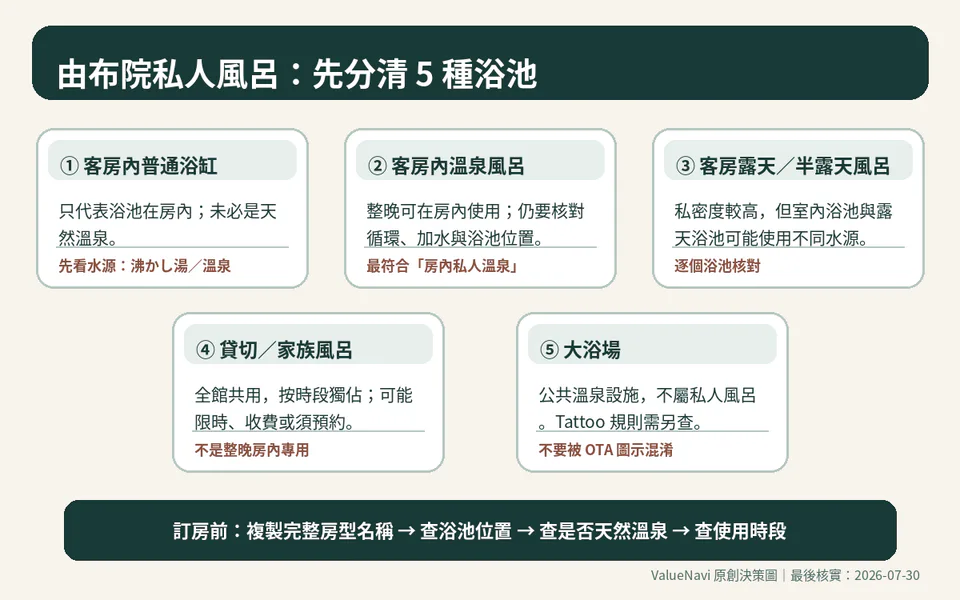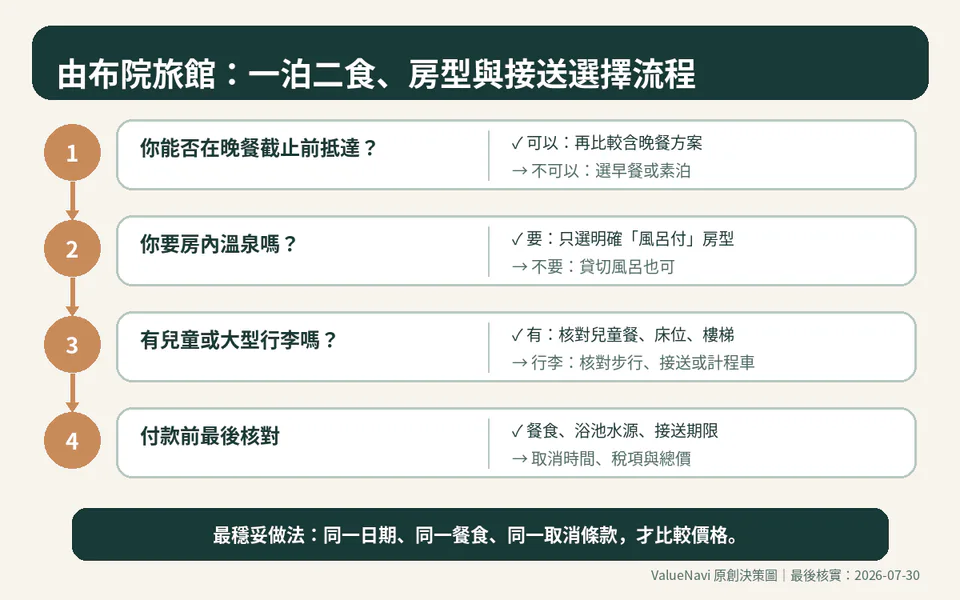
Do not start a Yufuin ryokan search with the hotel name. Start with the bath you actually want. If you want a natural hot spring inside your room that you can use whenever you like, eliminate any room that offers only a reservable family bath, an ordinary ensuite tub or access to a communal onsen. Then check dinner arrival, the last mile from Yufuin Station and every child in the booking. Only after those constraints match should price decide the winner.
This matters because “private bath” is not a standard product. At Yufuin Iyotomi, the property’s hot-spring baths can be used privately, but many guest rooms do not have an in-room bath at all. At Mori no Yu Yufuin Yasuha, some named rooms include the private blue hot spring while other rooms do not. At Yufuin Bettei Itsuki, every independent cottage has its own exclusive natural hot spring. At Yufuin Hanayoshi, even a room with both an indoor bath and an open-air bath can use different water sources. The complete room name matters more than the hotel badge.
↔ Scroll table left or right
Your real requirement | Start with | Main reason | What can make it wrong |
Private natural hot spring inside the room, guaranteed at property level | Yufuin Bettei Itsuki | All 14 independent cottages have an exclusive hot spring | Higher spend, taxi-oriented last mile and an 18:00 last check-in |
The distinctive Yasuha blue spring in your own room | Yasuha — only a named bath-equipped room | The property sells both private-hot-spring and no-private-hot-spring room types | Booking the wrong room name or missing the pre-booked 15:00–17:00 transfer |
Private bathing without paying for an in-room-onsen cottage | Yufuin Iyotomi | Its five hot-spring baths are private-use and it is about seven minutes on foot from the station | The bath is outside the room; some rooms also have shared wash/toilet facilities |
Family/group room plus private open-air bath and mountain setting | Yufuin Hanayoshi — exact room required | Many detached room categories have private open-air baths and larger layouts | Hills, stairs, fixed shuttle window and room-by-room bath differences |
Arrival after about 18:00 | Reconsider the ryokan night | Dinner, pickup and final check-in are the fragile parts of a Yufuin stay | A station-side room-only stay may be safer; Beppu may fit the route better |
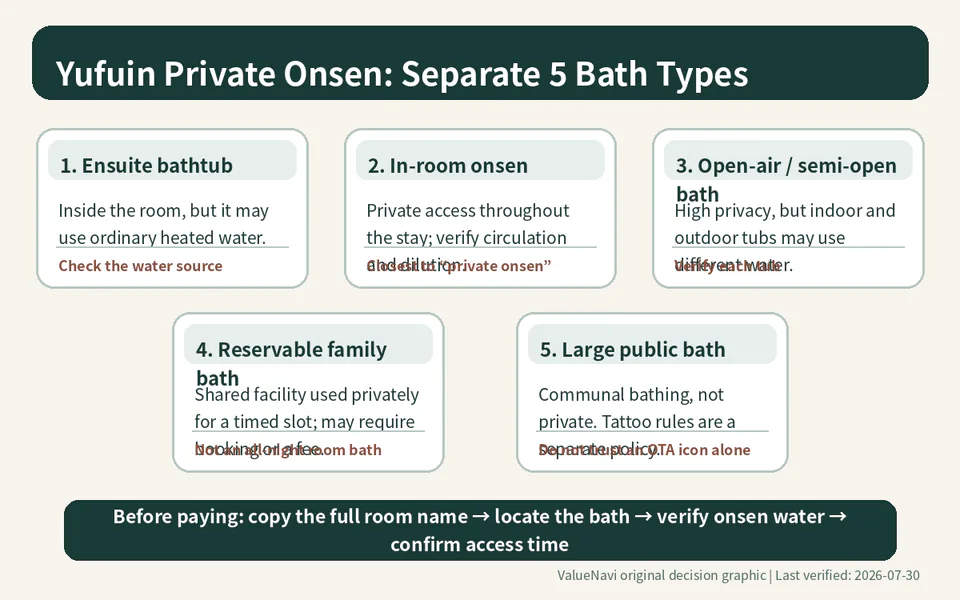
Private bathing is a category, not one product. Verify bath location, water source and access rules on the exact room.
First decide which version of “private onsen” you mean
There are four materially different products hiding behind similar booking-page language.
Exclusive natural hot spring inside your room: the strongest privacy product. You can normally bathe on your own schedule without competing for a time slot. Bettei Itsuki is the cleanest example because every cottage has an exclusive hot spring.
Only selected room categories have a private hot spring: the property may be famous for its water, but the cheapest room can still be a different product. Yasuha is the important example: its official room list includes both bath-equipped rooms and rooms without a private hot spring.
Private-use bath elsewhere in the property: you still bathe privately, but you leave the room and may have to wait or reserve. Iyotomi’s five hot-spring baths are private-use; that does not mean every room contains an onsen.
A room has more than one bath, but not every bath uses hot-spring water: Hanayoshi’s Detached Room A, for example, currently lists an indoor heated-water bath and a separate open-air bath using circulating hot-spring water. “Room with bath” is therefore not enough information.
This distinction should come before price. If your reason for paying more is privacy, an ordinary room with one 40- or 50-minute private-bath slot is not interchangeable with an in-room hot spring you can use after check-in, after dinner and again before breakfast.
Use a private-bath session test before paying the room premium
There is no universal yen amount that makes an in-room onsen worth it. Room rates move too much by date, meals and cancellation terms. A more useful calculation is:
private-bath premium ÷ realistic number of private bathing sessions = cost per usable session.
If you arrive at 17:30, rush into dinner, bathe once and leave early the next morning, a large room-category premium is concentrated into one session. If you check in around 15:00, bathe before dinner, again later in the evening and once more after breakfast, the same price gap buys three distinct uses. The private bath also becomes more valuable when one guest avoids communal bathing, a child’s schedule keeps the family in the room, or the group wants to bathe at different times.
Do not count imaginary sessions. If your itinerary keeps you on Yunotsubo Kaido until closing, sends you out for dinner and starts the next morning with an early train, the room onsen may receive far less use than the booking page suggests.
Dinner is a hard deadline, not a free extra attached to the room
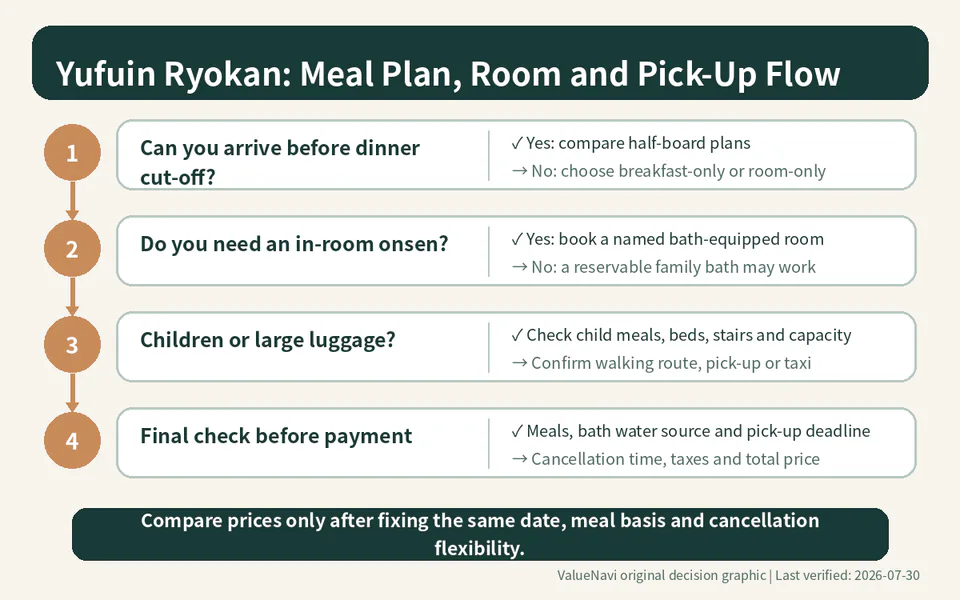
Half-board is one of the strongest reasons to sleep in Yufuin, but it also makes the night less flexible. The best ryokan booking can become the worst one if the train arrives after the property’s useful check-in and dinner window.
Current official information makes the boundary visible. Yasuha lists a final check-in of 18:00. Bettei Itsuki also lists 18:00 as the last check-in. Hanayoshi asks guests to contact the property when arrival will be after 18:00, and its station shuttle only operates for pre-booked pickups between 15:00 and 17:00. These are property rules, not a town-wide Yufuin cutoff, but they show why a luxury ryokan night should normally begin in the afternoon rather than after a full sightseeing day somewhere else.
If your transport is uncertain, compare the damage from being late. Missing one city restaurant is inconvenient. Missing the dinner, the hotel pickup and the relaxed pre-dinner bath can erase a large share of what made an expensive Yufuin room worth booking.
For a late arrival, I would rather use a simple station-side stay or rethink whether Beppu is the better night than turn a time-sensitive Yufuin ryokan into a midnight transit hotel.
Eliminate the wrong room and arrival pattern before comparing prices.
Large luggage creates a 15:00 problem most hotel lists do not mention
Yufuin’s official baggage service, Yufuin Chikki, is extremely useful—but it is not a 24-hour rescue system. The current service accepts baggage for delivery from the tourist information centre to participating ryokan from 09:00 to 15:00. Temporary baggage storage runs from 09:00 to 17:00. Delivery is limited to participating accommodation in the Yufuin Onsen Tourist Association network, and the eligible-property list can change.
That creates a real failure mode. If you arrive at 16:30 with two 29-inch suitcases and only then discover that the hillside ryokan is not a sensible walk, same-day Chikki delivery is no longer the obvious fix. You need the hotel’s pre-booked pickup, a taxi or another luggage plan.
For a no-car trip, solve the last mile before paying:
Walkable: Iyotomi is about seven minutes on foot from Yufuin Station and the bus centre.
Taxi-oriented: Bettei Itsuki is about a 20-minute walk; the hotel itself recommends a taxi and currently provides round-trip taxi tickets for staying guests.
Reserved pickup: Yasuha’s free station transfer runs in half-hour slots from 15:00 to 17:00 and must be requested by the previous day.
Reserved hillside shuttle: Hanayoshi also requires advance reservation for its 15:00–17:00 station pickup; after 17:00 it tells guests to use a taxi.
The important question is not “Does the ryokan have a shuttle?” It is “Does the shuttle exist at the time my train arrives, and what is Plan B if I miss it?”
Yufuin Iyotomi: best when private bathing matters more than having the bath inside the room
Iyotomi is the strongest counterexample to the idea that privacy automatically requires an expensive in-room bath. Its official hot-spring information says all five baths are used privately by guests. The open-air bath currently operates from 06:00 to 23:00, while the indoor baths are available around the clock.
But the room inventory is deliberately mixed. The official room list includes rooms with semi-open or indoor baths, rooms with toilets but no bath, and lower-cost rooms with shared washbasin and toilet facilities. That makes Iyotomi a good value only when you are comfortable separating private bathing from private bathroom inside the room.
Choose it when: you are travelling without a car, want a short station walk, will happily use private-use baths elsewhere in the ryokan, and would rather spend less on the room category.
Avoid or upgrade when: you require a bathroom inside the room, dislike waiting for a shared private bath to become free, or need a modern large-room layout for several suitcases.
The useful booking move is to inspect the room line by line. “Yufuin Iyotomi” does not define the bathroom; the room name does.
Yasuha: book the room name, not the reputation of the blue spring
Mori no Yu Yufuin Yasuha is known for its unusual blue hot spring, but the official room list shows why property-level reputation can mislead a booking. It sells detached and main-building rooms with private hot springs, but it also sells rooms without a private hot spring. A traveller who selects the cheapest available room can therefore book “the blue-onsen ryokan” without buying the in-room blue-onsen experience they imagined.
Yasuha is also a last-mile product. Its current FAQ says the property is about five minutes by car from Yufuin Station but roughly 25 minutes on foot with an uphill section. The free pickup runs between 15:00 and 17:00 in 30-minute slots, has limited capacity and must be requested by the previous day. The current basic information lists 18:00 as final check-in.
Choose it when: the blue spring itself is a reason for the stay, you can secure a named bath-equipped room, and you will arrive early enough to use the transfer and the property.
Avoid it when: you are booking quickly from a thumbnail, your train arrival is close to 18:00, or your group assumes every room has the same bathing arrangement.
One additional accessibility detail matters: Yasuha notes that some detached-room routes contain steps and level changes, while one main-building bath-equipped room is described as stair-free on the path to the bath. For older travellers, exact room geometry can matter more than detached-villa atmosphere.
Bettei Itsuki: the cleanest answer when the private hot spring must be guaranteed
Bettei Itsuki removes one major uncertainty: its official room information says all 14 independent cottages have an exclusive hot spring. Capacities and layouts still differ—some rooms are for one or two guests, others take up to four—but the property-level product is much clearer than at a mixed-inventory ryokan.
That is what the premium buys: not merely a prettier room, but lower booking ambiguity. You are not trying to work out whether the private bath belongs to the room or whether you need to reserve a shared slot after arrival.
The trade-off is location and timing. The property is about a 20-minute walk from Yufuin Station, and its own access page recommends a taxi; it currently provides round-trip taxi tickets to staying guests. Check-in is from 15:00 with an 18:00 last check-in.
Choose it when: privacy is non-negotiable, an anniversary or special stay justifies more hotel time, and you plan to arrive early enough to use the cottage rather than only sleep in it.
Avoid it when: the trip is built around a late arrival, early departure or a sightseeing schedule that leaves almost no awake time in the cottage. In those cases, you can pay for private-hot-spring certainty and barely use it.
Hanayoshi: excellent for room-and-view time, but the hillside and bath source must be part of the decision
Yufuin Hanayoshi has many detached room categories with private open-air baths, larger layouts and views. That makes it attractive for couples, families and groups who want the room itself to be part of the stay. It also makes the room list easy to oversimplify.
The official room page provides an important example. Detached Room A is about 45 m² and lists an indoor bath using heated water plus a separate open-air bath using circulating hot-spring water. Several other detached rooms use the same distinction. If “natural onsen in the room” is your requirement, do not stop at the word bath—check which tub uses what water.
The property is also on a hillside. Its free Yufuin Station shuttle is fully reservation-only, with pickup between 15:00 and 17:00. The FAQ says guests arriving after 17:00 should take a taxi, and asks guests to contact the property if arrival will be after 18:00. Some room routes are explicitly marked as having slopes or stairs.
Choose it when: you want a larger private-bath room, view and hotel time, can pre-book the shuttle or taxi, and the exact room works for the group.
Avoid it when: someone has significant mobility concerns, the arrival is late or the room is being chosen from an OTA icon without checking the actual bath description.
Families should book the child before they book the ryokan
Japanese ryokan pricing can separate adults, primary-school children, younger children with meals and bedding, children with only meals, children with only bedding and infants sharing existing bedding. The exact categories vary by property and plan.
That means the family decision starts in the booking engine, not with a “family friendly” badge. Enter every child with the correct age and compare the resulting room choices. A room that physically appears large enough may have a lower legal or plan-specific occupancy. A child rate can also change the dinner and futon arrangement enough to alter the total cost materially.
For a family, I would prioritise in this order: legal occupancy → true sleeping layout → bath safety → slopes/stairs → dinner timing → price. A private open-air bath is not a benefit if supervising it becomes the hardest part of the stay.
Tattooed travellers: private bathing can reduce the problem, but do not invent a policy
An exclusive in-room bath can make a ryokan much easier for a tattooed traveller because it may remove the need to use a communal bath. But it does not prove the property has no tattoo-related rules elsewhere, and a reservable family bath does not automatically tell you what the public bath permits.
For the ryokan compared here, public English-language tattoo guidance is not consistently detailed enough to make a blanket claim. If this affects the booking, ask the property in writing about three things separately: the in-room bath, any reservable private bath and the communal bath. Save the reply. Do not rely on a review written under an older policy.
The cheapest room is often cheap because it deletes the feature you were searching for
Compare like with like. A room-only twin with shared facilities should not be compared directly with a detached cottage that includes a private natural hot spring and dinner. Break the total into components:
room and sleeping layout;
private-bath type and water source;
dinner and breakfast;
taxes and bathing tax;
taxi, shuttle or Chikki cost;
cancellation flexibility.
The real value question is not “Which ryokan is cheapest?” It is “What is the cheapest booking that still guarantees the product I actually want?”
This is also where the private-bath session test helps. If a ¥20,000 room-category premium buys one likely soak, you are assigning almost the entire premium to one session. If it buys three or four realistic private-bath windows plus extra room space and privacy, the same price gap can be easier to justify. Use your live rate difference; do not copy somebody else’s threshold.
Four common booking failures that can ruin a one-night Yufuin stay
Booking the right ryokan but the wrong room: the hotel is famous for private onsen, but the selected room has no private hot spring.
Arriving after the transfer and dinner window: the room is excellent, but the night loses the meal, pre-dinner bath and easy pickup that justified the premium.
Assuming Chikki will fix luggage after arrival: ryokan delivery currently closes at 15:00 and only serves eligible participating accommodation.
Comparing headline rates with different products: room-only/shared-bath and half-board/in-room-onsen rates look like the same “Yufuin hotel price” when they are not remotely equivalent.
Who should choose which Yufuin ryokan product?
First visit, no car, one large suitcase each: start with Iyotomi if private-use baths are sufficient. If in-room onsen is mandatory, pick the room first at Yasuha or another bath-equipped property, then solve taxi/pickup before payment.
Anniversary or privacy-first couple: Bettei Itsuki is the cleanest of these examples because exclusive hot-spring bathing is built into every cottage. It only makes sense if you protect enough afternoon, evening and morning hotel time to use what you paid for.
Family or group that wants a larger room and private open-air bath: Hanayoshi can fit well, but room capacity, bath source, slopes and pickup all need room-level checking. Do not buy the property name and assume every building works the same way.
Blue-spring priority: Yasuha, but only after confirming a named private-hot-spring room. The hotel’s reputation does not override its mixed room inventory.
Late arrival after a long travel day: avoid making a remote half-board ryokan the most fragile link in the itinerary. A station-side stay—or Beppu—can be the more rational night.
Seven checks before you pay
What is the complete room name?
Is the private bath inside the room or elsewhere in the property?
Does that exact bath use natural hot-spring water?
What is the latest realistic arrival for dinner and check-in?
How will you move from Yufuin Station with your largest luggage if the shuttle is missed?
Are every child’s age, meal and bedding arrangements correctly entered?
What cancellation deadline applies to this exact room and meal plan?
If any of the first five answers is unclear, the booking is not ready. A cheaper price does not fix an undefined product.
Final verdict: eliminate by bath, arrival and last mile—then compare price
For a Yufuin ryokan with private onsen, the strongest default is not one hotel. It is an elimination order. First decide whether you need an in-room natural hot spring or simply private bathing. Then eliminate plans whose dinner/check-in timing does not fit your arrival. Then eliminate properties whose station transfer is fragile with your luggage. Then check children, mobility and tattoo requirements. Price comes last.
Among the representative options here, Iyotomi is the value-oriented private-bathing answer near the station; Yasuha is the room-name-sensitive blue-spring choice; Bettei Itsuki is the clearest privacy guarantee because every cottage has an exclusive hot spring; and Hanayoshi is the larger hillside room-and-view product where shuttle timing and exact bath source matter.
The best Yufuin ryokan is the one that still delivers the bath, meal and arrival experience you wanted after the train is late, the suitcases are full-size and the booking page stops showing you marketing labels.
Compare Yufuin stays after fixing your bath and arrival requirements
References and verification date
Yufuin Iyotomi — official hot-spring information · Yufuin Iyotomi — official rooms · Mori no Yu Yufuin Yasuha — official rooms · Yasuha — official transfer FAQ · Yufuin Bettei Itsuki — official cottages · Bettei Itsuki — official access · Yufuin Hanayoshi — official rooms · Hanayoshi — official transfer information · YUFUINFO — Yufuin Chikki baggage storage and ryokan delivery. Checked August 25, 2026. Room inventory, meal plans, pickup times, child rules and cancellation conditions can change; verify the exact booking page before payment.
Where to Stay in Fukui: Keep the Dinosaur Museum and Eiheiji Near the Rails, or Sleep in Awara Onsen
Where to Stay Near Nyuto Onsen: Inside the Onsen Village or Lake Tazawa?
Where to Stay in Osaka With Parents: Cut Transfers Before You Pay for More Luxury