
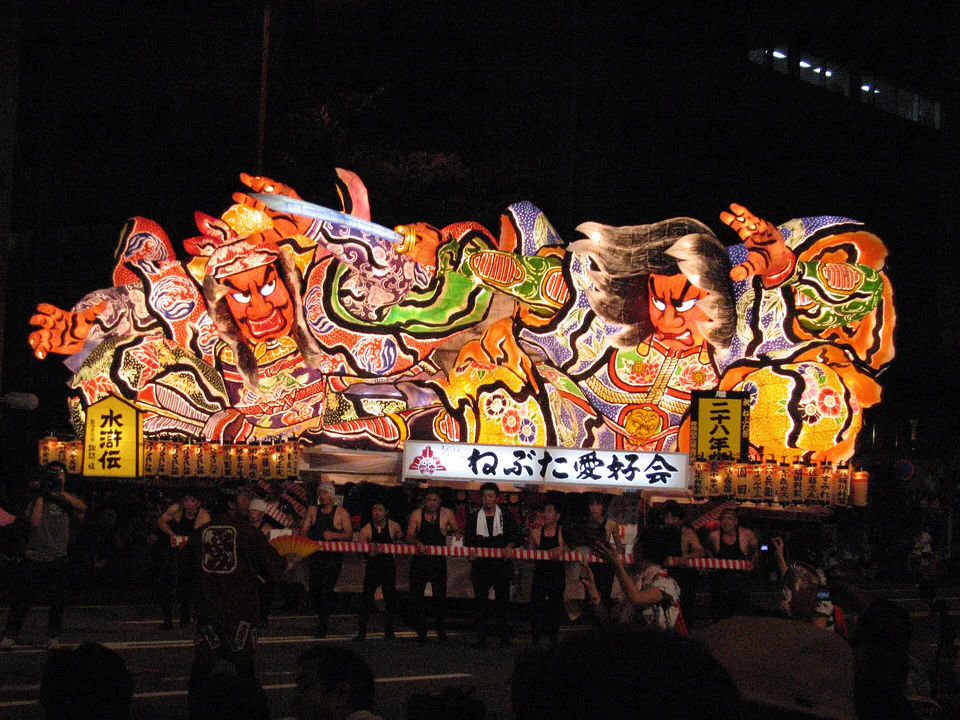
Aomori Nebuta 2026 is over. The reusable lesson is that a reserved seat was not simply the “better view” option and free viewing was not simply the “budget” option. The paid product bought a guaranteed place to sit and reduced the need to spend the afternoon protecting a roadside position. Free viewing bought mobility, an easier early exit and zero ticket sunk cost.
For overseas visitors, the real 2026 price was also materially higher than the JPY 4,000 face value: the official channel added JPY 1,000 per ticket plus a JPY 950 transaction fee per order. A couple paid JPY 10,950 for two seats; a family/group of four paid JPY 20,950. That party-level total is the number that should be compared with the physical cost of standing and waiting.
↔ Scroll table left or right
Your constraint | 2026 better fit | What you were really buying |
Need reliable sitting for most of the parade | Reserved seat | Endurance certainty, not a guaranteed front row |
Wheelchair user | Dedicated wheelchair seating first | Accessibility inventory and companion rules sit above the normal paid-vs-free comparison |
Fit solo traveller / couple who can stand and move | Free viewing | Mobility and no sunk ticket cost |
Young child may need to leave early | Free viewing near a clean exit can win | The family does not feel forced to stay because four seats were prepaid |
Stroller is essential | Replan before choosing the seat | The organiser does not recommend stroller arrival because reserved-seat areas are very crowded and lack spare stroller space |
Older traveller or child who needs sitting breaks | Reserved seat gets stronger | One person's standing limit can determine the whole group's usable festival time |
Two festival nights | Mix the modes | One stable seated night + one mobile/participatory night usually creates more contrast |
The overseas checkout total changed the paid-vs-free decision
The official overseas sales page for August 2–6, 2026 listed JPY 4,000 per reserved seat, a JPY 1,000 service fee per ticket and a JPY 950 transaction fee per order. The official page also required physical ticket pickup from a 7-Eleven in Japan before entry.
↔ Scroll table left or right
Paid seats in one overseas order | Face value | Service fees | Order fee | 2026 total |
1 | JPY 4,000 | JPY 1,000 | JPY 950 | JPY 5,950 |
2 | JPY 8,000 | JPY 2,000 | JPY 950 | JPY 10,950 |
3 | JPY 12,000 | JPY 3,000 | JPY 950 | JPY 15,950 |
4 | JPY 16,000 | JPY 4,000 | JPY 950 | JPY 20,950 |
This is a derived calculation from the official 2026 fee structure. It shows why “only JPY 4,000” was a misleading way to discuss the family decision. Four reserved seats did not cost JPY 16,000 through the overseas channel; they cost JPY 20,950 before hotel, transport or any other festival spending.
The next edition can change the platform, fees and pickup procedure. Keep the method, not the 2026 totals.
Reserved seats bought afternoon time as well as a chair
A free roadside position can cost JPY 0 and still be expensive if the group spends a large part of the afternoon protecting it. The reserved product competed against that time cost.
For a future trip, compare:
reserved-seat checkout total for the whole party
versus
waiting time + standing cost + sightline uncertainty + exit flexibility
A solo traveller may reasonably prefer to save the money and accept uncertainty. A family of four faces a much larger checkout total, but one child or older relative who cannot stand comfortably can make a chair valuable to everyone. The correct answer depends on which resource is scarcer: money, afternoon time or physical endurance.
Wheelchair accessibility is a separate ticket product, not a normal seat upgrade
In 2026 the festival operated dedicated wheelchair viewing spaces in front of Aomori City Hall. The official Japanese page priced the wheelchair user at JPY 3,200 and accompanying guests at JPY 4,000, with up to two companions per wheelchair user. A pipe chair was provided for companions.
The overseas English page used a different operational instruction: wheelchair visitors buying through that route were told to contact the organiser at least two days before the visit. That source difference matters. Do not assume a normal JPY 4,000 overseas seat automatically converts into an accessible position at the gate.
Future decision rule: accessibility comes before the free-vs-reserved price comparison. Check the current dedicated-space sale, companion limit and overseas contact procedure first. If a party has three or more companions, the 2026 FAQ said the extra person would need to stand behind the wheelchair area or buy a separate general seat. That can split a family group and should be solved before payment.
Do not pay for a front row that the ticket never promised
The official 2026 individual-seat page says seats were assigned; there were no unreserved paid seats. The overseas page likewise described numbered reserved seating. Paying therefore bought a defined place, not the right to choose the perfect row or photographic angle.
This matters because “better view” is too vague to justify a JPY 20,950 family checkout. The defensible paid-seat case is much more concrete: everyone knows where they will sit, nobody has to protect a free spot for hours, and the group can spend more of the pre-parade day elsewhere.
Free viewing was a flexibility product
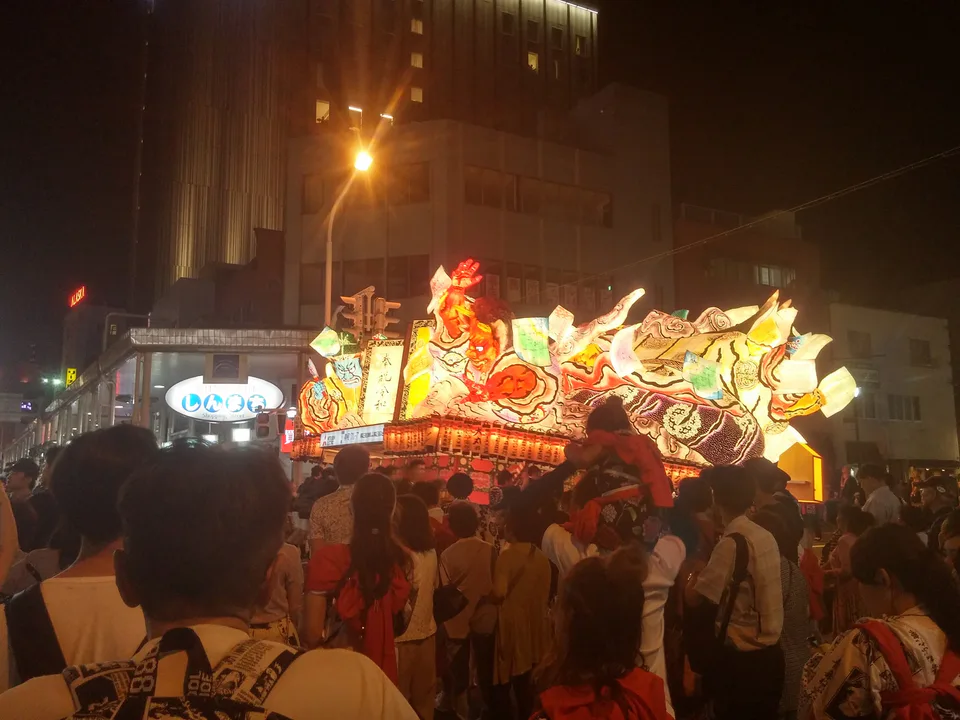
Nebuta floats circulate on a central-Aomori route rather than appearing on one fixed stage. Free roadside viewing let a visitor change position, leave early or choose an exit direction that matched the hotel or station.
That makes free viewing especially strong for a fit solo traveller, photographer or repeat visitor. Its weakness is variable sightline and standing/waiting. The legal position you find may be second row or partly obstructed.
Do not build a future trip around a permanent “best free pin.” Barriers, reserved-seat placement and crowd-control operations can change. Use a more durable rule: choose the exit direction first, then optimise the view inside the current legal viewing area.
Families should compare the cost of an early exit—and the stroller problem
In 2026, very young children could use an adult's lap under the published rule; a dedicated seat required a normal ticket. But the bigger family question is not the child discount. It is whether the child is likely to remain happy for enough of the parade to use the seat.
If a predictable bedtime or sensory overload means the family may leave after a short block, free viewing near an easy exit can be the more rational choice. If the child can stay for most of the night but needs sitting breaks, reserved seating gets stronger.
The organiser's 2026 FAQ adds a harder operational warning: because the festival is extremely crowded and there is little space around reserved viewing areas, it does not recommend arriving with a stroller. Staff do not provide stroller management or storage. For a family whose child genuinely needs a stroller, this is not a minor convenience issue; it can change the whole evening plan.
The sunk-cost test is simple: if you had paid JPY 20,950 for four seats and the child wanted to leave early, would the ticket price pressure you to stay longer than is good for the family? If yes, the “certainty” product may actually reduce flexibility too much.
Sold out in June or July did not necessarily mean “no paid seat is possible”
The 2026 individual-seat programme had advance sales, but the organiser also planned same-day tickets when final seat adjustments created availability. If same-day sales were offered, the festival said it would announce them on the homepage by 15:00; sales then started at 17:00 at the festival information shop in front of Aomori City Hall, cash only.
This was a recovery option, not something to build a long-haul trip around. The organiser could not tell buyers the seat location in advance, and same-day inventory existed only if seats became available. But it matters for the decision framework: a traveller who missed advance sales did not need to jump immediately from “sold out” to paying a reseller or abandoning the festival. The rational order was check official same-day announcement → if no seat, use legal free viewing.
Carry the method forward, not the 15:00/17:00 times. Future editions can change the same-day procedure.
Reserved seats did not remove rain risk
The 2026 official seat information stated that the viewing areas were uncovered. A paid seat solved sitting, not weather.
That distinction matters because travellers can otherwise pay for the wrong benefit. If rain tolerance is the hard constraint, the question is not only “free or reserved?” It is whether the event is operating, what rain gear is permitted and whether the group is willing to remain outdoors.
August 7 was a different product
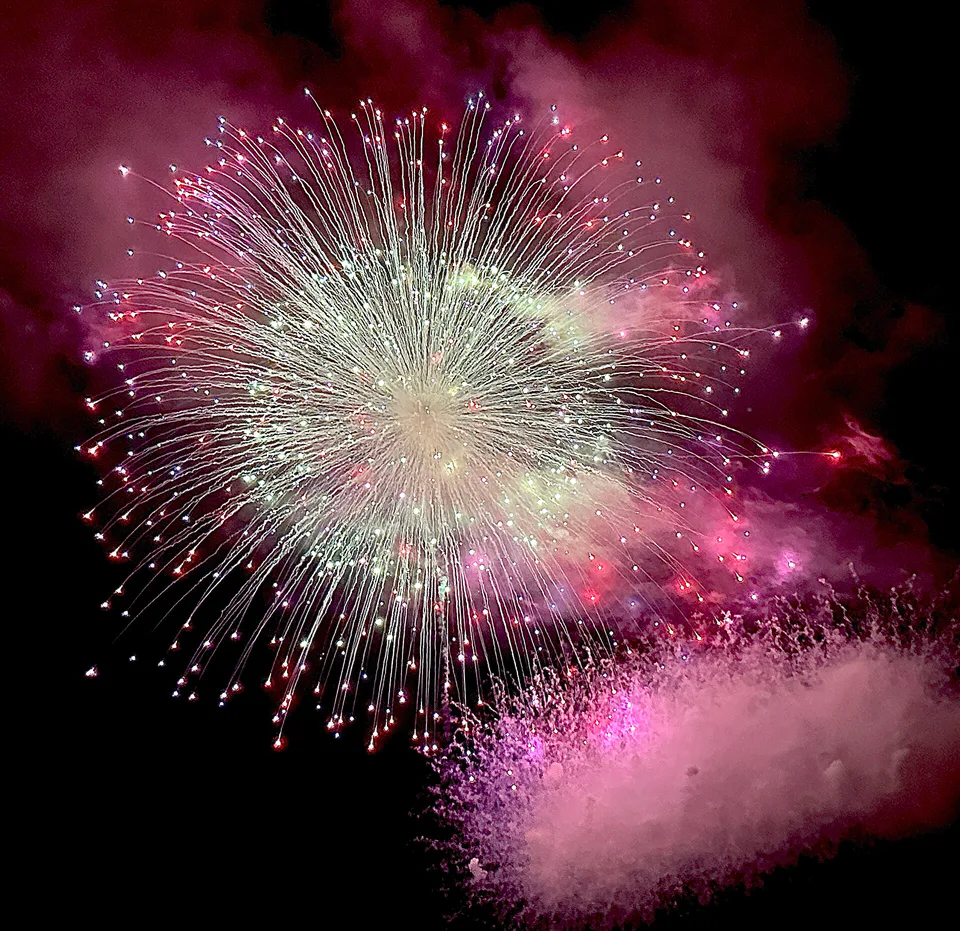
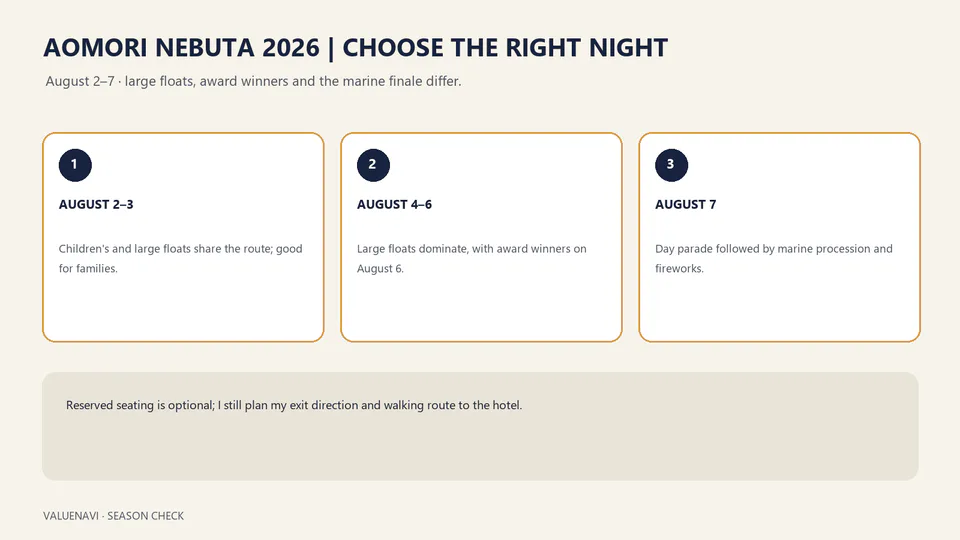
The overseas 2026 guide listed August 7 as a 13:00 daytime parade followed by the marine procession and fireworks from 19:15, and it explicitly noted that a ticket was not needed for the daytime parade because it was usually less crowded. Separate paid products existed for the daytime parade and/or fireworks through other channels.
That is not the same decision as August 2–6 night viewing. A future August 7-style finale should be chosen because you want the daytime floats or harbour programme, not because it is “one more Nebuta night.”
Two nights: use the second night to change the experience
If the trip includes two Nebuta nights, repeating the exact same viewing product twice has diminishing value. A stronger sequence is one stable seated night and one mobile or participatory night.
For example, reserved seating on the first evening can teach you the scale and route. The second night can become free viewing or, if the current rules fit you, Haneto participation. Pay for seats twice only when the group genuinely needs sitting certainty twice.
What must be rechecked for the next edition?
Exact parade dates and times.
Reserved-seat face value and sales channels.
Dedicated wheelchair-seat price, location, companion limit and overseas contact process.
Overseas per-ticket and per-order fees.
Whether physical pickup is still required and where.
Whether same-day tickets are offered and when the availability announcement is made.
Reserved-seat locations and legal free-view areas.
Stroller guidance.
Rain, cancellation and refund rules.
August 7 daytime/marine programme structure.
The 2026 pages are useful evidence for the decision framework. They are not a future booking form.
Final verdict
Aomori Nebuta 2026 showed that reserved seats were mainly a certainty-and-endurance product, while free viewing was a mobility-and-flexibility product—but accessibility and child mobility can sit above that normal comparison. A wheelchair user first needed the dedicated-space rules; a stroller-dependent family first needed a workable crowd plan. Those are not ordinary price preferences.
For the next edition, calculate the total for everyone travelling, solve accessibility and stroller constraints, decide how much standing and pre-parade waiting the group can tolerate, and choose the exit you need. If advance seats are gone, check the official same-day process before abandoning the paid option. Then let those constraints choose reserved or free viewing.
Sapporo Ramen Tour 2026: Ramen Alley Is Free — So What Are You Paying a Guide For?
Nishimonai Bon Odori 2026 Is Over: What to Reuse for 2027 Planning
Nijigen no Mori Tickets 2026: Free Entry Makes Three IPs the Expensive Choice
Yamagata Castle Guide 2026: Get the Stamp Before Kajo Park’s 10 PM Closing Time
Katakai Festival 2026: September 11 or 12? Daytime Fireworks, Seats and the Nagaoka Exit
References
Aomori Nebuta Festival — 2026 overseas reserved-seat information, fees and wheelchair contact rule · Aomori Nebuta Festival — dedicated wheelchair seating and companion rules · Aomori Nebuta Festival — individual-seat FAQ and stroller guidance · Aomori Nebuta Festival — 2026 same-day ticket procedure · Aomori Nebuta Festival — 2026 individual reserved-seat rules. Checked August 25, 2026. Recheck the next edition's current pages before purchasing.