
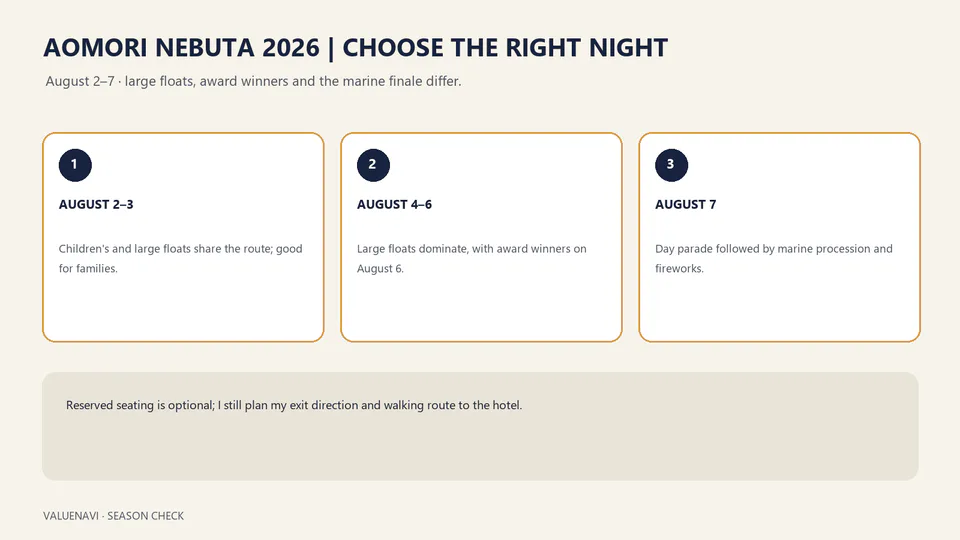
Aomori Nebuta 2026 is over. For families, the most reusable lesson is that the night parades and the August 7 daytime parade solved different child-specific problems. The August 2–6 night parades delivered the classic illuminated-float experience but pushed bedtime later. August 7 removed the bedtime problem with a 13:00 parade, then introduced a different risk: midday heat and a long gap before the 19:15 marine procession and fireworks.
For a future first visit, choose the format from the child's real rhythm rather than from a generic “family-friendly” label. A school-age child who handles late evenings well is usually a stronger fit for one night parade. A toddler or habitual early sleeper may fit a daytime finale date better—but only if the family treats the later harbour programme as a second optional event.
↔ Scroll table left or right
Family pattern | 2026 better fit | Reusable reason |
School-age child who can stay up late | Aug 2–6 night parade | The illuminated floats are the core visual experience |
Toddler / early sleeper | Aug 7 daytime | Removes the late-night fight, but shifts the burden to heat |
Child likely to fade early | Free viewing near a clean exit | No sunk seat cost if the family leaves early |
Family needs reliable sitting | Reserved seats | The ticket buys endurance and certainty, not a guaranteed front row |
Wheelchair user | Dedicated wheelchair space | It is a separate official product and should not be improvised from standard seating |
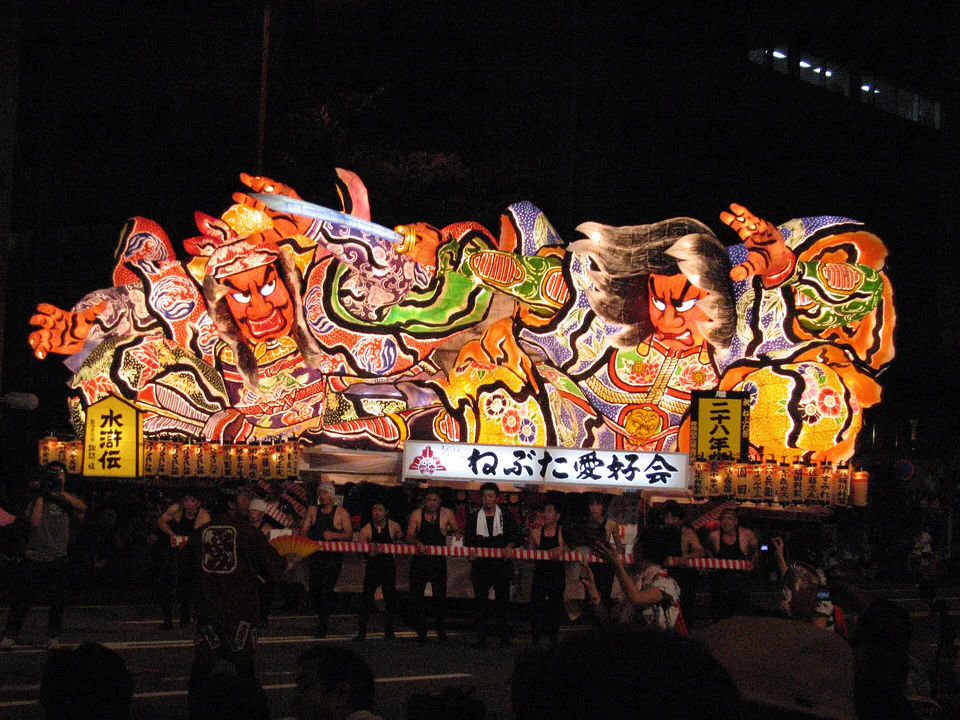
The first family decision is bedtime versus heat
In 2026 the August 2–3 night parades began at 19:00, while August 4–6 began at 18:45. August 7 shifted to a 13:00 daytime parade, followed by the marine procession and fireworks from 19:15.
That makes the trade-off concrete. A child who normally sleeps at 20:00 is being asked to stay stimulated in a loud crowd beyond the normal routine. A child who tolerates late nights but struggles badly with summer heat may actually do better after sunset.
There is no universal age cutoff. Use the child's normal bedtime, nap pattern, heat tolerance and crowd response. The festival date should adapt to the child rather than forcing the child to satisfy a “complete Nebuta” itinerary.
The real overseas family seat total was higher than the old article showed
The 2026 overseas reserved-seat channel listed JPY 4,000 per ticket plus a JPY 1,000 service fee per ticket and a JPY 950 transaction fee per order.
That means one overseas order worked out to:
2 paid seats: JPY 10,950
3 paid seats: JPY 15,950
4 paid seats: JPY 20,950
The previous article's JPY 20,000 figure for four seats omitted the order-level transaction fee. This is exactly why families should calculate the full party checkout total instead of multiplying only the face value.
Keep the method for next time; recheck the actual fees because sales channels can change.
A paid seat bought family energy, not a better guaranteed row
Reserved seats were allocated by the system rather than by the buyer choosing a specific row. That means a family should not pay on the assumption that “reserved” means “front row.”
What the ticket did buy was a stable place to sit. For a child, grandparent or parent carrying supplies, that can be much more important than being one row closer to a five-metre-tall float.
The useful question is: will sitting certainty materially increase how much of the parade the family can enjoy? If yes, the paid product has a job. If the child is likely to leave after a short block anyway, free viewing near a good exit may be the stronger value.
August 7 was not one child-friendly “full day”
The daytime parade and the 19:15 harbour finale were separated by several hours. Treating them as one mandatory package can create a long summer endurance test.
A family that wants both should plan a real reset: hotel rest, indoor meal, air-conditioning, toilets and a complete change of pace. A central hotel therefore had more value on August 7 than a simple map-distance comparison suggested.
The better alternative for many toddlers is to watch the daytime parade and stop. The harbour finale is a second decision. Leaving before it is not an incomplete festival experience.
Free viewing only works well when the family has an exit
Aomori Nebuta uses a central-city route rather than one stage. For families, that means the best free position is not necessarily the closest-looking corner. It is a legal location with a workable side street, toilet route and simple return direction.
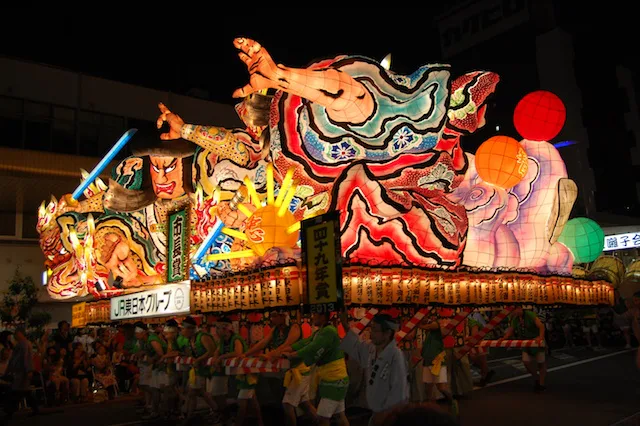
A stroller strengthens this rule. In dense crowds, the ability to turn around and leave matters more than squeezing one row closer to the float.
Choose the exit first. Then optimise sightline inside the legal area published for the current edition.
Wheelchair seating is a separate planning branch
For 2026, the official wheelchair space was in front of Aomori City Hall. The price was JPY 3,200 for the wheelchair user and JPY 4,000 for each accompanying person, with up to two companions.
The organiser states that the space is for people who routinely use a wheelchair and that wheelchairs are not lent at the venue. A future family should therefore book the dedicated product rather than buying an ordinary seat and hoping to convert it later.
Rain does not remove the need for an exit strategy
The 2026 festival guidance said the event was held in rain and the reserved seats were uncovered. The ticket therefore solved sitting, not weather.
For families, use wearable rain protection and keep the plan short enough to abandon when the child is cold, wet or exhausted. Do not let the price already paid become a reason to force the final part of the night.
Leaving early can be the correct family decision
A family festival night is not scored by how many floats remain after the child stops enjoying it. If the best hour has already happened and the child is fading, leaving can protect the memory and avoid the densest exit wave.
This is particularly important with reserved seats because sunk-cost thinking is strong: “we paid, so we must stay.” The money is already spent. The remaining decision is whether the next 30 minutes improves or worsens the trip.
Do not schedule another hard Tohoku morning automatically
A late Nebuta night followed by the earliest possible train to another major festival can turn a good family route into cumulative sleep debt. The next morning should be part of the festival decision.
If the route also contains Akita Kanto, Morioka Sansa or Sendai Tanabata, deliberately choose which city gets the slow morning. One protected recovery block can be more valuable than one extra daytime attraction.
Future family decision
School-age child + good late-night tolerance: one night parade; buy seats when sitting certainty meaningfully improves endurance.
Toddler / early sleeper: consider the August 7-style daytime programme if the future schedule keeps that structure.
Likely early exit: free viewing near a clean route home.
Wheelchair user: use the current dedicated wheelchair product.
Two nights: vary the experience rather than repeating two identical late nights.
What must be rechecked next time?
Parade start times, August 7 structure, reserved-seat price, overseas service/transaction fees, wheelchair-seat terms, viewing map, rain rules and ticket-sale channels. The annual festival dates may be stable, but the operating details are not permanent.
Final verdict
Aomori Nebuta 2026 showed that the best family plan is the one that removes the child's highest-cost failure mode. For some families that is bedtime; for others it is heat, standing, wheelchair access or a bad crowd exit.
Do not buy a “complete festival experience.” Buy the piece your child can actually enjoy, calculate the full party cost, and give yourself permission to leave while the night is still good.
Where to Stay in Aomori on Your First Night: Station, Aomoriya, Oirase or Hirosaki
Akita Kanto 2026 Is Over: What S, A, B and Free Viewing Taught Us
Niseko Private Ski Lessons 2026–27: 3 Hours vs 6 Hours, and Who Should Share?
Morioka Sansa Odori 2026 Is Over: What Free vs Reserved Viewing Taught Us
Otsu Matsuri 2026: Yoimiya or the Main Parade? Choose by scene, stamina and hotel friction
References
Aomori Nebuta — 2026 schedule · 2026 overseas reserved-seat pricing and fees · 2026 wheelchair seats · Official festival site. Checked August 25, 2026. Future family logistics must be reverified.