
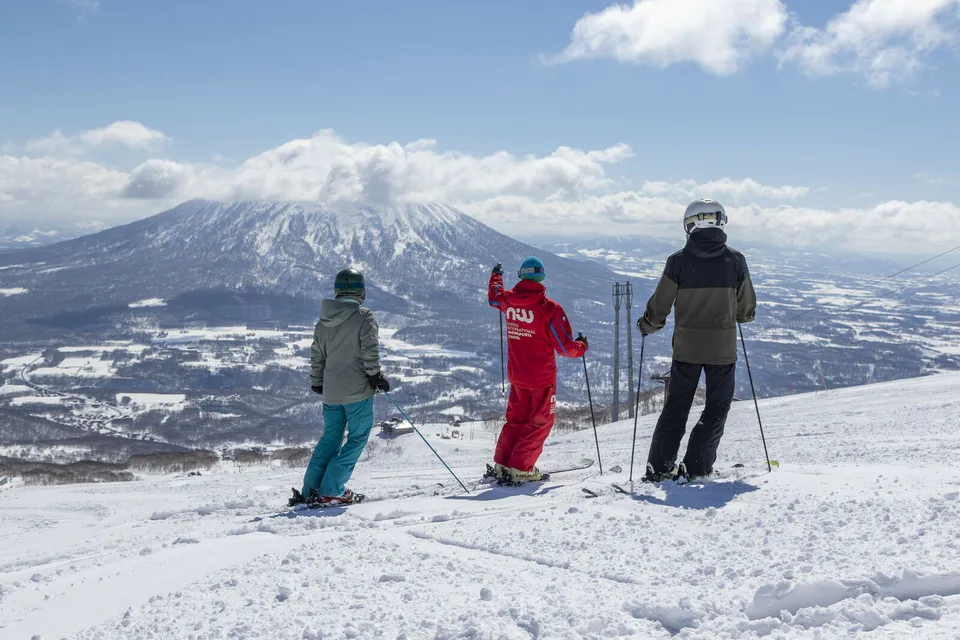
For a solo beginner or couple on Day 1, I would usually buy about three hours of private instruction, then spend the rest of the day repeating the same skills without paying an instructor to watch every lap. I move to a six-hour private when the instructor is doing more than teaching technique: managing a family, choosing terrain, pacing a mixed day, moving the group efficiently around the resort, or coaching several similar-level skiers who can genuinely divide a flat group price.
The key mistake is treating “3 hours vs 6 hours” as one universal Niseko price comparison. It is not. Rhythm currently charges ¥60,000 (about US$376) for 3 hours and ¥115,000 (about US$721) for 6 hours, both for up to six similar-ability guests. At NISS and GoSnow, however, the premium from a shorter private to a full day can be much smaller in some seasons. And full-day clocks can include lunch or rest time. You need to compare the usable lesson, not just the headline duration.
2026–27 prices and rules checked August 27, 2026 from Rhythm Japan, GoSnow and Niseko Hanazono/NISS. JPY is the primary price. USD figures are rounded planning equivalents using roughly ¥1,000 = US$6.27; exchange rates move.
30-second decision: who should choose 3 hours, 6 hours or neither?
↔ Scroll table left or right
Your group | Default choice | Why | What reverses it |
Solo first-timer | 2–3 hours | Learn braking, turning, lift use and fall recovery, then practise independently | You are anxious enough that independent practice would be unsafe or unproductive |
Couple, same discipline and similar ability | 3–4 hours | Private feedback remains concentrated without consuming the whole ski day | You have only one ski day and want the instructor to manage terrain and progression all day |
Family of 3–6, genuinely similar ability | 6 hours can win | Flat group pricing spreads the full-day premium across more useful learners | Age or ability gaps force the slowest learner to dictate terrain |
Six friends with beginner-to-advanced spread | Split the group | Maximum headcount is not the same as maximum teaching value | Everyone actually wants the same terrain, pace and goal |
Christmas/New Year or February peak dates | Check full-day inventory first | NISS only allows full-day private lessons to be advance-booked during its published peak periods | Another provider still has a shorter product that matches your base and group |
Budget-first solo beginner | Compare group lessons first | Private flat-rate economics are weakest when only one person uses the instructor | Language, confidence or a specific learning need makes private coaching materially more useful |
ValueNavi lesson-cost rule: count useful learners, not booked headcount
A flat group price can make a six-person private look cheap. The wrong conclusion is to add people until the instructor reaches the maximum capacity. The useful denominator is not the number of names on the booking. It is the number of people who can learn together without forcing the lesson onto the wrong terrain.
ValueNavi Useful Learner Count = guests with compatible discipline × ability × pace × goal.
If four people ski at roughly the same level and want the same progression, four is a useful learner count of four. If two are first-time skiers, one is an intermediate snowboarder and one wants powder technique, the booking may contain four people but the useful learner count for a single lesson is effectively much lower.
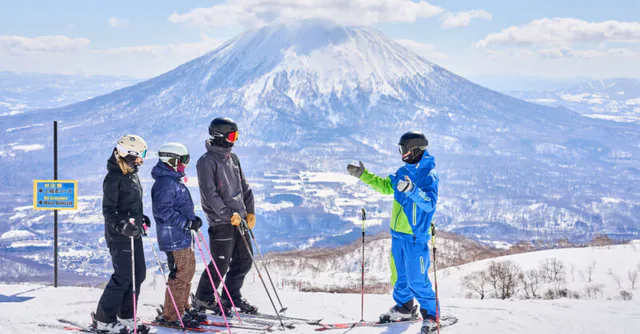
Rhythm makes this explicit: its private price is per lesson for up to six guests of similar ability in the same discipline, and the instructor bases the group on the least experienced rider. GoSnow similarly allows a private group of up to six guests of similar ability. NISS also allows up to six depending on ages. These are capacity rules, not promises that six mixed learners will progress efficiently.
Rhythm gives the cleanest 3-hour vs 6-hour break-even
Rhythm currently publishes 2h ¥45,000, 3h ¥60,000, 4h ¥85,000 and 6h ¥115,000 for 2026–27 Niseko private lessons. Because the same flat price can be shared by up to six suitable guests, the decision changes sharply with group size.
The jump from 3 hours to 6 hours is ¥55,000 (about US$345). That buys three more advertised hours. The incremental cost is therefore roughly ¥18,333 per added hour for the whole group.
↔ Scroll table left or right
Useful learners sharing | 3h price per person | 6h price per person | Extra cost per person to move 3h → 6h |
1 | ¥60,000 (~US$376) | ¥115,000 (~US$721) | ¥55,000 (~US$345) |
2 | ¥30,000 (~US$188) | ¥57,500 (~US$361) | ¥27,500 (~US$173) |
3 | ¥20,000 (~US$125) | about ¥38,333 (~US$240) | about ¥18,333 (~US$115) |
4 | ¥15,000 (~US$94) | ¥28,750 (~US$180) | ¥13,750 (~US$86) |
6 | ¥10,000 (~US$63) | about ¥19,167 (~US$120) | about ¥9,167 (~US$58) |
This table explains why “full day is expensive” and “full day is great value” can both be correct. For a solo learner, the extra three hours cost another ¥55,000. For six genuinely compatible learners, the same upgrade is only about ¥9,167 each. The full-day premium collapses when the group is large and well matched.
Red-team: six people paying less per head is still bad value if half the group spends the day waiting for the slowest learner. The cheapest per-person number is not the objective; useful progression is.
NISS and GoSnow prove why one universal 3h-vs-6h rule fails
Provider pricing can completely change the upgrade decision.
↔ Scroll table left or right
Provider / season example | Shorter private | Full day | Upgrade premium | Important clock rule |
NISS regular season | AM 2.5h ¥71,000 (~US$445) | 6h ¥93,000 (~US$583) | ¥22,000 (~US$138) | NISS booking flow says a 1h lunch break is included inside the full-day duration |
NISS early/spring | AM 2.5h ¥59,000 (~US$370) | 6h ¥87,000 (~US$546) | ¥28,000 (~US$176) | Same full-day lunch issue |
GoSnow regular | AM 4h ¥87,000 (~US$546) | 6h ¥110,000 (~US$690) | ¥23,000 (~US$144) | At least 30 min break is included in the 6h period |
GoSnow peak | AM 4h ¥99,000 (~US$621) | 6h ¥130,000 (~US$816) | ¥31,000 (~US$194) | At least 30 min break included |
The lesson lengths are not identical, so this is not a cheapest-school ranking. It shows something more useful: the marginal price of “staying with the instructor longer” varies more than the words half-day/full-day suggest. At NISS regular pricing, the jump from the 2.5-hour AM product to the full day is only ¥22,000 per group. At Rhythm, 3h → 6h costs ¥55,000. Those are different decisions even before you compare resort privileges or instructor fit.
Usable Coaching Time: the paid clock is not the same as technical instruction
For expensive private lessons, I would use this planning model:
Usable Coaching Time
=
Booked lesson window
− lunch / required breaks
− rental and lift-pass setup
− meeting-point delay
− avoidable gear adjustment
− terrain lost to ability mismatch
Only the first line appears in most price tables. The rest is where private-lesson value disappears.
GoSnow explicitly includes a minimum 30-minute break inside its six-hour full-day lesson. NISS’s current booking flow says the full-day six-hour Niseko Classic includes a one-hour lunch break. That does not make either lesson poor value; it means you should not calculate “price ÷ 6” and assume six hours of uninterrupted coaching.
The same logic applies before the lesson. Rhythm states that lift passes and rentals are not included. If you spend the first 40 minutes fitting boots, buying a lift ticket or walking from the wrong base, you are burning expensive private time on logistics.
The most expensive beginner mistake is starting the lesson before the group is ready
For a first-day family, I would try to finish equipment fitting the previous evening whenever the rental shop and arrival time allow it. At minimum, everyone should know where the meeting point is, have the correct lift product ready, and be wearing boots before the private clock starts.
A simple example shows why. If a ¥60,000 three-hour Rhythm private loses 30 minutes to rental or meeting problems, the group has effectively paid for three hours but received only 2.5 hours of useful lesson window before normal breaks. For a solo traveller, that wasted half-hour represents a much larger per-person loss than it does for a family sharing one flat price.
Use the Niseko lift pass, rental and lesson booking-order guide if those pieces are still unresolved. Private instructor time should be used for skiing, not administration.
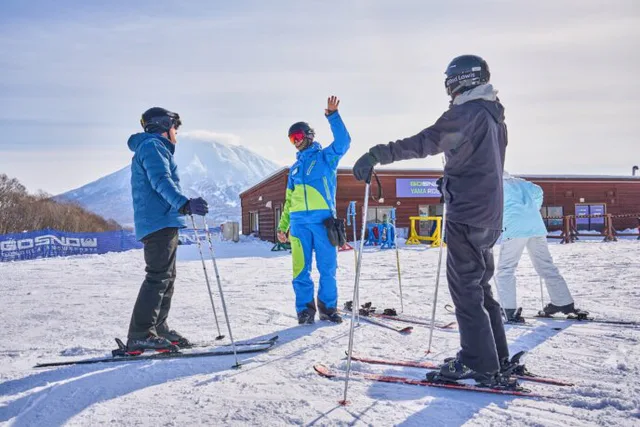
ValueNavi Lesson Fit Score: 3 hours wins more often for beginners; 6 hours wins when the instructor manages the day
This editorial score weights money efficiency 25%, skill-fit 25%, time efficiency 20%, logistics value 15% and fatigue resilience 15%. It is not a rating of any ski school. It tests how well a lesson length fits a trip scenario.
↔ Scroll table left or right
Scenario | 3h / short private | 6h / full day | Why |
Solo first-time skier, 4 ski days ahead | 9.1/10 | 6.7/10 | Learn the foundation, then practise; full-day flat price is hardest to justify solo |
Couple, same level, only 1 ski day | 8.5/10 | 7.9/10 | Short private protects independent skiing time; full day rises if confidence is low |
Family of 4, similar level, 3 ski days | 7.7/10 | 9.0/10 | Flat group price, pacing and terrain management create value all day |
Six friends, large ability spread | 5.2/10 as one group | 4.6/10 as one group | Split the group; more hours cannot repair incompatible learning goals |
Peak-season family at Hanazono | Availability-constrained | 8.8/10 | NISS full day is the advance-bookable private product during its published peak dates and includes Hanazono priority lift access |
The score is deliberately conditional. Change the group size, language requirement, hotel base or number of ski days and the result changes. That is more useful than declaring “full day is best value” for everyone.
Peak season can remove the shorter option before price even matters
NISS has published its 2026–27 peak periods as December 14, 2026–January 3, 2027 and February 6–12, 2027. During those periods, only full-day private lessons are available for advance booking. The six-hour Niseko Classic is currently ¥120,000 per group (about US$753) in peak season, versus ¥93,000 regular and ¥87,000 early/spring.
GoSnow uses different date bands: its peak private pricing applies December 21–January 3 and February 4–10. Its six-hour private is ¥130,000 peak, ¥110,000 regular and ¥81,000 value.
These calendars are not interchangeable. If you are travelling around Christmas, New Year or Lunar New Year season, “I will decide between half-day and full-day later” may fail because the product you wanted is no longer available at that provider.
If dates are still flexible, compare the whole trip with the Niseko ski-trip cost and booking timeline. Instructor availability can be a bigger constraint than lift access.
Resort integration can justify a higher lesson price
Private lessons are not just instructor hours. NISS includes priority lift access in Hanazono, which can convert queue time into skiing time on busy days. GoSnow operates from Hirafu and its private lessons stay within the resort boundary. Rhythm is based from Grand Hirafu and offers upgrades for neighbouring resorts.
This is why the cheapest instructor can be the wrong purchase if the meeting point creates an awkward transfer from your hotel. Decide the ski base first, then shortlist lessons that naturally operate there.
If your accommodation is not settled, use the Niseko ski-in/ski-out hotel checklist. A hotel that removes a morning shuttle or long boot walk can protect more private-lesson value than a small difference in lesson price.
Children and adults: provider rules matter more than the word “private”
Do not assume one family booking means every age can always learn together. Rhythm accepts ages 3+ but says children six and under generally will not be grouped with adults; it asks families to enquire about options. NISS says private capacity is up to six depending on ages. Other providers use different thresholds.
For families, I would ask four questions before comparing prices:
Can these ages legally and operationally share one instructor?
Are all participants skiing, or all snowboarding?
Are the abilities close enough for the same terrain?
Does everyone want the same outcome: first turns, confidence, carving, powder, or mountain touring?
If the answer to questions 2–4 is no, split groups even if the total price rises. The purpose of private instruction is targeted progress, not filling every seat in a flat-rate product.
Does language justify a premium?
For a beginner, clear language can improve both confidence and safety because instructions cover stopping, edge control, lift loading, spacing and fall recovery. Official schools such as Rhythm and NISS advertise multilingual instructors, but a language preference is not necessarily a guarantee that every language is available for every date and time.
If Cantonese, Mandarin, French or another language materially changes whether your group understands technical instructions, confirm the exact language before paying. Do not read “multilingual” or “Chinese” as a guaranteed match to your preferred spoken language.
Five failure modes that destroy private-lesson value
Maximising headcount instead of learning fit. Six mismatched people can be worse value than three compatible learners.
Dividing price by six advertised hours. Full-day products can include lunch or rest inside the paid window.
Renting gear after the lesson starts. Paid instructor time disappears into boot fitting and admin.
Booking before choosing the resort base. The wrong meeting point creates a morning transfer you did not price in.
Assuming half-day inventory survives peak dates. NISS explicitly restricts advance peak-season private bookings to full day.
Final decision tree
How many useful learners are actually sharing? Count only guests with compatible discipline, ability, pace and goals.
Is this Day 1 or the only ski day? Day 1 beginners often benefit from 2–3 hours plus practice; a one-day family may benefit from full-day management.
What is the provider-specific upgrade premium? Do not transfer Rhythm’s ¥55,000 3h→6h logic to NISS or GoSnow.
What is inside the clock? Remove lunch, required breaks and preventable logistics from the advertised duration.
Does your hotel match the lesson base? If not, price the morning transfer and boot-walking friction.
Are you travelling in a peak period? Check whether the shorter product can actually be advance-booked.
Final verdict: buy 6 hours when the instructor is managing complexity, not just adding time
Three hours is my default for a solo beginner or couple with several ski days ahead. It buys concentrated correction, preserves independent practice and limits the amount of expensive instructor time that can be lost to fatigue.
Six hours becomes much stronger for a family or group of similar ability, especially when the flat group price is divided across four to six useful learners or when resort integration saves queue and navigation time. But the reason is not that “six hours has a lower hourly rate.” It is that the instructor is managing a more complex ski day that would otherwise create friction.
If your six-person group only works on paper, split it. If your full-day lesson spends an hour at lunch and another 40 minutes fixing rentals, count the usable time, not the brochure time. And if you are travelling on NISS peak dates, accept that inventory rules may decide the duration before your spreadsheet does.
Official sources
Rhythm Japan — Niseko private lesson 2026–27 · GoSnow — private lessons, 2026–27 prices and break rules · Niseko Hanazono / NISS — private lesson prices, capacity and peak dates · NISS booking flow — full-day lunch inclusion and booking restrictions. Checked August 27, 2026; prices, operating dates and availability can change.
Lake Biwa Otsu Prince Hotel: Is the 36.2m² Lake View Worth the Shuttle?
National Museum of Nature and Science 2026: The ¥630 Ticket Is Cheap — Your 3–5 Hours Aren’t
Japan eSIM Guide 2026: Data, Networks, Activation and Limits
Aomori Nebuta Haneto 2026 Is Over: Should You Watch or Dance Next Time?
Mt Fuji Private Car Charter from Tokyo: 10 Hours Isn’t 10 Hours of Sightseeing