
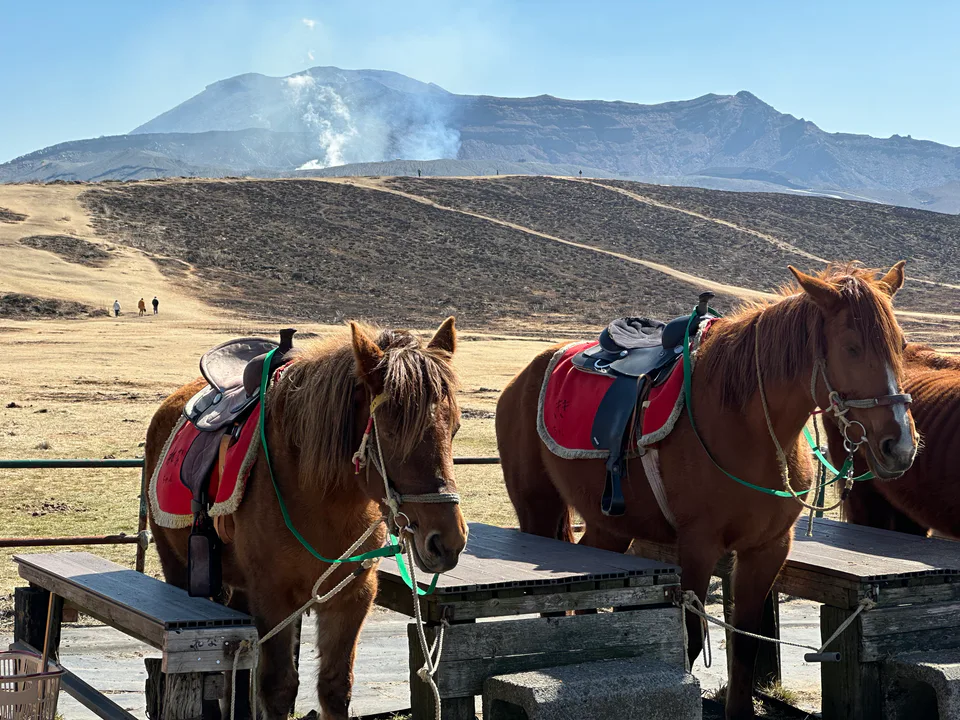
Do not choose between Aso horse riding, an e-bike and the hot-air balloon as though they were three versions of the same sightseeing activity. They solve three different trips. Horse riding is a destination experience on the outer grasslands. The official Aso Station e-bike is a local mobility tool for the town and basin area and is explicitly not allowed at Mount Aso, Kusasenri, Komezuka or Daikanbo. Aso Nature Land’s balloon is a roughly five-minute tethered ascent at dawn, not a half-day flight. For most visitors, the right answer appears once you decide which geography and which time of day you are actually trying to buy.
As of August 25, 2026, there is also a current boundary that should sit above every Aso itinerary: the Japan Meteorological Agency continues to list Mount Aso at eruption alert level 3, with restrictions around roughly 2 km of Nakadake First Crater. That does not mean the whole Aso region is closed, and the activities below continue to appear on current official tourism/operator pages. It does mean you should not use an old “activity + crater” itinerary without checking the live restriction first.
↔ Scroll table left or right
What you actually want | Best fit | What it really buys | Hard limit |
Ride through open Aso grassland | Horse riding | A guided outdoor experience where the ranch landscape is the destination | The ranch location must fit your road/transport plan; weather and course conditions matter |
Explore near JR Aso Station without a car | Official Aso e-bike | Flexible local movement around the Aso city/basin area | Mountain areas including Kusasenri and Daikanbo are prohibited |
A short, unusual dawn experience while already staying nearby | Tethered balloon | About five minutes aloft, up to roughly 35 m, with early-morning atmosphere | Very early meeting, minimum participant threshold, rain/wind cancellation |
Your real goal is the crater/high mountain | None of these is a substitute | Check the current volcanic restriction and mountain transport separately | Do not use an e-bike or an unrelated activity to pretend the original crater goal has been met |
The first decision is geography: basin, outer rim or dawn
The original temptation is to rank these activities by excitement. That produces a poor itinerary because they occupy different parts of Aso and different parts of the day.
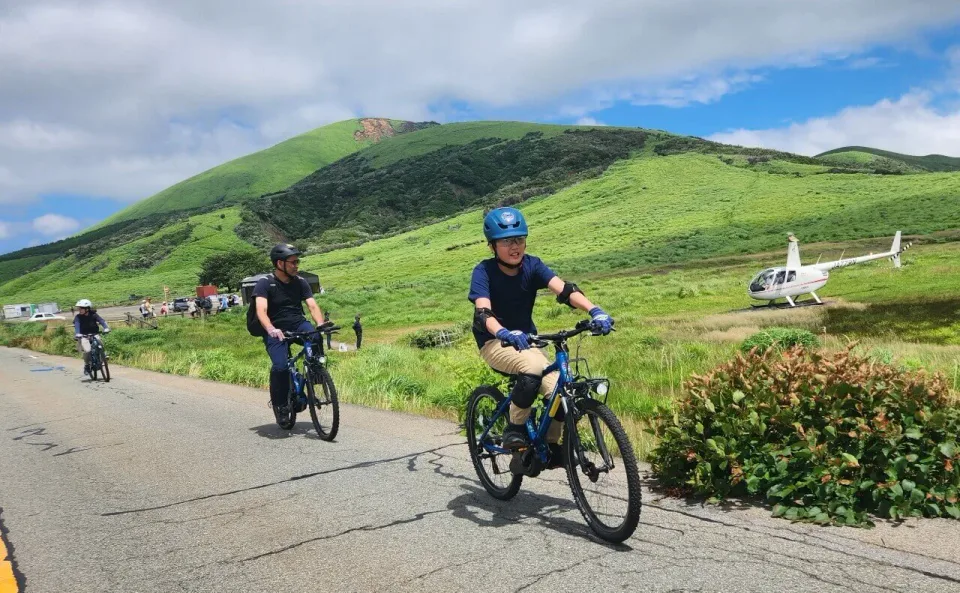
The Aso Station e-bike belongs to the basin/local-town layer. Aso City Tourism Association currently rents 18 electric-assist bicycles from the information centre inside JR Aso Station. The published usage area is limited to the city area around the station. The operator specifically excludes mountainous destinations such as Mount Aso, Kusasenri, Komezuka and Daikanbo. This is the most important correction to the usual “e-bike around Aso” advice: the motor does not turn the rental into a car-free route to the famous highland viewpoints.
El Patio Ranch belongs to the outer-grassland layer. Aso’s tourism association describes the ranch as roughly 300,000 tsubo of grassland and lists eight riding courses ranging from about 1 km to 6 km, with riding hours from 09:00 to 17:00 and final reception at 16:30. You go there because riding through that landscape is the experience. It should not be squeezed between three other distant Aso pins merely because the riding session itself has a defined duration.
Aso Nature Land’s balloon belongs to the dawn layer. The current experience is tethered, rises to a maximum of about 35 m and gives each passenger roughly five minutes of flight time. Seasonal meeting can be as early as 05:15. That makes it a powerful add-on to an Aso overnight and a poor reason to create a heroic pre-dawn transfer from another city.
Once you use those three layers, the comparison becomes much easier. Choose the experience whose geography already fits the itinerary rather than adding transport merely to collect a second activity.
E-bike: the best car-free option only when you accept the official boundary
The official e-bike is the most useful option for a traveller who reaches JR Aso Station by train or bus and wants independent local movement without renting a car. Current rates are JPY 1,000 for up to two hours, JPY 1,500 for more than two and up to four hours, and JPY 3,000 for more than four and up to eight hours. Registration is same-day only; advance reservations are not accepted. The current published hours are 09:00–17:00, and rental is unavailable when rain is forecast.
Those rules reveal what the product is designed to do. It is good for a local loop where being able to stop independently matters more than covering huge distances. It is not a mountain-transfer hack.
Choose the e-bike when: your day starts at Aso Station, the local basin/town is genuinely interesting to you, the forecast is stable and you want a flexible two-to-four-hour block before continuing elsewhere.
Do not choose it when: your saved pins are Kusasenri, the crater zone and Daikanbo. The official restriction on rental-bike usage already answers that itinerary. Use the current mountain bus, taxi, a tour or a car as appropriate instead of designing a route that violates the rental conditions.
This also changes the weather calculation. “We will rent e-bikes if it rains a little” is not a robust backup because the tourism association says rental is unavailable when rain is forecast. A genuinely resilient Aso day needs an indoor or transport-based fallback rather than treating cycling as the rainy-day substitute.
Horse riding: choose it when the grassland experience is worth the transport by itself
Horse riding has almost the opposite value proposition. It is less useful as transport and stronger as a self-contained destination experience. El Patio Ranch’s current tourism listing describes eight courses from about 1 km to 6 km and a broad difficulty range from beginners upward. That makes course selection more important than simply buying the longest ride available.
For a first-time rider, the “best” course is the one that gives enough time in the grassland without making the rest of the day a fatigue test. Riding uses unfamiliar muscle groups even at a controlled pace. If the same itinerary also includes substantial walking, a longer course has an opportunity cost that will not appear on a booking page.
The other cost is geographic. El Patio is not a facility inside JR Aso Station. Its value has to justify getting to the ranch and then continuing from it. If you already have a car and the ranch lies naturally on the day’s route, that friction falls sharply. If you are car-free and would need a dedicated taxi movement solely for a short ride, compare that entire door-to-door cost with a local Aso activity before deciding.
My default: choose horse riding over the station e-bike when the grassland itself is one of the reasons you came to Aso. Choose the e-bike when independent local exploration matters more than one guided experience.
The balloon is not a “bigger” experience just because it is airborne
Aso Nature Land’s current early-morning balloon page is unusually specific: the balloon is tethered, reaches up to roughly 35 m and the actual ride is about five minutes. Current prices are JPY 3,000 for junior-high-school age and above, JPY 2,000 for elementary-school children, JPY 1,500 for preschool children and free for children aged three and under with a guardian.
That means the balloon should be evaluated as a short dawn experience, not as a transport ride or a long scenic flight. A couple paying JPY 6,000 is buying a few minutes in the air plus the atmosphere of the very early Aso basin. If you expected a free-flight balloon journey that travels across the landscape, skip it rather than trying to make the tethered format satisfy a different goal.
The scheduling cost is larger than the five-minute ride suggests. Current seasonal reception can fall anywhere from about 05:15 to 07:45 depending on season and booking volume. The operator provides the exact meeting time by the previous business day, and the meeting point is Fureai Mizuibe Park rather than the Aso Nature Land office. That makes a nearby overnight and a clear dawn transfer plan part of the purchase.
There is also a minimum operating threshold of 15 junior-high-school-age-or-older participants. Even perfect weather therefore does not guarantee operation. The operator currently cancels for rain or wind of 3 m/s or more and communicates the go/no-go decision by the previous business day evening.
The deeper booking guide is in Aso Hot-Air Balloon: Booking, Meeting and Cancellation. For this comparison, the conclusion is simpler: book the balloon when the Aso overnight already makes sense without it.
Current Level 3 volcanic restrictions should change the second half of your day, not erase Aso automatically
The Japan Meteorological Agency raised Mount Aso to eruption alert level 3 on August 14, 2026 and its August 24 update continues the alert. The warning concerns roughly a 2 km area around Nakadake First Crater, where large volcanic blocks and pyroclastic flows are a concern.
That is a serious restriction, but it should not be generalized into “all Aso outdoor activities are closed.” The current Aso tourism pages continue to list the station e-bike, horse riding and Aso Nature Land activities. Their geography is different from the restricted crater zone.
What the alert changes is the common itinerary habit of attaching “and then the crater” to everything. If your original day was balloon → Kusasenri → crater, or horse riding → crater, recheck the live road/bus and access restrictions before departure. If the crater was the non-negotiable reason for the day, a balloon or horse ride is not a like-for-like replacement. If the wider caldera, grassland and Aso landscape were the reason, the trip can retain value with a different route.
This distinction matters because it avoids two opposite mistakes: travelling into a restricted area because an old itinerary still shows it, and cancelling an entire Aso overnight because one high-risk zone is restricted.
Do not stack three weather-sensitive activities into one “efficient” day
The three products fail differently.
Balloon: the operator currently cancels for rain or wind at 3 m/s or more, and operation also depends on the minimum participant threshold.
Official e-bike: rental is unavailable when rain is forecast, so the failure can be known before you even reach the counter.
Horse riding: route and operating conditions depend on the ranch and weather; the outdoor ground experience cannot be assumed to run identically in poor conditions.
A brittle itinerary books the balloon at dawn, assumes an e-bike after breakfast and adds horse riding in the afternoon. One weather system can degrade all three, while the geography creates extra transfers between them.
A stronger itinerary gives one activity the day’s identity, then uses sightseeing that survives if the activity changes. The Japan rainy-day backup guide applies especially well here: your fallback should change the type of day, not merely swap one exposed outdoor product for another.
One-day visitor: which single activity should win?
Car-free, arriving at Aso Station in the morning: the e-bike is the lowest-friction activity if the local allowed area is what you want. Do not rent it expecting to reach the mountain.
Driving and the grassland is the priority: horse riding is the strongest anchor because the ranch can become a deliberate stop rather than an awkward extra transfer.
Sleeping in Uchinomaki/Aso the previous night: the balloon can be added before breakfast, but it should remain a bonus rather than the only reason the overnight exists.
Coming from Fukuoka and returning the same day: solve the transport problem before the activity problem. The rebuilt Fukuoka to Aso: Day Trip or Overnight? shows how little usable mountain time can remain after the long transfer. Adding an activity does not create more hours.
Overnight visitor: the best combination is usually one dawn bonus + one daytime anchor
An Aso overnight creates the only itinerary where combining two of these experiences can feel natural rather than collectible.
A good pattern is balloon at dawn → breakfast → one daytime anchor. That anchor might be a local e-bike loop if you are car-free and staying in the basin, or horse riding if a car/taxi plan takes you toward the ranch. The balloon’s five-minute ride does not consume the day, but its early wake-up does consume energy. Keep the afternoon lighter than the map tempts you to make it.
I would rarely plan e-bike + horse riding + balloon in one overnight unless the transport, weather and personal priorities all make sense independently. The article passes the deletion test only if it helps you remove an activity, not if it simply gives you three reasons to buy three products.
Families and older travellers: eliminate the option with the hardest failure mode
For families, the balloon’s age pricing is accommodating, including free participation for children aged three and under with a guardian, but the pre-dawn wake-up may be a larger cost than the ticket. The e-bike introduces rider confidence and weather considerations. Horse riding introduces ranch access and physical comfort.
For an older traveller, do not assume the least physically active-looking option is automatically easiest. A 05:15 meeting can be harder than a daytime ranch visit; an e-bike requires balance and road confidence; a horse ride still uses the body differently from walking. Pick the activity whose whole chain—wakeup, transport, participation and recovery—fits the person, not the prettiest photo.
Final verdict: these are three different Aso products, not a ranking
Choose the official e-bike for local basin exploration from JR Aso Station, and only within its published city-area boundary. Choose horse riding when the outer-grassland experience is worth travelling to the ranch for. Choose the tethered balloon when you already have an Aso overnight and want a short dawn experience that can disappear with wind, rain or insufficient participation.
If your real goal is Mount Aso’s crater or the high mountain, solve that separately against the current volcanic alert and transport status. None of these three activities should be used as a substitute merely because the original mountain plan is restricted.
Osaka for Couples: A 7-Day Itinerary That Saves the Best Nights for Kyoto, Kobe and One Big View
Best Dates for USJ Halloween 2026: Crowds, Prices and Hotels
Sapporo Winter Horseback Riding: 50 vs 80 Minutes — Direct Booking, Pickup and Winter Access
35 Best Things to Do in Osaka 2026: What’s Worth Your Time by Area, Budget and Trip Style
References
Aso City Tourism Association — official Aso Station e-bike rental, current rates, hours, same-day registration, rain rule and prohibited mountain area · Aso City Tourism Association — El Patio Ranch riding courses and operating hours · Aso Nature Land — tethered balloon height, ride duration, prices, meeting windows, minimum participants and weather rules · Japan Meteorological Agency — current Mount Aso volcanic activity and alert level. Checked August 25, 2026. Activity availability and volcanic restrictions can change; verify the live operator and JMA notices for the actual date.